Every few months, someone in a clinic, a courtroom or a comment thread announces that “sex addiction isn’t even in the DSM” — as if that settles whether the problem exists. It settles almost nothing. But the reason hypersexuality is missing from America’s diagnostic manual is a genuinely interesting story, with a named proposal, a real scientific trial, and a rejection that reveals psychiatry’s caution.
This is the hypersexuality and DSM-5 story in full: what psychiatrist Martin Kafka proposed in 2010, how the proposal was tested, why the American Psychiatric Association (APA) said no — and what US clinicians write instead, because the patients kept coming anyway.
Quick answer: In 2010, Martin Kafka proposed a DSM-5 diagnosis called “hypersexual disorder,” with defined criteria. A formal field trial found clinicians could apply those criteria reliably. The APA still rejected it — not even granting it “further study” status — citing insufficient research, the risk of false positives and labelling normal sexuality as illness, and fears of forensic misuse. The DSM-5 (2013) and DSM-5-TR (2022) therefore contain no diagnosis for this pattern, while the WHO’s ICD-11 recognises it as CSBD.
Contents
Before the proposal: a pattern with no home
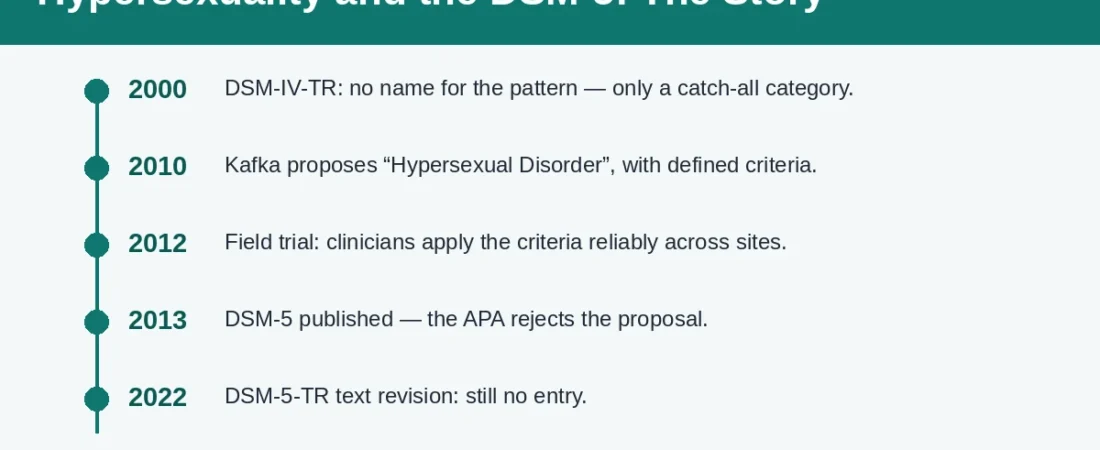
The hypersexuality and DSM-5 story does not start in 2010: the previous manual, the DSM-IV-TR (2000), had no name for the pattern either. The closest it came was a leftover category, “Sexual Disorder Not Otherwise Specified” (NOS) — a drawer for significant problems matching no defined diagnosis.
The manual’s own example for that drawer was “distress about a pattern of repeated sexual relationships involving a succession of lovers who are experienced by the individual only as things to be used.” The phenomenon was visible to psychiatry; it simply had no criteria and no agreed name.
Through the 2000s, the field used a patchwork of labels — sexual addiction, sexual compulsivity, hypersexuality — each implying a different theory. The older generation of labels has its own history, told in our article on the outdated words medicine dropped. When the APA began revising the manual, the question became unavoidable: should the new DSM-5 give this pattern a real diagnosis?
The Kafka proposal: “hypersexual disorder” (2010)
Martin P. Kafka, a psychiatrist who had studied the pattern for years, published the formal proposal in the Archives of Sexual Behavior in 2010: a diagnosis called hypersexual disorder. The name was chosen deliberately, to describe the behaviour without smuggling in a theory of its cause.
The proposed criteria were specific: at least six months of recurrent, intense sexual fantasies, urges and behaviour, plus at least four of five features — excessive time consumed; use in response to unpleasant moods; use in response to stress; repeated, unsuccessful attempts to control them; and disregard for the risk of harm to self or others. It also had to cause significant distress or impairment, and was restricted to adults — Kafka set the minimum age at 18 to avoid pathologising normal adolescent sexuality.
The DSM-5’s Sexual and Gender Identity Disorders Work Group reviewed it and recommended hypersexual disorder be included among the manual’s “conditions for further study” — psychiatry’s waiting room for promising diagnoses. It never got that far.
The field trial: the criteria worked
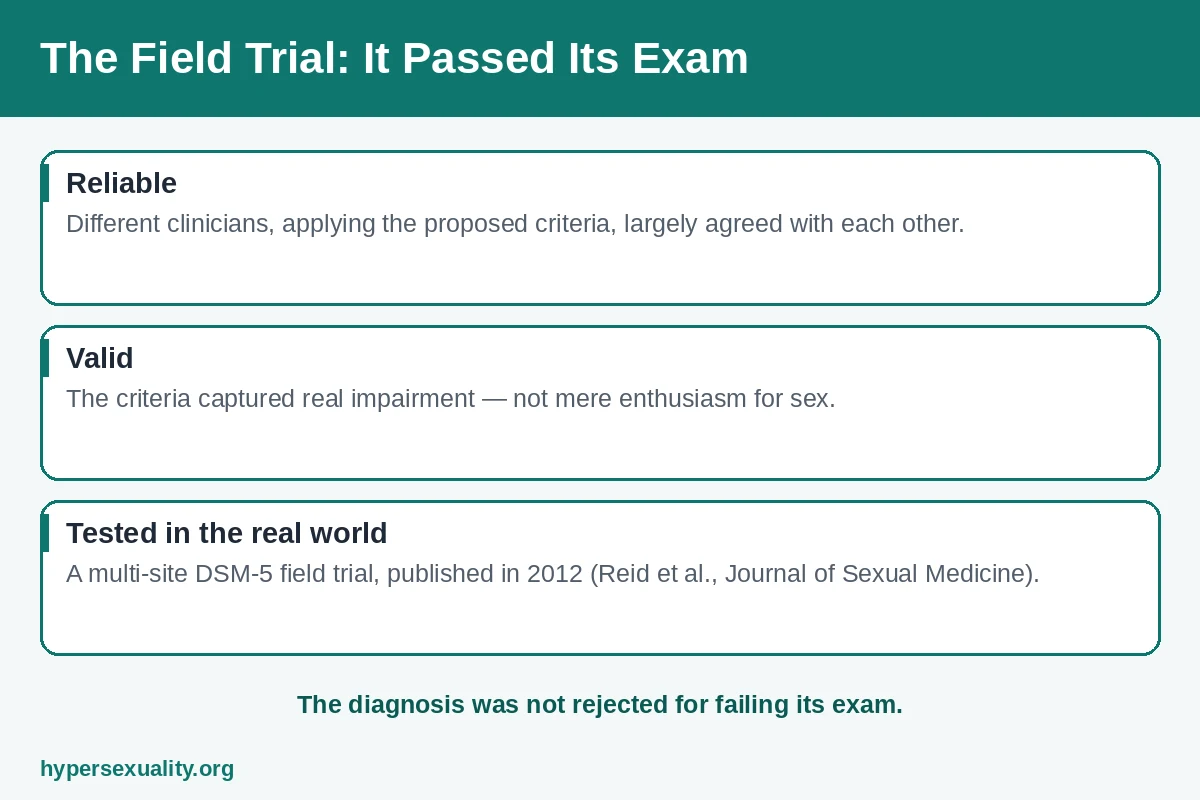
The hypersexuality and DSM-5 story then moved from argument to testing. Proposed diagnoses were put through field trials — real-world tests of whether ordinary clinicians could apply the criteria consistently — and the hypersexual disorder trial, led by psychologist Rory Reid at UCLA, tested them across multiple sites.
The results, published in 2012, were about as good as such trials get: clinicians applying the criteria largely agreed, and the criteria captured real impairment rather than mere enthusiasm for sex. Kafka and others later pointed to this as the frustrating heart of the hypersexuality and DSM-5 episode: the diagnosis was not rejected for failing its exam.
Why the APA said no anyway
So why did the APA reject a field-tested proposal? The answers explain most of what is misunderstood about hypersexuality and DSM-5 today. The reasons given at the time, and analysed since (including by Kafka himself in a 2014 paper titled “What happened to hypersexual disorder?”), cluster into four:
- The evidence base was judged too thin. There was limited research on prevalence, course and causes — and the APA was under general pressure not to expand the manual without strong data.
- False positives and pathologising normal sexuality. Critics warned that a diagnosis built around intense sexual preoccupation could be turned on people — especially sexual minorities or the simply highly desiring — whose behaviour was unusual but controlled and harmless, and that distress caused by others’ disapproval could be misread as disorder.
- Forensic misuse. A formal diagnosis could be exploited in legal settings — invoked to excuse harmful behaviour, or, conversely, in “sexually violent predator” proceedings and custody fights, where labels carry heavy consequences.
- No consensus on what it is. Addiction? Compulsion? Impulse-control failure? Without agreement on the underlying concept, the APA balked at fixing a name. The same logic was applied to “sex addiction,” which the DSM-5 text explicitly lists among behavioural addictions not included, for insufficient evidence.
The DSM-5 appeared in 2013 without the diagnosis; the 2022 text revision (DSM-5-TR) left that unchanged, and the decision remains controversial.
What US clinicians diagnose and document instead
Here is what the slogan skips: American patients did not stop existing in 2013, and neither did their treatment. US clinicians work around the gap in several ways:
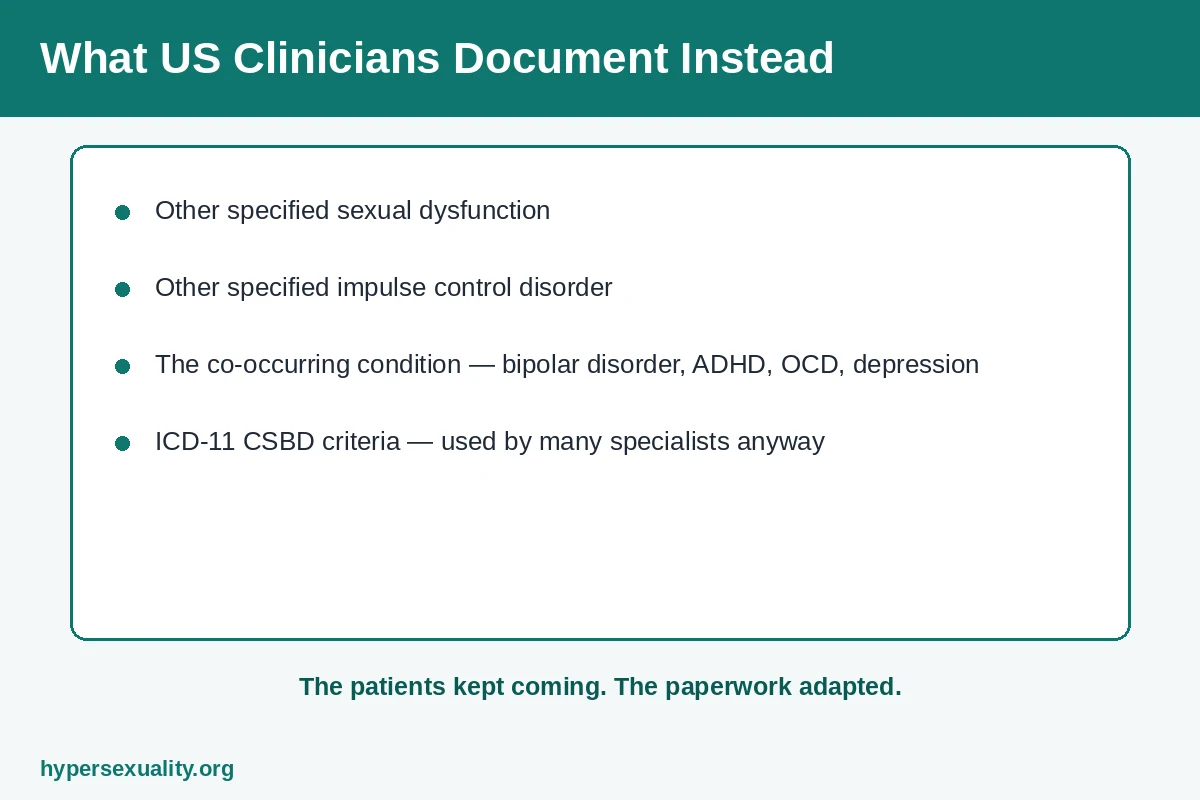
- Neighbouring codes. The pattern is commonly documented under “other specified sexual dysfunction” or an “other specified impulse control disorder” heading — imperfect fits that at least record a real, treated problem. These codes raise the wider question of whether hypersexuality counts as a mental illness.
- The co-occurring condition. Much treatment is organised around what travels with the pattern — bipolar disorder, ADHD, OCD, depression, substance use — each with its own solid DSM home, and each often driving the sexual pattern.
- ICD-11 thinking, specialist practice. Many specialists assess using the ICD-11’s CSBD criteria and the validated measures built on them, because those criteria exist and match the patients in front of them. Our step-by-step guide to how hypersexuality is assessed shows it from the patient’s chair.
Consider Grace, a composite example. Her US therapist told her “there’s no code for that in our manual,” and Grace heard: so it isn’t real. A second opinion reframed it: the pattern is recognised internationally, assessed with published criteria, and treatable — the missing entry is a fact about a book’s editorial history, not about her. She started treatment under a co-occurring anxiety diagnosis and an impulse-control care plan.
Hypersexuality and DSM-5: where this leaves things
The hypersexuality and DSM-5 debate is not closed. Research has grown since 2013, and ICD-11’s adoption of CSBD has given the field shared criteria across dozens of countries; a future DSM revision will have to reckon with that evidence. For now, the summary is the one our pillar guide to hypersexuality gives: the pattern is real, formally recognised in most of the world, unnamed in the American manual — and help does not wait for manuals to agree. To organise your own picture first, the structured hypersexuality test screening page is a reasonable step — used as screening, not diagnosis.
Q&A
What exactly did Kafka propose in 2010?
A diagnosis called “hypersexual disorder” for the DSM-5: at least six months of recurrent, intense sexual fantasies, urges and behaviour, with at least four of five features — excessive time consumed, use in response to bad moods, use in response to stress, repeated failed attempts to control it, and disregard for risk of harm — plus significant distress or impairment, in adults only. The name was chosen to avoid assuming a cause.
If the field trial went well, why was hypersexual disorder still rejected?
Because reliability was never the APA’s main objection. The stated concerns were the overall thinness of research on the condition, the risk of false positives and of pathologising normal or merely disapproved-of sexuality, possible misuse of the label in legal settings, and the lack of expert consensus on what the condition is. The work group had recommended it for “further study” status; the APA declined even that.
What do US therapists write on the treatment plan instead?
Usually a neighbouring category — commonly other specified sexual dysfunction, or an other-specified impulse-control heading — together with any co-occurring diagnoses such as bipolar disorder, ADHD, OCD or depression, which often carry the plan. Many specialists also assess against the ICD-11 CSBD criteria, which are precisely defined, even though that code belongs to the WHO system, not the DSM.
Could hypersexuality appear in a future edition of the DSM?
It could. Manuals are revised, and the evidence base has grown substantially since 2013 — the ICD-11’s inclusion of CSBD has produced standardised research across many countries. Whether a future DSM adds it will depend on that evidence and on whether the old objections — false positives, misuse, conceptual disagreement — are considered answered. The DSM-5-TR (2022) made no change. Until then, hypersexuality and DSM-5 remain a story of a pattern recognised everywhere except in that one book.
What did the DSM say about this pattern before 2013?
Less than people assume, but not nothing. The DSM-IV-TR had no named diagnosis for it; the pattern could only be recorded under the catch-all “Sexual Disorder Not Otherwise Specified.” Strikingly, that category’s own examples included distress about repeated sexual relationships with a succession of partners experienced merely as things to be used — a recognisable description of the pattern, filed there because psychiatry had never agreed on its name.
Sources: World Health Organization, ICD-11 entry 6C72 “Compulsive sexual behaviour disorder”; Kafka, M. P. (2010), “Hypersexual disorder: A proposed diagnosis for DSM-V,” Archives of Sexual Behavior, 39(2), 377–400; Reid, R. C. et al. (2012), “Report of findings in a DSM-5 field trial for Hypersexual disorder,” The Journal of Sexual Medicine, 9(11), 2868–2877.
Medical disclaimer: This article is educational information only and is not medical advice, diagnosis or treatment. Only a qualified clinician who knows your history can assess whether any diagnosis applies to you. If sexual behaviour is causing you distress or harm, consider speaking with your doctor or a licensed mental-health professional.