For many people, the hardest part of getting help is not the treatment — it is not knowing what the first appointment will involve. Will you be judged? Interrogated about intimate details? Handed a label in twenty minutes? The fear of the unknown keeps people Googling “how is hypersexuality diagnosed” at midnight instead of booking the visit that could answer it.
A professional evaluation is far more ordinary, and far more respectful, than most people fear. This article walks through it step by step: preparation, the conversation, the questionnaires, the rule-outs, and what you leave with.
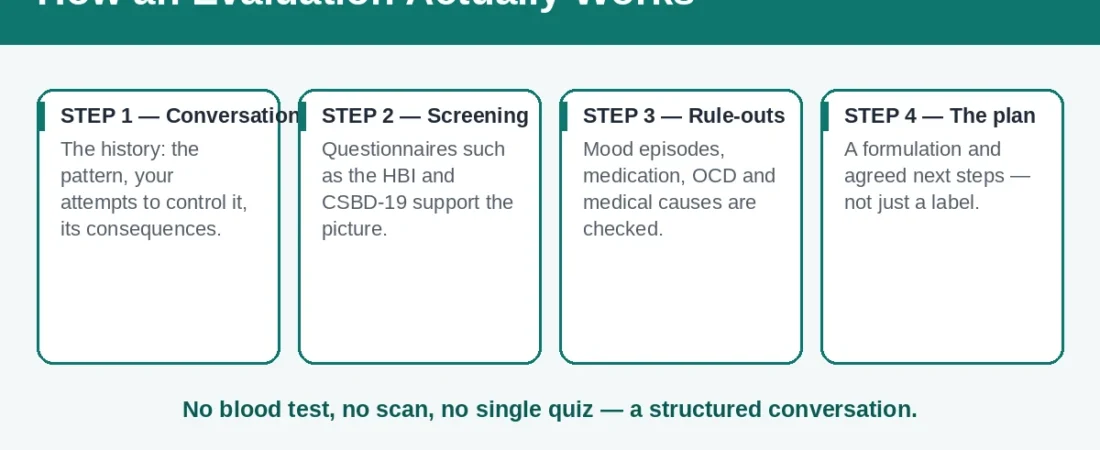
Quick answer: There is no blood test, scan or single quiz that diagnoses this pattern. A clinician diagnoses it — or rules it out — through a structured conversation about the pattern’s history, your attempts to control it, and its consequences, usually supported by validated screening questionnaires, plus checks for look-alike causes such as manic episodes, medication effects and OCD. The process typically takes one to three sessions, and produces a working picture (a “formulation”), not just a label.
Contents
Before the appointment: referral and preparation
How is hypersexuality diagnosed? The process starts before anyone asks you a question. Depending on your country and health system, the first professional might be your family doctor, a psychiatrist, a psychologist or a specialist therapist. In the US, where the DSM-5 has no standalone entry, people often arrive via a therapist treating something alongside it — hence our backgrounders on hypersexuality and the DSM-5 and whether hypersexuality counts as a mental illness.
You do not need to prepare a speech. Two things genuinely help: a rough timeline (when the pattern started, when it escalated, what was happening in your life at the time) and a list of any medications you take. Timing is diagnostic gold: a pattern that began weeks after a new prescription tells a different story from one that has run for a decade.
Step 1: The history conversation
In practice, how is hypersexuality diagnosed? Through a structured conversation whose questions follow a logic you can recognise as you go:
- The pattern itself. What form does the behaviour take, how often, in what situations — and, more importantly, what happens when you try to stop? Clinicians listen for the control story: rules set, rules broken, resolve and relapse.
- The consequences. What has it cost — sleep, work, money, health, your relationship, your self-respect? Has it continued after those costs became obvious?
- The function. What does the behaviour do for you? Escape from stress, boredom, loneliness or low mood is a classic driver, and naming it shapes treatment.
- The timeline and context. Mood, sleep, substances, major life events, and any periods when the pattern switched off — all clues to what is driving it.
- Your wider health. Other conditions, past treatment, and — only as relevant — earlier experiences, including trauma, that taught sexual behaviour as a coping tool.
None of this requires graphic detail — a clinician needs the pattern’s shape, not a scene-by-scene account.
Step 2: Screening questionnaires — support, not verdict
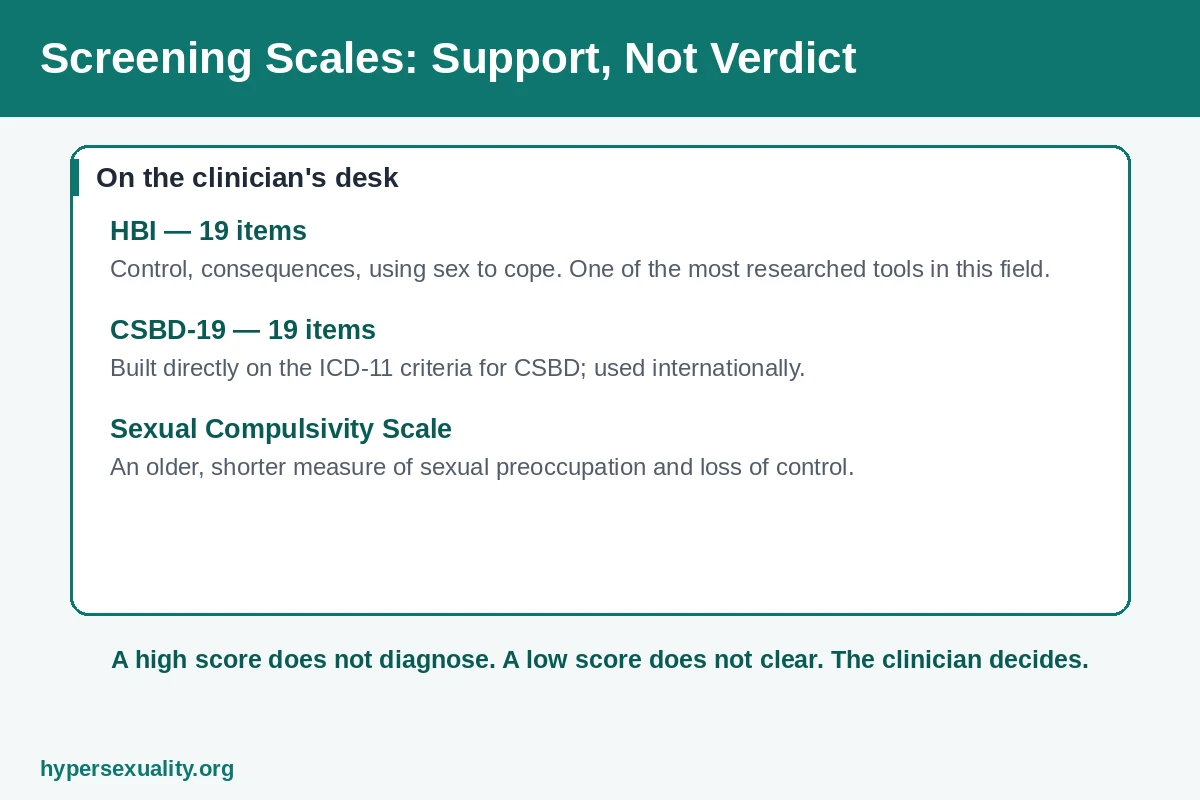
At some point you may be handed a questionnaire. These are screening instruments: self-reports that help the clinician see the pattern’s shape and severity, and give you both a baseline to measure change against. Screening is one part of getting hypersexuality diagnosed properly. Three instruments are widely used and studied:
- The Hypersexual Behavior Inventory (HBI) — 19 items covering control, consequences and using sex to cope; one of the most researched tools in this field.
- The CSBD-19 — a 19-item scale built directly on the ICD-11 criteria for compulsive sexual behaviour disorder, used internationally.
- The Sexual Compulsivity Scale — an older, shorter measure of sexual preoccupation and loss of control.
A high score on any of these does not diagnose you, and a low score does not clear you: screening tools sort and structure, while the clinician’s judgement on the whole picture produces the diagnosis. That is also why online versions — including our own structured hypersexuality test screening page — are framed as screening and self-reflection, never as a verdict.
Step 3: The rule-outs — what else could this be?
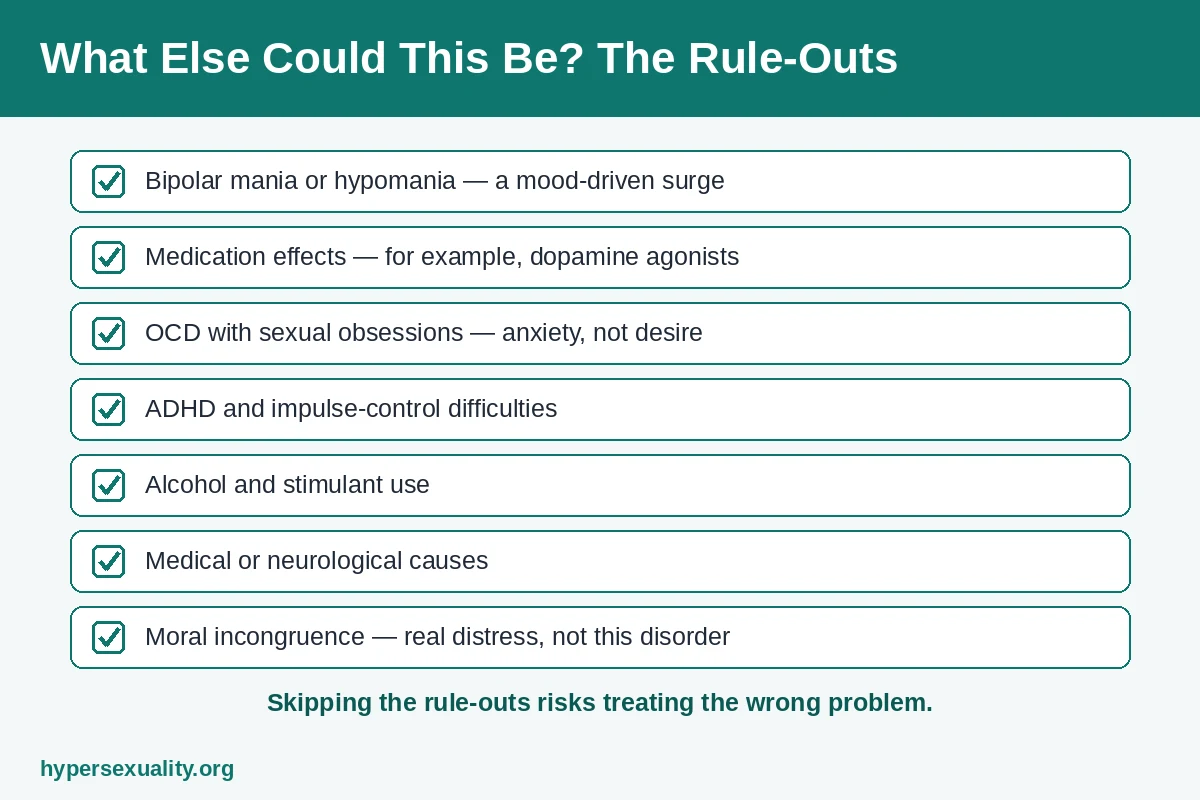
How is hypersexuality diagnosed without jumping to conclusions? A careful clinician spends real effort trying not to apply this label, because several look-alike conditions need different treatment:
| What is checked | Why it matters |
|---|---|
| Bipolar mania or hypomania | A surge in sexual behaviour that rises and falls with mood episodes is usually a symptom of the mood disorder; stabilising mood comes first |
| Medication effects | Dopamine agonists (used for Parkinson’s and restless legs) and some other drugs can switch the pattern on; the fix may start with the prescriber — never stop a drug yourself |
| OCD with sexual obsessions | Intrusive sexual thoughts that horrify the person, with rituals to neutralise them, are an anxiety problem wearing sexual clothing — treatment differs sharply |
| ADHD and impulse-control difficulties | Novelty-seeking and weak brakes can mimic or amplify the pattern, and respond to their own treatment |
| Substances | Alcohol and stimulants can disinhibit behaviour that is controlled when sober |
| Medical and neurological causes | Sudden, out-of-character change — especially later in life — can signal thyroid, neurological or other physical problems needing a medical workup |
| Moral incongruence | Distress caused purely by a clash between behaviour and beliefs is real suffering, but ICD-11 explicitly says it is not this disorder |
Medical tests are not routine here. Blood work or scans enter only when the story points that way — sudden onset, physical symptoms, or a medication timeline to check.
Step 4: The judgement call — and what you leave with
Finally, the clinician weighs the whole picture against the criteria: a persistent pattern (ICD-11 uses an extended period, typically six months or more, as guidance), genuine failure of control, and marked distress or significant impairment — the framework set out in our guide to what hypersexuality actually is.
Often the conclusion is not a single word but a formulation: what the pattern is, what drives it, what keeps it going, and what to work on first. You should leave knowing: whether a diagnosis is being made and which one; what else was found (co-occurring conditions are the rule, not the exception); the recommended next steps — therapy such as CBT, treatment of an underlying condition, or monitoring — and when you will review progress. If the clinician concludes the pattern does not meet criteria, that is also a useful answer — it usually redirects help toward the real driver, such as mood or values conflict.
What does getting hypersexuality diagnosed actually feel like? Consider Robert, a composite example. He nearly cancelled his appointment twice, convinced he would have to “confess everything.” Instead, the first session covered his timeline and a screening questionnaire; the second explored why the pattern had spiked after a job change and a new antidepressant. The outcome was not the label he feared but a plan: adjust the medical side with his prescriber, and start skills-based therapy for the stress-escape loop.
His verdict afterwards is typical: “The questions were about my life, not about judging it.”
Q&A
How long does a hypersexuality assessment usually take?
Expect the picture to be built over one to three sessions rather than in a single sitting. A first appointment often covers the history and a screening questionnaire; follow-ups explore rule-outs and agree a plan. Complex presentations — for instance, where bipolar disorder or medication effects are in the picture — can take longer, because getting the driver right matters more.
What questions will the clinician actually ask me?
Questions about the pattern (what form it takes, how long it has run), your attempts to control it, its consequences for work, health, money and relationships, what triggers it, and what it does for you emotionally. Expect also questions about mood, sleep, substances, medications and general health. The purpose is diagnostic, not voyeuristic — you can share the pattern’s shape without graphic detail.
Will I need blood tests or a brain scan?
Not routinely. There is no laboratory test for this pattern, and scans are not part of a standard evaluation. Physical investigations are added only when your history suggests a medical driver — sudden change, neurological symptoms, a hormone-related picture, or a pattern that began with a new medication. In those cases the clinician may order tests or involve your doctor, because treating the cause changes everything else.
What if I am too ashamed to describe everything honestly?
Then you are in the majority — shame is the most common thing people bring into the room. Honesty matters because the conclusions depend on the pattern you describe; a minimised version can lead to the wrong label or the wrong treatment. Practical helps: write key points down beforehand, and start with the timeline rather than the details.
Can an online quiz diagnose hypersexuality?
No. Online questionnaires — even ones based on validated instruments like the HBI or CSBD-19 — are screening tools. They can show that a pattern looks consistent with the clinical picture and is worth a professional conversation. They cannot weigh rule-outs, context or duration the way an assessment does, and no score, high or low, is a diagnosis. Treat a quiz result as a signpost, not a stamp. Hypersexuality diagnosed is a clinical judgement, not a quiz result.
Sources: World Health Organization, ICD-11 entry 6C72 “Compulsive sexual behaviour disorder”; Bőthe, B. et al. (2020), “The development of the Compulsive Sexual Behavior Disorder Scale (CSBD-19),” Journal of Behavioral Addictions, 9(2), 247–258; Reid, R. C., Garos, S. & Carpenter, B. N. (2011), “Reliability, validity, and psychometric development of the Hypersexual Behavior Inventory in an outpatient sample of men,” Sexual Addiction & Compulsivity, 18(1), 30–51.
Medical disclaimer: This article is educational information only and is not medical advice, diagnosis or treatment. Only a qualified clinician who knows your history can assess whether any diagnosis applies to you. If sexual behaviour is causing you distress or harm, consider speaking with your doctor or a licensed mental-health professional.