Most people arrive at a page like this at 2 a.m., half hoping a test will settle the question and half afraid it will. So let us be straight with you before you answer a single question: this hypersexuality test is a screening, not a diagnosis. It cannot tell you that you “have” anything. What it can do — and what most online tests never bother to do — is show you exactly which parts of the clinical pattern are present in your life, which are absent, and what a sensible next step looks like for each result.
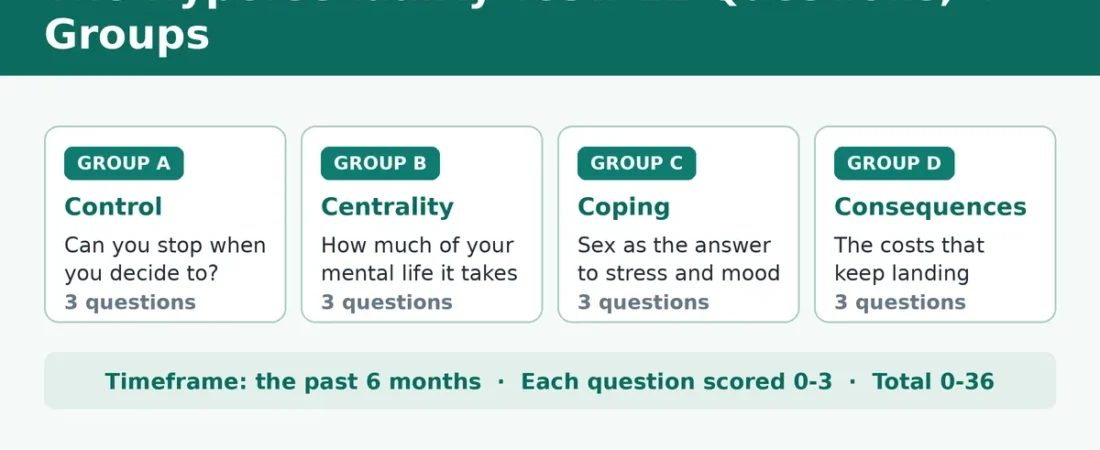
The 12 questions below are original. They are not copied from any clinical inventory. Each one is written from a specific part of the pattern the World Health Organization describes in ICD-11 for compulsive sexual behaviour disorder (CSBD): failed control, sexual behaviour becoming a central focus that displaces other parts of life, continuing despite harm, and distress or impairment that follows. Answer for the last six months — that is the timeframe clinicians use, because a bad fortnight is not a pattern.
Quick answer: A hypersexuality test is a screening tool: a short set of questions that checks whether your experience matches the pattern professionals look for — loss of control, behaviour continuing despite consequences, and real distress or damage to your life. A high score means “this pattern is present and worth a professional conversation”. It never means “you have a disorder”, because diagnosis also requires ruling out other explanations — a mood episode, a medication effect, a values conflict — which no questionnaire can do.
Contents
Before you start: three honest warnings
First, distress is not the same as disorder. Research on moral incongruence (Grubbs and colleagues) shows that some of the most distressed test-takers are people whose behaviour is actually infrequent and controlled, but which clashes hard with their religious or personal values. ICD-11 is explicit: distress that comes entirely from moral judgement about your sexual behaviour does not count towards this diagnosis. If your answers are driven mostly by guilt rather than by lost control and real-world harm, your result needs that lens.
Second, answer about behaviour, not about identity. No hypersexuality test measures what kind of person you are. It measures a pattern over a defined period. Patterns can change; that is rather the point of looking at them.
Third, be boringly honest. Screening only works if you answer for the typical month, not the best week or the worst night. Nobody sees your answers. There is no score at which you should panic, and no score at which you should feel dismissed.
The screening questions
Answer each question for the last six months: Never (0) · Rarely (1) · Sometimes (2) · Often (3).
Group A — Control
- I have decided to cut down or stop a sexual behaviour and then found myself doing it anyway.
- When an urge arrives, I find it very hard to delay or redirect it, even when I intend to.
- I have broken limits I set for myself — times, places, spending, apps deleted and reinstalled.
Group B — Centrality and neglect
- Sexual thoughts, planning or behaviour take up time I meant to spend on work, study, family or rest.
- I have put off or dropped activities that matter to me because sexual behaviour took priority.
- I arrange my day, travel or privacy around opportunities for sexual behaviour.
Group C — Coping use
- I use sexual behaviour to change how I feel — to escape stress, loneliness, boredom or low mood.
- When I feel bad, sexual behaviour is my fastest and most automatic response.
- Afterwards, the feeling I was escaping comes back, and the cycle repeats.
Group D — Consequences and distress
- My sexual behaviour has caused problems I cannot ignore — money, work, health risk, or harm to a relationship.
- I have continued the behaviour after it caused a problem like that, knowing it could happen again.
- I keep parts of my sexual behaviour secret, and the secrecy itself distresses me.
How the scoring works — in the open
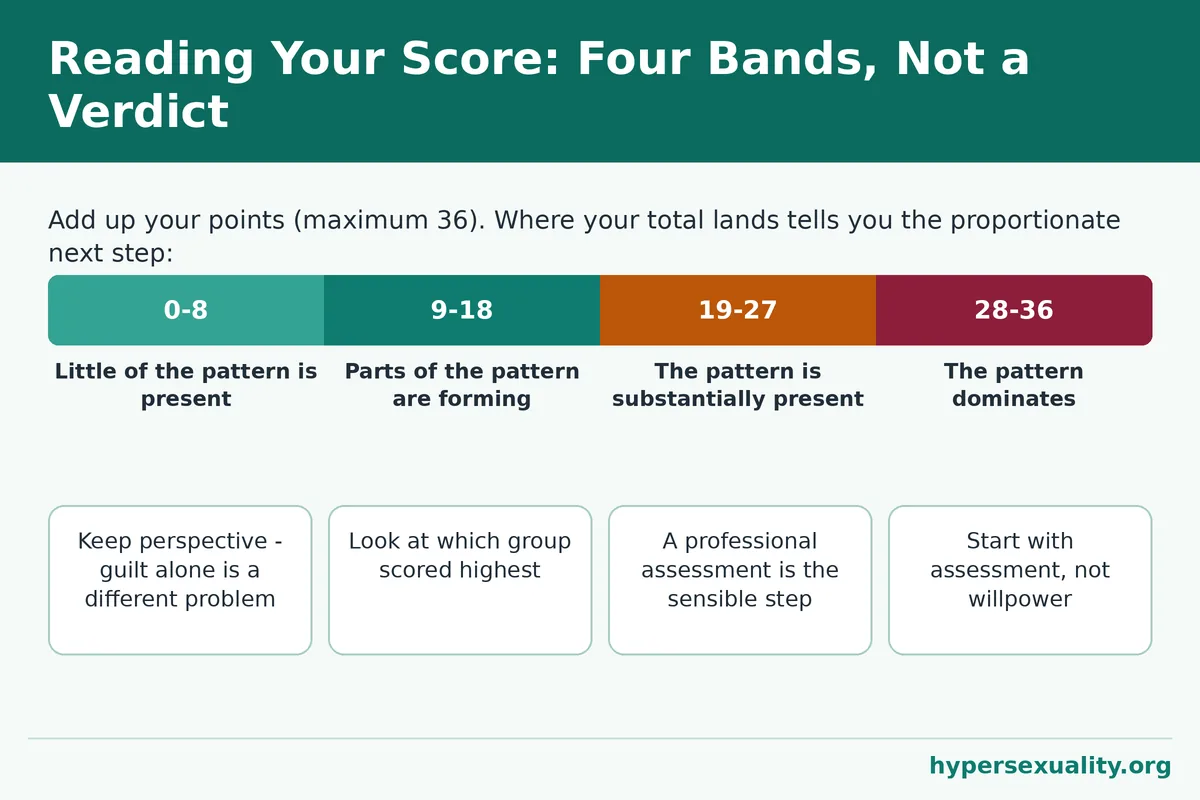
Add up your points (maximum 36). This hypersexuality test uses bands, not a verdict, because a single cut-off pretends to a precision screening does not have:
- 0–8 — Little of the pattern is present. Occasional urges, intact control, no real-world damage. If you still feel distressed, read the moral-incongruence warning above: guilt and disorder are different problems, and they need different help.
- 9–18 — Parts of the pattern are forming. Look at which group scored highest rather than at the total. A high Group C (coping) with low Group D (consequences) is an early picture — the cheapest moment to change course, often with self-help and honest tracking.
- 19–27 — The pattern is substantially present. Control is failing, behaviour is continuing despite costs. This is the range where a professional assessment stops being optional advice and becomes the sensible next step.
- 28–36 — The pattern dominates. If most of your points sit in Groups A and D — failed control plus real consequences — please treat this as a prompt to book an assessment soon, and read the “what to do next” links below today.
One more scoring rule that matters more than the total: any answer of “Often” in Group D outweighs a low total. Consequences are the part of the pattern clinicians weight most heavily, because they are the part that does not depend on how you feel about your behaviour.
What this can look like in a real life
Consider Priya, a composite example: 34, a project manager who took this hypersexuality test after her second broken promise to herself in a month. Her total was 16 — mid-band, easy to shrug off. The group breakdown told the truer story: Group A scored 7 of 9 (control nearly gone), Group C scored 6 (almost every episode followed a brutal workday), while Group D was still low — no debts, no discovery, no health risks yet.
Priya did not have a label. She had a map: a coping-driven pattern, caught while the consequences were still small. Her next step was not a diagnosis; it was tracking her trigger days for two weeks and booking one appointment with a therapist to work on the stress end of the loop. That is what a screening result is for.
What a hypersexuality test cannot tell you
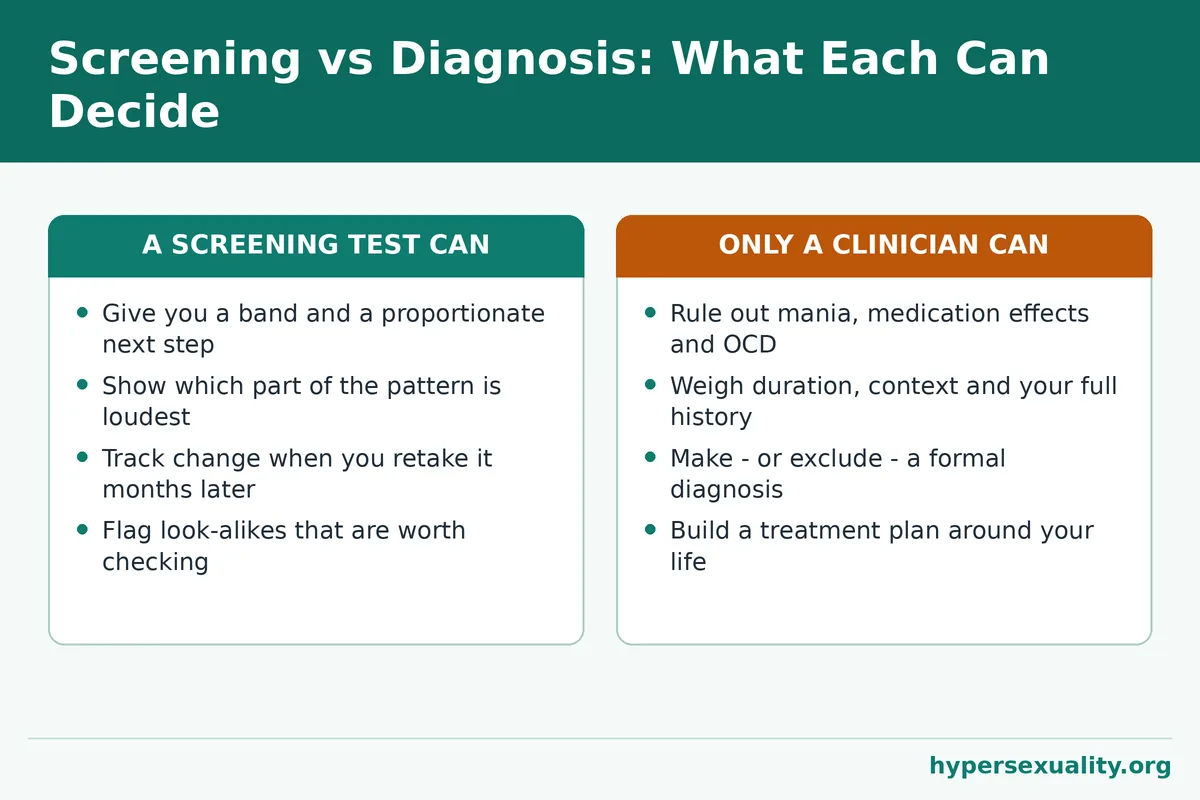
It cannot rule other explanations in or out. The same outward pattern can be produced by a manic or hypomanic episode, by dopamine-agonist medication prescribed for Parkinson’s or restless legs, by ADHD impulsivity, or by OCD — where intrusive sexual thoughts are unwanted and feared, almost the opposite experience. It cannot weigh how long the pattern has run, whether it appears only while intoxicated, or how it sits inside your relationship and culture.
And it cannot hear the difference between “I can’t stop” and “I believe I shouldn’t want this” — the difference the moral-incongruence research keeps flagging. A clinician’s job is exactly that sorting. Ours, here, is the honest first pass.
| This screening can… | This screening cannot… |
|---|---|
| Show which parts of the ICD-11 pattern are present | Diagnose CSBD or any other condition |
| Reveal which group (control, coping, consequences) leads | Rule out mania, medication effects, ADHD or OCD |
| Give you a band and a proportionate next step | Predict how your pattern will develop |
| Give a professional a head start on the conversation | Replace that conversation |
What to do with your result
If your hypersexuality test band was low but the question still nags at you, the gentler hypersexuality quiz approaches the same territory in plain yes/no form. If your band was high, read why online sex addiction tests are not a diagnosis before you search anything else at 2 a.m. — it will steady the picture — and then look at the hypersexuality hub page for what assessment and treatment actually involve. Screening is a door, not a destination. Walking through it is the part only you can do.
Q&A
How accurate is this hypersexuality test?
It is a screening built directly from the ICD-11 criteria, which makes its questions clinically relevant — but no self-test is “accurate” the way a diagnosis is. It will catch most people whose pattern matches the criteria, and it will also flag some people whose distress is really a values conflict. That is why the result is a band plus a next step, not a yes or no.
I scored high but my sex life feels normal to me. What does that mean?
Look at your group scores. A high total driven by Group B (time and centrality) with working control and no consequences can reflect a very high drive in a busy season of life. A high total driven by Groups A and D — failed control plus real harm — is the combination that matters clinically, whatever the behaviour itself looks like.
Should I retake the test later?
Yes — that is one of its best uses. Retake it after three months of honest tracking or after starting any change effort. Movement between bands, and especially movement inside Group A (control), tells you more than any single score.
My partner wants me to take this test. Should I?
You can, but a screening taken under pressure produces defended answers, and defended answers help nobody. If your partner is distressed, their concern is itself information worth a conversation — ideally with a professional — regardless of what any score says.
Can a high score mean something else is wrong instead?
Yes. Mania and hypomania, some prescribed medications, ADHD and OCD can all produce a pattern that screens positive. That is a core reason screening is not diagnosis: a high score is the start of a sorting process, not the end of one.
Sources: World Health Organization, ICD-11 entry 6C72 “Compulsive sexual behaviour disorder”; Kraus, S. W. et al. (2018), “Compulsive sexual behaviour disorder in the WHO ICD-11,” World Psychiatry, 17(1), 109–110; Grubbs, J. B. et al. (2020), “Sexual addiction 25 years on: A systematic and methodological review of empirical literature,” Clinical Psychology Review, 82, 101925.
Medical disclaimer: This article is educational information only and is not medical advice, diagnosis or treatment. Only a qualified clinician who knows your history can assess whether any diagnosis applies to you. If sexual behaviour is causing you distress or harm, consider speaking with your doctor or a licensed mental-health professional.