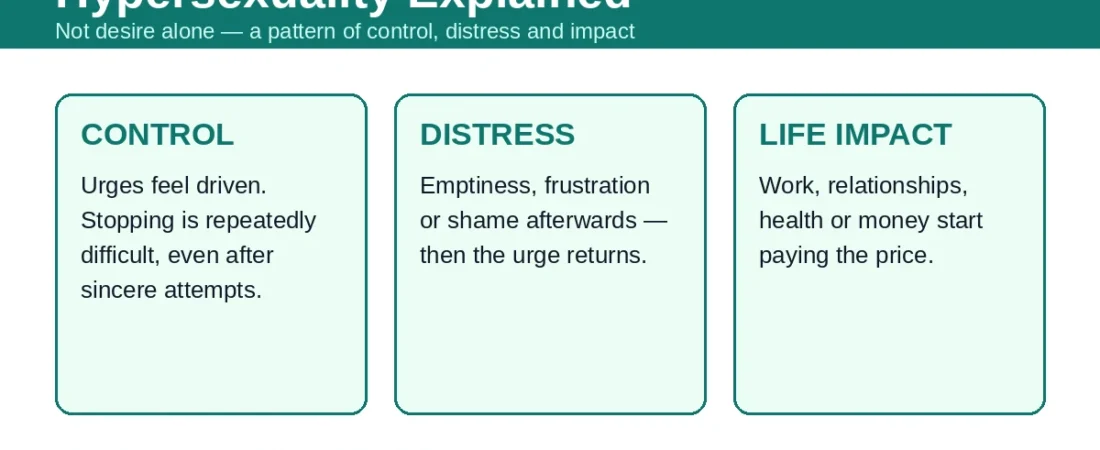
Wanting sex often does not make someone hypersexual — and that single misunderstanding causes a lot of unnecessary fear. Hypersexuality is not about how much sex a person has, how often they masturbate, or how strong their desire is. It is about a pattern: sexual thoughts, urges or behaviour that feel increasingly hard to control, keep going despite real consequences, and start to crowd out the rest of a person’s life. Someone can have a very active sex life and be completely healthy. Someone else can think about sex far less often, yet feel trapped by urges they cannot switch off. The difference is control, distress and impact — not frequency.
Quick answer: Hypersexuality describes a persistent pattern in which sexual urges or behaviour feel out of control, continue despite harm, and cause marked distress or problems at work, in relationships or in daily life. It is not a measure of how much someone wants sex. In the WHO’s ICD-11, the diagnosable form of this pattern is called compulsive sexual behavior disorder (CSBD).
Contents
What hypersexuality actually means
Clinicians use the word to describe sexual behaviour that has shifted from something a person chooses into something that feels like it chooses them. The fantasies and urges are intense and repetitive. Attempts to cut back are made — sincerely — and then quietly abandoned. The behaviour continues even when it stops being pleasurable, which is one of the most confusing parts for the people experiencing it: “If I don’t even enjoy it any more, why can’t I stop?”
That question is exactly why this is a health topic rather than a character flaw. In the ICD-11, the international diagnostic manual published by the World Health Organization, this pattern is recognised as compulsive sexual behavior disorder, classified among the impulse control disorders. The older word “hypersexuality” is still widely used by clinicians, researchers and the public to describe the same territory, while “sex addiction” is a popular label that no major diagnostic system uses as an official diagnosis. Knowing which term means what saves a lot of confusion, because the three labels are often mixed up as if they were interchangeable.
What hypersexuality is not
A clear definition is only half the job. Just as important is what falls outside it:
- It is not a high sex drive. A strong libido that a person enjoys, directs and can set aside when life requires it is healthy sexuality, however frequent it is.
- It is not about particular tastes. Unconventional but consensual interests, a high partner count by someone else’s standards, or enjoying pornography do not, by themselves, indicate any disorder.
- It is not a moral verdict. Distress that comes entirely from moral or religious disapproval of one’s own sexual behaviour is explicitly not enough for a CSBD diagnosis in ICD-11 — that is a values conflict, which deserves support, but it is a different problem with different help.
- It is not an excuse. Understanding the pattern never removes responsibility for repairing harm done to partners or others; it explains the mechanism so the pattern can be changed.
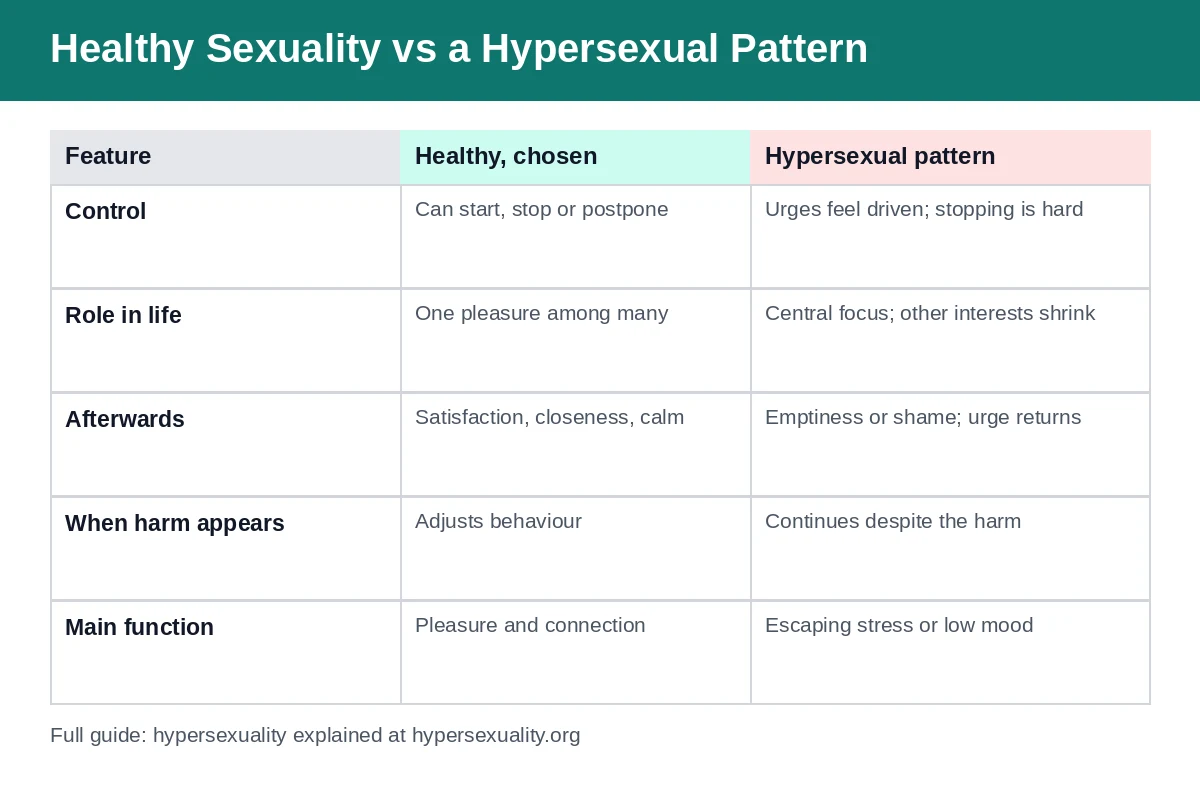
| Feature | Healthy, chosen sexuality | Hypersexual pattern |
|---|---|---|
| Sense of control | Can start, stop or postpone | Urges feel driven; stopping is repeatedly difficult |
| Role in life | One pleasure among many | Becomes a central focus; other interests shrink |
| Aftermath | Satisfaction, closeness, calm | Emptiness, frustration or shame, then the urge returns |
| Response to problems | Adjusts when something causes harm | Continues despite harm to health, work or relationships |
| Function | Pleasure, intimacy, connection | Often used to escape stress, boredom or low mood |
The three questions clinicians actually ask
Because there is no blood test and no “normal number” of sexual thoughts per day, professionals assess the pattern itself. Three questions do most of the work:
1. Can you control it?
Have there been repeated, genuine attempts to reduce the behaviour that did not hold? Occasional overindulgence is human; a long record of broken promises to yourself is information.
2. Is it costing you something real?
Clinicians look for significant impairment — missed work, neglected health or self-care, money spent that was needed elsewhere, a relationship under strain, risks taken that the person would not normally take.
3. Has it persisted, and does it continue despite the cost?
A rough patch after a breakup is different from a pattern sustained over many months (ICD-11 uses an extended period, typically six months or more, as guidance) that survives its own bad consequences — and often continues even when the satisfaction has faded.
What it can look like in an ordinary week
Consider Maya, a composite example. Nothing about her week looks dramatic from outside. But she notices her phone breaks at work keep stretching into long pornography sessions she did not plan. She has deleted and reinstalled the same apps four times this month. She cancelled two evenings with friends because the urge felt louder than the plans, then felt flat and annoyed with herself afterwards. She is not enjoying the behaviour more than before — she is enjoying it less, while doing it more. That combination — less pleasure, more compulsion, real costs — is the pattern this article is about, and it looks quite different from a person who simply has a strong, happy sex drive.
Why does this pattern develop?
There is no single cause, and any page that names one confidently is oversimplifying. Research points to several contributors that often combine: the brain’s reward system and its response to sexual cues; using sexual behaviour as a fast way to regulate stress, loneliness or low mood; co-occurring conditions such as bipolar disorder, ADHD or depression; certain medications (notably some Parkinson’s treatments) and, for some people, earlier life experiences including trauma. Sorting out which of these is relevant is part of a professional assessment, because the right support depends heavily on the driver underneath.
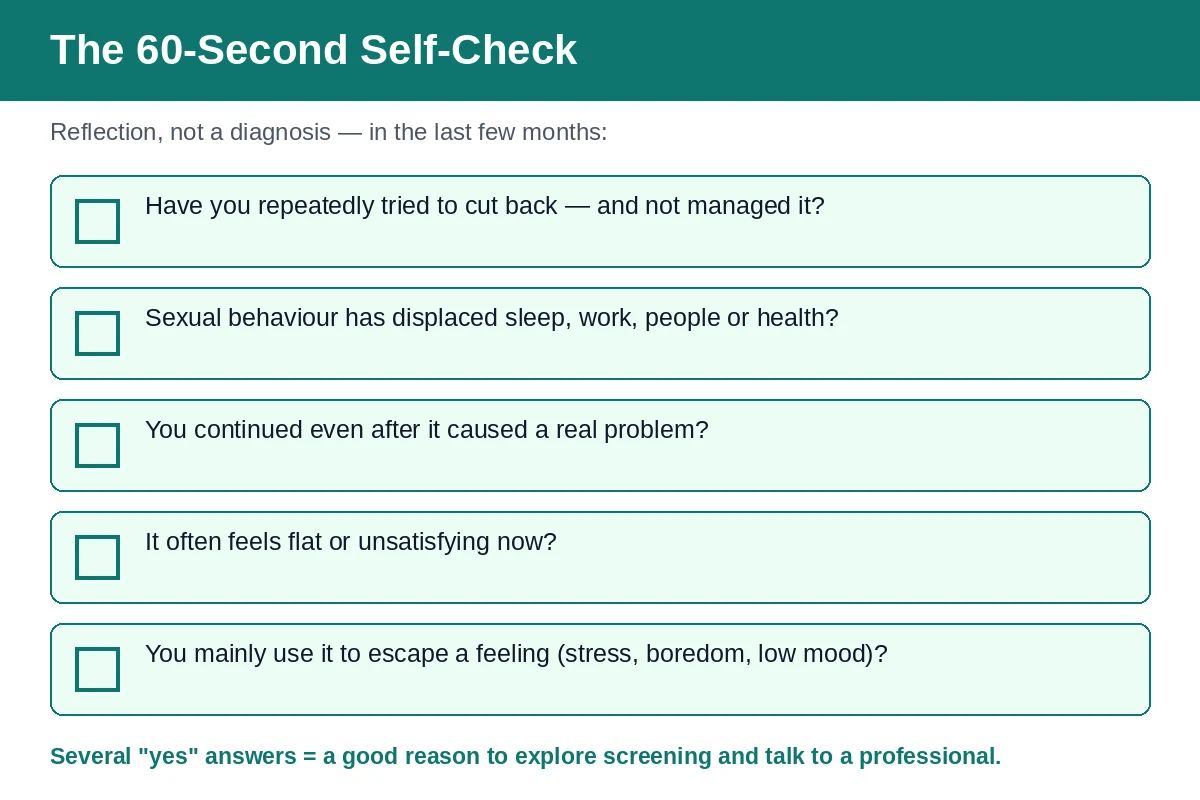
60-second self-check (reflection, not a diagnosis): In the last few months — (1) Have you repeatedly tried to cut back and not managed it? (2) Has sexual behaviour displaced things you value — sleep, work, people, health? (3) Have you continued after it caused a problem? (4) Does it often feel flat or unsatisfying now? (5) Do you use it mainly to escape a feeling? Several “yes” answers are a reasonable prompt to explore the structured hypersexuality test screening page and, if the pattern is costing you, to talk to a professional.
When it becomes a problem worth acting on
The threshold is not a number of partners, hours or orgasms. It is the point at which the pattern is causing marked distress or damaging something that matters — and self-observation has stopped being enough to change it. Help, when people seek it, usually starts with an honest conversation with a doctor or therapist, who will explore the pattern, screen for co-occurring conditions, and discuss approaches such as CBT or other therapies. Many people find that naming the pattern accurately — neither catastrophising it nor dismissing it — is itself a relief.
If you are not sure where your experience sits, the most useful next step is comparison, not labels: read how hypersexuality differs from a high libido, look through the fuller checklist of hypersexuality symptoms, and then read what compulsive sexual behavior disorder actually means in the official sense.
Q&A
Can someone be hypersexual at one time of life but not another?
Yes. The pattern can emerge or intensify during particular periods — for example alongside a mood episode, a medication change, or a stretch of severe stress or loneliness — and ease when the underlying driver is addressed. That is one reason clinicians ask about timing and context, not just behaviour.
Does hypersexuality mean someone will act on every urge?
No. An urge is a mental event; behaviour is what a person does. Many people with this pattern act on urges in private, repetitive ways (such as pornography use) and never harm anyone. Loss of control describes difficulty steering one’s own behaviour against one’s own intentions — it is not a prediction about harming others.
Is hypersexuality more common in men or women?
Research samples usually identify more men, but women are increasingly recognised as under-detected rather than unaffected — stigma and older, male-centred screening tools have skewed the picture. Gender-diverse people are also affected and have been largely missing from older research.
If I recognise this pattern, should I try to stop all sexual activity?
For most people the clinical goal discussed in treatment is not a sex-free life; it is restoring choice — reducing the compulsive pattern while keeping a healthy sexual life. Total-abstinence approaches exist in some programmes, but that is a decision to explore with a professional, not a self-prescription.
Can hypersexuality go away on its own?
Sometimes a pattern tied to a temporary driver (an episode, a medication, a crisis) settles when the driver resolves. A long-standing pattern with real impairment less often resolves through willpower alone, because failed self-control attempts are part of the pattern itself. Support tends to work better than repeated private resolutions.
Sources: World Health Organization, ICD-11 entry 6C72 “Compulsive sexual behaviour disorder” (icd.who.int); Kraus, S. W. et al. (2018), “Compulsive sexual behaviour disorder in the WHO ICD-11,” World Psychiatry, 17(1).
Medical disclaimer: This article is general information about a health topic. It is not medical advice and cannot diagnose you or anyone else. Only a qualified clinician who knows your situation can do that. If sexual behaviour is causing you distress or harm, consider speaking with a doctor, psychologist or qualified therapist.