Most symptom lists for this condition read like a pile of behaviours — pornography, masturbation, multiple partners — with no explanation of how they connect. That is genuinely unhelpful, because none of those behaviours, on its own, means anything is wrong. Plenty of people do all of them with complete control and no distress at all.
What makes a symptom a symptom is the pattern underneath: thoughts that will not switch off, behaviour that keeps escaping your own rules, and consequences that pile up while the behaviour continues anyway. This checklist organises hypersexuality symptoms the way clinicians actually look at them — in three layers — and then flags the signs that suggest you may be looking at a different condition entirely.
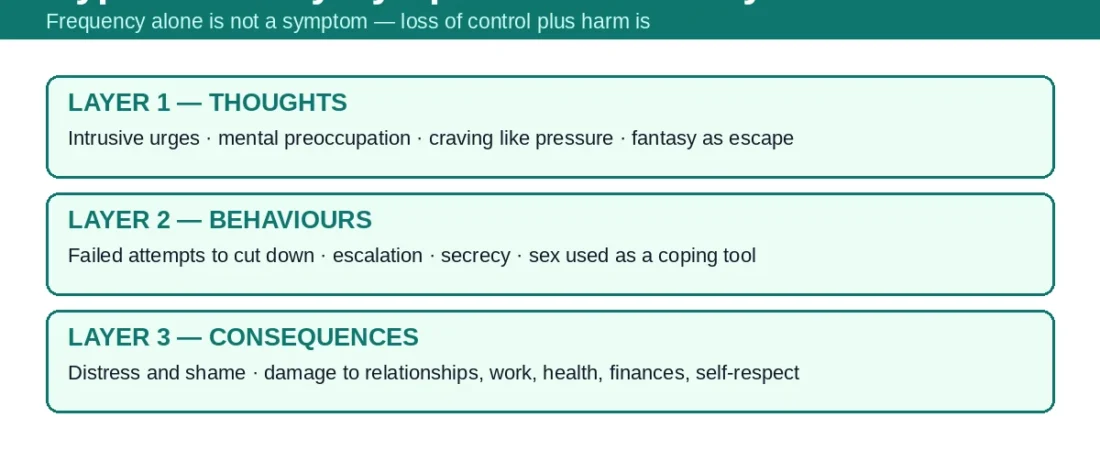
Quick answer: The core hypersexuality symptoms are: (1) in your thoughts — intense, repetitive sexual fantasies and urges that intrude on daily life and feel hard to control; (2) in your behaviour — repeatedly failing to cut down, using sex or pornography to cope with stress, boredom or low mood, and continuing despite risk; and (3) in the consequences — marked distress, or real damage to relationships, work, health, finances or self-respect. Frequency alone is not a symptom. Loss of control plus harm is the pattern that matters.
Contents
Layer 1: Symptoms in your thoughts
The pattern usually starts privately, long before anyone else could notice anything.
- Intrusive sexual thoughts. Sexual fantasies and urges return again and again through the day — in meetings, on the bus, mid-conversation — and cannot be postponed by deciding to think about something else.
- Mental preoccupation and planning. A background track of the mind is always partly occupied: anticipating the next opportunity, replaying past encounters, browsing “just to look”.
- Craving that builds like pressure. The urge is experienced less as desire and more as tension that demands discharge — and it narrows attention until it is dealt with.
- Using fantasy as an escape hatch. At the first sign of stress, boredom, loneliness or criticism, the mind defaults to sexual fantasy as its regulator. This coping function is a key clinical clue.
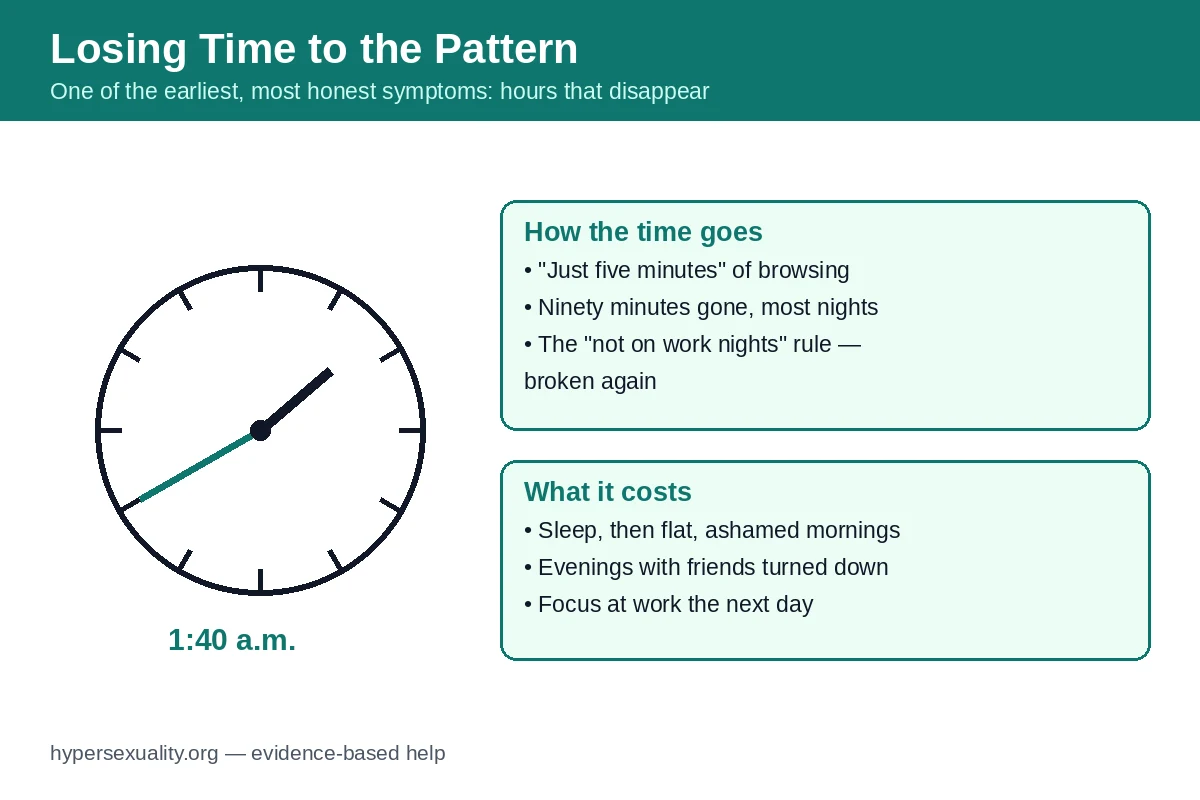
- Losing time to the thoughts. Hours disappear into fantasy, browsing or messaging that was only ever meant to take five minutes.
Layer 2: Symptoms in your behaviour
In behaviour, hypersexuality symptoms become visible — at least to you. This is where the loss of control shows.
- Failed attempts to cut down. You have set rules (“weekends only”, “no apps on my phone”, “never at work”), broken them, re-set them, and broken them again. One broken rule is human; a repeating cycle is a symptom.
- Escalation. Over time the same material or behaviour stops registering, and you need more — more time, more novelty, more intensity — to get the same effect. Clinicians call this tolerance-like escalation.
- Continuing despite known risk. The behaviour persists even when the costs are explicit: a partner’s ultimatum, an STI scare, a workplace warning, money you cannot afford.
- Sex as a coping tool. The behaviour reliably follows emotional triggers — a bad day, an argument, a rejection, an empty evening — rather than arising from relaxed desire.
- Secrecy and a double life. Deleted histories, second accounts, hidden spending, lying by omission. Secrecy is often the symptom partners notice first, and it is diagnostic information in its own right: people do not usually build infrastructure to hide behaviour they feel in control of.
- Neglecting obligations. Work tasks, family time, sleep, friendships or health appointments get displaced — not once, but as a pattern.
Layer 3: Symptoms in the consequences
The consequences are where hypersexuality symptoms stop being private. ICD-11’s definition turns on this layer: the pattern must cause marked distress or significant impairment in personal, family, social, educational or occupational life.
- Persistent guilt, shame or self-disgust after episodes — followed, paradoxically, by the urge returning.
- Relationship damage: broken trust, a partner who feels betrayed or replaced, intimacy replaced by performance or avoidance.
- Work or study impact: missed deadlines, disciplinary risk, using work devices or time.
- Health impact: STI exposure, injuries, exhaustion from late-night sessions, neglected medical care.
- Financial impact: paid content, apps, services or travel that strain real budgets.
- A shrinking life: hobbies, friendships and ambitions quietly abandoned because the behaviour eats the time and the motivation.
A concrete scenario. Maya, 29, does not think her pornography use “counts” because it is solo and free. Then she maps her week honestly: she loses ninety minutes most nights after stressful shifts, has broken her own “not on work nights” rule eleven times, turned down two evenings with friends to stay in, and feels flat and ashamed most mornings.
No single behaviour on that list is pathological. The pattern — failed control, coping function, displacement, distress — is exactly the pattern this checklist exists to reveal.
What is not a symptom
Being precise about the negatives protects people from needless shame:
- A high sex drive, by itself, is not a symptom. If you can postpone, decline and stay present in the rest of your life, intensity alone is not pathology — see how this differs from simply having a high libido.
- Enjoying pornography, masturbation or consensual non-monogamy is not a symptom.
- Feeling guilty only because your religion or upbringing condemns the behaviour is, on its own, explicitly excluded by ICD-11 — that is moral incongruence, a different (and real) source of suffering that deserves its own kind of support.
- One lapse, one bad month after a bereavement or breakup, is a human response to life — the diagnosis-level pattern is persistent, typically evident over six months or more.
Signs that point to a different condition instead
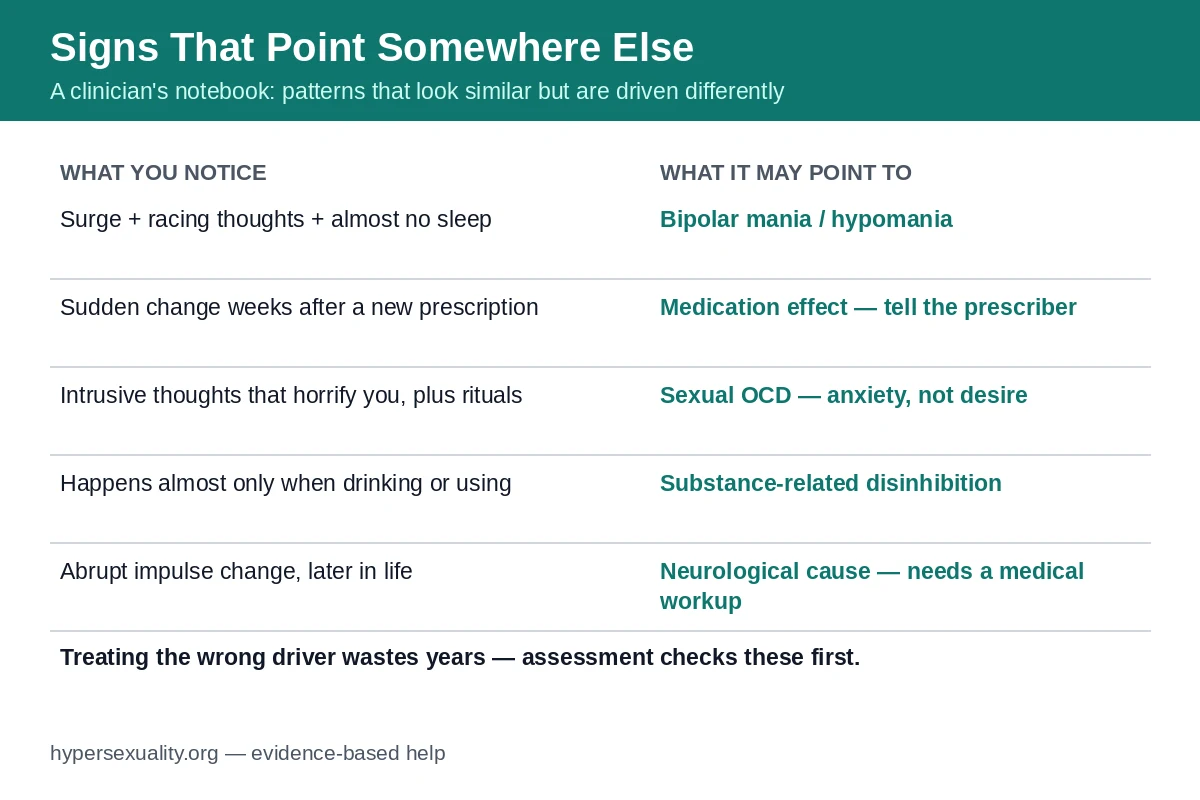
Some presentations look like hypersexuality but are driven by something else — and treating the wrong driver wastes years.
| What you notice | What it may point to | Why it matters |
|---|---|---|
| Sexual surge arrives with racing thoughts, almost no sleep and grandiose plans, then vanishes | Bipolar mania or hypomania | Episodic, mood-linked pattern — mood treatment comes first |
| Sudden change in desire within weeks of starting a new prescription | Medication effect (e.g. dopamine agonists for Parkinson’s) | Tell the prescriber — never stop the drug on your own |
| Intrusive sexual thoughts that horrify you, with rituals to neutralise them | Sexual OCD | The problem is anxiety and doubt, not desire; treatment differs |
| Behaviour happens almost only when drinking or using substances | Substance-related disinhibition | Sobriety changes the picture; both may need addressing |
| Abrupt personality and impulse change later in life, out of nowhere | Neurological cause (e.g. frontal-lobe injury, dementia) | Needs medical workup before psychological framing |
When to take the next step
If you recognise your own hypersexuality symptoms across the three layers — uncontrollable thoughts, escaping behaviour, accumulating consequences — the useful next step is not self-condemnation; it is information. Our hypersexuality test walks through the same pattern as a structured screening (screening, not diagnosis), and our guide to how hypersexuality is assessed explains what a professional would actually do with what you tell them. And if the word itself is still new, start with what hypersexuality actually is.
Q&A
What is usually the first symptom of hypersexuality?
For most people it is mental, not behavioural: sexual thoughts and urges that keep intruding and become hard to postpone, often starting as a way to escape stress or boredom. Behavioural escalation and visible consequences typically develop later.
How much pornography use counts as a symptom?
There is no hour count that defines it. Clinicians look at function instead: Can you stop when you decide to? Is it displacing sleep, work or relationships? Do you keep going despite harm? A person using pornography daily with control has a habit; a person who cannot keep their own rules has a symptom pattern.
Can you have hypersexuality symptoms without a high sex drive?
Yes — and this surprises people. Many people with the pattern report that the behaviour is driven more by tension, habit and relief than by pleasure or desire; some feel little enjoyment during episodes at all. Compulsion and libido are different things.
Do the symptoms have to be present every day?
No. The pattern is judged over months, not days. ICD-11 describes a persistent pattern (commonly referenced as evident over six months or more); episodes can cluster around stress, access or mood and still form a clinical pattern.
I recognise several symptoms. Does that mean I have CSBD?
It means the pattern is worth taking seriously, not that a diagnosis is made. Screening tools and checklists — including this one — cannot diagnose. A clinician would also check duration, rule out mood episodes, medication and substances, and separate moral distress from loss of control before using any label.
Sources: World Health Organization, ICD-11 entry 6C72 “Compulsive sexual behaviour disorder”; Derbyshire, K. L. & Grant, J. E. (2015), “Compulsive sexual behavior: A review of the literature,” Journal of Behavioral Addictions, 4(2), 37–43.
Medical disclaimer: This article is educational information only and is not medical advice, diagnosis or treatment. Checklists and screening tools cannot diagnose any condition. If you recognise this pattern and it is causing distress or harm, consider speaking with your doctor or a licensed mental-health professional.