Two people can want sex equally often and be in completely different situations. One is enjoying a strong appetite that fits happily into a full life. The other feels chased by urges that ignore their own decisions, their tiredness, their promises and their circumstances. Outwardly, the frequency looks the same; inwardly, almost nothing is the same.
That is the heart of hypersexuality vs high libido: the comparison is never really about how much desire someone has. It is about control, consequences and how the desire feels from the inside. This article lays out the seven differences clinicians actually rely on, then gives you a scenario check to locate your own experience — as reflection, not as a diagnosis.
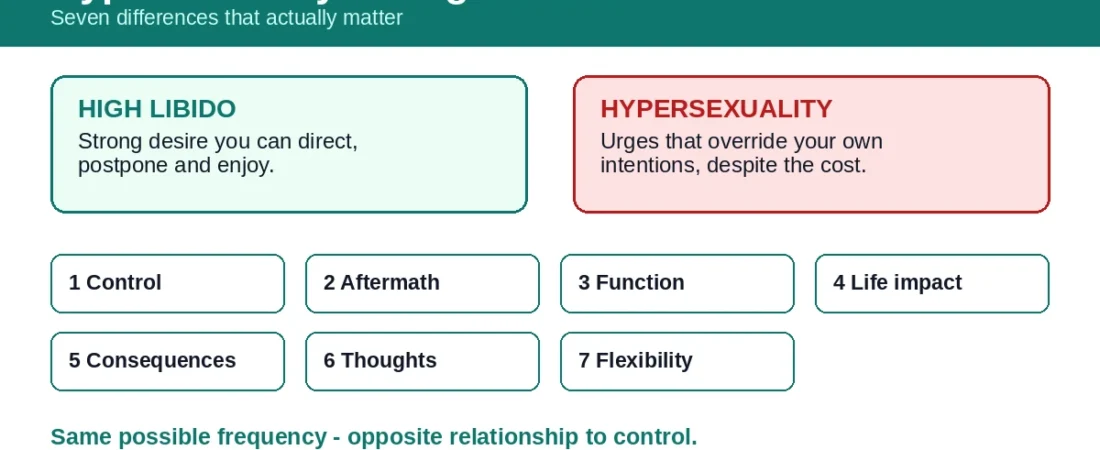
Quick answer: A high libido is a strong sexual desire that a person can direct, postpone and enjoy, with no damage to their life. Hypersexuality is a pattern in which urges repeatedly override a person’s own intentions, continue despite negative consequences, and cause distress or impairment. Same possible frequency — opposite relationship to control.
Contents
Hypersexuality vs high libido: the core distinction
Libido is appetite. Like appetite for food, it varies naturally between people and across a lifetime — with age, health, hormones, relationship stage and a dozen other factors. There is no healthy “setting” everyone should match. Hypersexuality, by contrast, is not a bigger appetite; it is a pattern of dyscontrol around sexual behaviour, the pattern the ICD-11 formalises as compulsive sexual behavior disorder.
Confusing the two causes harm in both directions: people with a happy high drive get shamed for a non-problem, and people with a genuine control problem get told they “just have a high sex drive” while the damage accumulates.
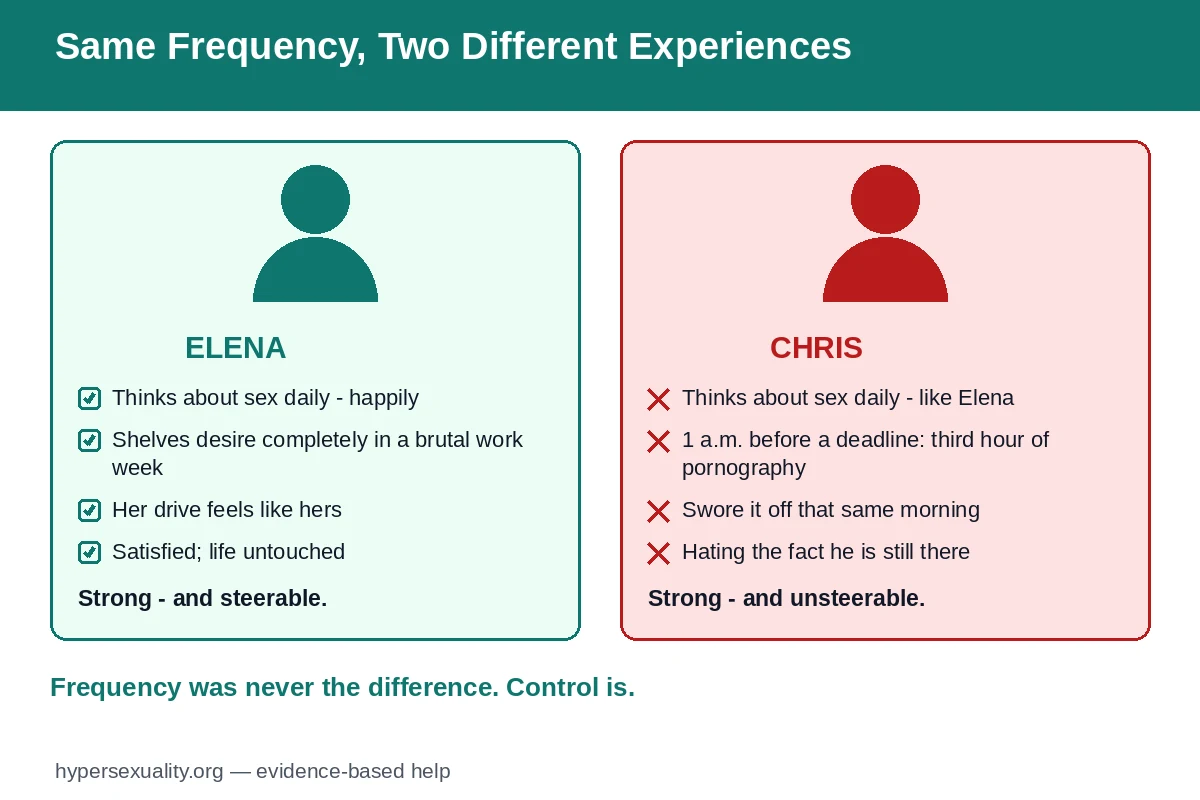
Elena and Chris, two composite examples, make the contrast concrete. Both think about sex daily and would happily have it most days. Elena can shelve desire completely during a brutal work week and barely notice; her drive feels like hers. Chris also has a brutal work week — and finds himself, at 1 a.m. before a deadline, in a third hour of pornography he swore off that morning, hating the fact that he is still there. Elena’s desire is strong and steerable. Chris’s is strong and unsteerable. Frequency was never the difference.
The 7 differences that actually matter
Here is hypersexuality vs high libido compared on the seven points clinicians actually use.
1. Control — High libido: desire can be postponed, redirected or declined without a fight. Hypersexual pattern: repeated, sincere attempts to cut back fail. This is the single most important difference — the ICD-11 definition is built on it.
2. Pleasure and aftermath — High libido: sexual activity is satisfying, and afterwards there is calm, closeness or simple contentment. Hypersexual pattern: satisfaction fades fast or barely registers; the common aftermath is flatness, frustration or shame, with urges returning quickly.
3. What the behaviour is for — High libido: desire points toward pleasure, play and intimacy. Hypersexual pattern: the behaviour is increasingly used as an escape hatch — to blunt stress, boredom, loneliness or low mood. When sex becomes the default anaesthetic, function has changed even if frequency hasn’t.
4. Impact on the rest of life — High libido: work, sleep, friendships, finances and health are untouched, or accommodated without strain. Hypersexual pattern: something measurable is being displaced or damaged — deadlines slip, sleep thins, money leaks, a partner feels displaced or deceived.
5. Response to consequences — High libido: if something causes a problem, the person adjusts — that is what steering means. Hypersexual pattern: the behaviour survives its own consequences. A warning, a conflict, a scare changes intentions but not, for long, behaviour.
6. The quality of the thoughts — High libido: sexual thoughts are welcome visitors — pleasant, occasional or frequent, but not intrusive. Hypersexual pattern: thoughts arrive uninvited and will not leave; they interrupt meetings, conversations and tasks, and the mental noise itself becomes a source of distress.
7. Flexibility across situations — High libido: desire adapts to reality — a partner’s illness, a newborn in the house, a period of grief. Hypersexual pattern: the urges are rigid; they press for expression regardless of context, which is why the person often describes feeling “driven” rather than desiring.
| Difference | High libido | Hypersexual pattern |
|---|---|---|
| Control | Steerable, postponable | Repeated failed attempts to cut back |
| Aftermath | Satisfaction, calm | Flatness, shame, urge returns |
| Function | Pleasure and connection | Escape from feelings |
| Life impact | None significant | Work, sleep, money or relationships suffer |
| Consequences | Behaviour adjusts | Behaviour continues anyway |
| Thoughts | Welcome, non-intrusive | Intrusive, hard to dismiss |
| Flexibility | Adapts to circumstances | Rigid, context-blind |
Which sounds more like you? A scenario check
The hypersexuality vs high libido question becomes clearer in situations than in definitions. Read each pair and notice which column feels familiar more often. This is reflection, not scoring — there is no total that labels you.
| Situation | More like high libido | More like a hypersexual pattern |
|---|---|---|
| A stressful day ends | “I’d love to connect tonight — or unwind another way; either is fine.” | “The urge spikes with the stress, and nothing else will quiet it.” |
| Your partner is unwell for a month | Desire dips into the background; affection finds other forms | Urges build resentfully; solo behaviour escalates and feels compulsory |
| You decide to take a break for a week | Mildly annoying, easily done | The decision is renegotiated within days, again |
| After sexual activity | Settled, present, done | Already restless, or annoyed at how little it gave you |
| A busy, fulfilling week | Sex fits around everything else | Everything else is quietly rearranged around opportunities for sex |
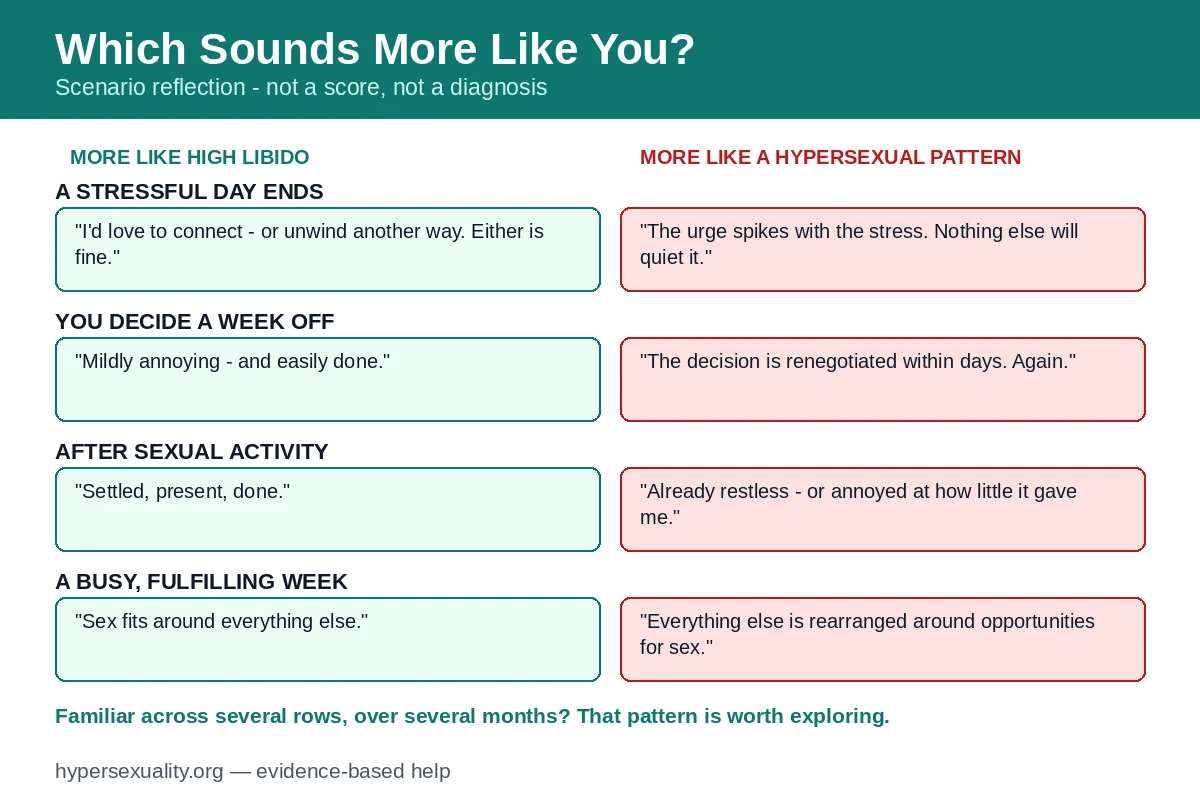
If the right-hand column felt uncomfortably familiar across several rows and several months, that pattern — not any single answer — is worth exploring further, starting with the fuller signs and symptoms of hypersexuality and the reflective “am I hypersexual?” page.
The two-question test clinicians lean on
When professionals compare hypersexuality vs high libido in the shortest possible way, they ask two questions. Can you stop or postpone it when you decide to? and Is it costing you anything that matters — and continuing anyway? Two comfortable answers point toward libido, however strong. Two uncomfortable answers point toward a control problem, however modest the frequency. Notice that neither question mentions a number.
The grey zones, honestly
Three situations blur the hypersexuality vs high libido line and deserve honesty rather than a forced verdict. First, the two can coexist: a person can have a naturally high drive and a control problem layered on top of it — the drive explains the appetite, not the broken promises. Second, values distress can mimic disorder: someone raised with strict teachings may feel intense guilt about a perfectly steerable, harmless sex life; that is moral incongruence, a real difficulty, but a different one, explored alongside hypersexuality vs healthy sexuality.
Third, a mismatch between partners’ drives is a relationship issue, not evidence that the higher-drive partner is disordered — a point worth remembering before anyone gets labelled at the kitchen table. For the wider map, the spectrum of sexual desire shows where high drive ends and compulsion begins, and the hub article on hypersexuality covers the full picture.
Q&A
Is wanting sex every day a sign of hypersexuality?
No. Daily desire is well within normal human variation, especially at certain ages and relationship stages. The sign that matters is not wanting it daily; it is being unable to steer the behaviour, having it displace other parts of life, or continuing despite real costs. A daily desire you enjoy and control is libido doing its job.
Can a high libido turn into hypersexuality over time?
The drive itself does not “turn into” a disorder, but a control problem can develop around any level of drive — for example if sexual behaviour becomes someone’s main way of coping with stress, if a mood condition develops, or after certain medication changes. What changes is the control-and-consequence pattern, not the appetite. In the hypersexuality vs high libido comparison, appetite is the constant — control is the variable.
My partner wants sex far more than I do — are they hypersexual?
Almost certainly that question cannot be answered from frequency alone. Differences in desire are one of the most common relationship friction points and usually say something about two different normal libidos, life stage, health or stress — not about disorder. Look instead at the seven differences above: control, aftermath, impact and flexibility, and at how the mismatch is handled between you.
Can hormones or medication raise libido without it being hypersexuality?
Yes. Higher desire can follow hormonal changes, improved health, a new relationship, or certain medications — and if it remains steerable, pleasurable and cost-free, it is raised libido, not a disorder. A sudden, uncharacteristic change in desire is still worth mentioning to the prescribing clinician, because context matters medically.
What if I recognise both columns — strong drive and occasional loss of control?
That mixed picture is common and is exactly why one article cannot sort it out. Occasional lapses of control are human; a persistent pattern of failed control with real costs is the clinical concern. Tracking the pattern honestly for a few weeks — when urges spike, what they follow, what they cost — gives a professional (and you) far better material than a label chosen in one sitting.
Sources: World Health Organization, ICD-11 entry 6C72 “Compulsive sexual behaviour disorder”; Bőthe, B. et al. (2020), “High-frequency pornography use may not always be problematic,” Journal of Sexual Medicine, 17(4), 793–811.
Medical disclaimer: This article is general information about a health topic. It is not medical advice and cannot diagnose you or anyone else. Only a qualified clinician who knows your situation can do that. If sexual behaviour is causing you distress or harm, consider speaking with a doctor, psychologist or qualified therapist.