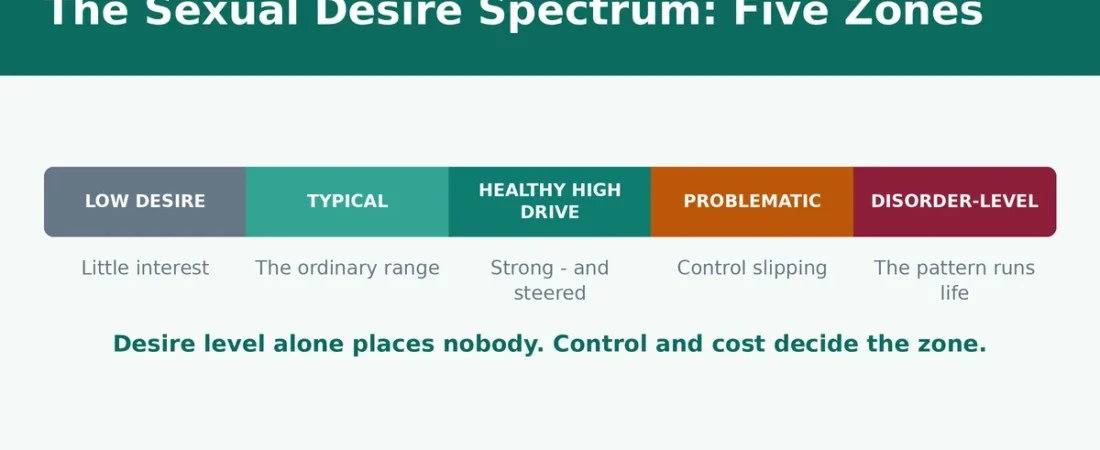
Ask the internet about your sex drive and it offers you two boxes: normal, or disordered. Real human desire does not live in two boxes. It runs along a spectrum — from people who rarely think about sex at all, through every shade of ordinary appetite, to a small number whose sexual behaviour has escaped their control and is costing them their lives as they know them.
The sexual desire spectrum matters because almost everyone who worries about their drive is actually somewhere unremarkable on it — and because the few who are not need to know which end is which. This page maps the whole range, and shows you the questions that locate you far better than any quiz score.
Quick answer: The sexual desire spectrum runs from very low desire, through the broad typical range and healthy high drive, to problematic and disorder-level patterns. Where you sit is decided by two things — how much control you have over the behaviour, and what it costs you — not by how strong your appetite is. A person with a very high drive and full control sits in the healthy zone. A person with a modest appetite who cannot stop, despite real harm, sits at the compulsive end. Desire is the volume; control is the steering.
Contents
The sexual desire spectrum at a glance
| Zone | What it typically feels like | Control | Impact on life |
|---|---|---|---|
| 1. Very low or absent desire | Sex rarely comes to mind; little or no urge to seek it | Not applicable — nothing is pressing to be controlled | A problem only if it distresses you or conflicts with a partner’s needs |
| 2. Typical range | Desire comes and goes with mood, health, stress and relationship stage | Full — easy to postpone, redirect or decline | Neutral to positive |
| 3. High drive (healthy) | Frequent, strong desire; sex is a significant pleasure in life | Full — can wait, can choose, can stop | Neutral to positive; friction only if a partner’s drive differs |
| 4. Problematic pattern | Urges feel pushy; behaviour is becoming a coping tool; costs are appearing | Slipping — cut-downs partly work, then don’t | Sleep, work, money or relationships starting to suffer |
| 5. Disorder-level pattern | Behaviour feels driven; secrecy and escalation; harm continues despite clear cost | Repeatedly lost — sincere attempts to stop fail | Marked distress or impairment across important life areas |
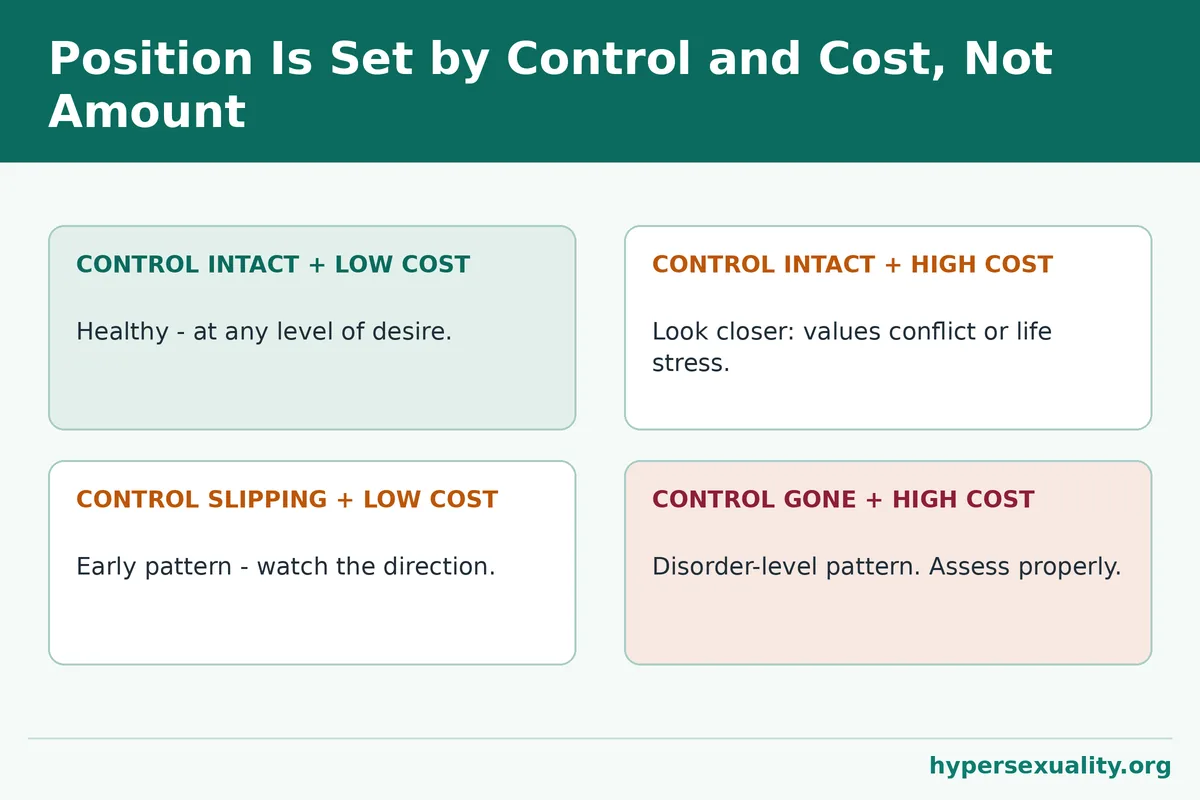
Read the table’s last two columns carefully, because they are the whole argument of this page: movement along the sexual desire spectrum from zone 3 to zone 5 is not driven by appetite growing. Plenty of zone-3 people have stronger drives than plenty of zone-5 people. What changes is the steering — and the bill.
Zone 1: very low or absent desire
The low end of the sexual desire spectrum gets forgotten by sites that only sell worry about the high end. Some people have simply never had much sexual desire; for some, including many asexual people, that is an orientation, not a symptom — asexuality is not a disorder and needs no fixing. Desire can also drop because of depression, medication, hormonal changes, illness, exhaustion or a relationship in trouble, and a sudden drop in someone who previously had desire is worth a medical conversation. The zone becomes a clinical concern mainly when it causes distress or when it is a change that needs explaining — not merely because it is low.
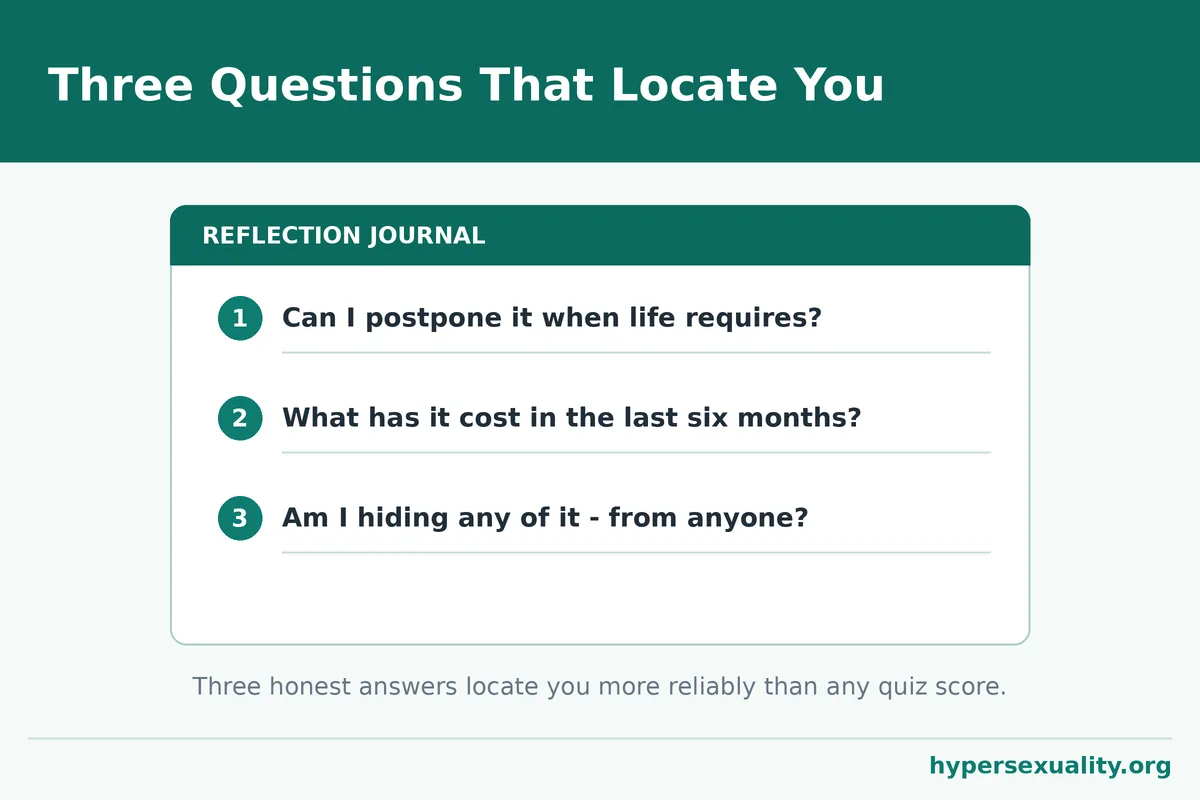
Reflection prompt: is my low desire a stable part of who I am, or a change — and if it changed, what else changed at the same time?
Zone 2: the broad typical range
Most adults live here, and “here” is wide: desire that rises and falls with sleep, stress, health, the season of a relationship and the simple fact of ageing. Weeks of high interest and months of very little can both be entirely ordinary in the same person. If your drive fluctuates and you are looking for your place on the sexual desire spectrum with some anxiety, this zone — unglamorous, variable, unbothered — is statistically where you most likely are.
Reflection prompt: when my desire changes, does it track my life — tiredness, stress, conflict — or does it seem to run on its own schedule regardless?
Zone 3: high drive, fully steered
A strong sex drive is a trait, not a diagnosis. People in this zone think about sex often, seek it enthusiastically, and may want it daily or more — and they can also hear “not tonight”, postpone during a busy month, stay faithful to agreements they have made, and stop when something matters more. Their desire is loud; it is not in charge.
The only common problem in zone 3 is relational arithmetic: a partner in zone 2 experiences the difference as pressure or inadequacy, and the higher-drive partner experiences it as rejection. That is a negotiation problem between two healthy people, and it deserves to be treated as one — not mislabelled as illness, which is what happens when sexual behavior affecting relationship trust is blamed on appetite instead of on secrecy or lost control.
Reflection prompt: when I decide to postpone or skip, does the decision hold without a fight — and does my desire leave room for my partner’s “no” without resentment or sulking?
Zone 4: the problematic middle
This is the zone the two-box internet cannot see, and it is where honest articles earn their keep. In zone 4, nothing dramatic has happened — yet. But the function of sexual behaviour is changing: it has become the default response to stress, boredom and low mood; sessions run longer than intended; a private rule (“not on work nights”, “nothing paid”) has been broken a few times; sleep or concentration is starting to pay. Control has not vanished, but it has become effortful and unreliable.
Zone 4 is not a diagnosis and this page will not pretend otherwise — but it is the cheapest place on the whole sexual desire spectrum to change direction, while the pattern is still young enough to argue with.
Reflection prompt: over the last six months, is my behaviour moving — more time, more intensity, more secrecy — or is it steady?
Zone 5: the disorder-level pattern
At the far end sits the pattern the WHO’s ICD-11 recognises as compulsive sexual behavior disorder: a persistent failure to control intense sexual impulses, over an extended period (the manual uses six months as a guide), where behaviour continues despite harm, takes over the centre of a person’s life, and causes marked distress or serious impairment in personal, family, work or other important areas. Failed attempts to stop are characteristic.
Two clarifications matter: distress that comes purely from moral disapproval of your own behaviour does not count toward this diagnosis — values conflict is real suffering but a different problem — and only a professional assessment can place anyone here, which is why this site’s hypersexuality test is a screening that organises the picture, never a verdict.
Reflection prompt: have I genuinely tried to stop or cut down, more than once, and failed — and is the behaviour still continuing after it has already cost me something I value?
Your position can move — in both directions
Nobody is issued a permanent zone. People slide along the sexual desire spectrum with medication changes, mood episodes, grief, new relationships, ageing, and the quiet accumulation of habit — and they slide back. A zone-4 pattern that gets honest attention often returns to zone 3; a zone-3 drive under a year of brutal stress can start behaving like zone 4. Treat your position as a snapshot with a direction of travel, and pay more attention to the direction than to the still photograph. The tipping mechanics — how expression becomes compulsion — are the subject of the next article in this series, on when healthy sexual expression becomes compulsive.
What it looked like for Peter
Consider Peter, a composite example: 45, married, with a sex drive that had always been the strongest of anyone he knew. At university it was a joke among friends; in his marriage it was a negotiation, mostly good-natured. Then he found an online “self-diagnosis” quiz at 1 a.m. after his wife had turned him down, answered yes to questions about thinking about sex often and wanting it soon after having it, and was told he might have a disorder. He spent three weeks frightened and quietly ashamed.
Mapping himself against the spectrum told a different story. Control: intact — he had postponed for a month during his father’s illness without distress. Secrecy: none; his wife knew his drive better than he did. Costs: none, except a difference in appetite the two of them had been managing, imperfectly, for years.
Peter sat squarely in zone 3. His real problem was a mismatch and a moment of rejection sensitivity, and it needed a conversation, not a diagnosis. The quiz had measured his appetite and called it illness — exactly the error the spectrum exists to correct, and exactly why clinicians insist on understanding what compulsive sexual behavior disorder is before anyone applies the label to themselves.
Q&A
Is a high sex drive a medical problem?
No. A high sex drive with intact control and no harm is a healthy trait — zone 3 of the spectrum. It becomes a medical matter only when control is lost and costs appear: failed attempts to stop, secrecy, escalation and distress or impairment in work, relationships or health. Appetite alone has never been a diagnostic criterion.
Can low desire be a problem too, or is only the high end concerning?
Low desire can merit attention — mainly when it is a change from your own baseline, when it distresses you, or when it signals something else such as depression, medication effects or hormonal problems. Stable low desire that does not distress you, including asexuality, is not a disorder and does not need treatment.
Where does a couple’s desire discrepancy fit on the spectrum?
It doesn’t — and that is the point couples most often miss. A discrepancy is two people sitting in two different zones, both possibly healthy. The mismatch itself is a relationship negotiation, not one partner’s pathology. It only becomes a clinical issue if one partner’s behaviour has separately moved into the loss-of-control zones.
Can you move from healthy high drive to a compulsive pattern?
Yes. The movement is usually gradual and functional rather than appetitive: sex becomes the default coping tool, rules start breaking, secrecy appears, costs accumulate. That is why direction of travel matters more than a single snapshot — and why zone 4, where control is slipping but harm is still limited, is the best place to intervene.
Does the spectrum apply to women as well as men?
Yes. The zones describe function, not gender, and the ICD-11 criteria apply to everyone. Women’s patterns are historically under-recognised — presentations organised around fantasy, apps and relationships are more easily missed or mislabelled than pornography-volume patterns — but the deciding questions, control and cost, are identical.
Sources: World Health Organization, ICD-11 entry 6C72 “Compulsive sexual behaviour disorder”; Bancroft, J. & Vukadinovic, Z. (2004), “Sexual addiction, sexual compulsivity, sexual impulsivity, or what? Toward a theoretical model,” Journal of Sex Research, 41(3), 225–234.
Medical disclaimer: This article is educational information only and is not medical advice, diagnosis or treatment. Only a qualified clinician who knows your history can assess whether any diagnosis applies to you. If sexual behaviour is causing you distress or harm, consider speaking with your doctor or a licensed mental-health professional.