
Almost nobody asks this question in the abstract. They ask it after a discovery — a phone picked up at the wrong moment, a story that did not add up — or after a quieter realisation: that the person next to them feels like a stranger, and sex has something to do with it. The honest answer is rarely found by looking at one partner alone. Sexual behavior affecting relationship health shows up between two people: in what one of them hides, in what the other one senses, and in the slow changes both of them explain away. This page looks from both sides, and part of it is written for the two of you to read together.
Quick answer: A relationship is being damaged not by how much sex one partner wants, but by secrecy, broken agreements and behaviour that continues after its cost is clear. The reliable signs of sexual behavior affecting relationship trust are a double life (hidden accounts, deleted histories, stories that shift), intimacy being displaced by solo behaviour, and promises that keep being made and broken. A simple difference in sex drive — however frustrating — is a mismatch, not damage, and the two need completely different responses.
Contents
Signs from the inside: what the person doing it notices first
If you are the one whose behaviour is in question, the earliest signs are usually private ones, and they arrive before any discovery: These inside signs of sexual behavior affecting relationship health are the ones you can act on earliest.
- You are editing reality in real time. Deleting, renaming, minimising, deciding in advance what you would say if asked. The effort of concealment is itself a sign — people do not build infrastructure around behaviour they feel fine about.
- Solo behaviour is replacing partnered intimacy. You turn down sex with your partner, or go through it distracted, while your private behaviour stays intense. Partners feel the withdrawal long before they understand it.
- Irritability when interrupted or questioned. A disproportionate flash of anger when a partner picks up your phone or walks in is information, not just embarrassment.
- Promises with a shelf life. You have sincerely promised yourself — or them — that it stops, and it has not stopped. Repeated failed promises are among the clearest signs of sexual behavior affecting relationship stability, because they mark the point where intention stopped being in charge.
- Relief when your partner is away. If their absence mainly registers as opportunity, the behaviour has started reorganising the relationship around itself.
Signs from the outside: what partners usually see first
Partners rarely begin with evidence. They begin with a feeling they cannot justify, and they often doubt themselves for months before anything is confirmed. What they are usually picking up is real. These are the outside signs of sexual behavior affecting relationship closeness, and they tend to arrive in this order:
- A guarded device. A phone that is suddenly always face down, always carried, never left charging in the kitchen — after years of being unremarkable.
- Stories with small inconsistencies. Timings that shift, explanations that are slightly too detailed, evenings that cannot quite be reconstructed.
- Emotional distance that has no name. Conversations get thinner; affection becomes performative; the partner feels like a flatmate while being told everything is fine.
- Changes in the couple’s sexual life. Avoidance, or sudden pressure for things that feel imported from somewhere else, or a sense of being compared.
- Money or time that does not reconcile. Small unexplained spending, late nights with nothing to show for them.
A partner reading this list deserves one caution stated plainly: these signs can have other explanations — depression, work stress, an affair of the heart rather than a compulsive pattern, or a private habit your partner is simply ashamed of rather than controlled by.
Signs justify a conversation and, where needed, a professional assessment. They do not, on their own, prove a diagnosis — which is why the structured hypersexuality test screening exists, to organise the picture rather than settle it by suspicion.

Desire mismatch, or a compulsive pattern?
The most common confusion in this territory is between two very different problems. Couples waste years treating the first as if it were the second, and vice versa — and learning to tell them apart is the single most useful skill in recognising sexual behavior affecting relationship health early.
| Question | Desire mismatch (common, workable) | Compulsive pattern (needs proper help) |
|---|---|---|
| Who wants what? | One partner simply wants sex more often; both can say so openly | Behaviour is hidden; what the partner sees is not the whole picture |
| Control | The higher-drive partner can postpone and redirect without distress | Attempts to cut back or stop keep failing despite sincere promises |
| Secrecy | Little or none; the frustration is discussed, even if awkwardly | Deleted histories, hidden accounts, stories that change |
| Effect of honesty | Talking about it, however hard, tends to help | Talking happens after discovery, and the behaviour continues anyway |
| Trend over time | Fairly stable; fluctuates with life stage and stress | Escalating — more time, more intensity, more risk |
Where the right-hand column describes your situation, the issue is not compatibility. It is the pattern clinicians describe under compulsive sexual behavior disorder — a loss-of-control problem that happens to be playing out inside a relationship.
A section to read together
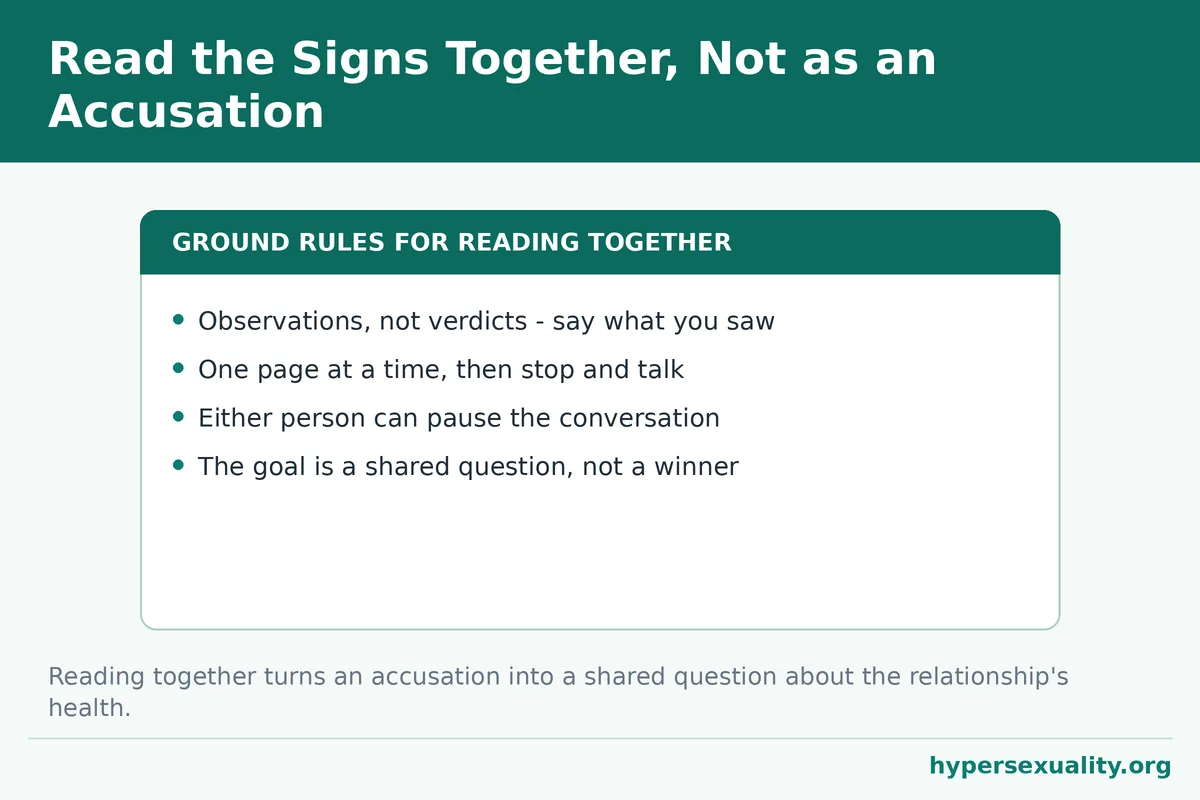
If you can, read this part aloud, both of you, somewhere neutral and not at midnight. Three ground rules first: nobody is on trial; detail about specific acts is less useful than honesty about impact and pattern; and the goal of this conversation is one agreed next step, not a verdict.
Question one: what does each of us actually know? Not suspect — know. The gap between knowledge and suspicion is where most couples live, and it corrodes more than facts do.
Question two: what has this cost each of us? The partner acting out usually names shame and exhaustion. The other partner usually names loneliness, self-doubt and the feeling of going mad over “nothing”. Both costs are real, and naming them is the beginning of treating sexual behavior affecting relationship damage as a shared problem rather than a crime scene.
Question three: what would each of us need to see change in the next month? Small, observable, agreed: no behaviour on shared devices; the screening on this site done honestly and discussed; an appointment booked. If those conversations keep collapsing into denial and discovery, that collapse is itself the answer — outside help is needed, and sooner is kinder than later.
What it looked like for Amara
Consider Amara, a composite example: 33, married four years. For most of a year she believed she was the problem — less attractive, too anxious, imagining things. Her husband’s phone had become a body part; his showers got longer; he turned her down and then she heard him awake at 2 a.m. She found nothing, because he was careful, and the not-finding made her doubt herself more.
What changed things was not evidence. A friend sent her a page about partner-visible signs, and she recognised the pattern of small inconsistencies rather than any single act. She asked for a conversation with three questions, not an interrogation. He broke down — less from being caught than from exhaustion at his own double life. Their story is not finished, and this page cannot finish it. But the shift from “what is wrong with me?” to “what is this pattern doing to us?” is the shift that made help possible: individual assessment for him, support for her in her own right, and couples work only once honesty had something solid to stand on.
Research on why partners can feel “addicted” to a problem that is not theirs — and why guilt and values complicate everyone’s reading of a situation — is part of why a structured screening beats months of suspicion; the fuller clinical picture is set out in our explainer of what compulsive sexual behavior disorder is.
Where to go from here
If you are the partner who acted out: the most useful first step is an honest self-screening, done alone and then shared — not performed for sympathy. If the pattern is real, individual professional help comes before couples therapy; a relationship cannot do the work of a treatment plan. Our previous article in this series looks at the same pattern from the workplace side — sexual behavior affecting career — because the domains usually crack together.
If you are the partner who noticed: your distress counts independently of any diagnosis he or she may or may not receive. Support exists for partners specifically, and you are entitled to it whether or not the other person engages. Left unaddressed, sexual behavior affecting relationship trust tends to widen over time: the concealment grows, and the distance grows with it. And for both of you: the question this page cannot answer is where your own desire levels sit in the first place — which is the subject of the next article, the sexual desire spectrum.
Q&A
My partner just has a higher sex drive than me. Is that the same thing?
No. A higher drive that is open, controllable and responsive to conversation is a mismatch — extremely common, and workable through negotiation, scheduling and sometimes couples therapy. The damaging pattern is different: secrecy, failed promises, escalation and behaviour that continues after its cost is undeniable. The table above is designed to help you tell them apart.
Can a relationship recover after this kind of trust damage?
Many do, but recovery has a shape: the behaviour is addressed in treatment in its own right, honesty becomes verifiable rather than performed, and the betrayed partner’s recovery is treated as real work, not an afterthought. Relationships struggle most when the discovery is followed by minimising and further discoveries. A diagnosis, where one applies, explains the pattern — it does not by itself repair anything.
Should I check my partner’s phone if I suspect something?
It is understandable, and people do — but go in clear-eyed. Searching rarely settles anything: finding nothing proves nothing to a frightened mind, and finding something starts a crisis without a plan. If you feel you cannot live in the uncertainty, say that directly and ask for honesty or for a joint session with a professional. Your distress is legitimate either way, and support for partners does not require evidence.
Is it normal to keep some sexual privacy in a relationship?
Yes — privacy and secrecy are different things. Privacy is a boundary both partners know exists: solo sexuality, unshared fantasies, personal devices. Secrecy is concealment that would change the other partner’s choices if they knew — hidden behaviour that breaks the couple’s actual agreements. Most couples can live comfortably with privacy. It is secrecy that does the corrosive work, and secrecy, more than any single act, is sexual behavior affecting relationship trust from the inside.
How do I raise this without it becoming an accusation?
Choose a calm, private, sober moment — not the aftermath of a discovery at 1 a.m. Describe what you have observed and what it has cost you, rather than naming a condition: “You’ve seemed far away for months, I feel lonely, and I need us to look at what’s happening” opens a door that “you’re an addict” slams. The read-together section above is built for exactly this conversation, and bringing a structured screening or a booked appointment gives the talk somewhere to go. That conversation is the first repair step for sexual behavior affecting relationship trust.
Sources: World Health Organization, ICD-11 entry 6C72 “Compulsive sexual behaviour disorder”; Grubbs, J. B., Hoagland, K. C., Lee, B. N., Grant, J. T., Sampson, P. & Wu, A. (2020), “Sexual addiction 25 years on: A systematic and methodological review of empirical literature and an agenda for future research,” Clinical Psychology Review, 82, 101925.
Medical disclaimer: This article is educational information only and is not medical advice, diagnosis or treatment. Only a qualified clinician who knows your history can assess whether any diagnosis applies to you. If sexual behaviour is causing you distress or harm, consider speaking with your doctor or a licensed mental-health professional.