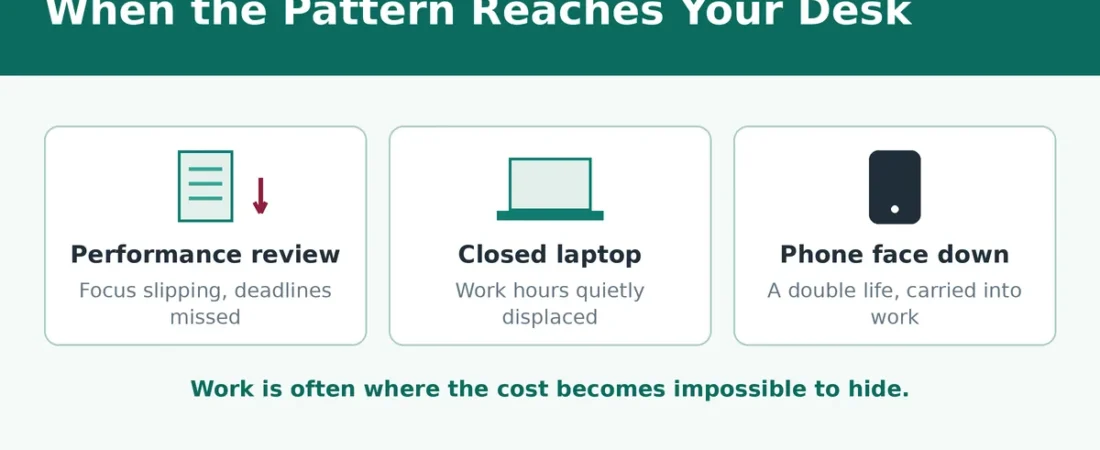
It rarely starts with a catastrophe. It starts with a browser tab closed a second too late, a phone taken to the bathroom for twenty minutes instead of five, a report finished at midnight because the afternoon quietly disappeared. Then a performance review uses a phrase like “not as focused as last year”, and you already know something your manager does not.
If you are searching about sexual behavior affecting career prospects, you do not need a lecture. You need an honest way to audit what is happening at work, privately, and a clear picture of the risks and the exits. That is what this page is for.
Quick answer: Yes, sexual behaviour can damage a career — but through function, not appetite. Sexual behavior affecting career outcomes almost never begins with desire itself. It begins with time disappearing into urges during work hours, concentration thinning, and behaviour migrating onto work devices, work networks or work trips, where it creates real disciplinary and legal risk. The self-check below separates a private habit from a pattern that is now costing you professionally.
Contents
How the damage actually happens
Careers are not usually harmed by what someone feels. They are harmed by four concrete mechanisms, and it is worth naming them plainly.
Time displacement. The most common pattern of sexual behavior affecting career performance is simple theft of hours: sessions that stretch, “quick checks” that become forty minutes, work started late and finished in a panic. Over a quarter, that is the equivalent of days of lost output — visible to everyone except, often, the person doing it.
Thinned concentration. Preoccupation does not clock off when the tab closes. Intrusive urges and the mental replay of the last session sit underneath meetings, calls and detailed work, and the quality of thinking drops before the quantity of hours does. Colleagues notice vagueness and missed details long before they suspect a cause.
Migration to work systems. This is where a private issue becomes an employment issue. Behaviour that moves onto a work laptop, a work phone, the office network or a work trip is no longer only yours: it is logged, monitored and governed by policies you signed. One sync, one screen-share, one IT audit can surface years of it at once.
Risk behaviour around people. The gravest category is behaviour that involves colleagues — messages, comments or advances that cross professional boundaries. That is no longer a self-management problem; it can be a conduct and safeguarding matter with consequences far beyond one job, and it needs professional help immediately, not self-help.
The workplace self-check
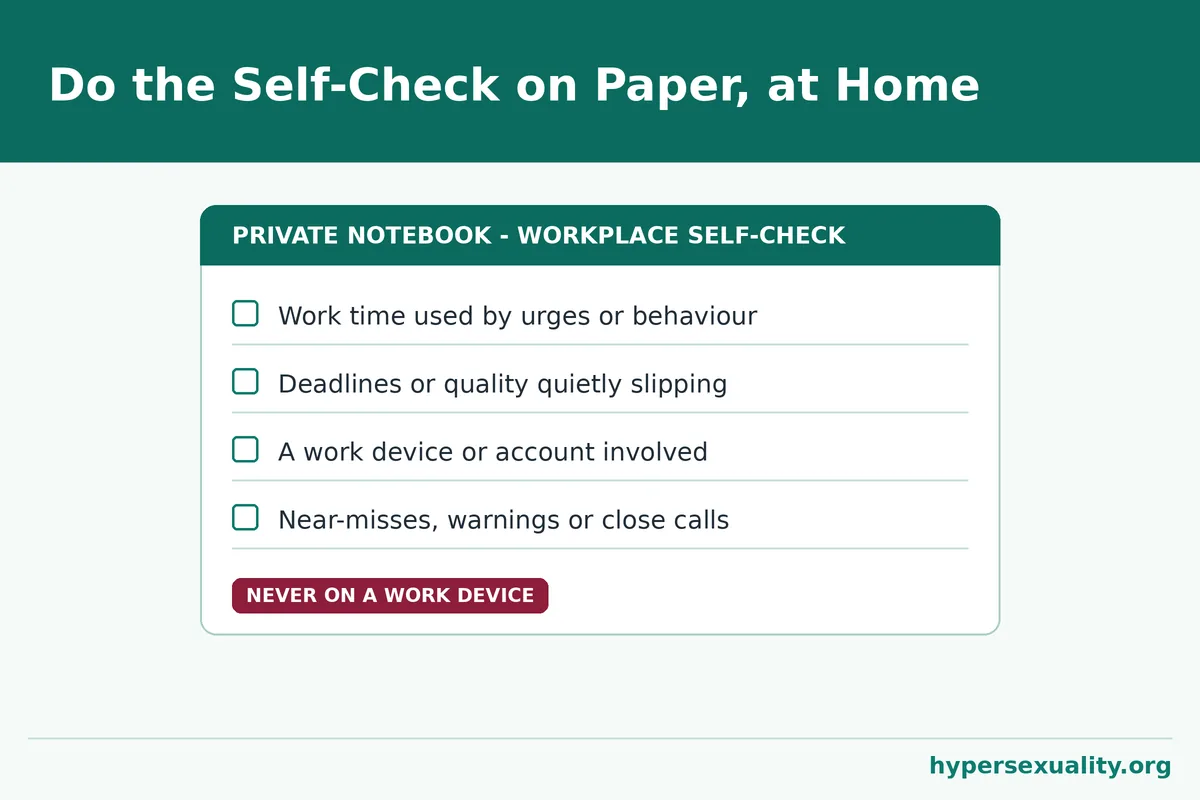
Read these over the last six months, and answer honestly — nobody sees this but you. Use Never, Sometimes or Often rather than yes/no, because pattern matters more than a single bad week.
- Have urges or sexual thoughts repeatedly pulled your attention out of work you needed to finish?
- Have you used pornography, dating apps or sexual chat during work hours, or stretched breaks to do so?
- Has any of this behaviour touched a work device, work account or work network, even once?
- Have deadlines, quality or responsiveness slipped in ways you privately connect to this behaviour?
- Have you hidden, minimised or reconstructed what you were doing when a colleague or manager asked?
- Have you tried to keep work hours completely clear of it, and failed despite meaning to?
- Do work trips, lone working or working from home reliably make the behaviour worse?
- Has a manager’s feedback, a warning or a near-miss (a screen nearly seen, a message nearly sent) already happened?
A single “often” on questions 3 or 8 deserves attention on its own, because those are about exposure, not just habit. Several “often” answers across the list describe sexual behavior affecting career functioning in exactly the way clinicians mean when they ask about occupational impairment — one of the life domains a professional assessment explores, as our explainer of what compulsive sexual behavior disorder is sets out.
This is a screening reflection, not a verdict: it tells you whether the work domain belongs in the conversation, and a fuller hypersexuality test screening can place it alongside the other domains of your life.
What employers see, and what it costs
| What is happening inside | What it looks like from outside | Typical consequence |
|---|---|---|
| Afternoons lost to urges and sessions | Missed deadlines, slow replies, “reliability concerns” | Informal warnings, then a formal performance process |
| Behaviour on a work laptop or network | An IT flag, a synced photo, a screen-share slip | Disciplinary investigation; often treated as gross misconduct |
| Preoccupation and poor sleep | Vague, error-prone, disengaged in meetings | Passed over for promotion; quietly managed out |
| Boundary-crossing messages to a colleague | A complaint to HR | Suspension, dismissal, and a record that follows you |
| Escalation during work trips | Expense anomalies, complaints, client incidents | Immediate dismissal risk and possible legal exposure |
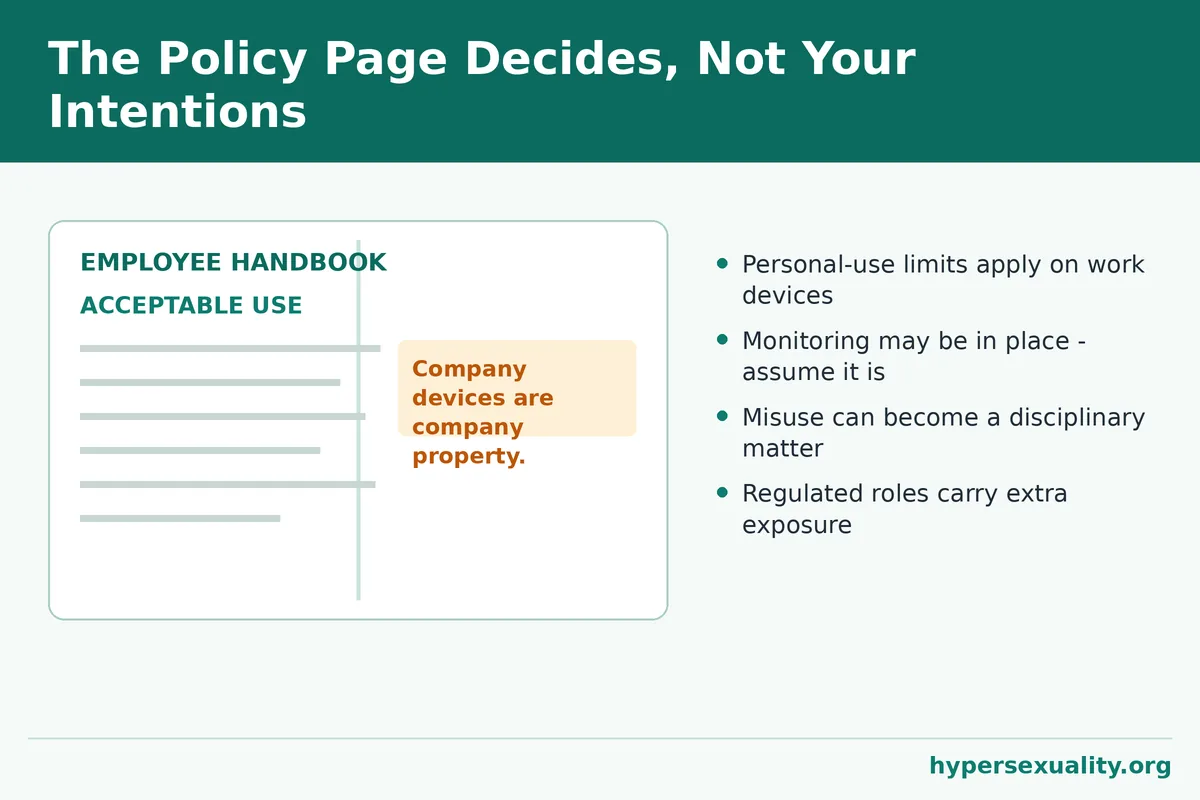
Two points in that table deserve emphasis. First, on company equipment there is generally no meaningful privacy: most employment contracts and acceptable-use policies allow monitoring, and “it was my lunch break” rarely protects behaviour on a company device or network.
Second, the legal side of sexual behavior affecting career security varies by country and profession — regulated roles (finance, healthcare, education, law) often carry fitness-to-practise standards that reach further into private conduct than ordinary jobs do. Treat this page as orientation, not legal advice; if a disciplinary process has already started, an employment lawyer in your jurisdiction is the right next call.
What it looked like for Lucas
Consider Lucas, a composite example: 38, a regional sales manager with a strong record. His pattern lived on his phone, late at night — until a restructure moved him to home working. Within months, sessions had migrated into the working day, then onto his work laptop because “the screen was better”. He told himself the numbers were still fine. They were, until a quarter where two client reports went in late and his manager used the word “focus” three times in one review.
What frightened Lucas was not the review. It was opening his laptop on a client site and realising the browser had synced his history. Nothing was seen. But that near-miss was the first time he understood that sexual behavior affecting career survival was no longer a hypothetical: one IT audit would have ended the job he had spent a decade building.
He did the audit in this article at home, on paper, recognised six “often” answers, and took the pattern — not a confession, the pattern — to a therapist he found himself. The work-device use stopped that week, as a hard boundary, before anything else changed.
What to do next, in an order that protects you
Draw the device line today. Whatever else is unresolved, behaviour on work devices, accounts and networks stops now — not as a willpower vow, but as an environment rule: work systems are for work, full stop. This single boundary removes most of the career-ending risk while you address the rest, and every week that sexual behavior affecting career safety continues on work systems is a week of unnecessary exposure.
Audit at home, on paper. Run the fuller picture with our sexual behavior impact audit, which scores time, money, health and self-respect alongside work, so you can see whether the career domain is one crack or part of a wider pattern.
Do not confess to HR as a first step. Employers are not clinicians, and a written disclosure can follow you. If your workplace offers an Employee Assistance Programme, those are typically confidential and separate from your employer — but read its confidentiality terms first. A GP, a sexual health service or a private therapist are routes that keep the conversation clinical rather than corporate.
Take the pattern seriously at the level the check suggests. If the answers here are mostly “never”, keep the device line and revisit in a few months. If several are “often”, that is the same occupational-impairment signal a professional would explore — and this cluster continues with the companion question of whether the same pattern is affecting your relationship, which is where it most often shows next.
Q&A
Can my employer actually see what I do on a work laptop or phone?
In most workplaces, yes. Company devices and networks are company property, and acceptable-use policies usually permit monitoring, logging and review — including browsing history, synced accounts and messages sent through work systems. The exact rules vary by employer and country, but the safe assumption is that nothing done on work equipment is private. It is also the most easily evidenced form of sexual behavior affecting career standing, because it leaves logs.
Can you be fired for looking at pornography at work?
In many jobs, yes. Using work systems for sexual content is commonly classed as gross misconduct, and dismissal can follow even without earlier warnings, particularly where policies are explicit or the material was visible to others. Behaviour involving colleagues is more serious again. The specifics depend on your contract and local employment law — if you are already facing a process, get legal advice rather than relying on general information.
Should I tell my manager what is really going on?
Usually not as a first move. Managers have a duty to the organisation, not a duty of care to treat you, and anything you put in writing can be hard to retract. If you need time or adjustments for treatment, that conversation can happen later, briefly and with professional advice behind you. Confidential routes — a GP, a therapist, or an Employee Assistance Programme with verified confidentiality — come first.
Does using pornography on my own phone during breaks still count as a work problem?
It depends on function, not location. A short break on your own device that never displaces work is a different picture from breaks that stretch, sessions that escalate, or a pattern you cannot keep out of work hours despite trying. The career risk also changes the moment any of it touches work devices, work premises in view of others, or client time.
My job means travel and hotel nights alone. Does that change the picture?
Yes — unstructured, unsupervised time away from home is one of the most common settings in which this pattern escalates, and work trips combine it with expenses, clients and colleagues, which multiplies the risk. If travel is reliably your worst setting, treat it as your highest-risk situation: plan the evenings, keep behaviour off work systems entirely, and build in contact with someone who knows the real picture.
Sources: World Health Organization, ICD-11 entry 6C72 “Compulsive sexual behaviour disorder”; Kraus, S. W. et al. (2018), “Compulsive sexual behaviour disorder in the WHO ICD-11,” World Psychiatry, 17(1), 109–110.
Medical disclaimer: This article is educational information only and is not medical advice, diagnosis or treatment. Only a qualified clinician who knows your history can assess whether any diagnosis applies to you. If sexual behaviour is causing you distress or harm, consider speaking with your doctor or a licensed mental-health professional.