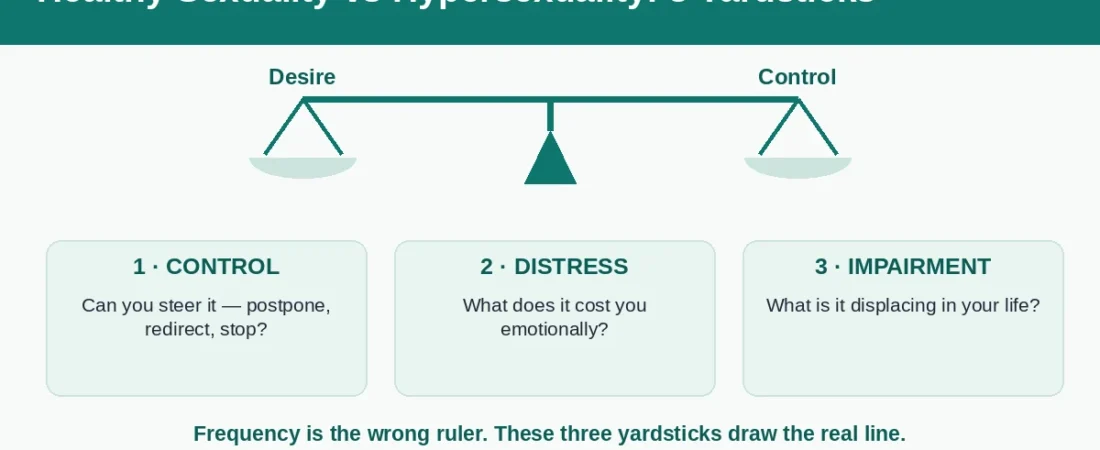
“How much sex is normal?” is the question almost everyone asks first — and it is the wrong question. One person can want sex daily, enjoy it fully, and be entirely healthy. Another can have sex once a month and be in genuine trouble. The difference between them is not on a frequency chart. When clinicians compare hypersexuality vs healthy sexuality, they never reach for a number. They reach for three yardsticks: control, distress and impairment.
That is good news, because yardsticks can be used. This article sets healthy sexuality and a compulsive pattern side by side against each of the three, then turns them into honest questions you can ask yourself. Used properly, they can replace a vague worry — “is something wrong with me?” — with specific observations. What they cannot do is diagnose anyone, and this article will not pretend otherwise.
Quick answer: Healthy sexuality is desire and behaviour that a person can direct, postpone and enjoy, that fits their own values, and that adds to their life without damaging it. Hypersexuality is the opposite configuration: urges that repeatedly override intentions, behaviour that continues despite distress, and real impairment in relationships, work, health or self-respect. The line between them is drawn by control, distress and impairment — never by frequency, partner count or taste.
Contents
Why frequency is the wrong ruler for healthy sexuality
Desire varies enormously between healthy people, and across one person’s lifetime, with age, health, hormones, stress and relationship stage. There is no healthy setting and no dangerous one. Nor does the content of someone’s sexuality settle the question: consensual kink, non-monogamy or a strong appetite for pornography can all sit comfortably inside healthy sexuality, while entirely conventional behaviour can be compulsive.
What changes a pattern from healthy to disordered is its function — what it does to the person’s control, their peace of mind and the rest of their life. That is the same logic the ICD-11 uses for compulsive sexual behavior disorder, and it is why our hub guide to hypersexuality defines the pattern by control and impact rather than appetite.
Yardstick 1: Control — can you steer it?
Healthy sexuality is steerable. Desire can be postponed for a busy week, declined without a fight, redirected when circumstances demand it. The person is, in a real sense, driving.
In a hypersexual pattern, the steering fails — repeatedly and despite sincere effort. Rules are set and broken. Apps are deleted and reinstalled. Promises made in the morning are renegotiated by night. The out of control sexual behavior (OCSB) model was built to describe precisely this gap between intention and behaviour, without assuming an addiction underneath it.
The reflection question is not “how strong is my desire?” but “when I decide to stop or postpone, does my behaviour obey — most of the time, over months, not just on a good week?”
Yardstick 2: Distress — what does it cost you emotionally?
Healthy sexuality leaves a person settled: pleasure, closeness, or simple contentment afterwards. A compulsive pattern leaves a residue — emptiness, frustration, shame or anxiety that returns with the next urge, in a loop many people describe as feeling trapped.
One caution matters enormously here. Distress about the behaviour’s effects — lost control, broken promises, a partner’s hurt — is clinically meaningful. Distress that comes entirely from moral or religious disapproval of behaviour that is otherwise controlled and harmless is a different experience, called moral incongruence. The ICD-11 explicitly says that kind of distress alone is not enough for a diagnosis.
It deserves support, but it is a values conflict, not a compulsion — and confusing the two harms people in both directions.
Yardstick 3: Impairment — what is it displacing?
Healthy sexuality fits around a life. A compulsive pattern starts eating the life: sleep thins, deadlines slip, money leaks into paid content or services, health checks are skipped, a partner feels displaced or deceived. Impairment is the most objective of the three yardsticks, because it can be observed rather than argued about — calendars, bank statements and a partner’s experience all record it.
Duration matters too. The ICD-11 describes the pattern as persistent over an extended period, typically six months or more. A bad month after a bereavement is human; the same displacement, sustained and surviving its own consequences, is a pattern.
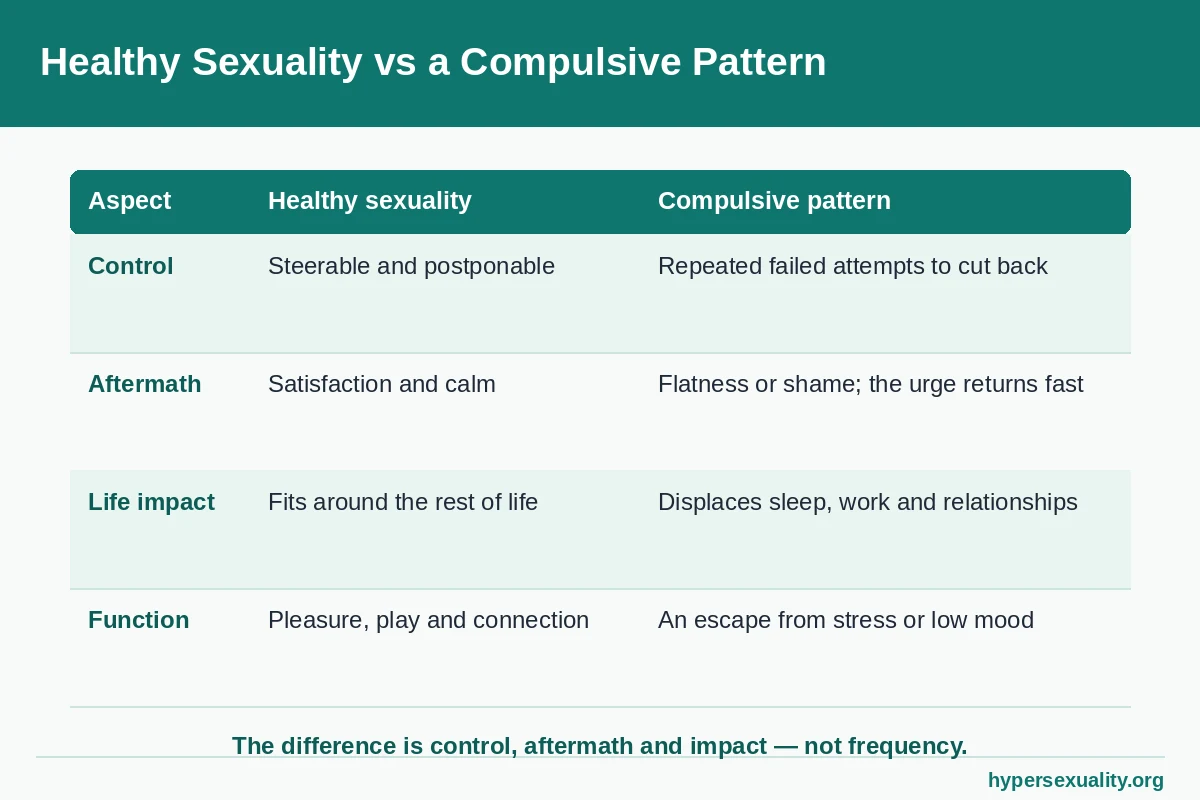
| Yardstick | Healthy sexuality | Hypersexual pattern |
|---|---|---|
| Control | Can start, stop and postpone by choice | Repeated failed attempts to cut back |
| Distress | Aftermath is satisfaction or calm | Aftermath is shame, emptiness or anxiety |
| Impairment | Life, work and relationships untouched | Sleep, work, money or relationships damaged |
| Fit with own values | Behaviour matches the person’s values | Behaviour repeatedly violates their own values |
| Pattern over time | Stable, chosen, flexible | Persistent, rigid, continues despite harm |
A concrete scenario
Alicia, 33, arrived at this question through a magazine quiz that scored her “at risk” — which frightened her, because her desire is strong and daily. Walking through the yardsticks told a different story. Control: during her bar exams she had set desire aside for two months without distress; it obeyed her. Distress: her only anguish was the quiz result itself and an upbringing that called female desire shameful — moral incongruence, not compulsion. Impairment: none; her work, friendships and relationship were thriving, and her partner’s only complaint was scheduling.
By every clinical yardstick, Alicia’s sexuality was healthy. What she needed was not treatment but an accurate map — and permission to stop measuring herself against a frequency chart.
Using the three yardsticks on yourself
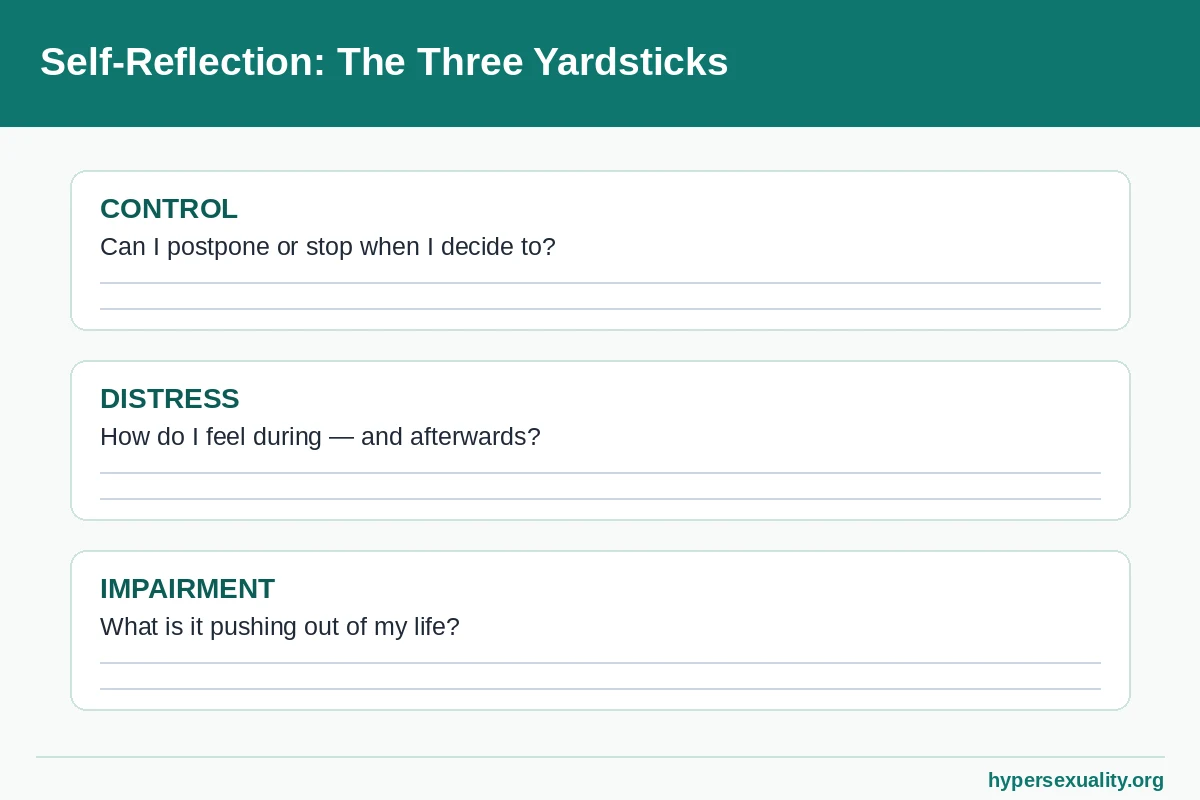
Take the yardsticks one at a time, and answer in specifics rather than impressions. On control: how many serious attempts to cut back have you made in six months, and what happened? On distress: is your pain about effects — lost control, real consequences — or about disapproval, your own or others’? On impairment: name what has actually been displaced or damaged.
Three honest answers give you a picture, not a verdict. If all three yardsticks look sound, the pattern is very likely healthy sexuality, however strong it is.
If control is failing and impairment is real, that combination is exactly what a professional assessment is for. And if your concern is where a pattern is heading, watch the mechanics next: escalation and tolerance in sexual behavior explains how “needing more” develops, and for people rebuilding after a compulsive pattern, what healthy sexuality looks like after porn addiction shows the destination this framework points toward.
Q&A
How much sex is too much?
There is no number. Clinicians do not diagnose any quantity of sex, masturbation or pornography use. What they assess is the pattern around it: whether you can control it, whether it distresses you, and whether it is impairing your relationships, work or health. Daily and controlled is healthy; infrequent and out of control is a problem.
Can healthy sexuality include kink or non-monogamy?
Yes. Unconventional but consensual sexuality sits comfortably within healthy sexuality when it is chosen, controllable, honest with partners and causes no impairment. The clinical yardsticks are control, distress and impairment — not conformity. A pattern is only a concern when it escapes the person’s control or damages their life, whatever form it takes.
If I feel guilty after sex, does that mean my sexuality is unhealthy?
Not necessarily. Guilt that comes entirely from moral or religious disapproval — while the behaviour itself is controlled, consensual and harmless — is moral incongruence, and the ICD-11 explicitly excludes it as a basis for diagnosis. Guilt about real effects, like broken promises or harm to a partner, is different information. Both deserve support; they are different problems.
Where exactly does healthy sexuality end and hypersexuality begin?
At the point where the three yardsticks start failing together: behaviour repeatedly overrides your own intentions, the aftermath becomes distress rather than satisfaction, and real parts of life — sleep, work, money, relationships — begin to be displaced or damaged, persistently over months. There is no line based on frequency or taste.
Can sexuality become healthy again after a compulsive pattern?
Yes — that is the goal of treatment, and it usually does not mean a life without desire. Recovery work aims to restore exactly what the yardsticks measure: control over behaviour, an aftermath of calm instead of shame, and a sex life that fits the person’s values and life rather than consuming it. Desire itself is not the enemy.
Sources: World Health Organization, ICD-11 entry 6C72 “Compulsive sexual behaviour disorder”; Kafka, M. P. (2010), “Hypersexual disorder: A proposed diagnosis for DSM-V,” Archives of Sexual Behavior, 39(2), 377–400.
Medical disclaimer: This article is educational information only and is not medical advice, diagnosis or treatment. Only a qualified clinician who knows your history can assess whether any diagnosis applies to you. If sexual behaviour is causing you distress or harm, consider speaking with your doctor or a licensed mental-health professional.