Ask ten websites “is hypersexuality a mental illness?” and you will collect ten different answers — “yes,” “no,” “it’s an addiction,” “it’s a myth” — often on pages that never explain which authority they are quoting. That confusion is not your fault. It exists because psychiatry itself keeps two official rulebooks, and they currently give different answers to the same question.
This article gives you the answer the way a psychiatrist would have to: system by system. Then it explains what actually matters for your life — what each answer changes about getting assessed, getting treated, and being believed.
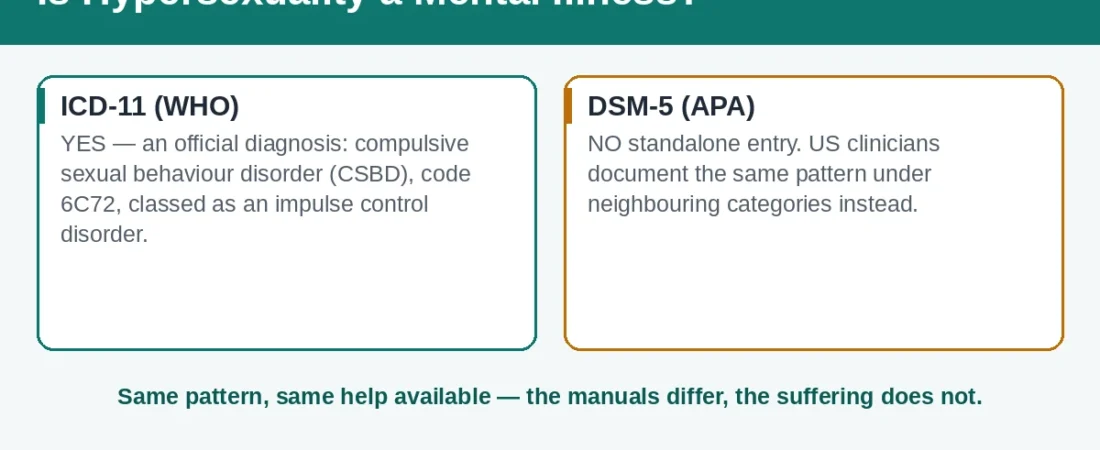
Quick answer: It depends which manual your clinician uses. In the WHO’s ICD-11, the pattern is an official diagnosis — compulsive sexual behaviour disorder (CSBD), classed as a mental and behavioural disorder — so in that system, yes. In the American DSM-5, there is no standalone entry for it, so formally, no. The behaviour, the distress and the treatment options are the same either way; what changes is the label, the paperwork and sometimes the payment.
Contents
The short answer, system by system
“Mental illness” is the everyday phrase; psychiatry’s own term is “mental disorder,” and a pattern only counts as one if it appears in an official classification with defined criteria. So the honest way to answer “is hypersexuality a mental illness?” is to open both classifications.
What the ICD-11 says
Is hypersexuality a mental illness in the ICD-11? In its diagnosable form, yes. The ICD-11, published by the World Health Organization and used for diagnosis and health records across most of the world, includes compulsive sexual behaviour disorder (code 6C72) among its mental, behavioural and neurodevelopmental disorders, grouped with the impulse control disorders.
Its criteria describe a persistent failure to control intense, repetitive sexual impulses or urges, lasting over an extended period (typically six months or more) and causing marked distress or real impairment — with distress based entirely on moral disapproval explicitly excluded.
In short: in the system most of the world’s health services use, the diagnosable form of this pattern is officially a mental disorder. Note the precision, though — the diagnosis is CSBD; “hypersexuality” is the older, broader descriptive word, not a separate listed illness.
What the DSM-5 says
Is hypersexuality a mental illness in the DSM-5? Formally, no. The DSM-5, published by the American Psychiatric Association and dominant in the United States, contains no diagnosis for this pattern. A formal proposal to add “hypersexual disorder” was considered during the DSM-5’s development and rejected — a story told in full in our article on hypersexuality and the DSM-5. US clinicians still assess and treat the pattern, but they document it under neighbouring categories, such as other specified sexual dysfunction or an impulse-control heading, or they diagnose the co-occurring condition driving it.
So the two systems are not contradicting each other about whether the suffering is real. They disagree about whether the evidence is strong enough to give the pattern its own official box — a genuine scientific argument, not a verdict on anyone’s experience.
Why psychiatrists argue about the label at all
Why can’t experts simply settle the question — is hypersexuality a mental illness? It helps to see what each side is protecting. Supporters of official recognition point to people who lose jobs, relationships and savings to a pattern they have sincerely tried to stop. For them, a diagnosis means the problem is named, researchable and treatable — not a character flaw.
Critics raise three serious concerns. First, false positives: desire varies enormously between people, and a loose diagnosis could pathologise a strong but healthy sex drive — especially where cultural or religious disapproval is doing the real work. (This is exactly why ICD-11 built in the moral-judgment exclusion.) Second, evidence: the research base is young compared with older diagnoses. Third, misuse: a label can be weaponised — in custody disputes, in moral campaigns, or as an excuse that erases responsibility for harm done to others.
Both sides agree on more than the headlines suggest: the pattern exists, it can cause serious harm, frequency alone proves nothing, and nobody should be diagnosed for simply wanting sex more than their neighbours do.
A pattern, a symptom, or a disorder? Three different situations
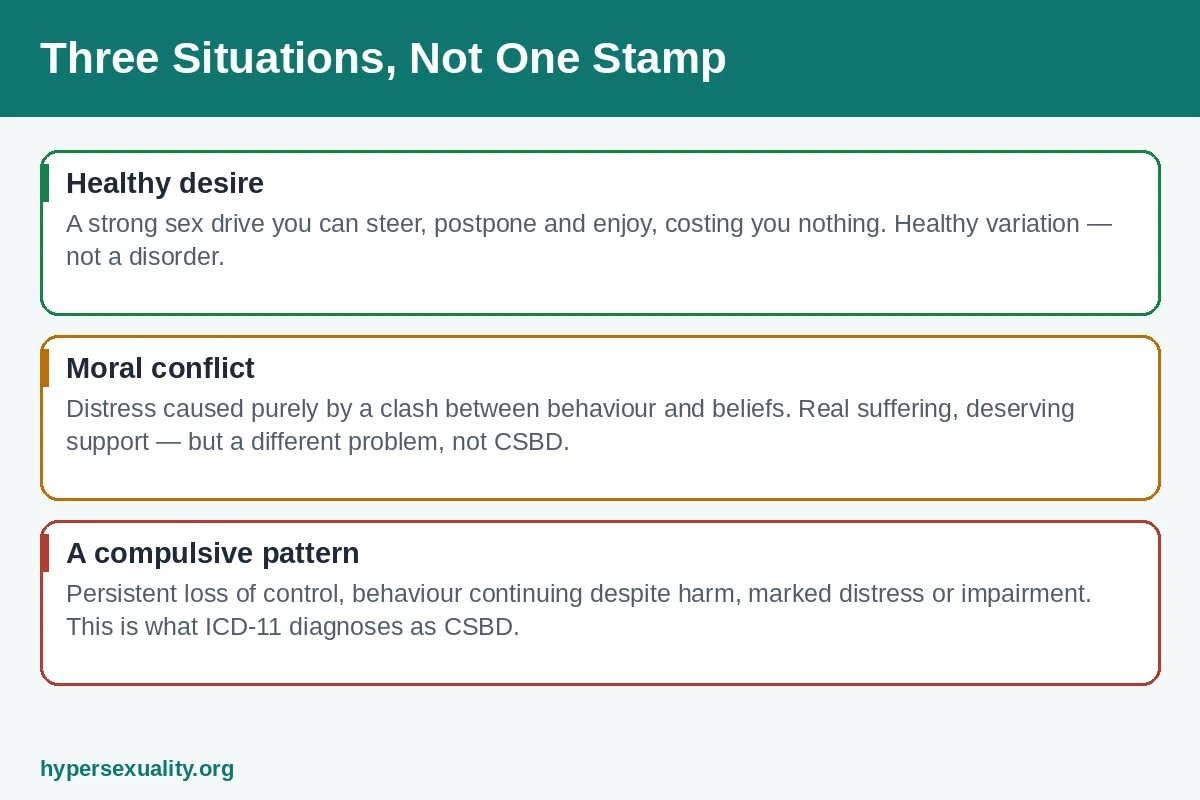
Part of the confusion is that “hypersexuality” gets used for three clinically different situations:
- A symptom of another condition. A surge in sexual urges and behaviour is a recognised feature of manic and hypomanic episodes in bipolar disorder, and it can also follow certain medications (notably dopamine agonists used for Parkinson’s disease), brain injury, or some neurological illnesses. Here the hypersexuality is real, but the primary diagnosis — and the treatment — belongs to the condition underneath.
- A standalone disorder. When the pattern is persistent, not explained by another condition or substance, and causes marked distress or impairment, ICD-11 calls it CSBD. This is the situation the question “is hypersexuality a mental illness?” is really about.
- Not a disorder at all. A high sex drive that a person can steer, enjoys, and that costs them nothing is healthy variation. So is distress that comes purely from moral conflict about behaviour that is otherwise controlled and harmless — painful, deserving of support, but a different problem (often called moral incongruence).
A good assessment exists precisely to sort out which of the three you are dealing with. If you are preparing for one, our walkthrough of how hypersexuality is assessed shows what the appointment actually involves, and the structured hypersexuality test screening page can help you organise your own picture first — as screening, never as a self-diagnosis.
What the answer changes in real life
Consider Nadia, a composite example. After months of broken promises to herself, she searches at 2 a.m. and lands on two pages: an American site saying the condition “isn’t a real diagnosis,” and a European clinic describing CSBD as an official disorder. She arrives at her doctor more confused than before: am I mentally ill or not?
Her doctor’s answer to “is hypersexuality a mental illness?” is the practical one. The label question matters less than what flows from it. In an ICD-11 country, a CSBD diagnosis can unlock a recorded treatment plan, referrals to specialists, and insurance or public coverage coded to that diagnosis. In the US, the same help usually still happens — therapy, treatment of co-occurring conditions — but the paperwork carries a neighbouring code, which can affect what insurers approve and how the problem is described in your record. Either way, no competent clinician treats the manual instead of the person.
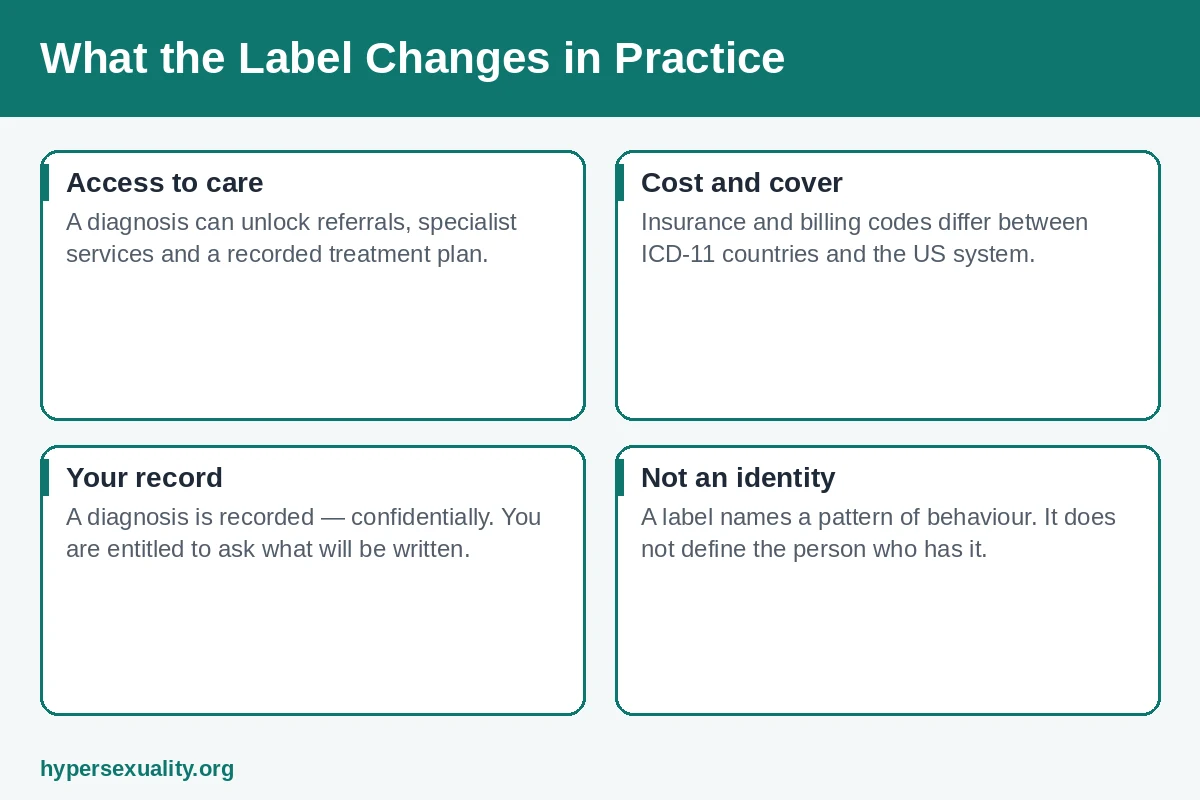
What a diagnosis should never do is define you. It names a pattern of behaviour, not a kind of person — which is also why many people prefer the plain descriptive language of our pillar guide to what hypersexuality actually is, whatever their local manual calls it. And if the pattern sits alongside another labelled condition, context matters too: the presentation in women, for instance, is still routinely missed or misread, as our article on hypersexuality in women explains.
Q&A
If hypersexuality is a mental illness, does a high sex drive make me mentally ill?
No. A strong sex drive that you can direct, postpone and enjoy — with no damage to your life — is healthy sexuality, in every diagnostic system. The ICD-11 diagnosis (CSBD) is about loss of control, persistence and harm: repeated failed attempts to cut back, behaviour continuing despite real consequences, and marked distress or impairment. Desire alone has never been a criterion. That is true whichever way your local manual answers “is hypersexuality a mental illness?”
Does a hypersexuality or CSBD diagnosis go on my medical record?
Usually, yes — any formal diagnosis a clinician makes is recorded, because records are how treatment is planned, communicated and, in many systems, paid for. What is written varies by country and system: an ICD code for CSBD in much of the world, or a neighbouring category in the US. Your record is confidential health information, and you are entitled to ask what a clinician intends to record before they record it.
Is hypersexuality classed as a disability?
Not automatically, anywhere. Disability status is a legal and functional question, decided case by case on how much a condition limits daily life and work — not on the diagnosis name alone. A CSBD diagnosis by itself does not grant disability status, and most people with the pattern work and function well in other areas of life. If impairment is severe, that is a conversation for your clinician and local advice services, not something a label settles.
Why do some experts argue it should NOT be called a mental illness?
For three main reasons: the evidence base is younger than for most diagnoses; the risk of false positives — labelling healthy high desire, or purely moral distress, as illness — is real; and labels can be misused, from stigma to legal arguments. Recognition supporters reply that the ICD-11 criteria were written narrowly to guard against exactly those risks. The debate is about where the line sits, not about whether people suffer.
Does being diagnosed change what treatment I can actually get?
It can. A named diagnosis makes treatment easier to organise and, in many health systems, easier to fund: structured therapy for the pattern itself, plus treatment of anything travelling with it — bipolar disorder, ADHD, depression, trauma — which often does much of the work. Without a local diagnosis code, US clinicians typically still treat the same problems under adjacent labels. Either way, the help exists; the diagnosis mainly changes the route, not the destination.
Sources: World Health Organization, ICD-11 entry 6C72 “Compulsive sexual behaviour disorder”; Kraus, S. W. et al. (2018), “Compulsive sexual behaviour disorder in the WHO ICD-11,” World Psychiatry, 17(1); Bőthe, B. et al. (2023), “Compulsive sexual behavior disorder in 42 countries,” Journal of Behavioral Addictions, 12(2), 393–407.
Medical disclaimer: This article is educational information only and is not medical advice, diagnosis or treatment. Only a qualified clinician who knows your history can assess whether any diagnosis applies to you. If sexual behaviour is causing you distress or harm, consider speaking with your doctor or a licensed mental-health professional.