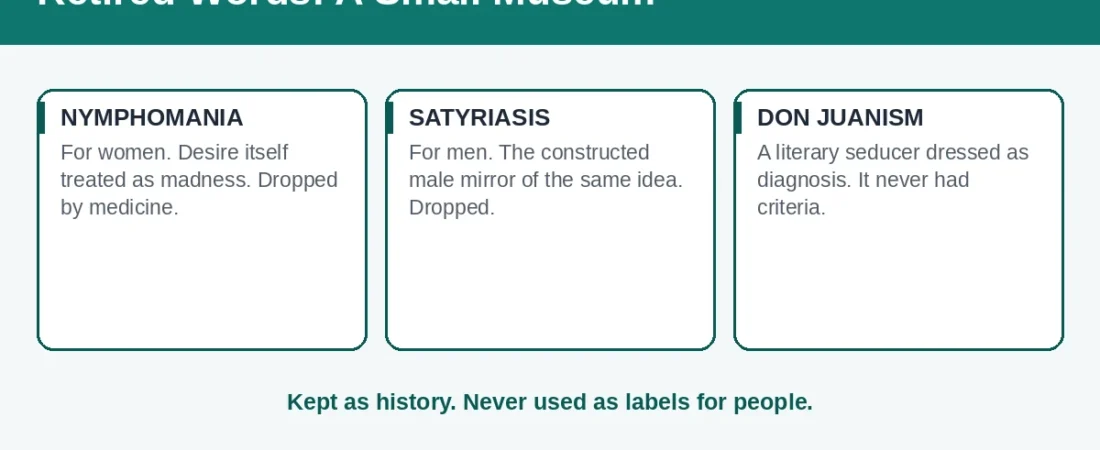
Search for information about out-of-control sexual behaviour and the old words still surface — in book titles, forum posts, and clinics that should know better. Nymphomania. Satyriasis. Don Juanism. They sound clinical, almost elegant. They are none of that. Each is a relic from an era when medicine mixed moral judgment into diagnosis, and each was abandoned for reasons worth understanding.
This is a history of those outdated terms for hypersexuality: where they came from, whose behaviour they policed, why modern medicine dropped them, and what to say instead. One ground rule: these words belong in quotation marks, as history, never as labels for people.
Quick answer: Nymphomania (for women), satyriasis (for men) and Don Juanism (for men) were pre-scientific labels for strong or uncontrolled sexual desire. Medicine dropped them because they were imprecise (they measured quantity, not loss of control), morally loaded, and applied with a glaring gender double standard. The modern, neutral vocabulary is hypersexuality as a description and compulsive sexual behaviour disorder (CSBD) as the ICD-11 diagnosis.
Contents
Nymphomania: the word that pathologised women
Of all the outdated terms for hypersexuality, this one did the most damage. The word was assembled from Greek roots — nymphē, a bride or young woman, and mania, madness — entering medicine in the late eighteenth century, when a 1771 treatise presented it as a disease of women — an “uterine fury” in which female desire itself was the pathology.
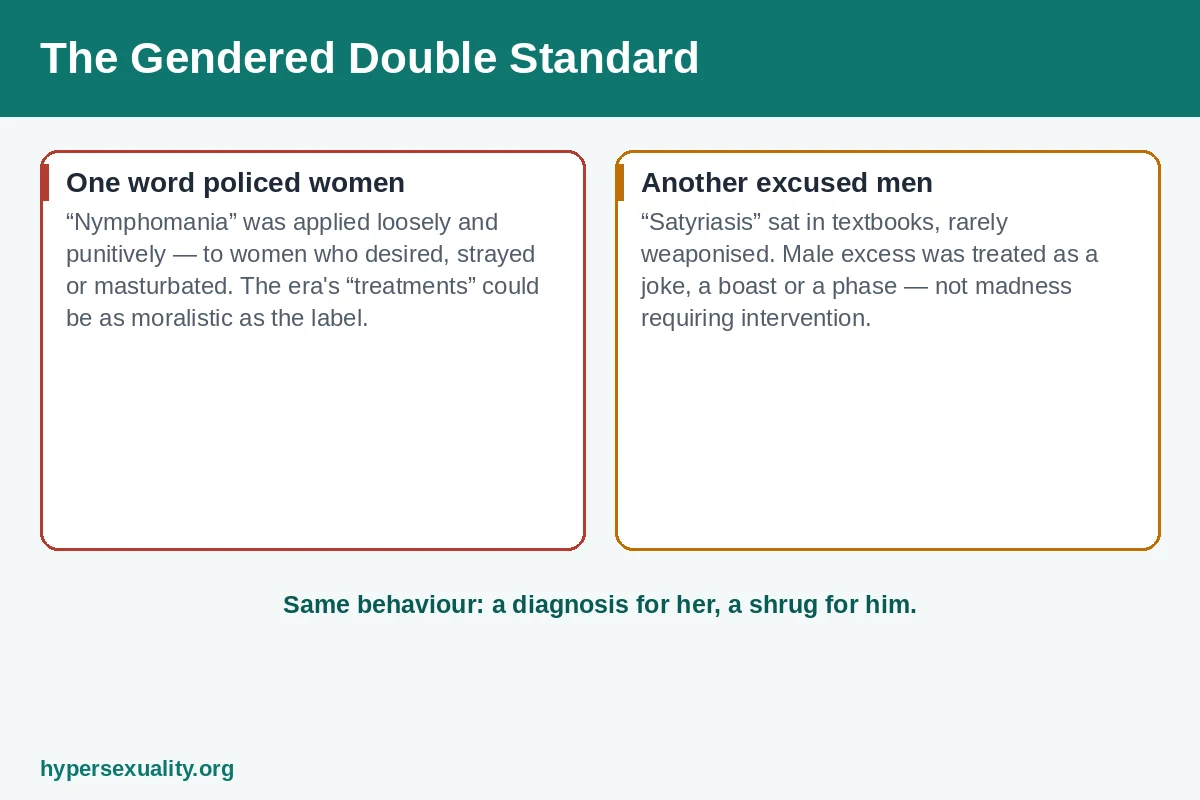
Notice what the concept measured. Not loss of control. Not distress or harm. Simply a woman wanting sex more than her culture permitted. In the nineteenth and early twentieth centuries the label was applied loosely and punitively — to women who masturbated, had affairs, or simply expressed desire their doctors disapproved of. “Treatments” in some eras were as moralistic as the diagnosis — enforced rest, cold baths and, in documented cases, surgery. The word did not describe a disorder so much as it enforced a rule: female desire beyond a narrow allowance was madness.
It faded from manuals across the twentieth century as psychiatry separated desire from disease, and as its double standard became indefensible. It survives in popular culture and search boxes, which is why it still needs explaining, not using.
Satyriasis: the male mirror that never cut as deep
Satyriasis — named for the satyrs of Greek myth, famous for insatiable lust — was the constructed male equivalent: a supposed disease of excessive male desire. It appeared in the same era, with the same defect: counting appetite rather than assessing control, consequences or suffering.
But the two words were never truly mirrors. Where the female version carried heavy stigma and could trigger institutional consequences, the male version mostly collected dust — mentioned in textbooks, rarely weaponised. Male excess was more often treated as a joke, a boast or a phase than as madness requiring intervention. That asymmetry is the history in miniature: the same behaviour, in a woman, was a diagnosis; in a man, a punchline or a shrug. Modern criteria reject that asymmetry: ICD-11’s are identical for everyone.
Don Juanism: literature dressed as diagnosis
Don Juanism took its name from Don Juan, the legendary seducer of Spanish literature, endlessly pursuing conquest without satisfaction. In twentieth-century psychoanalytic writing, the term described a pattern in men of compulsive seduction — conquest after conquest, each one hollow — interpreted as a defence against deeper anxieties.
It was never a rigorous diagnosis: no agreed criteria, no field trials, no code. Its kernel of observation — that some people’s sexual behaviour is driven, repetitive and joyless rather than desiring — was real, and survives inside the modern concept. The packaging did not survive, because a literary allusion cannot do the work of a diagnosis: it cannot say where healthy behaviour ends, what to measure, or what to treat. It remains one of the outdated terms for hypersexuality that survives mainly in books about literature.
Why medicine dropped these outdated terms for hypersexuality
Three failures run through all the outdated terms for hypersexuality, and together they explain why none of them appears in the ICD-11 or the DSM-5:
- They measured the wrong thing. Quantity of desire — how much, how often, with how many — instead of the modern questions: Can the person control it? Does it continue despite harm? Does it cause distress or impairment? A diagnosis of appetite is a judgment; a diagnosis of lost control is a clinical finding.
- They were moral judgments in lab coats. Each term encoded its culture’s rules about whose desire was acceptable. The ICD-11 went so far as to write the correction into the modern criteria: distress based entirely on moral disapproval cannot make the diagnosis.
- They were imprecise and gendered. One word for women, another for men, none with testable criteria. Modern terms are deliberately sex-neutral and criteria-based — which is also why our guide to what hypersexuality actually is uses the same language for everyone.
A footnote: erotomania changed meaning rather than dying — once excessive sexual love, today a delusional belief that someone is in love with you.
The bridge to modern words: addiction language and hypersexual disorder
After the outdated terms for hypersexuality faded, the next attempt at vocabulary came from addiction medicine: “sexual addiction,” popularised in the 1980s, and later the proposed diagnosis “hypersexual disorder,” considered and rejected for the DSM-5 — the story told in our article on hypersexuality and the DSM-5. Neither became an official diagnosis. What finally stuck, in the WHO’s ICD-11, was compulsive sexual behaviour disorder — chosen because it describes observable behaviour and its consequences without asserting a cause. Researchers also study the brain’s reward system in this pattern — the subject of our explainer on dopamine and hypersexuality.
What to say instead
If the outdated terms for hypersexuality are retired, what replaces them in real conversation?
| Situation | Words that work | Why |
|---|---|---|
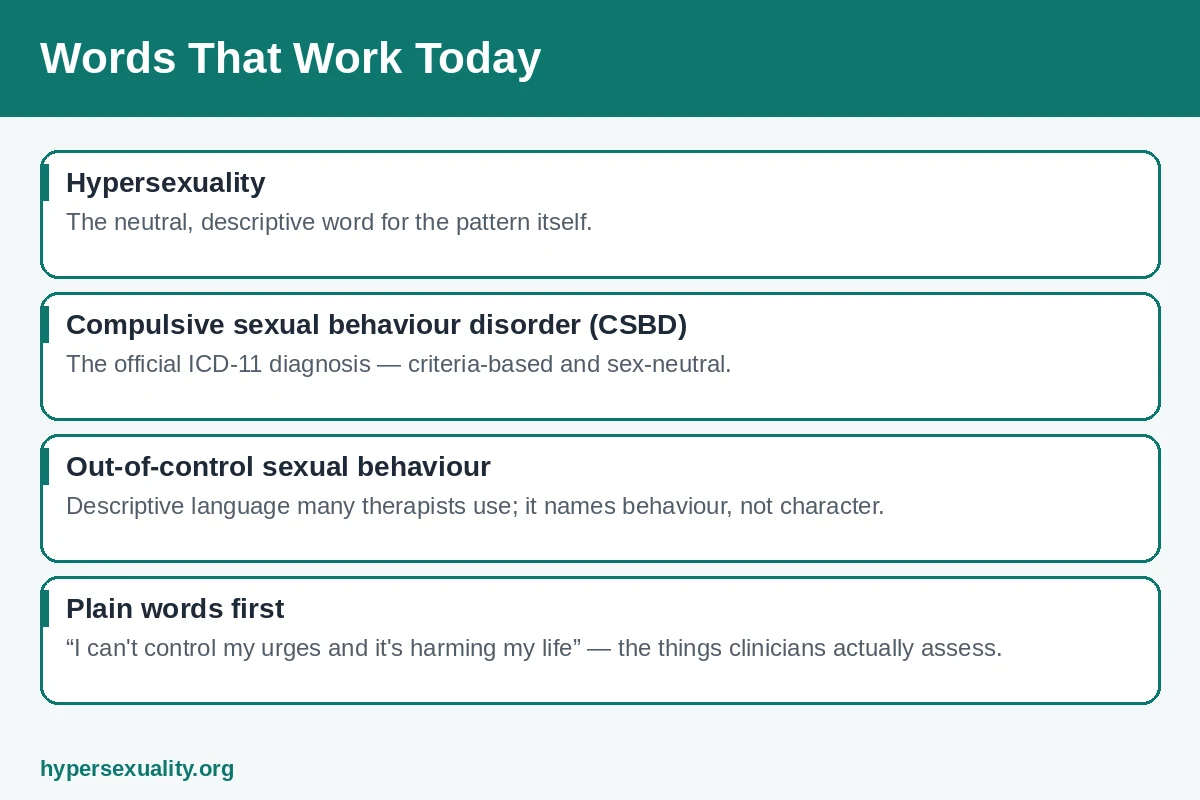
| Talking to a clinician | “I can’t control my sexual urges and it’s harming my life” — plain description first; hypersexuality or compulsive sexual behaviour as terms | Describes control and consequences, the things clinicians actually assess |
| The formal diagnosis (ICD-11) | Compulsive sexual behaviour disorder (CSBD) | The official, criteria-based, sex-neutral term |
| Describing the pattern generally | Hypersexuality; out-of-control sexual behaviour | Descriptive, not identity labels |
| Reading older sources | Treat old terms as historical artefacts — translate them mentally into the modern pattern | Keeps the information, drops the stigma |
Consider Omar, a composite example. Searching his own behaviour one night, he found a forum thread labelling men like him with “Don Juanism” and a scanned textbook page on “satyriasis” that read like a caricature. He closed the tabs feeling branded, not helped.
Months later, a therapist used different words: a compulsive pattern, loss of control, treatable drivers. Same facts — but the modern vocabulary let him discuss behaviour he could change instead of an identity he was stuck with. That difference — behaviour versus brand — is the entire point of retiring the old words. If you are at that starting point, the structured hypersexuality test screening page can help you describe your own pattern in modern terms — as screening, before a professional conversation.
Q&A
What does nymphomania mean, and why don’t doctors say it any more?
It was a historical diagnosis applied to women, built from Greek words for a young bride and madness, and it treated strong female desire as disease. Doctors abandoned it because it measured how much a woman desired — against her culture’s allowance — rather than loss of control or harm, and because it was used punitively and stigmatisingly. Modern medicine uses the same neutral criteria for everyone — no female-specific diagnosis exists.
What was satyriasis?
The intended male counterpart of nymphomania, named after the satyrs of Greek myth: a supposed disorder of excessive male sexual desire. It shared the same scientific defects — counting appetite instead of assessing control, consequences and distress — but was applied far less harshly — part of the era’s double standard. Like its female counterpart, it has no place in modern diagnostic manuals.
If a website or clinic still uses these old words, is that a red flag?
Usually, yes — with context. A historical article, a quotation, or a page explaining the terms is fine. But a modern clinic marketing diagnosis or treatment under “nymphomania” is using vocabulary medicine retired decades ago, often because the word still attracts searches. Judge such sources by whether they use current criteria — control, persistence, consequences — or whether they are selling labels. The same caution applies to sites that diagnose you from a checklist alone. That is the pattern with outdated terms for hypersexuality generally: they survive as marketing long after they die as medicine.
What should I actually say to my doctor instead of these terms?
Describe the pattern in plain words: what the behaviour is, that you have tried to control it and could not, and what it is costing you. “My sexual behaviour feels out of control and it’s affecting my work and relationship” gives a clinician everything the old labels pretended to say, without the stigma. If you want the technical vocabulary, the terms are hypersexuality for the pattern and compulsive sexual behaviour disorder (CSBD) for the ICD-11 diagnosis.
Are these old words ever acceptable to use today?
In historical discussion, scholarship, quotation, or when someone knowingly uses one about themselves — context decides. What is not acceptable is applying them to other people as if they were diagnoses or insults: they carry a built-in sneer about character, especially about women’s desire, that modern clinical language was designed to remove. When in doubt, describe behaviour and impact; those words never go out of date.
Sources: World Health Organization, ICD-11 entry 6C72 “Compulsive sexual behaviour disorder”; Kaplan, M. S. & Krueger, R. B. (2010), “Diagnosis, assessment, and treatment of hypersexuality,” Journal of Sex Research, 47(2–3), 181–198; Briken, P. et al. (2024), “Assessment and treatment of compulsive sexual behavior disorder: a sexual medicine perspective,” Sexual Medicine Reviews, 12(3), 355–370.
Medical disclaimer: This article is educational information only and is not medical advice, diagnosis or treatment. Only a qualified clinician who knows your history can assess whether any diagnosis applies to you. If sexual behaviour is causing you distress or harm, consider speaking with your doctor or a licensed mental-health professional.