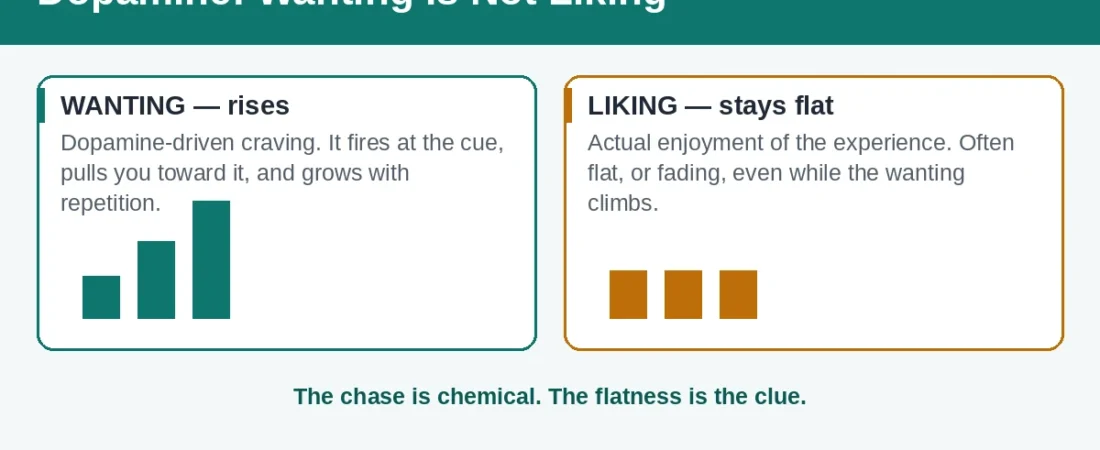
Almost every explanation of this pattern online begins and ends with one sentence: dopamine is the pleasure chemical, and too much of it makes people chase sex. It is a tidy story — and it gets the most important part backwards. Dopamine is much less about pleasure than about wanting.
Understanding that single distinction explains facts about this pattern that the tidy story cannot: why urges can feel overwhelming while the behaviour itself has stopped being enjoyable, why a phone notification can restart a craving out of nowhere, and why “just enjoy it less” is not what is happening at all.
This article explains dopamine and hypersexuality the way researchers actually describe it — in plain language, and with the hype removed.
Quick answer: Dopamine is the brain’s wanting-and-learning chemical, not its pleasure chemical. In dopamine and hypersexuality research, brain-imaging studies show that sexual cues trigger heightened reward-system responses in people with the compulsive pattern — craving that tracks how much they want, not how much they like. That is why urges can be intense while satisfaction stays flat, and why cues (an app, a place, a time of night) can fire the craving before any conscious decision is made.
Contents
Dopamine and hypersexuality: start with wanting vs liking
Neuroscientists separate two things everyday language merges: wanting a reward and liking it. Liking is the enjoyment while it happens. Wanting is the pull beforehand — the anticipation, craving and motivation to go and get it. Different brain systems carry the two, and dopamine belongs overwhelmingly to the wanting side.
This split, developed in the work of researchers Kent Berridge and Terry Robinson, is the key that unlocks the lived experience of hypersexuality. People frequently report that the chase has taken over their lives while the behaviour itself feels mechanical, flat or even unpleasant. That is not a contradiction. It is wanting running at full volume while liking stays where it always was — or fades.
Once you see the split, a common self-accusation dissolves. “If I keep doing it, I must secretly love it” is usually wrong. A person can intensely want something they no longer particularly like, because the wanting system and the liking system are not the same system.
How a cue becomes a craving
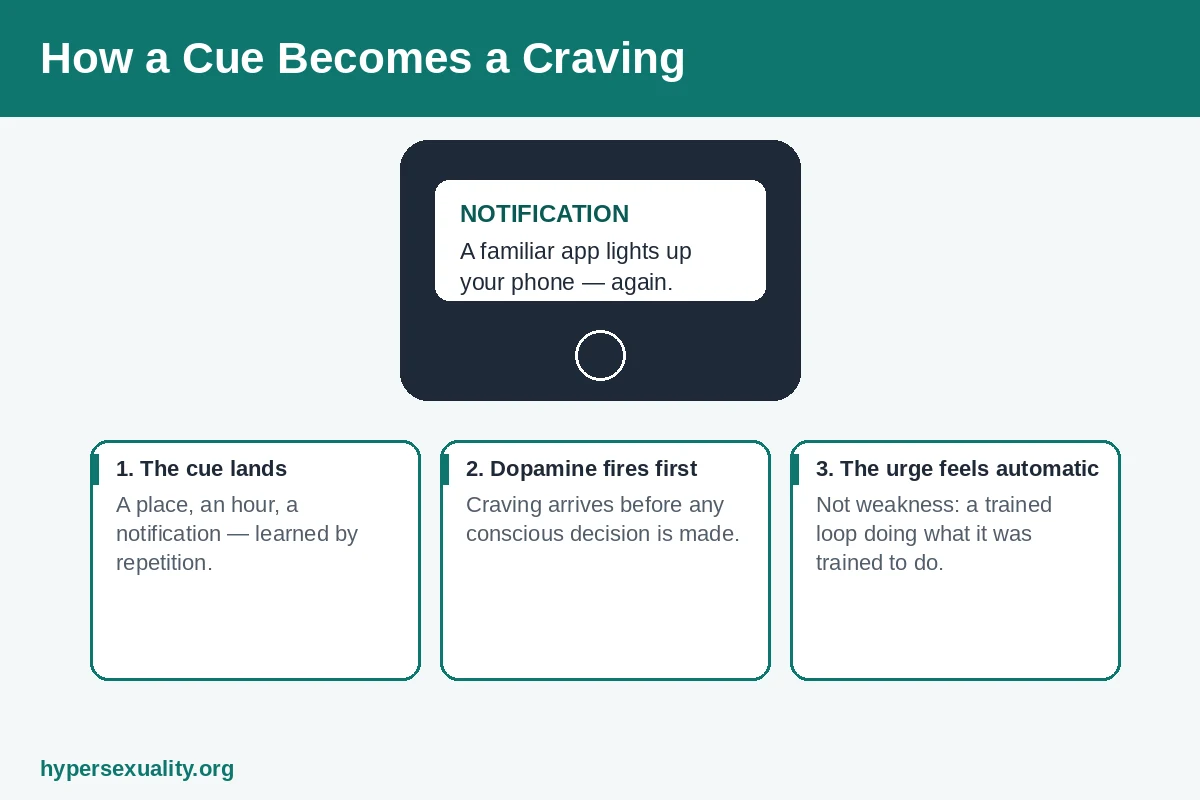
Dopamine’s second job is teaching. When something rewarding happens, dopamine helps the brain record what came just before it — the place, the time, the device, the emotional state — so that next time, the cue alone can trigger wanting in advance. Psychologists call this cue-triggered craving, and it is one of the best-documented features of the pattern.
In a widely cited brain-imaging study (Voon and colleagues, 2014), people with compulsive sexual behaviour watched sexual videos while their brains were scanned. Their reward regions — including the ventral striatum — reacted more strongly to the sexual cues than the same regions in control participants. And critically, the strength of that reaction tracked the participants’ reported wanting, not their liking. The cues had learned to shout.
This is why willpower conversations so often miss the point. By the time a person is consciously “deciding”, the cue has already fired the wanting system. The decision that matters happened earlier — in which cues the day contains, and what has been repeatedly paired with them. That timing — cue first, decision second — is the practical heart of dopamine and hypersexuality.
Tolerance: why the chase keeps escalating
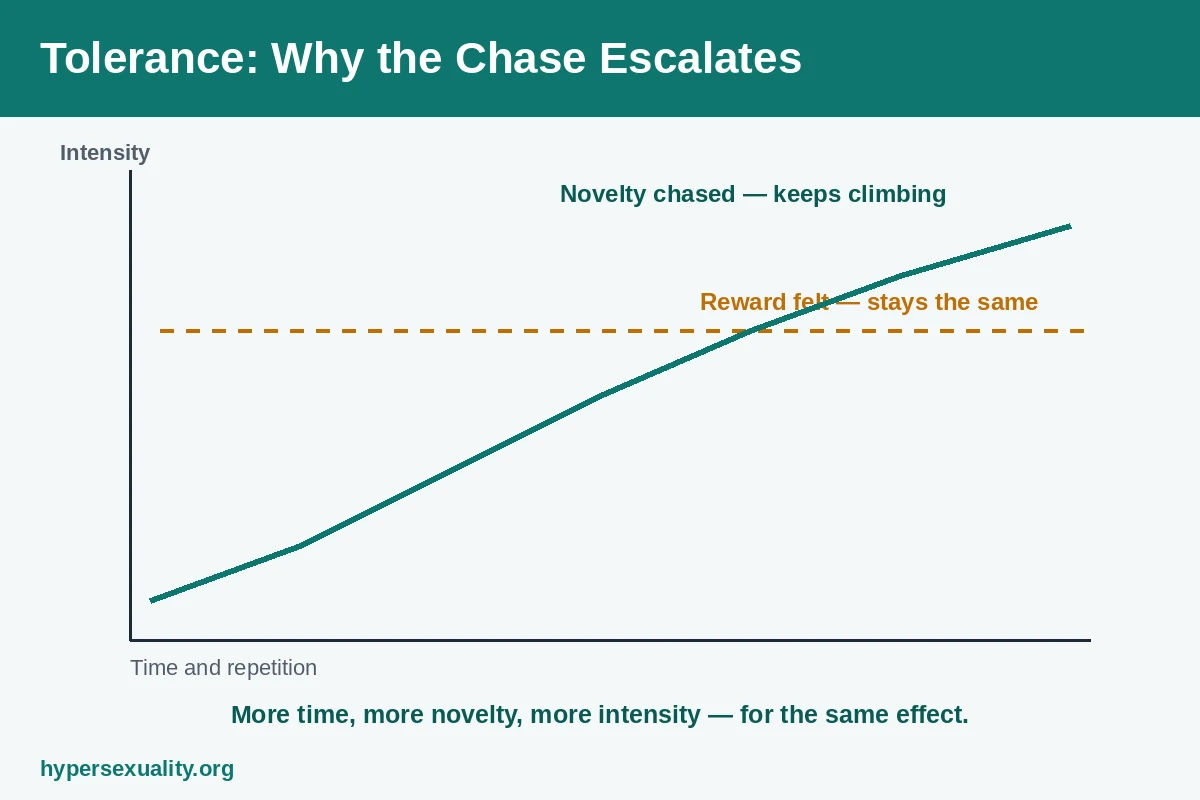
Dopamine and hypersexuality also meet in a third idea: tolerance. When a reward is repeated at high intensity, the brain adapts — the same stimulus produces a smaller response, and more novelty, more time or more intensity is needed to reach the same effect. In sexual behaviour, novelty is the cheapest dial to turn, which is one reason escalation so often takes the form of endless new material rather than more of the same.
Notice what tolerance does to the wanting/liking split. As liking dulls, wanting does not necessarily dull with it — in addiction research, wanting can stay high or even grow as liking falls. The result is a person chasing harder for less, and describing the experience accurately when they say: “I don’t even enjoy it. I just can’t seem to not want it.”
Two honest cautions belong here. First, most tolerance evidence in this field is indirect — inferred from behaviour and a small number of imaging studies, not measured dose-by-dose as it can be with drugs. Second, tolerance is not destiny: cue pairings weaken when they stop being reinforced, which is part of why environment design features so heavily in treatment.
What dopamine does not explain
A dopamine-only story is still a partial story. It does not explain why one person develops this pattern and another, with the same internet connection, does not. It says little about the braking systems that normally keep wanting in proportion — serotonin and the prefrontal cortex, covered in our companion pieces on the brain’s reward pathways and sexual compulsion and the neurotransmitters involved in compulsive sexual behavior. And it says nothing about what the behaviour is for in a person’s life — the stress, loneliness or shame it may be regulating.
There is also a medical exception that proves the rule. Certain Parkinson’s medications that stimulate dopamine receptors can switch this pattern on in people with no history of it — the clearest evidence that dopamine genuinely matters here. Our guide to dopamine-agonist-induced hypersexuality in Parkinson’s covers that story; the short version is that if a pattern starts after a medication change, the prescriber needs to know.
A pattern you might recognise
Consider Lena, a composite example. She describes her evenings as “autopilot”: a particular app icon, the flat to herself, a specific tired-and-restless feeling — and the wanting arrives before she has thought anything at all. What puzzles her most is that the sessions themselves feel empty. “If it was about pleasure, I’d understand it,” she says. “It isn’t. It’s about the ten minutes before.”
In the language of dopamine and hypersexuality: her cues are trained, her wanting is loud, and her liking has left the room. Naming those three parts separately is often the first moment the pattern stops feeling like a character flaw and starts looking like a mechanism — and mechanisms can be worked with.
Where this leaves the bigger picture
Dopamine is one system inside a whole person. The clinical definition of the pattern — what hypersexuality actually is in ICD-11 terms — turns on control, persistence and harm, not on any chemical. Brain chemistry explains how urges gain their force; it does not decide whether a pattern is a disorder, and it never removes the person’s role in changing it. For readers who arrived with an older vocabulary for all this, our page on outdated terms for hypersexuality explains which labels medicine retired, and why.
Q&A
Does dopamine make you want sex, or enjoy it?
Mainly, it makes you want it. Dopamine drives anticipation, motivation and craving — the pull toward a reward. Enjoyment itself (“liking”) depends more on other systems, including opioid and endocannabinoid signalling. This is why, in compulsive patterns, wanting can keep escalating while enjoyment stays flat or fades.
Can a blood test measure my dopamine and diagnose hypersexuality?
No. There is no blood, saliva or urine test that diagnoses this pattern, and peripheral dopamine levels do not reflect what is happening in specific brain circuits. Diagnosis is clinical: a professional assesses control, persistence, distress and impairment, and rules out other causes such as mood episodes or medication effects.
What is a “dopamine detox”, and does it fix compulsive sexual behaviour?
The phrase is popular online but misleading: you cannot detox a neurotransmitter your brain needs every minute, and no study shows a weekend of abstinence “resetting” dopamine receptors. Taking a break from specific cues and behaviours can still help — because cue pairings weaken when unreinforced — but that is ordinary learning, not a chemical cleanse, and durable change usually needs more than a break. For dopamine and hypersexuality, the durable lever is retraining cues, not cleansing chemicals.
Why do urges spike the moment I open a certain app or walk into a certain place?
Because your brain has learned the pairing. Dopamine helps record which cues predict a reward, and afterwards the cue itself can trigger craving before any conscious decision. This cue-triggered wanting is one of the most replicated findings in addiction science, and brain scans show the same heightened cue response in people with compulsive sexual behaviour.
If dopamine is involved, was I simply born with a chemical defect?
No. Dopamine signalling varies between people, and genes play some role in vulnerability, but the pattern is learned and situational as much as chemical: cues, habits, stress, access and co-occurring conditions all shape it. “Dopamine is involved” is true of every motivated behaviour, from eating to ambition. It is not a life sentence and not the whole explanation.
Sources: World Health Organization, ICD-11 entry 6C72 “Compulsive sexual behaviour disorder”; Voon, V. et al. (2014), “Neural correlates of sexual cue reactivity in individuals with and without compulsive sexual behaviours,” PLoS ONE, 9(7), e102419; Berridge, K. C. & Robinson, T. E. (2016), “Liking, wanting, and the incentive-sensitization theory of addiction,” American Psychologist, 71(8), 670–679.
Medical disclaimer: This article is educational information only and is not medical advice, diagnosis or treatment. Only a qualified clinician who knows your history can assess whether any diagnosis applies to you. If sexual behaviour is causing you distress or harm, consider speaking with your doctor or a licensed mental-health professional.