Search this topic and you will meet two kinds of article. One kind is so cautious it says almost nothing. The other announces that pornography “erodes” your prefrontal cortex and promises your receptors will recover in a fortnight. Neither serves a reader who is frightened about their own behaviour and wants to know what is actually known.
Brain reward pathways and sexual compulsion is a real research field with real findings — but they are more specific, and more interesting, than the slogans. This article separates the two: what brain studies of sexual compulsion have solidly shown, what they suggest, and what is simply hype wearing a lab coat.
Quick answer: The best-supported finding is cue-reactivity: in brain-imaging studies, people with compulsive sexual behaviour show stronger responses in reward regions — especially the ventral striatum — when viewing sexual cues, and that response tracks craving (“wanting”) rather than enjoyment. Evidence for the control side is real but softer: differences in how prefrontal “braking” regions engage during inhibition tasks. Claims of physical brain damage or “erosion” go well beyond what any study has shown.
Contents
Brain reward pathways and sexual compulsion: the circuit in one minute
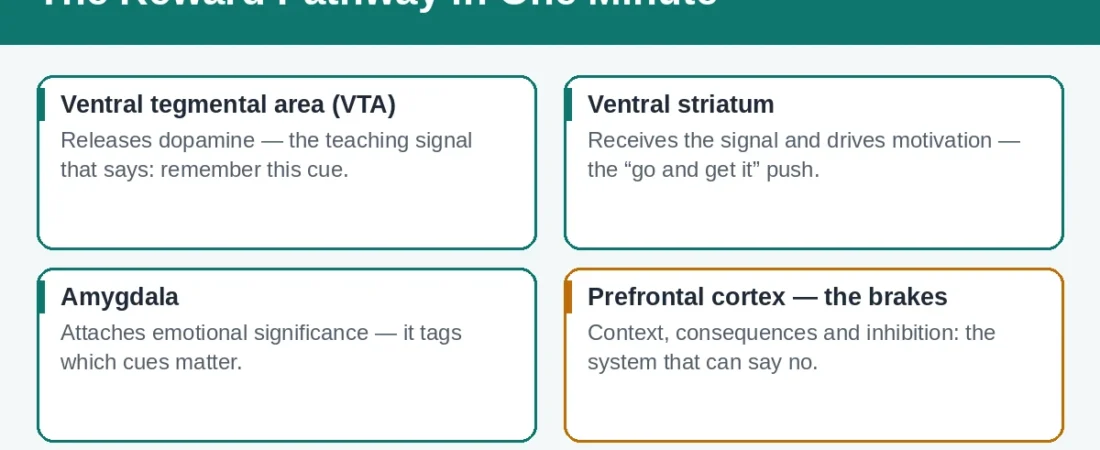
The reward pathway is a loop, not a single “pleasure centre”. Three parts matter for this topic. The ventral tegmental area releases dopamine as a teaching signal. The ventral striatum (including the nucleus accumbens) receives it and drives motivation — the “go and get it” signal. The amygdala attaches emotional significance, tagging which cues matter. Wrapped around all of it, the prefrontal cortex supplies context, consequences and inhibition — the brakes.
In everyday life this loop is doing its job: it makes rewarding things feel worth pursuing and teaches you where to find them again. Sexual reward is one of its oldest inputs. Nothing about the loop is broken in principle — which is precisely why the research question is not “is the pathway damaged?” but “how is it tuned, and how is the balance between accelerator and brakes set?” Our primer on dopamine and hypersexuality covers the accelerator’s chemical in depth; this article is about the whole circuit.
What the studies actually found
The core evidence comes from a handful of functional MRI (fMRI) studies, mostly from one Cambridge research group, comparing small groups of men with compulsive sexual behaviour against matched controls while they watched sexual and non-sexual videos.
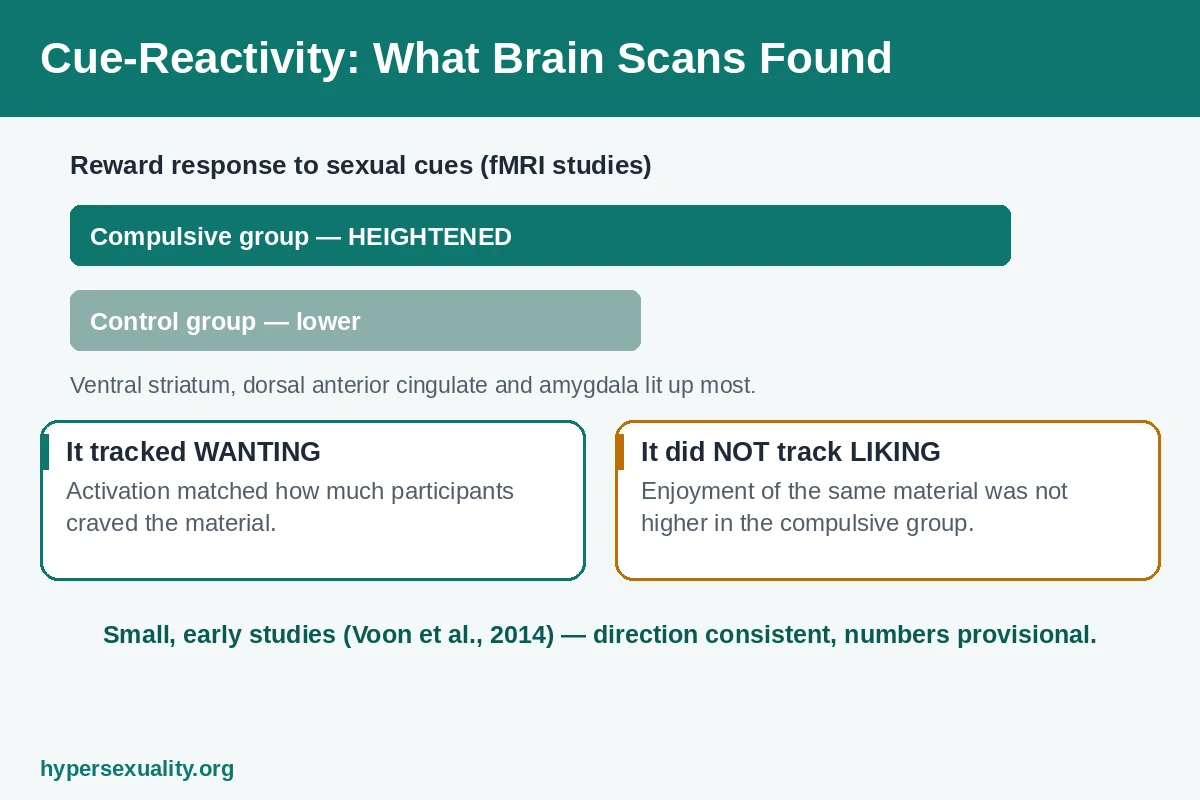
The headline result (Voon et al., 2014) is cue-reactivity: the compulsive group showed heightened activation in the ventral striatum, dorsal anterior cingulate and amygdala in response to explicit cues. Two details make this finding stronger than a vague “their brains lit up”. First, the activation correlated with the participants’ subjective wanting of the material, but not with their liking of it — the same wanting/liking split seen in substance addiction research. Second, related studies from the same programme found that the compulsive group showed a stronger preference for sexual novelty, and altered responses when outcomes were anticipated versus received.
Read those findings at their correct size and they are genuinely informative: they show a reward system that has learned to react intensely to sexual cues and to pull toward them, decoupled from enjoyment. That maps remarkably well onto what people with the pattern report. This is the solid core of what is known about brain reward pathways and sexual compulsion.
The brakes: what is known, and what “erosion” gets wrong
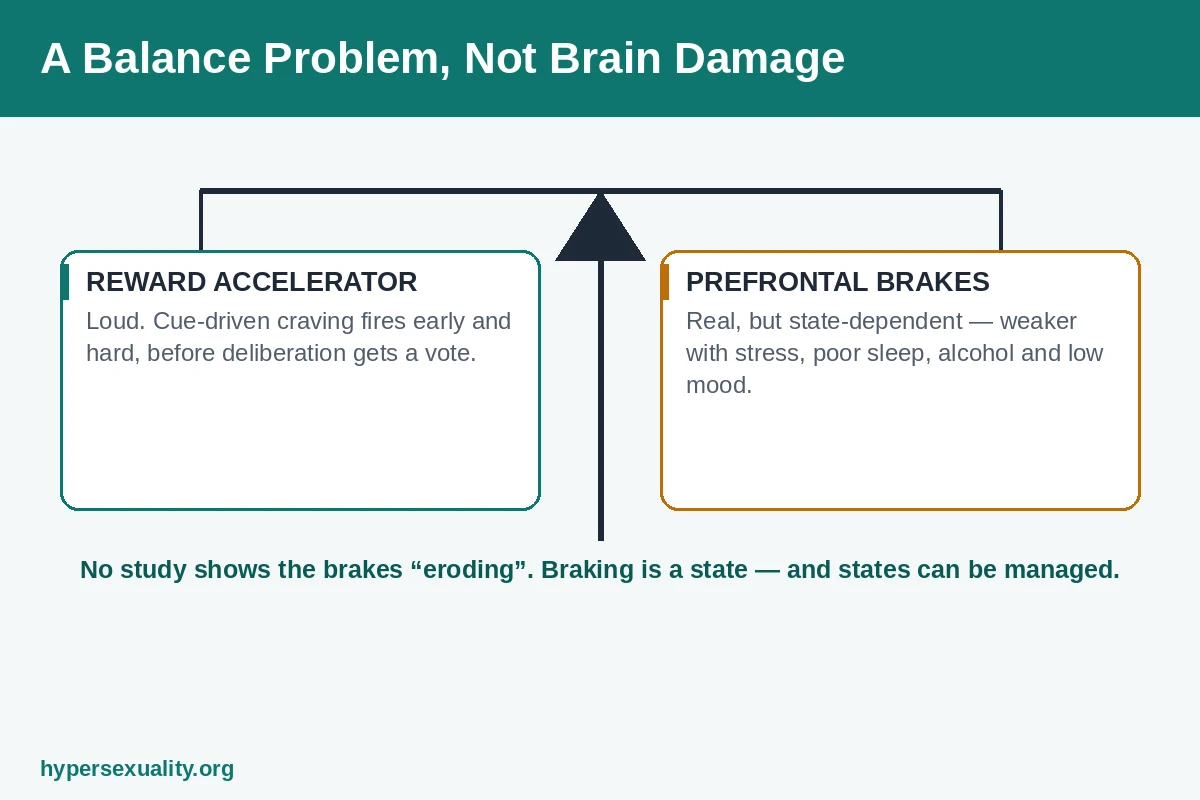
Now for the control side — because brain reward pathways and sexual compulsion is really a story about balance. Some studies report that, during tasks requiring inhibition, people with compulsive sexual behaviour engage prefrontal and anterior cingulate regions differently from controls, and connectivity studies describe altered communication between reward and control networks. A person mid-urge is not imagining that “knowing better” feels weaker than usual; cue-driven accelerator signals genuinely compete with braking signals, and in this pattern the accelerator appears to start louder.
But here is where popular writing leaves the evidence behind. No study has shown the prefrontal cortex physically eroding, shrinking from use, or being damaged by sexual behaviour in otherwise healthy adults. “Erosion” is a metaphor doing the work of a finding. The honest version is functional and hopeful: braking is a state, influenced by stress, sleep, alcohol, mood and cue exposure — which is why the same person can feel in control on Tuesday and overwhelmed on Friday, and why treatment works on states and situations, not just on insight.
It also matters that most of these studies are small — often around 19 to 25 participants per group, almost all men, scanned once. That does not make them worthless; it makes them early. Effect directions have been consistent, but anyone quoting exact percentages, timelines for “receptor recovery”, or guarantees about your brain is selling something the papers do not contain. The chemistry running through both pedals — dopamine, serotonin, norepinephrine — is its own topic, covered in our guide to the neurotransmitters involved in compulsive sexual behavior.
A table the hype pages never print
Here is the brain reward pathways evidence, claim by claim.
| Claim you will read online | What the evidence supports |
|---|---|
| “Porn rewires your brain permanently” | Cue pairings are learned and can weaken when unreinforced; “permanent” is not in the literature |
| “Your prefrontal cortex is eroding” | Functional differences in inhibition tasks; no evidence of physical damage in healthy adults |
| “Dopamine receptors recover in 7–14 days” | No study measures a recovery timeline for this pattern; timelines are invented |
| “Scans prove sex addiction is identical to cocaine addiction” | Overlapping cue-reactivity patterns; the WHO still classifies the pattern as an impulse-control disorder, not an addiction — see the brain reward system and sexual addiction debate |
| “Craving is stronger in people with this pattern” | Supported: cue-reactivity tracks wanting in controlled imaging studies |
What this means if the pattern is yours
Consider Felix, a composite example. He read a viral post telling him his prefrontal cortex was eroding and felt something close to despair: if the hardware was damaged, effort seemed pointless. A clinician walked him through the actual findings instead — a cue-reactive accelerator, state-dependent brakes, no damage — and the treatment plan that followed was practical rather than hopeless: fewer trained cues in his evenings, sleep treated as braking fuel, urge-management skills for the moments when the accelerator fires anyway.
Months later his description had changed from “my brain is broken” to “my accelerator is loud and I manage it”. The second sentence is not just kinder. It is the accurate one.
The brain reward pathways model also explains why purely informational approaches fail. Felix already knew everything in the viral post. Knowledge lives in the prefrontal system; cues fire the accelerator before knowledge gets a vote. Change has to be built at the level of cues, routines and states — which is why effective help looks behavioural, and why the definition of the problem (hypersexuality itself) is written in terms of control and consequences, not brain pictures.
Q&A
What does a brain scan of someone with sexual compulsion actually show?
In research settings, group-average differences: stronger reward-region responses (ventral striatum, amygdala, dorsal anterior cingulate) to sexual cues, tracking craving rather than enjoyment. These are statistical patterns across small groups, not a diagnostic image — no scan can look at one person’s brain and diagnose this pattern.
Is the prefrontal cortex really damaged by compulsive sexual behaviour?
There is no evidence of physical damage or “erosion” in otherwise healthy adults. Studies find functional differences — how strongly control regions engage during inhibition, and how networks communicate — which vary with state: stress, fatigue and cue exposure all weaken braking temporarily. Functional and changeable is a very different claim from damaged.
Can the brain’s reward pathways recover once the behaviour stops?
The learning that built cue-reactivity can weaken: cue pairings fade when they stop being reinforced, and people in recovery consistently report urges losing force over time. What nobody can honestly give you is a timetable. Claims that receptors reset in a fixed number of days are marketing, not findings from any published study of this pattern.
Why does willpower feel weakest exactly when the urge is strongest?
Because the two systems compete in real time. A cue fires the reward accelerator and generates craving; braking depends on prefrontal systems that are slower, effortful and easily degraded by stress, tiredness, alcohol or low mood — exactly the states in which urges tend to arrive. It is a fair fight structurally rigged against the brakes, which is why changing cues and states beats relying on in-the-moment resistance.
Are brain studies of sexual compulsion done on large groups?
No — and this is the caveat hype pages omit. The key imaging studies typically involve around 20 participants per group, mostly men, in a few research centres. Their findings point consistently in one direction, but they are early-stage evidence. Research on brain reward pathways and sexual compulsion is promising, but young. Treat any article that reports them as settled, precise or universal with suspicion.
Sources: World Health Organization, ICD-11 entry 6C72 “Compulsive sexual behaviour disorder”; Voon, V. et al. (2014), “Neural correlates of sexual cue reactivity in individuals with and without compulsive sexual behaviours,” PLoS ONE, 9(7), e102419; Kraus, S. W., Voon, V. & Potenza, M. N. (2016), “Should compulsive sexual behavior be considered an addiction?” Addiction, 111(12), 2097–2106.
Medical disclaimer: This article is educational information only and is not medical advice, diagnosis or treatment. Only a qualified clinician who knows your history can assess whether any diagnosis applies to you. If sexual behaviour is causing you distress or harm, consider speaking with your doctor or a licensed mental-health professional.