Every online quiz ends at the same cliff edge. You have a score, or a band, or a sentence saying you “may” have something — and then the page offers you a booking button or nothing at all. The minutes after a hypersexuality self test are oddly important: people tend to do one of two unhelpful things with a result, panic about it or bin it, and both waste the one genuinely useful thing a screening can give you, which is a well-aimed next step.
This page is that next step. It answers, practically, what to do after a hypersexuality self test: how to read what your result can and cannot mean, how to spend two weeks gathering information that is actually worth having, what to take to a first professional conversation, and the low-cost routes into one.
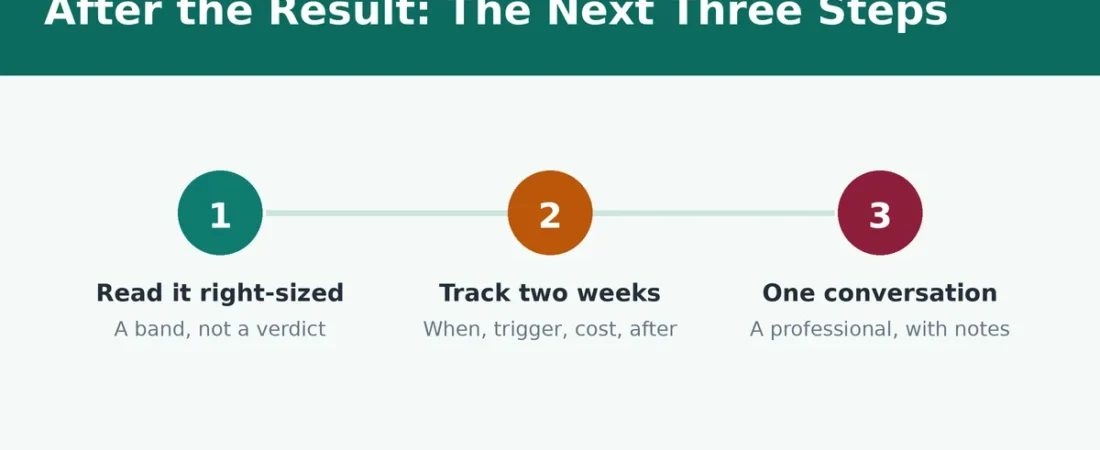
Quick answer: After a hypersexuality self test, do three things. First, read the result as a screening signal, not a verdict — it says a professional conversation is worthwhile, nothing more. Second, track your actual pattern for two weeks: when, what triggered it, how long, what it cost. Third, take the result and the tracker to one professional appointment — your GP is a legitimate first door. That sequence turns an anxious evening with a quiz into the start of an answer.
Contents
Step one: read your result at the right size
A screening result is a sorting device. It separates “worth a closer look” from “probably not the issue” — it does not, and cannot, say which condition you have or whether you have one at all. The reasoning behind that limit is worth understanding properly, and our next page sets it out: why online sex addiction tests are not a diagnosis. For now, hold the result at its correct size with three calibrations: That first calm reading is the foundation of everything else you will do after a hypersexuality self test.
- A high result is not a label. It means your answers resemble the pattern screenings are built to catch. Several different situations can produce that resemblance — including some that are not this pattern at all, such as intense moral conflict about ordinary behaviour.
- A low result is not an all-clear. If you answered hopefully rather than honestly — most people shade at least a little — or if your pattern runs through a channel the questions didn’t ask about, a low result proves very little. Your own unease outranks a score.
- Either way, the distress is real data. You took a hypersexuality self test at some hour, for some reason. Whatever the number said, the fact that you went looking is information a professional would want.
If you have not taken a structured screening yet, the cluster’s pillar page — our hypersexuality test — is the place to start; this page assumes you already have a result in hand.
Step two: two weeks of tracking beats two more quizzes
The strongest temptation after a result is to take another test, then another, hoping for a different answer. Resist it — and keep the hypersexuality self test result itself, dated and saved, because the tracker is about to become its context. Retesting measures your mood about the result, not your pattern. What actually moves you forward is fourteen days of plain records — the same evidence a clinician will ask about and you will otherwise have to reconstruct from impressions.
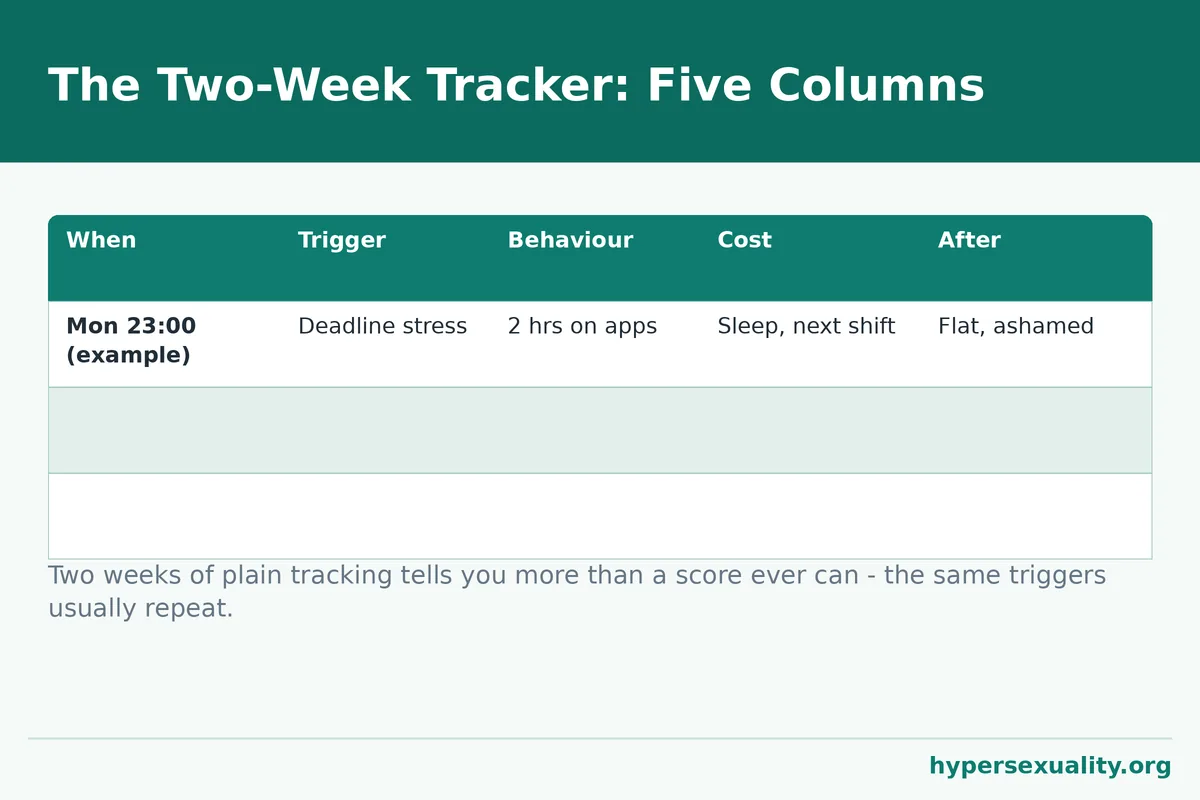
Keep it to five columns, on paper or in a notes app, filled in once a day in under two minutes:
| Column | What to record | Why it matters |
|---|---|---|
| When | Day, time, how long the episode or urge lasted | Shows the pattern’s shape — late nights, work hours, weekends |
| Trigger | What happened just before: stress, boredom, conflict, alcohol, a notification | Identifies the links in the chain, which is where change happens |
| Behaviour | What you actually did, factually | Replaces a global label with a specific, workable list |
| Cost | Sleep lost, money spent, work or intimacy displaced, secrecy required | This is the column that separates a habit from a problem |
| After | Mood afterwards, and how long it lasted | Shows whether the behaviour is delivering relief or charging interest |
Two weeks is enough. You are not building a court case; you are giving a professional — and yourself — a fortnight of fact instead of a year of fog. If your pattern runs through online channels, the questions on our internet sex screening test page will help you notice which functions to watch while you track.
Step three: prepare for one professional conversation
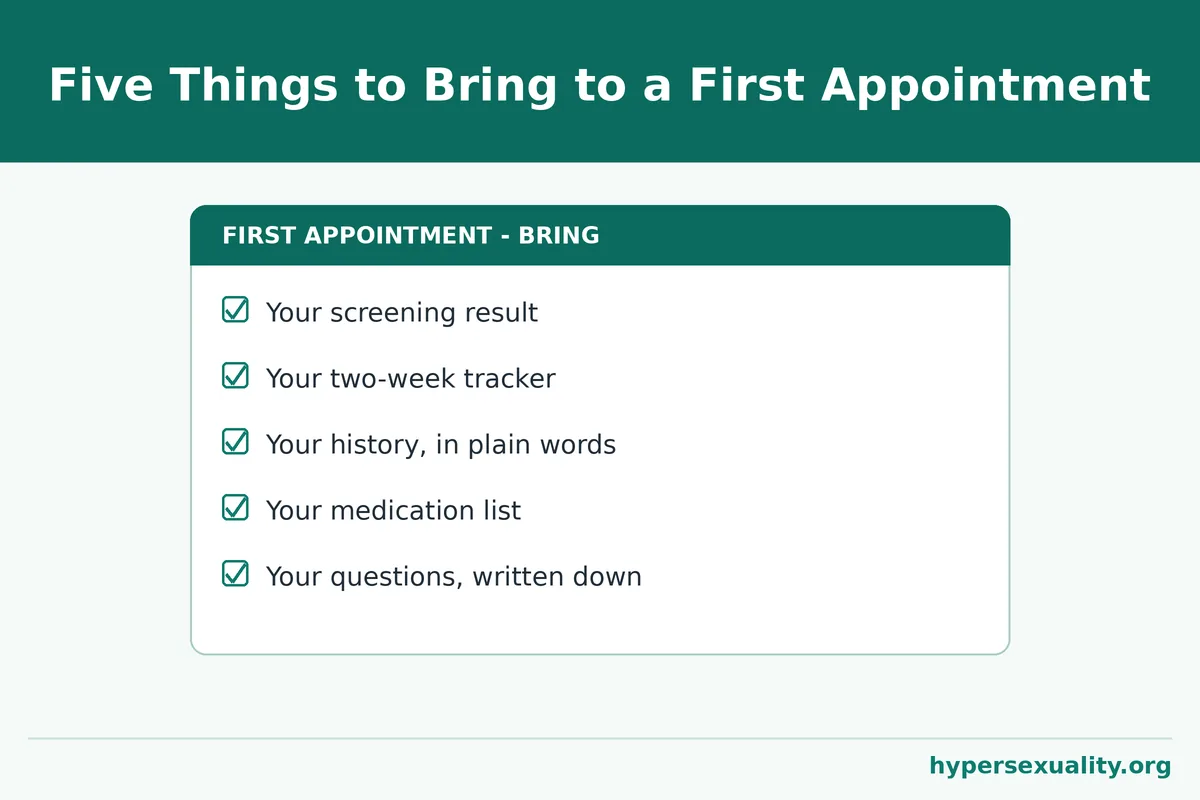
A first appointment goes better with a small amount of preparation — not a dossier, just the things clinicians consistently say they wish patients brought:
- The screening result itself, with the date and which test it was. Screenings are designed to be shown to professionals; that hand-off is their entire purpose.
- Your two-week tracker, or whatever of it you managed. A partial tracker beats a polished story.
- A one-paragraph history in your own words: when you first noticed the pattern, how it has changed, what you have already tried, and what “better” would look like for you.
- Your medication and health list, including anything recently started or changed. This is not a formality — some presentations are medication- or condition-driven, and a good assessment checks.
- Your questions, written down. The ones people forget to ask are usually the important ones: What do you think this pattern is? What would you want to rule out? What would treatment actually involve, and what does it cost?
And a permission note, because many people need one: you are allowed to find the first professional unhelpful and try another. Fit matters in this field more than most. Whatever your result, that first appointment is the most useful part of what to do after a hypersexuality self test.
Low-cost first options
Cost stops more people than stigma does — and none of these routes asks for more than the hypersexuality self test result you already hold and a few honest notes. Routes that are free or cheap in most systems, in rough order of effort:
- Your GP or primary-care doctor. A legitimate first door, not a consolation prize: they can assess, rule out medical contributors, and refer onward. You do not need the word “addiction” ready — describing the pattern from your tracker is enough.
- Sexual health clinics, which in many regions are free, walk-in and practised at non-judgemental first conversations about sexual behaviour.
- University counselling services for students — free, confidential, and more familiar with this presentation than students assume.
- Peer support fellowships (SAA, SLAA and similar), which cost nothing and provide the one thing a quiz cannot: other people in the room who recognise the pattern from inside.
- Reputable structured online programmes and workbooks, used as a bridge to — not a replacement for — professional input when a pattern is established.
For the background picture of what any of this is treating, our hub guide to hypersexuality sets out the clinical definition these routes all work from. None of these routes asks for anything more than deciding what to do after a hypersexuality self test — which is what brought you here. Whatever your budget, what to do after a hypersexuality self test includes options that cost nothing or almost nothing.
If your score was low but you’re still worried
Take the worry seriously anyway — a hypersexuality self test is a snapshot, while your unease is a longer record. Two common situations produce low scores in people who were right to come looking: shame-driven under-answering (the tracker fortnight usually corrects it), and moral incongruence — intense guilt about behaviour that is mo
dest and controlled, which is a real problem needing support, but a different one. A professional can tell these apart in a single conversation. “The test said I’m fine but I don’t feel fine” is a complete and sufficient reason to book one. Whatever the number said, deciding what to do after a hypersexuality self test is where a result becomes useful — one conversation with a professional settles what the quiz cannot. And when you are ready, the steps above are exactly what to do after a hypersexuality self test — tracker, preparation, one conversation.
What it looked like for Greta
Consider Greta, a composite example: 41, who took three different online quizzes in one evening, got three differently-worded versions of “possibly”, and arrived at this page more frightened than informed.
Instead of a fourth quiz, she reframed the hypersexuality self test result as a question — and tracked for two weeks to answer it. The tracker surprised her: the behaviour she thought of as “constant” clustered tightly — Sunday evenings, after phone calls with her mother, and after a second glass of wine.
Her appointment, when it came, lasted forty minutes and most of it was her own data. She later said the turning point was not the score at all: “The quizzes told me I might have a problem. The tracker showed me the problem’s timetable — and a timetable can be changed.” Her path is a good answer to what to do after a hypersexuality self test: track, prepare, and take the facts to one professional.
Q&A
My result says I “may” have hypersexuality. Should I tell my partner?
Eventually honesty usually serves a relationship better than a discovery does — but there is no rule that a screening result must be announced tonight. A common workable order is: trac That sequence is what to do after a hypersexuality self test before any announcement: track, talk to a professional, then decide together.king first, one professional conversation, then a planned disclosure with support if a real pattern is confirmed. What to avoid is the middle state of indefinite concealment, which is its own harm.
Can I just retest in a month to see if it improves?
You can, but it will tell you little. Scores move with mood, recent behaviour and how hopefully you answer. If you want to know whether things are improving, the tracker is the instrument: compare this month’s “cost” column with last month’s. Fewer lost hours and less secrecy are improvement, whatever a quiz says. That is what to do after a hypersexuality self test when the number won’t settle.
What if I can’t afford therapy at all?
Start where it is free: your GP, a sexual health clinic, a campus service if you are a student, and peer fellowships, which cost nothing. Bring the same preparation — result, tracker, history. That is the practical version of what to do after a hypersexuality self test when money is tight: start free, prepare well, and take one good conversation seriously. A single good assessment conversation, even without ongoing therapy booked, usually produces a plan you can begin on your own.
I scored low. Why do I still feel something is wrong?
Because scores are blunt. You may have under-answered, your pattern may run through a channel the questions missed, or the problem may be guilt and values conflict rather than loss of control — which still deserves support. A low result closes no doors. If the unease persists, one professional conversation is the way to settle it properly.
What should I do in the two weeks before an appointment?
Track, as above — and resist two urges: the binge (“one last run before I have to stop”) and the white-knuckle purge (deleting everything and promising a new life by Friday). Both distort the very pattern you are trying to show a professional. Ordinary honesty, recorded daily, is the preparation that helps most.
Sources: World Health Organization, ICD-11 entry 6C72 “Compulsive sexual behaviour disorder” ; Kraus, S. W. et al. (2018), “Compulsive sexual behaviour disorder in the WHO ICD-11,” World Psychiatry, 17(1), 109–110
Medical disclaimer: This article is educational information only and is not medical advice, diagnosis or treatment. Only a qualified clinician who knows your history can assess whether any diagnosis applies to you. If sexual behaviour is causing you distress or harm, consider speaking with your doctor or a licensed mental-health professional.