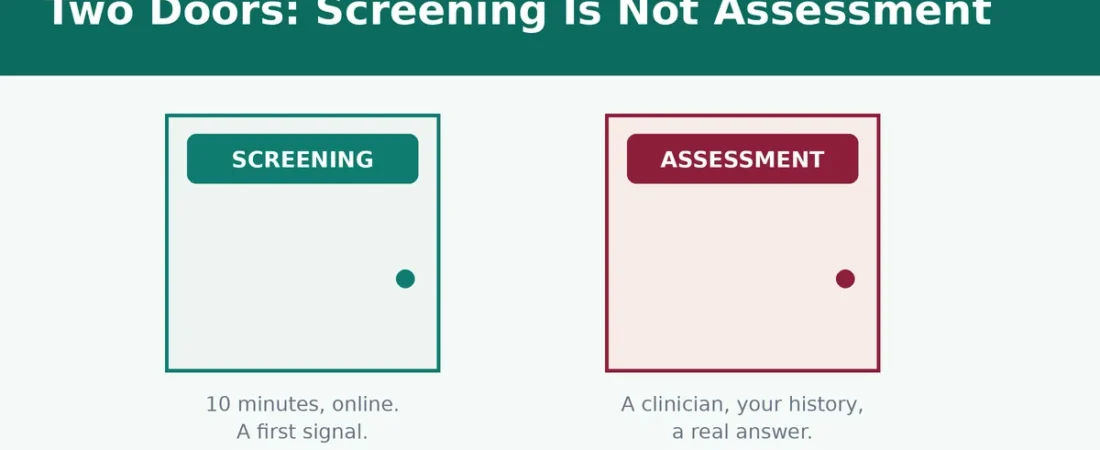
Type a worried question into a search engine at 2 a.m. and the internet will offer you a test. Fifteen questions later it will offer you something that feels like a verdict — and that feeling is precisely the problem. Online sex addiction tests are screening tools: useful, legitimate, and strictly limited. What they cannot do is diagnose you, and the gap between those two things is not fine print — it is where people get frightened unnecessarily, reassured wrongly, or sold treatment for a problem they do not have.
This page explains the limits honestly — what screening is for, what diagnosis involves, the false alarms and false all-clears, and how to use a test well anyway. If you have arrived here asking why online sex addiction tests are not a diagnosis, the short version is that screening and diagnosis are different jobs with different tools.
Quick answer: Online sex addiction tests screen; they cannot diagnose. Screening sorts people into “worth a closer look” and “probably not”, using fixed questions and a threshold. Diagnosis is a clinical judgement built on history, duration, context and the systematic ruling-out of other explanations — mania, medication, moral conflict, a high drive — which no questionnaire can see. A test result is a reason to have a conversation, never a substitute for one.
Contents
Screening and diagnosis are different jobs
The confusion starts with vocabulary, because quiz pages borrow clinical language without clinical meaning. The two processes differ in almost every respect:
| Question | Screening (an online test) | Diagnosis (a clinical assessment) |
| What is it for? | Sorting: flag who merits a closer look | Deciding what, if anything, this pattern is |
| Who or what does it? | A fixed questionnaire, self-scored | A clinician, in conversation, over time |
| What does it examine? | Your answers, in the moment you give them | History, duration, context, health, medication, other conditions |
| Can it rule things out? | No — it cannot even ask about most alternatives | Yes — excluding other explanations is half the work |
| What does it produce? | A score or band, instantly | A formulation: a judgement that can change with evidence |
Neither job is lesser. Screening is genuinely valuable — it is how most people find the door. But a door is not a destination, and a website that blurs the two is selling something: usually, its own therapy. That is why online sex addiction tests are not a diagnosis: a fixed questionnaire cannot do either of those jobs, and no threshold turns it into a clinician.
What a questionnaire cannot see — and why online sex addiction tests are not a diagnosis
A test is a fixed list of questions asked of one person, once. A diagnosis of compulsive sexual behaviour under ICD-11 is a pattern judgement with built-in conditions — and the conditions are exactly the parts a questionnaire is blind to.
Duration and persistence.
The clinical pattern must hold over an extended period — ICD-11 describes at least six months — and represent settled behaviour, not a bad season. A test taken in a bad week cannot tell a season from a pattern.
The exclusion questions.
Before CSBD is diagnosed, other explanations must be considered and set aside: another mental-health condition driving the behaviour, a substance, a medication, a neurological cause. Questionnaires rarely ask about your prescriptions or your sleep, and when they do, they cannot weigh the answers.
The moral clause.
ICD-11 states explicitly that distress based entirely on moral disapproval of one’s own behaviour does not qualify. A test counts your guilt as points. A clinician asks what the guilt is about — and that single question re-routes many people who score “positive” online.
False positives: when the test cries wolf
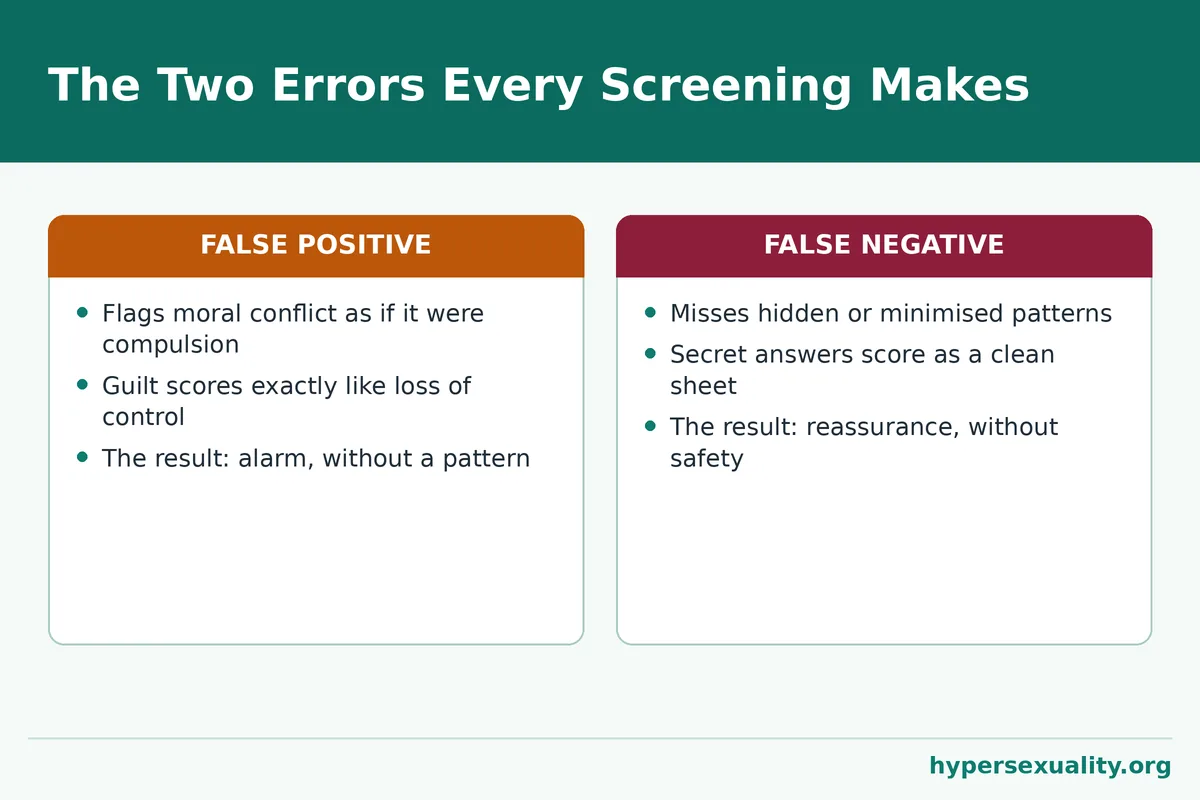
A false positive means the screening flags a problem that a full assessment would not confirm. With online sex addiction tests these are common, and they cluster in predictable places:
- Moral incongruence. Research by Grubbs and colleagues found that feeling addicted to pornography is predicted more strongly by moral — especially religious — disapproval of one’s own behaviour than by the behaviour’s frequency or loss of control. A person with modest, controlled use and intense values conflict can outscore a person with a genuine pattern. The suffering is real; the label is wrong, and the wrong label points to the wrong help.
- A manic or hypomanic episode. Hypersexuality arriving suddenly, alongside reduced need for sleep and racing energy, is a mood symptom until proven otherwise. A test scores the behaviour and misses the episode.
- Medication effects. Dopamine-agonist medicines — prescribed mainly for Parkinson’s disease and restless legs — are documented to switch on impulse-control problems, including hypersexual behaviour, in people with no prior history. A questionnaire cannot ask the question that matters here; a prescriber can.
- A high sex drive in a strict frame. Strong desire, honestly reported against conservative expectations, accumulates “yes” answers about preoccupation and frequency while control, consequences and functioning are all intact.
Each of these people deserves support. None is well served by a page that hands them an addiction label and a booking button. Each false positive is another illustration of why online sex addiction tests are not a diagnosis.
False negatives: when the test waves you through
Online sex addiction tests also fail in a quieter direction. A false negative — a genuine pattern scored as fine — happens when:
- The answers were hopeful rather than honest. Shame edits questionnaires. “Rarely” replaces “often”; the last six months get remembered as the best six weeks.
- The pattern runs through a channel the test doesn’t cover. Instruments designed around older behaviours can miss a pattern that is entirely app-based, solitary and free — nothing the questions imagine.
- Distress is carried as “just stress”. Some people score their consequences low because they have normalised years of lost sleep and secrecy — the same compartmentalisation that hides a pattern from a partner hides it from a checklist too.
Which is why this cluster repeats one sentence in different words: if your own unease says something is wrong, the unease outranks the score. Our pillar hypersexuality test page is written on that basis.
What a clinical assessment adds
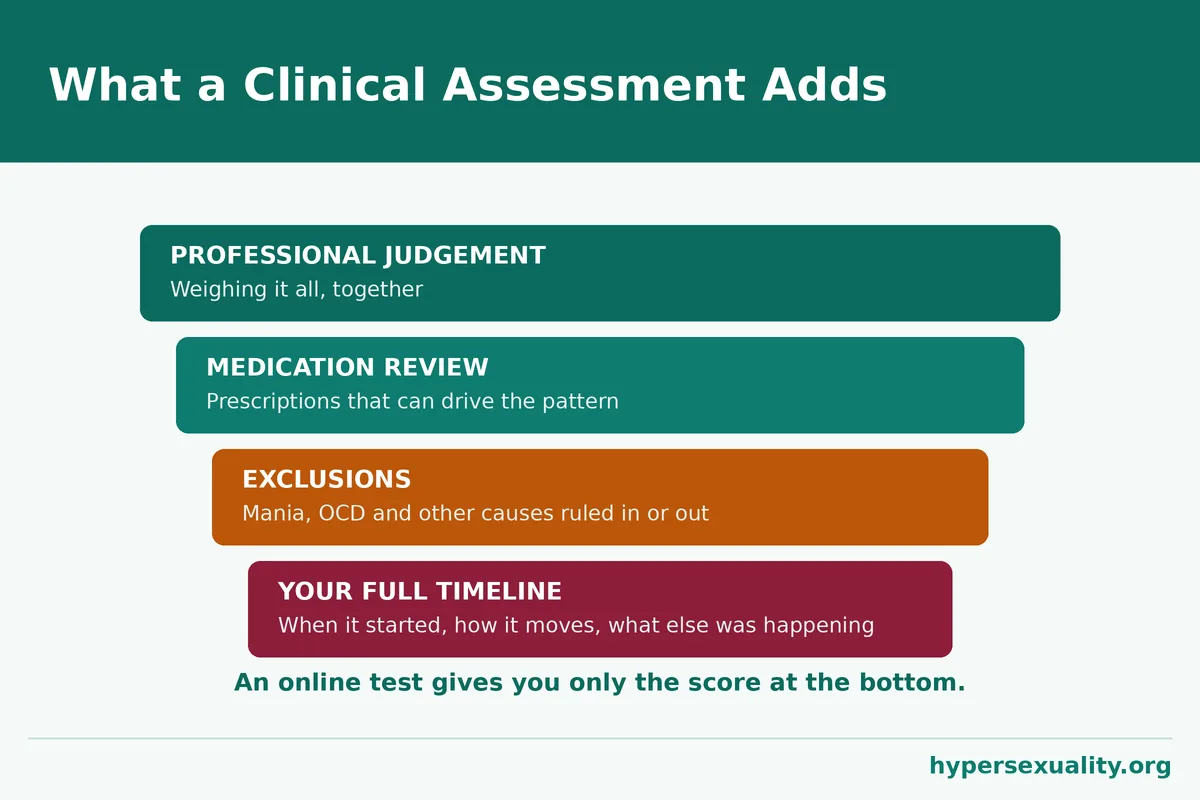
Set against a questionnaire, an assessment looks almost extravagant — and each element exists because a test failed without it. A clinician takes a timeline, not a snapshot: onset, changes, what else was happening in your life and health at each turn. They screen the neighbours — mood, ADHD, OCD, trauma, substances — because treatment depends on which of them is in the room. They ask about medication. They can hear minimisation and catastrophising, and gently test both. And they produce not a score but a formulation — “this is most likely what is happening, here is what we will do, here is how we will know if we are wrong” — which can be revised as evidence arrives.
None of this requires the assessment to be long or expensive to be real. One structured conversation with a GP who knows the territory does more diagnostic work than any number of quizzes. What it cannot be is instant, self-scored and anonymous — those are features of screening, and they are the very features that cap its authority. Everything beyond that point belongs to assessment, not to online sex addiction tests. This is the fuller answer to why online sex addiction tests are not a diagnosis — the conditions of a diagnosis are exactly what a questionnaire cannot see.
What it looked like for Hugo
Consider Hugo, a composite example: 33, raised in a devout household, who took an online test after a month of feeling wretched about his pornography use and scored deep into the “likely addiction” band. He arrived at his GP frightened and half-resigned to the label. The conversation surfaced a different picture in twenty minutes: his use totalled a few hours a month, stopped whenever he decided, had cost him nothing measurable — and every point on his score had come from the guilt questions.
What he was carrying was a values conflict, not a loss of control. That did not make his distress fake, and he left with support aimed at the actual problem — spared a diagnosis he did not have. The difference between a screening and an assessment, in one appointment. His appointment was the demonstration of why online sex addiction tests are not a diagnosis: twenty minutes of context did what fifteen questions could not.
How to use online tests well
None of this argues for ignoring tests. Used at their correct size, online sex addiction tests are a good front door:
- Use one to decide whether a professional conversation is worthwhile — that decision is exactly what screening is for.
- Answer from records, not from the mood of the evening.
- Take the result with you. Clinicians genuinely use them as a starting artefact.
- Decide in advance what you will do with the answer, using a follow-through plan like our page on what to do after a hypersexuality self test — a score with no next step is just anxiety with a number attached.
- And when the time comes to get support, weigh the formats honestly — including the differences between online vs in-person sex addiction meetings — rather than defaulting to whichever service the quiz page was selling.
Used this way, the question of why online sex addiction tests are not a diagnosis stops being a criticism and becomes a manual: screen to sort, assess to conclude.
Q&A
If online tests can’t diagnose, why do clinics and charities host them?
Because screening is a legitimate job. A good test lowers the threshold for the first step, gives people language for a pattern they could not name, and routes the right minority toward assessment. The problem is not tests — it is pages that present a screening score as a diagnosis, usually because a diagnosis is what their booking funnel needs. That is the short version of why online sex addiction tests are not a diagnosis, and the long version is above.
A test said I probably have sex addiction. Should I start treatment?
Start with an assessment, not treatment. Treatment aimed at the wrong formulation wastes money and can do harm — an addiction programme for moral incongruence deepens shame; addiction framing for a manic episode delays the treatment that would actually work. One assessment conversation first; then the plan follows from what the pattern turns out to be.
Can a professional diagnose from one session?
Sometimes a pattern is clear quickly, but a careful clinician treats early impressions as provisional. Assessment often involves more than one conversation, screening instruments used properly (in context, scored by the clinician), and sometimes information about your broader health. A diagnosis delivered in five minutes from a checklist should attract the same scepticism as one delivered by a website.
I scored low, but I still think something is wrong. Who is right?
Possibly you. False negatives are real — hopeful answering, channels the test doesn’t cover, consequences you have normalised. A screening can only report on its own questions. Persistent unease is a sufficient reason for one professional conversation, and settling the question properly is worth more than re-taking quizzes until one agrees with you.
Are any online tests better than others?
Yes, in degree. Better tests are transparent about being screening rather than diagnosis, ask about control and consequences rather than frequency and guilt alone, state the period they cover, and end with guidance rather than a sales funnel. Tests adapted from validated instruments — and explicit about it — deserve more trust than anonymous quizzes with percentage verdicts. Even the best online sex addiction tests, though, only sort. Only an assessment concludes. That is the limit this page exists to explain: why online sex addiction tests are not a diagnosis, whatever the branding on the button.
Sources: World Health Organization, ICD-11 entry 6C72 “Compulsive sexual behaviour disorder”; Grubbs, J. B. et al. (2020), “Sexual addiction 25 years on: A systematic and methodological review of empirical literature and an agenda for future research,” Clinical Psychology Review, 82, 101925; Kafka, M. P. (2010), “Hypersexual Disorder: A Proposed Diagnosis for DSM-V,” Archives of Sexual Behavior, 39(2), 377–400
Medical disclaimer: This article is educational information only and is not medical advice, diagnosis or treatment. Only a qualified clinician who knows your history can assess whether any diagnosis applies to you. If sexual behaviour is causing you distress or harm, consider speaking with your doctor or a licensed mental-health professional.