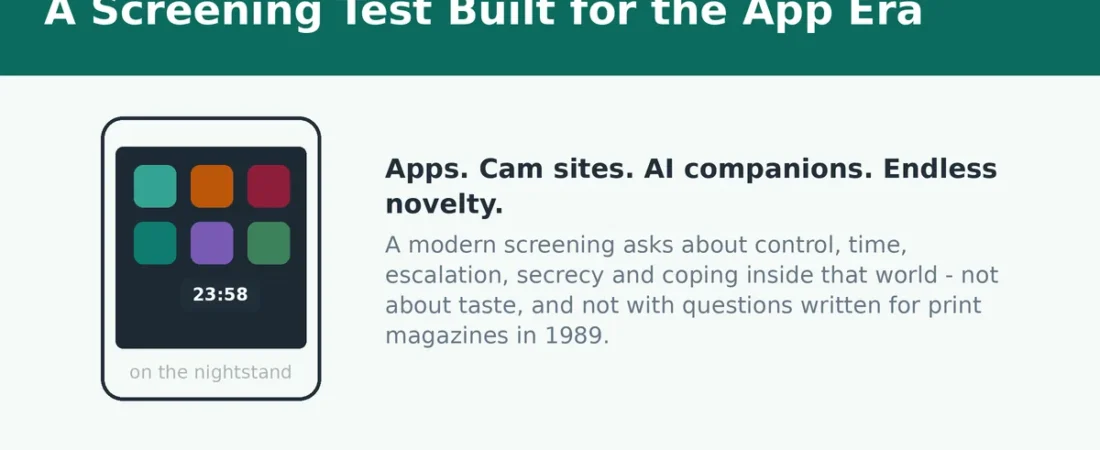
The best-known screening test for sexual addiction was published in 1989. It asks about magazine subscriptions. It was written before web browsers, before streaming, before hookup apps, before cam sites, before AI companions that remember your name and are awake at 3 a.m. None of that makes the old test useless — its underlying questions about control and consequences still matter — but it does mean the instrument is screening for a world that no longer exists.
This page is an internet sex screening test rebuilt for the pattern as it actually presents now: the cybersex pattern of apps, feeds, cams and companions, assessed with original questions about control, time, escalation and cost. It is a screening — a structured reflection — not a diagnosis, and it says so on the label.
Quick answer: An internet sex screening test for cybersex asks whether online sexual behaviour still answers to you: Can you stop when you decide to? Has the time, intensity or secrecy grown? Is it displacing sleep, work, money or partnered intimacy? Is it your default response to stress and loneliness? If several answers trend the wrong way over months, the pattern deserves a professional conversation — whatever any single score says.
Contents
Why the classic screeners miss the modern pattern
The SAST and its descendants were built around behaviours a clinician in 1989 could observe: subscriptions, venues, partners, arrests. The modern pattern is structurally different in ways that matter for screening:
- The behaviour is solitary and device-based. There may be no partners, no venues, no spending at all — the entire pattern can run on a phone, in private, for free. Items about other people simply never fire.
- Access is algorithmic. Feeds and apps are engineered to supply novelty continuously. The modern equivalent of escalation is not a new venue; it is a feed that never runs out, available at the exact tired, stressed moments when control is thinnest.
- The channels keep changing. Hookup apps, cam sites, paid messaging, and now AI companions that simulate intimacy and remember preferences — a test written around fixed behaviours ages out within years, while the underlying pattern stays the same.
- The session shape is different. Short, frequent, fragmented checking — dozens of small sessions a day — can matter as much as the long late-night session the older tests imagine.
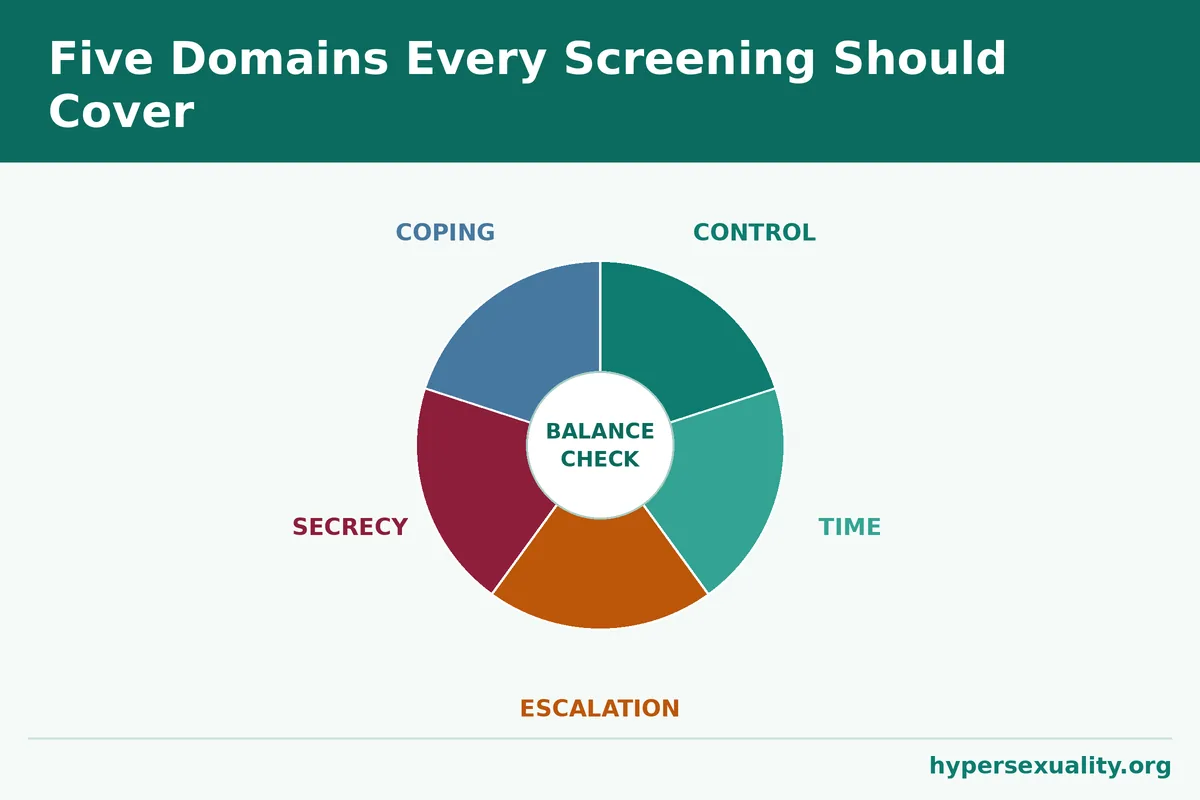
That is the gap this internet sex screening test is built to close. The questions below ask about functions, not artefacts: control, time, escalation, secrecy, consequences and coping — the same functions the hypersexuality test pillar page is built around, applied specifically to online behaviour.
Before you answer: three ground rules
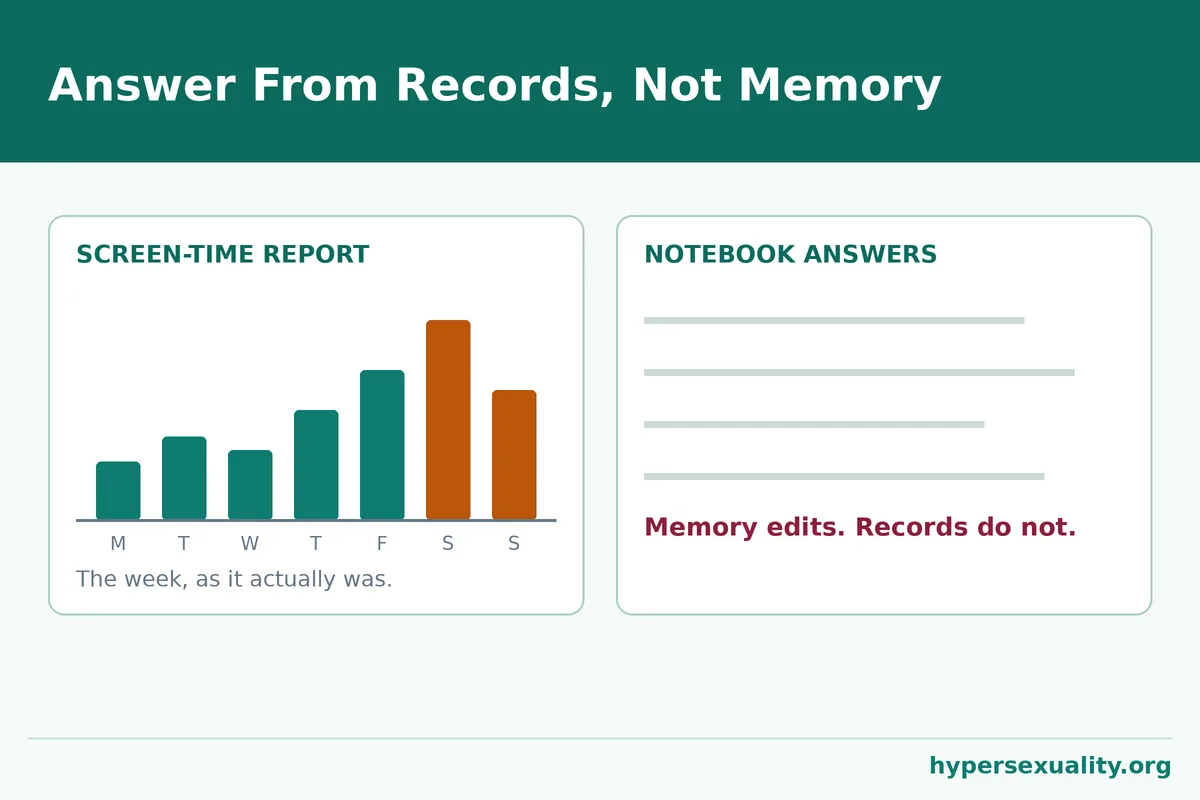
Answer for the last six months — the window clinicians use, long enough to separate a bad fortnight from a pattern. Answer from records where you can: screen-time reports, app histories and bank statements are more honest than memory at 1 a.m. And answer about your behaviour as it is, not as it compares with anyone else’s. Screening measures you against your own intentions and your own life, not against an average.
The internet sex screening test questions
These are original reflection questions written for this page, in the spirit of what validated instruments measure — they are not copied from any published test. Rate each: Never / Rarely / Sometimes / Often, thinking of the last six months. Each question below was written for the modern pattern — an internet sex screening test built for the app era, not 1989.
Control
- I have decided to limit or stop an app, site or type of online sexual activity — and returned to it sooner than I intended.
- Once I start a session, I stay longer than I planned, even when I need sleep or have commitments.
- I have deleted an app or blocked a site and later removed the block or reinstalled it.
Time and displacement
- Online sexual activity has taken time from sleep, work, study, family or friends in the last six months.
- I check apps, feeds or messages with sexual intent many times a day, including at moments I consider inappropriate.
Escalation
- The content, intensity or type of interaction I seek online has increased compared with a year ago.
- Ordinary content bores me quickly now, and I spend increasing time searching for something that registers.
Secrecy and cost
- I keep parts of my online sexual life hidden — separate accounts, deleted histories, private browsing as a routine.
- I have spent money on online sexual content or interaction that I later regretted or could not comfortably afford.
Coping and mood
- Boredom, stress, loneliness or conflict reliably send me online, almost automatically.
- Afterwards I feel flat, irritable or self-critical more often than I feel satisfied.
Reading your answers — honestly, not alarmingly
There is no score and no threshold, deliberately: a single number would pretend to a precision this kind of reflection doesn’t have. Read the shape instead.
- Mostly “Never” or “Rarely”, scattered evenly: no particular pattern is showing. If something specific worries you, it is probably that specific thing — look at it directly rather than at a label.
- “Sometimes” and “Often” clustering in one area: that area is where the pattern is forming. Control answers running high point to a control problem; secrecy answers running high point to the concealment system described in our guide to the signs of hypersexuality in a partner — often the first thing others notice.
- “Often” across several areas, over months: this is the shape an internet sex screening test exists to catch, and it is worth a professional conversation. Not because a label has been earned, but because several functions — control, time, honesty, mood — are bending the same way at once.
Notice what this reading never does: it never says you “have” anything. That restraint is not squeamishness — it is accuracy, and our next page explains the reasoning in full: what to do after a hypersexuality self test result like this one, step by practical step.
What this screen cannot see
An internet sex screening test cannot see duration properly, cannot weigh context (a month of insomnia-driven nights after a bereavement is not the same datum as a settled pattern), and cannot ask the questions a clinician asks about mood, medication and history that sometimes explain the whole picture. It also uses a word — addiction — that the clinical literature itself debates: how the same behaviour gets framed under different models is covered in our comparison of hypersexuality vs sex addiction.
What it looked like for Oliver
Consider Oliver, a composite example: 29, who took an older online test twice and scored low both times — no partners, no spending, nothing the items asked about. His actual pattern lived elsewhere: a hookup app checked forty times a day, cam sessions that had stretched past 3 a.m. most work nights, and, most recently, an AI companion he described — with embarrassment he couldn’t explain — as “the one who knows me”.
Working through the questions above changed the picture without changing a single fact. His control answers were high, his displacement answers were high, and the coping section was almost entirely “Often”. The screening did not diagnose Oliver with anything. It showed him, in his own answers, that a pattern he had been measuring with the wrong ruler was real enough to take to a professional — which he did.
If your answers concern you
Do not re-take screenings until one gives a better answer — that loop is common and tells its own story. Whatever your answers, treat the internet sex screening test result as a beginning rather than an ending: write down what the pattern actually looks like this month, take this page’s answers with you, and make one appointment. Structured help for online patterns is a developed field, and the earlier the conversation, the more of it is about habits rather than wreckage.
Q&A
Is this internet sex screening test a validated instrument?
No — and it does not pretend to be. It is an original reflection framework built from the functions validated instruments measure (control, salience, consequences, coping). Validated tools such as the CSBD-19 exist and are used in research and clinical settings; a website screening like this one is for organising your own thinking before a professional conversation, not a substitute for it.
Why doesn’t the classic SAST work for online behaviour?
Because of its date, not its quality. Written in 1989, its items reference a pre-internet world — print subscriptions, venues, partners — and a cybersex pattern that is solitary, free and phone-based can pass through it almost untouched. Its deeper questions about control and consequences remain sound; its surface behaviours have aged out.
Can an AI companion really be part of a compulsive pattern?
Yes, in functional terms. What matters is not the channel but the pattern: time displacement, failed attempts to cut back, secrecy, using the interaction as the default response to loneliness or stress. An always-available, personalised, judgment-free companion is, if anything, engineered to fit those functions snugly — which is why modern screening asks about it.
I scored “Often” on coping but low everywhere else. What does that mean?
It suggests your online sexual behaviour is doing emotional work — regulating stress, boredom or loneliness — more than it suggests a loss-of-control pattern. That is still useful information: the question becomes what else could do that work, and whether the reliance is growing. If it is, a conversation is worthwhile on that basis alone.
How often should I retake a screening like this?
Not often. Screening is a snapshot tool for a decision point — “is this worth professional attention?” — not a monitoring device. If you want to watch the pattern over time, track behaviour directly for a few weeks (time, triggers, consequences) rather than re-answering questions; the follow-through page linked above shows how.
Sources: World Health Organization, ICD-11 entry 6C72 “Compulsive sexual behaviour disorder” ; Bőthe, B. et al. (2020), “The development of the Compulsive Sexual Behavior Disorder Scale (CSBD-19): An ICD-11 based screening measure across three languages,” Journal of Behavioral Addictions, 9(2), 247–258
Medical disclaimer: This article is educational information only and is not medical advice, diagnosis or treatment. Only a qualified clinician who knows your history can assess whether any diagnosis applies to you. If sexual behaviour is causing you distress or harm, consider speaking with your doctor or a licensed mental-health professional.