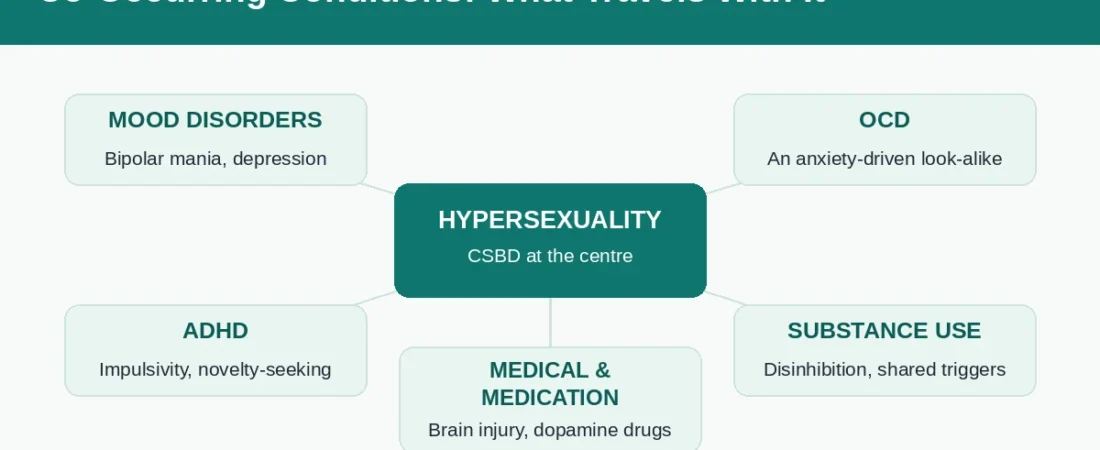
Hypersexuality rarely travels alone. In clinic samples, most people assessed for compulsive sexual behaviour also meet criteria for at least one other condition — a mood disorder, ADHD, an anxiety disorder, a substance problem, sometimes a medical cause hiding underneath. That is not a footnote to the story; it is the story, because co-occurring conditions decide what the sexual behaviour actually is. Sometimes it is the main pattern. Sometimes it is a symptom of something else wearing the pattern’s clothes.
This page maps the whole territory, group by group, and points you to the detailed article for each — starting from the base definition of hypersexuality itself.
Quick answer: The conditions that most commonly occur with hypersexuality are bipolar disorder and depression, ADHD, OCD (especially intrusive sexual thoughts), anxiety disorders, substance use disorders, PTSD, and medical causes including dopamine-agonist medication and neurological disease. Each one changes the treatment: a pattern driven by mania, medication or OCD is managed very differently from primary compulsive sexual behaviour — which is why assessment always sorts these first. Sorting these co-occurring conditions is the first job of any real assessment.
Contents
Why co-occurring conditions change everything
The relationship runs in both directions, and in a third way besides. A condition can drive the behaviour: mania switches it on, substances switch off the brakes. The behaviour can worsen the condition: the shame and wreckage of a compulsive pattern deepen depression and anxiety. And the two can share roots — impulsivity, trauma history, a reward system that runs hot — so that they rise together without either simply causing the other.
This is also why ICD-11 builds the sorting into the diagnosis itself: the pattern only counts as compulsive sexual behaviour disorder if it is not better explained by another condition, a substance or a medication, and if the distress is not purely moral. The professional process of ruling each candidate in or out has a name — the differential diagnosis of compulsive sexual behavior — and this page is its map.
Mood disorders: the episodic engine
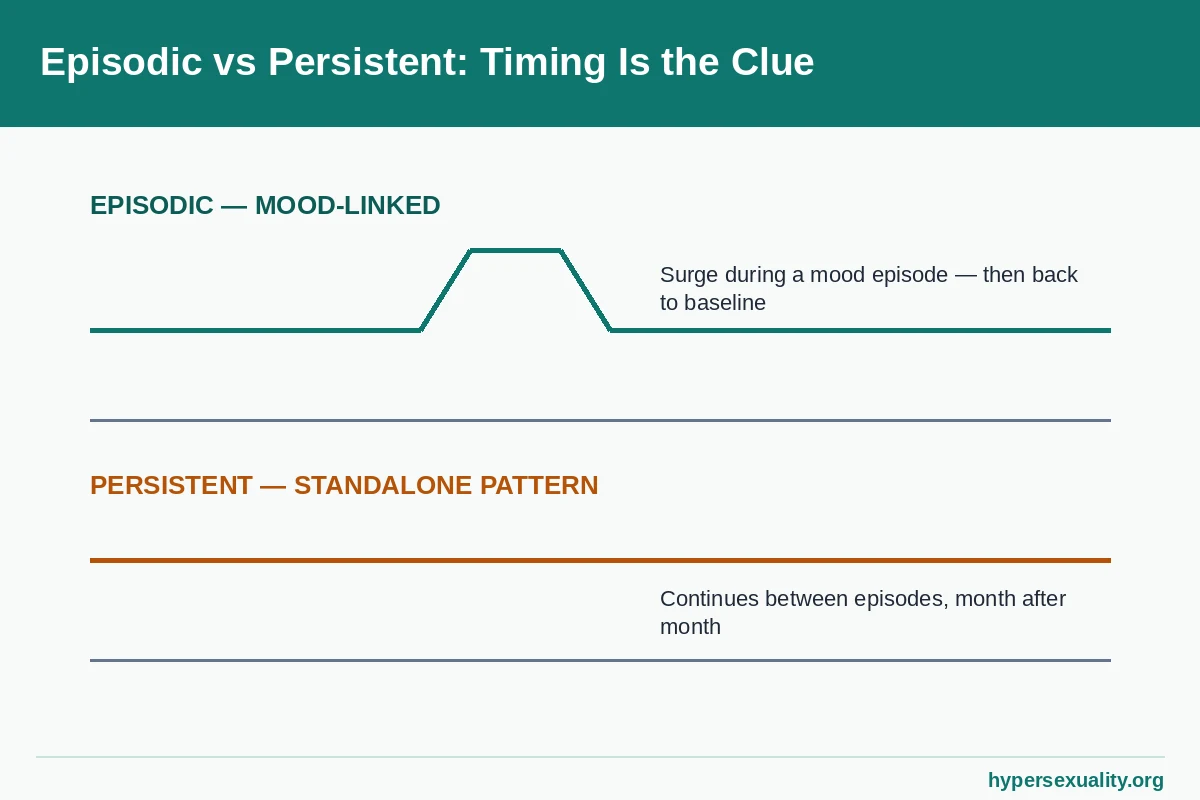
Bipolar disorder is the single most important look-alike and companion. During mania or hypomania, desire surges, inhibition drops and sexual risk-taking climbs — then, characteristically, it falls away as the episode ends. The signature is timing: the behaviour is episodic and arrives with reduced need for sleep, racing thoughts and inflated energy. Between episodes, many people return to a completely ordinary baseline. Our dedicated guide covers bipolar disorder and hypersexuality in depth.
Depression works from the opposite pole. When ordinary life feels flat and empty, intense sexual reward can become the fastest available way to feel anything at all — seeking that is about emptiness, not appetite. The article on depression and using sex to cope unpacks that quieter pattern.
ADHD: the novelty-seeking overlap
ADHD contributes three ingredients that combine dangerously with sexual behaviour: impulsivity (acting before the brakes engage), novelty hunger (an under-stimulated brain hunting stronger input) and emotional dysregulation (feelings that spike fast and need fast regulation). Research also suggests depressive symptoms are a key link in the chain — ADHD raises the risk of low mood, and low mood drives the seeking. The full mechanism is laid out in ADHD and hypersexuality. ADHD is one of the co-occurring conditions most often missed in adults.
OCD: the look-alike that isn’t desire
Sexual OCD deserves its own warning label, because it mimics hypersexuality while being its near-opposite. In OCD, intrusive sexual thoughts are unwanted and distressing — the person fears them, checks against them, seeks reassurance — and any behaviour is ritual aimed at anxiety relief, not pleasure-seeking.
Mistaking one for the other leads to exactly wrong treatment in both directions. Start with OCD and intrusive sexual thoughts, and note that anxiety more broadly runs its own tension–release loop with this behaviour, covered under anxiety and compulsive sexual behavior.
Substance use: which came first?
Alcohol and stimulants lower inhibition and intensify urges, so sexual behaviour that happens almost entirely while intoxicated may be a substance problem wearing a sexual mask — or the two patterns may be genuinely independent and feeding each other. Clinicians ask one sequencing question above all: does it happen sober? The evidence and the reasoning are in substance use and disinhibited sexual behavior. PTSD belongs on this part of the map of co-occurring conditions too: trauma can drive the pattern through numbing, avoidance or attempts to regain control, as detailed in PTSD and hypersexual behavior.
Medical causes and medication effects
Some presentations are medical first and psychological second. Dopamine-agonist medications — prescribed mainly for Parkinson’s disease and restless legs — are documented to switch on impulse-control problems, including hypersexual behaviour, in people with no prior history; frontal-lobe injury, some dementias, temporal-limbic conditions and certain epilepsies can do the same by damaging the brain’s braking systems.
The red-flag pattern is abrupt change, especially later in life. Two pages cover this properly: medication-induced hypersexuality and the neurological rule-outs. Rule one throughout: never stop a prescribed medication on your own — raise it with the prescriber. Medical causes are the co-occurring conditions no assessment can afford to skip.
What the map meant for one assessment
Consider Hannah, a composite example: 33, referred after two years of “hypersexuality” that baffled her because it came in waves. For months she would be settled and uninterested; then, over a fortnight, she would sleep four hours a night, message strangers compulsively, spend money she did not have and feel unstoppable — before crashing into shame and exhaustion.
Mapped against this page, the wave pattern pointed away from a primary sexual-behaviour disorder and toward mood. Her assessment confirmed a bipolar-spectrum condition; stabilising her mood largely switched the sexual surges off with it. Same presenting complaint as hundreds of others — different condition travelling with it, different treatment, different outcome.
Using this map
Work through it as orientation, not self-diagnosis: notice which descriptions match your timing (episodic or constant?), your relationship to the thoughts (wanted or intrusive?), and your context (sober, medicated, post-injury?). Then take that picture to a professional, or start with the structured hypersexuality test screening to organise it. And if you arrived here via the myths page — several wrong ideas about single causes are dismantled in hypersexuality myths and facts — the map above is what the evidence looks like instead.
Q&A
Which conditions most commonly occur alongside hypersexuality?
In clinical samples the most frequent companions are mood disorders (bipolar disorder and depression), substance use disorders, anxiety disorders and ADHD, with OCD as an important look-alike and medical causes — dopamine-agonist medication, neurological disease — as the must-not-miss group. Many people have more than one travelling with the pattern.
If another condition is causing the behaviour, is it still CSBD?
Usually not, by definition. ICD-11 only allows the CSBD diagnosis when the pattern is not better explained by another condition, a substance or a medication. In practice the labels can coexist — someone can have bipolar disorder and a persistent pattern between episodes — which is exactly the judgment a proper assessment is for. Co-occurring conditions can share a person without sharing a cause.
Should the other condition be treated first, or the sexual behaviour?
Often the driver comes first or both are treated in parallel: stabilising mood, adjusting a causative medication (with the prescriber), or treating a substance problem can shrink the sexual behaviour substantially. Behavioural skills work usually runs alongside rather than waiting. The sequencing is a clinical decision based on which condition is doing the most damage.
Can treating ADHD or depression reduce hypersexual behaviour on its own?
Sometimes, noticeably — when the sexual behaviour is mainly fuelled by impulsivity, novelty hunger or the emptiness of depression, treating that engine reduces the fuel supply. It does not always dissolve an established habit loop, which may still need its own skills work, but clinicians routinely see the behaviour quieten as the co-occurring condition is treated.
Why does assessment always ask about mood, medication and substances?
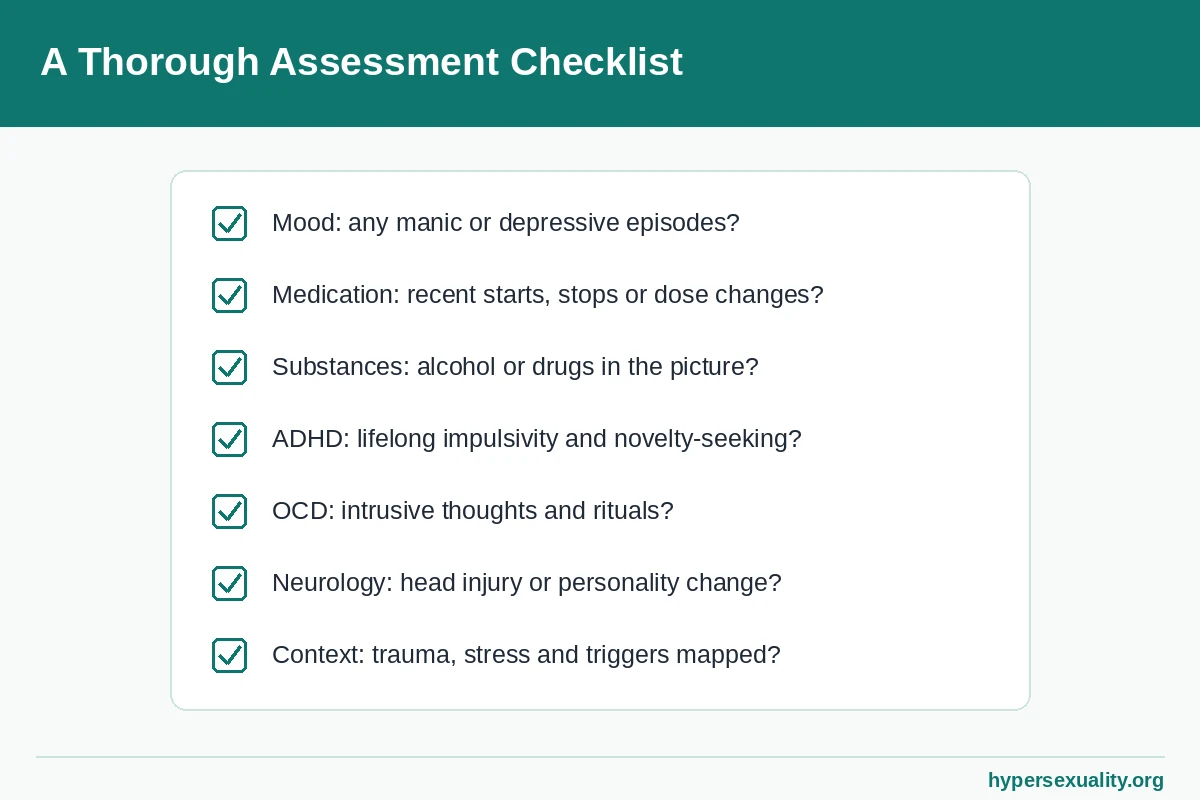
Because those three questions sort most of the map. Mood establishes whether the pattern is episodic; medication and substances identify causes that can be switched off or must be treated first; and the answers decide whether the sexual behaviour is the condition, a symptom, or a fellow traveller. Skipping them is how people end up treated for the wrong thing for years.
Sources: World Health Organization, ICD-11 entry 6C72 “Compulsive sexual behaviour disorder”; Kafka, M. P. (2010), “Hypersexual Disorder: A Proposed Diagnosis for DSM-V,” Archives of Sexual Behavior, 39(2), 377–400; Kraus, S. W., Voon, V. & Potenza, M. N. (2016), “Should Compulsive Sexual Behavior Be Considered an Addiction?” Addiction, 111(12), 2097–2106.
Medical disclaimer: This article is educational information only and is not medical advice, diagnosis or treatment. Only a qualified clinician who knows your history can assess whether any diagnosis applies to you. If sexual behaviour is causing you distress or harm, consider speaking with your doctor or a licensed mental-health professional.