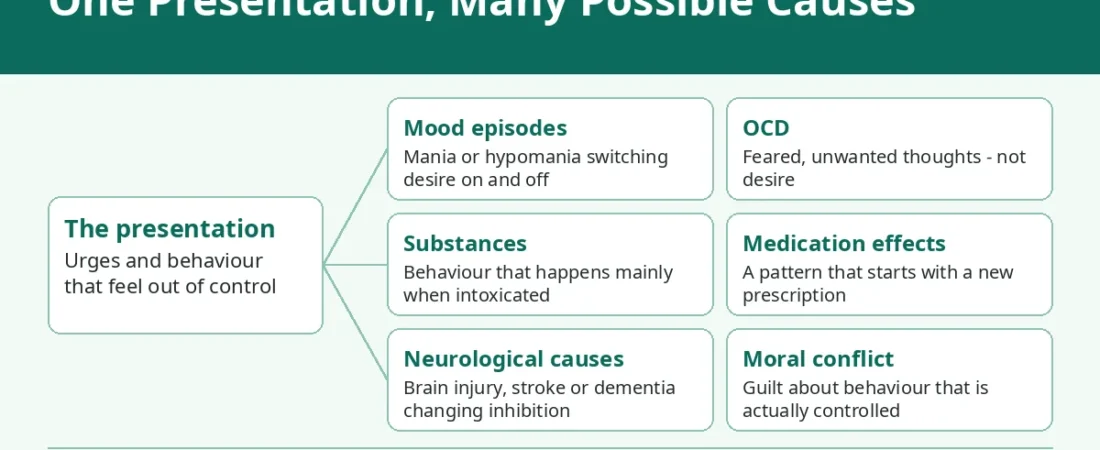
Two people can describe the same behaviour — urges they cannot switch off, hours lost, consequences piling up — and need completely different help. For one, the pattern is compulsive sexual behavior disorder (CSBD) itself. For the other, it is a symptom: of a mood episode, a medication, a brain injury, or a values conflict that only looks like compulsion. Telling these apart is not academic hair-splitting. It decides what treatment will work, and getting it wrong can mean months of therapy aimed at the wrong target.
That sorting process has a name — the differential diagnosis of compulsive sexual behavior — and this page walks through it the way clinicians actually work through it, in plain language.
Quick answer: The differential diagnosis of compulsive sexual behavior is the structured process of ruling out everything else that can produce out-of-control sexual behaviour before concluding it is CSBD. The main alternatives are bipolar mood episodes, OCD, substance use, medication effects (especially dopamine-boosting drugs), neurological conditions, and moral incongruence — distress about behaviour that is actually controlled. Only a qualified clinician who takes a full history can run this process; this page explains it, it cannot perform it.
Contents
Why “what else could this be?” comes first
In medicine, a differential diagnosis is the disciplined habit of asking what else could explain the picture before settling on one answer. It matters here more than in most areas, because compulsive sexual behaviour sits at a crossroads. The ICD-11 definition of CSBD builds the sorting into the diagnosis itself: the pattern only counts as CSBD if it is not better explained by another condition, a substance or a medication, and if the distress is not purely moral. The hub article on hypersexuality covers the definition in full; this page is about the look-alikes.
There is also a human reason. People usually arrive at this topic frightened, often after months of secrecy. A careful differential is frequently reassuring: a large share of the people who fear they have a lifelong disorder turn out to have something more specific, more treatable, or — in the case of moral conflict — not a disorder at all. The map of everything that travels with this pattern is drawn on our co-occurring conditions overview; the differential diagnosis of compulsive sexual behavior is how a clinician decides which item on that map, if any, is driving yours.
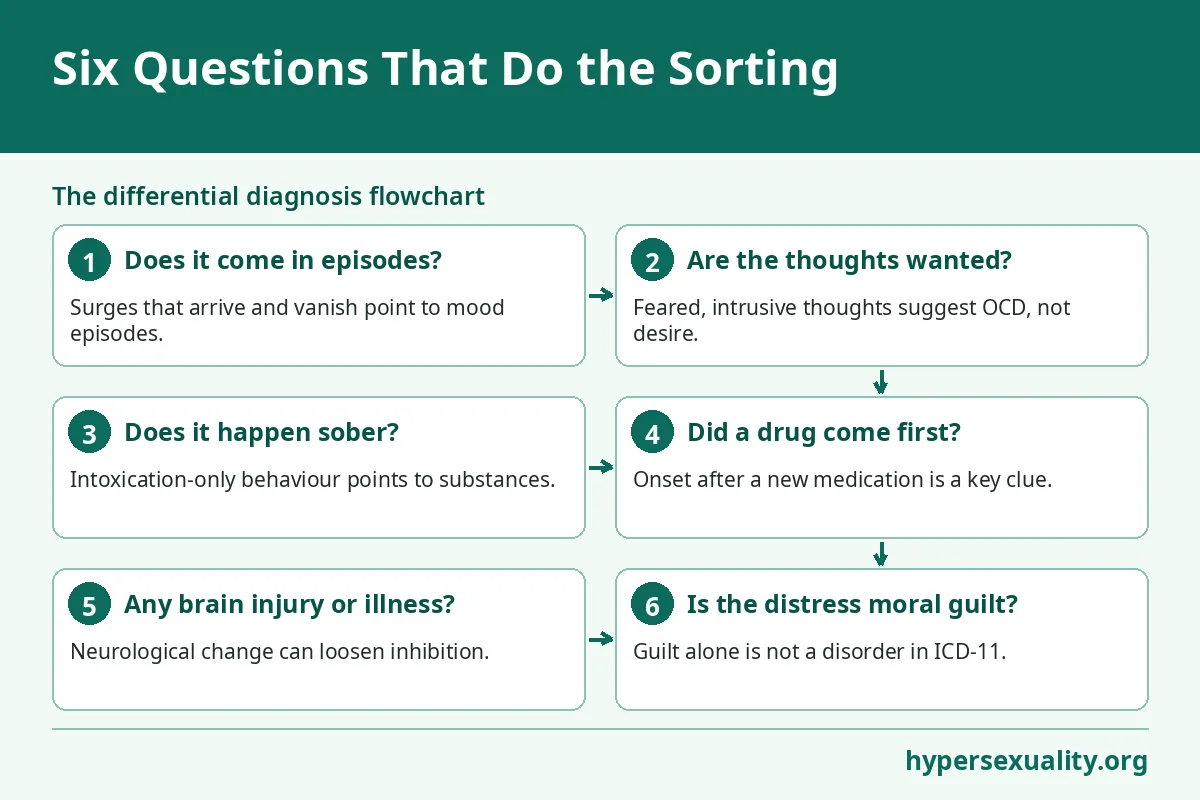
Differential diagnosis of compulsive sexual behavior: the six rule-outs, in the order clinicians test them
Clinicians do not test these in a rigid order, but some questions come early because the answers redirect everything else.
1. Is it episodic? The mood question
The single most informative question in the whole differential is about timing. Sexual behaviour that arrives in waves — switched on for days or weeks alongside reduced need for sleep, racing energy and inflated confidence, then gone again — points toward bipolar disorder, not a primary sexual-behaviour problem. Mania and hypomania switch desire on; between episodes, many people return to an ordinary baseline. A pattern that is constant, month after month, whatever the mood, points the other way. This is why the differential diagnosis of compulsive sexual behavior always starts with a mood history, and why our dedicated page on hypersexuality or another condition turns this into questions you can bring to an appointment.
2. Is it wanted? The OCD question
Sexual OCD mimics hypersexuality while being its near-opposite. In OCD, sexual thoughts are intrusive and unwanted: the person fears them, checks against them, seeks reassurance, and any behaviour is a ritual aimed at anxiety relief rather than pleasure. In CSBD the urges are, at least in the moment, wanted — the problem is control, not horror at the thoughts themselves. Mistaking one for the other leads to exactly wrong treatment in both directions, which is why the wanted/unwanted question is asked early and carefully.
3. Does it happen sober? The substance question
Alcohol and stimulants lower inhibition and intensify urges. Behaviour that happens almost entirely while intoxicated may be a substance problem wearing a sexual mask — or two genuinely independent patterns feeding each other. The sequencing question clinicians ask above all is simple: does it happen sober? If the answer is no, the substance moves to the front of the queue, because treating it often changes the sexual picture completely.
4. Did it start with a prescription? The medication question
Some of the clearest cases in the differential diagnosis of compulsive sexual behavior are medical. Dopamine-agonist medications — prescribed mainly for Parkinson’s disease and restless legs — are documented to switch on impulse-control problems, including hypersexual behaviour, in people with no prior history. The signature is timing: the behaviour begins after a drug is started or its dose is raised, in someone whose earlier life shows nothing like it. The rule that protects patients here is absolute: never stop a prescribed medication on your own — raise the timing with the prescriber, who can adjust safely.
5. Is there a brain-based cause? The neurology question
Frontal-lobe injury, some dementias, temporal-limbic conditions and certain epilepsies can damage the brain’s braking systems and release sexual behaviour that is completely out of character. The red-flag pattern is abrupt change, especially later in life, in someone with no earlier history. That pattern earns a medical workup first — scans and neurology before sex therapy — because the cause may be progressive and treatable in ways conversation cannot touch.
6. Is the distress moral? The values question
The last rule-out is the one the ICD-11 wrote into the criteria explicitly: distress based entirely on moral judgment about sexual behaviour does not qualify as CSBD. Research on moral incongruence shows that people whose behaviour clashes with their religious or cultural values often rate themselves as addicted at completely ordinary levels of use. That suffering is real and deserves support — but it is a values conflict, not a compulsion, and it needs a different kind of help. Our full explainer on moral incongruence and sexual behavior distress works through the evidence, and the wider question of how culture shapes compulsive sexual behavior diagnosis is taken up in its own article.
One assessment, two different answers
Consider Anders, a composite example: 52, referred for “sex addiction” after his wife discovered escalating online behaviour and spending. A checklist approach would have scored him quickly. His assessment instead started with timing — and the timing was wrong for CSBD. The behaviour had begun fourteen months earlier, within weeks of a new prescription for his restless legs, a dopamine-agonist drug. Before that: four decades of an unremarkable, controlled sexual life.
Anders’ prescriber was contacted, the medication was reviewed and changed under medical supervision, and over the following months the urges faded back to his lifelong baseline. Same presenting complaint as hundreds of others — but the differential diagnosis of compulsive sexual behavior caught what a symptom checklist would have missed, and the treatment was a prescription review, not addiction therapy.
What a real differential assessment involves
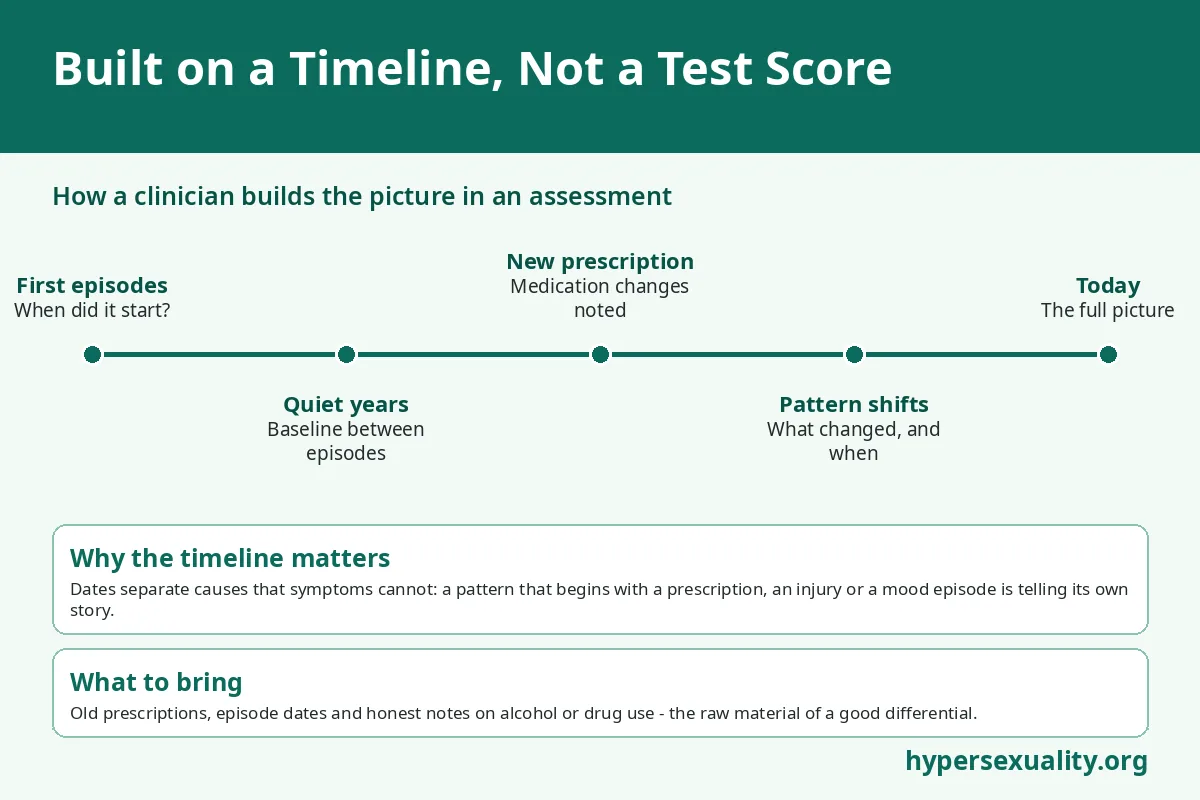
Expect a conversation, not a scan or a blood test — there is no biomarker for any of this. A thorough assessment usually covers: the timeline of the behaviour (when it started, whether it comes in episodes), mood and sleep history, a full medication review, substance use, medical history including head injury, and the texture of the thoughts themselves (wanted or intrusive, pleasure-seeking or anxiety-driven). Screening questionnaires can organise that conversation, but they cannot replace it, because the sorting is the history. If your clinician skips the timeline and the medication list, that is a reason to seek a second opinion.
Q&A
What does “differential diagnosis” actually mean here?
It means working out which of several possible explanations fits your pattern before naming it. The differential diagnosis of compulsive sexual behavior weighs CSBD against mood episodes, OCD, substance effects, medication effects, neurological causes and moral conflict — because each one is treated differently, and treating the wrong one wastes time and can cause harm.
Can I do this differential on myself with online tests?
No. Screening questionnaires measure how much a pattern resembles CSBD; they cannot weigh timing against a medication start date, or judge whether distress is moral rather than compulsive. That weighing is exactly what a clinician’s history-taking is for. Tests can start the conversation — they cannot finish it.
Which rule-out is missed most often?
Medication effects and mood episodes are the classic misses. A behaviour that began after a dopamine-boosting prescription, or that arrives in episodes with reduced sleep, can be misread as a primary sexual problem for years if nobody asks about timing. Both questions take a clinician two minutes to ask — and change everything when the answer is yes.
If another condition explains my behaviour, does that mean it isn’t serious?
Not at all. It means the serious thing has a different name and a different treatment. Mania, a medication effect or a neurological cause can each be more urgent than CSBD itself. “It isn’t CSBD” is the start of the right treatment, not a dismissal.
What should I bring to a first assessment?
A timeline: when the behaviour started, whether it comes in episodes, what changed around the same time (mood, sleep, new medication, illness, substances), and what you have already tried. That single page does more for the differential diagnosis of compulsive sexual behavior than any questionnaire score.
Sources: World Health Organization, ICD-11 entry 6C72 “Compulsive sexual behaviour disorder”; Briken, P. et al. (2024), “Assessment and treatment of compulsive sexual behavior disorder: a sexual medicine perspective,” Sexual Medicine Reviews, 12(3)
Medical disclaimer: This article is educational information only and is not medical advice, diagnosis or treatment. Only a qualified clinician who knows your history can assess whether any diagnosis applies to you. If sexual behaviour is causing you distress or harm, consider speaking with your doctor or a licensed mental-health professional.