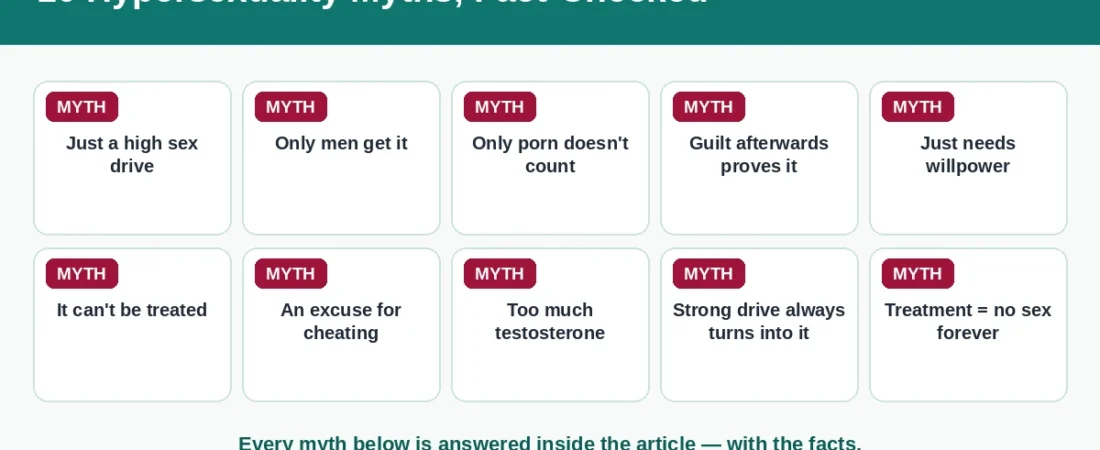
Most people meet this topic through myths first. They come from tabloid listicles, clinic marketing and low-quality health blogs that repeat each other’s claims — and they do real damage, because a person who believes the myths either panics about a healthy sex drive or dismisses a genuine problem until it costs them dearly. Below, the ten most persistent hypersexuality myths, checked one by one against what clinicians and the ICD-11 actually say.
They persist because each one contains a splinter of truth. Drives do vary. Some people do behave badly and reach for labels. Medication does get prescribed. Willpower does matter — just not in the way the myth claims. That is why simple reassurance never kills these myths; only the actual fact, placed next to the claim, does. So that is the format below: the myth, the fact, and what follows from it. If you have already read whether hypersexuality can be treated, you will recognise several of these — they are the reason that page needed writing.
Quick answer: The facts behind the myths: hypersexuality is defined by loss of control and harm, not by how strong your sex drive is; it affects women as well as men; pornography-only patterns count; guilt alone does not make the diagnosis; and treatment aims at restored control, not a sex-free life. The full map of what hypersexuality actually is sits on the hub page. Every one of these hypersexuality myths is checked in full below.
Contents
Myth 1: “It’s just a high sex drive.”
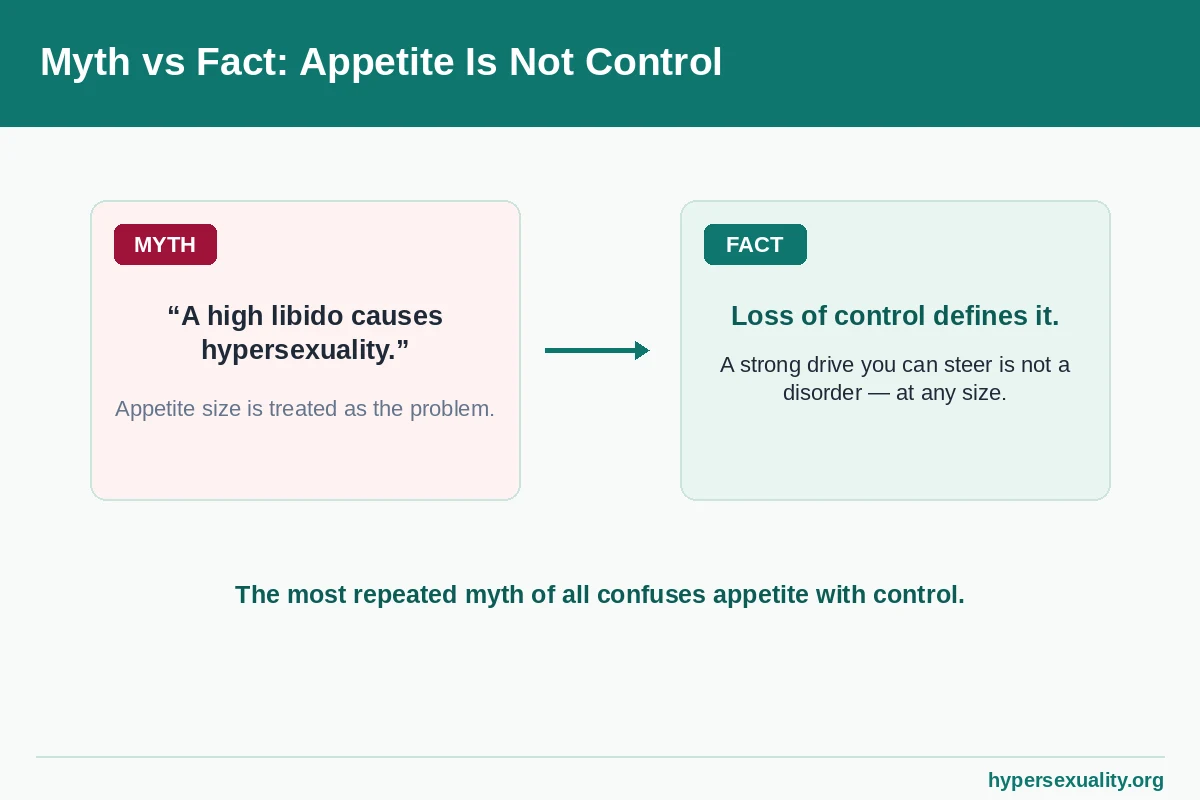
Fact: A high libido is healthy sexuality, not a disorder. The pattern clinicians call hypersexuality is defined by control and consequences — urges that repeatedly override your own decisions and behaviour that continues despite harm. Plenty of people want sex daily and steer it easily; plenty with modest drives cannot steer at all.
Myth 2: “A strong drive inevitably turns into hypersexuality.”
Fact: Some low-quality health pages state this as settled fact. It is not. There is no evidence that a healthy high drive “converts” into a compulsive pattern. What develops the pattern is a different machinery: using sex as the default coping tool, escalating access and secrecy, or an untreated co-occurring condition. Appetite is not the on-ramp.
Myth 3: “It’s just an excuse for cheating or bad behaviour.”
Fact: A diagnosis explains a mechanism; it does not excuse harm, and clinicians are explicit that responsibility for repairing damage remains. In practice, the excuse theory fails on contact with reality: most people with this pattern are distressed by behaviour that violates their own values, and seek help precisely because they cannot align what they do with what they intend.
Myth 4: “Only men get it.”
Fact: Women experience this pattern too — research samples find more men largely because women’s presentations (often organised around relationships, fantasy and apps rather than pornography volume) are under-recognised and under-reported amid stronger stigma. The ICD-11 diagnosis is a single, gender-neutral set of criteria for everyone. Of all hypersexuality myths, this one hides the most patients.
Myth 5: “If it’s only porn, it doesn’t count.”
Fact: Solo and digital behaviour is among the most common presentations clinicians see. The criteria are about impulses, control and impact, not about which acts are involved or whether another person is. A pornography-only pattern that eats sleep, money and self-respect for months meets the same threshold as any other.
Myth 6: “It’s caused by too much testosterone.”
Fact: One-chemical stories are marketing, not medicine. Most people with compulsive patterns have hormone levels in the normal range, and the research picture is multifactorial — reward learning, coping habits, mental-health conditions, sometimes medication effects or neurology. Hormone problems are occasionally relevant and worth ruling out; they are not the default explanation.
Myth 7: “People just need more willpower.”
Fact: Repeated failed attempts at self-control are part of the pattern’s definition — telling someone with it to try harder is prescribing the symptom as the cure. What works is different: trigger mapping, skills, environment changes and treating whatever is driving the loop. Willpower plays a role inside treatment; it is not a substitute for it.
Myth 8: “Feeling guilty afterwards proves you have it.”
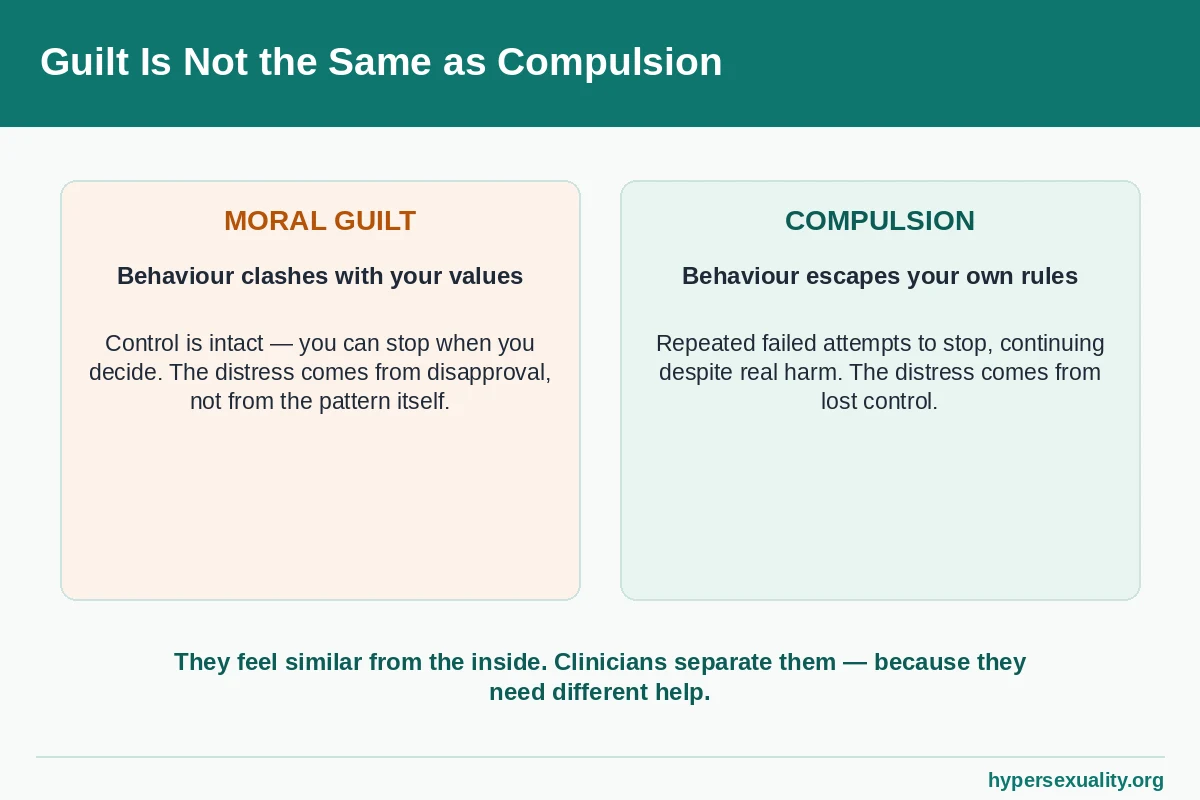
Fact: Guilt is evidence of a values conflict, not of compulsion. ICD-11 explicitly excludes distress that is based entirely on moral judgment about sexual behaviour. Research on moral incongruence shows that people whose behaviour clashes with their religious values often rate themselves as “addicted” at ordinary levels of use — a real form of suffering, but a different problem needing different help.
Myth 9: “Treatment means giving up sex forever.”
Fact: The clinical goal is restored choice: behaviour you can start, stop and enjoy, without the compulsive pattern running it. Some programmes use temporary abstinence periods as a reset tool, and some fellowships define sobriety strictly — but a sex-free life is not the standard medical endpoint, and desire itself is never the target.
Myth 10: “Once an addict, always an addict — it can’t be treated.”
Fact: Outcome research, including controlled trials of structured therapy, shows most people who engage with treatment gain substantial control and keep much of it. “Untreatable” survives because it is dramatic. The accurate statement is less quotable: it is a manageable, sometimes relapsing pattern — like many conditions medicine treats successfully without using the word cure.
Hypersexuality myths: a 10-second test for the next one you meet
Hypersexuality myths regenerate faster than any list can chase them, so take the test instead. Ask three questions of any claim about this topic. Does it mention control and consequences, or only amounts and appetites? Does it name one single cause for a pattern clinicians describe as multifactorial? And does it end by selling you something — a supplement, a programme, a diagnosis in five minutes? A claim that fails any of the three is a myth wearing a lab coat.
The reader these myths nearly stopped
Consider Owen, a composite example: 29, who spent three years believing Myth 3 and Myth 7 about himself — that he was simply weak and dishonest. What finally moved him was a fact, not a verdict: learning that failed self-control attempts are a criterion of the pattern he was using as proof of bad character. He took a structured hypersexuality test screening, recognised the shape of his last three years, and booked an assessment. Nothing about his behaviour changed the day he made that call — what changed was that he finally had an accurate description of it. The hypersexuality myths had not protected his standards; they had only postponed his help.
Q&A
Is hypersexuality just an excuse for bad behaviour?
No — and this is one of the most damaging hypersexuality myths. An explanation is not an exemption: treatment explicitly includes taking responsibility and repairing harm. What the diagnosis changes is the route out. People whose behaviour genuinely did not trouble them rarely sit in clinics asking why they cannot stop.
Can you be hypersexual if you only use pornography?
Yes. Clinicians assess control, persistence and impact rather than the specific behaviour. Pornography-only patterns are common, can meet the full ICD-11 picture — displacement of sleep and work, escalation, continued use despite harm — and respond to the same treatment approaches as other presentations.
Can women be hypersexual too?
Yes. This is one of the quieter hypersexuality myths: that the pattern belongs to men. The same diagnosis and criteria apply to everyone. Women appear less often in statistics mainly because their patterns are more likely to be misread — as relationship problems, mood problems or character flaws — and because stigma discourages disclosure. Under-diagnosis is not rarity.
If I feel guilty afterwards, does that mean I have it?
Not by itself. Guilt after behaviour that conflicts with your values is moral incongruence, which ICD-11 explicitly separates from this disorder. The distinguishing questions are about control and consequences: have you repeatedly failed to stop despite trying, and is the behaviour causing real harm in your life?
Can a brain scan diagnose hypersexuality?
No. There is no scan, blood test or biomarker that diagnoses this pattern. Brain-imaging research shows group-level differences in how reward systems respond to sexual cues, which informs science but cannot classify an individual. Diagnosis is a clinical conversation about history, control, consequences and what else might explain the picture.
Sources: World Health Organization, ICD-11 entry 6C72 “Compulsive sexual behaviour disorder”; Grubbs, J. B. et al. (2015), “Transgression as Addiction: Religiosity and Moral Disapproval as Predictors of Perceived Addiction to Pornography,” Archives of Sexual Behavior, 44(1), 125–136; Kraus, S. W. et al. (2018), “Compulsive sexual behaviour disorder in the WHO ICD-11,” World Psychiatry, 17(1).
Medical disclaimer: This article is educational information only and is not medical advice, diagnosis or treatment. Only a qualified clinician who knows your history can assess whether any diagnosis applies to you. If sexual behaviour is causing you distress or harm, consider speaking with your doctor or a licensed mental-health professional.