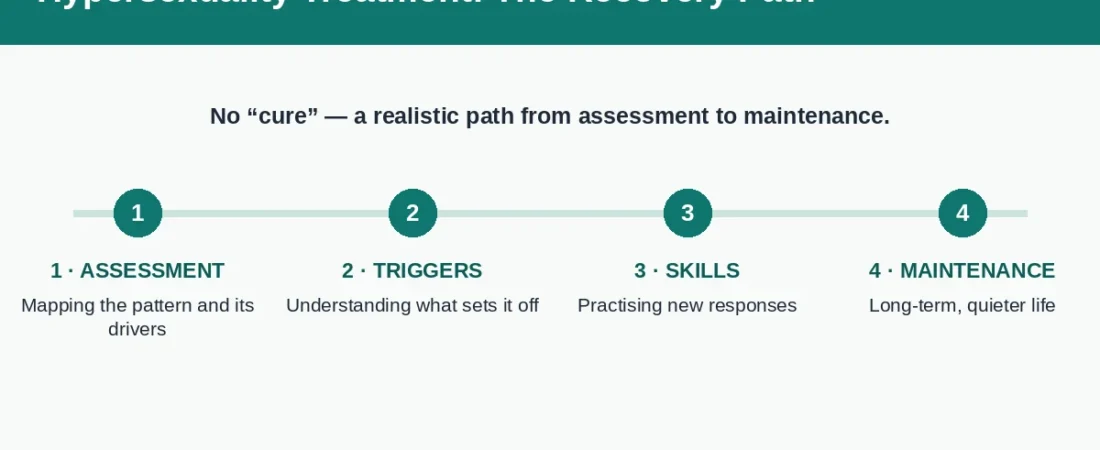
Yes — with an honest definition of “treated”. Hypersexuality treatment does not work like antibiotics for an infection, and any page that promises a cure is selling something. What good treatment reliably offers is different and, for most people, better than the fantasy of a cure: urges that lose their authority, behaviour that comes back under your own control, and a life the pattern no longer organises itself around. This page sets out what the evidence supports, what treatment can and cannot change, and what the timeline honestly looks like — whether you are asking for yourself at 45 or recognised your pattern in our guide to hypersexuality in young adults.
Quick answer: Hypersexuality can be treated successfully in the sense that matters: most people who complete structured treatment report substantially better control, fewer episodes and less distress, and controlled research supports approaches such as CBT. It is rarely “cured” in the sense of the desire or vulnerability disappearing forever. Recovery means managing a pattern — like other long-term conditions — not erasing part of your sexuality. That is the honest promise of hypersexuality treatment.
Contents
Why “cure” is the wrong word
A cure removes the problem and it stays removed. Sexual behaviour does not work that way, for three reasons. First, the target is not a foreign invader but your own desire, which is healthy and stays. Second, the pattern is usually maintained by learned loops — cue, urge, behaviour, relief — and learning can be redirected but not un-experienced. Third, the things that fed the pattern (stress, loneliness, a co-occurring condition) remain part of life. This vocabulary matters because hypersexuality treatment is judged against the wrong standard when people expect a cure.
Clinicians therefore talk about recovery and management, the same language used for other relapsing patterns. That is not lowered ambition. For most people the lived difference between “actively compulsive” and “recovered” is enormous: the difference between behaviour that runs your week and urges you can notice, ride out and decline. Several stubborn hypersexuality myths — including “once an addict, always an addict” — make this sound like failure. It is what success actually looks like.
What hypersexuality treatment can change
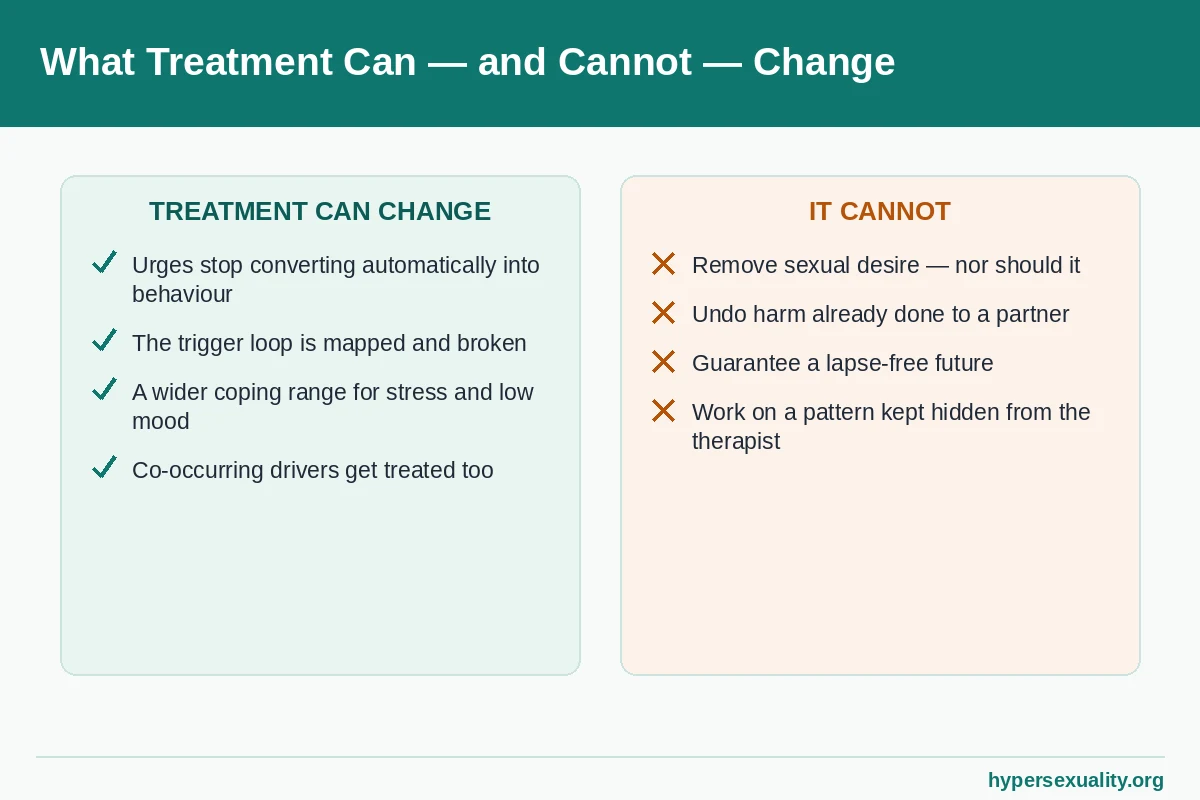
- Control. The core outcome: urges still occur, but they stop converting automatically into behaviour. Failed attempts to stop become rarer and shorter.
- The trigger loop. Treatment identifies the specific chain — boredom, conflict, alcohol, a particular app at a particular hour — and breaks it at its weakest links, so willpower is needed less, not more.
- Coping range. Sex stops being the only tool for stress, loneliness and low mood, because other tools are deliberately built and practised.
- Co-occurring drivers. Where depression, ADHD, trauma symptoms or a mood disorder are fuelling the pattern, treating them often reduces the sexual behaviour as a side effect.
- Relationships and self-respect. Secrecy shrinks, honesty becomes possible, and the shame cycle — episode, disgust, more episodes — loses its fuel.
What treatment cannot do
Honesty about hypersexuality treatment cuts both ways. Treatment cannot remove sexual desire, and should not try to. It cannot rewrite the past or undo harm already done to a partner, though it can equip you to repair what is repairable. It cannot guarantee a lapse-free future; lapses are common and are treated as information, not expulsion offences. And it cannot work on a pattern you keep hidden from the person treating you — the one hard precondition is candour.
Nor can it be done to you while you stay passive: every effective approach asks something of you between sessions, in the ordinary hours where the pattern actually lives.
What treatment actually involves
It starts with assessment, not exercises. A competent clinician maps the pattern, its history and its costs, and screens for the conditions that travel with it — because treating “hypersexuality” that is actually a manic episode or a medication effect means treating the wrong thing. (What that full sorting process looks like is its own topic: the map of co-occurring conditions.)
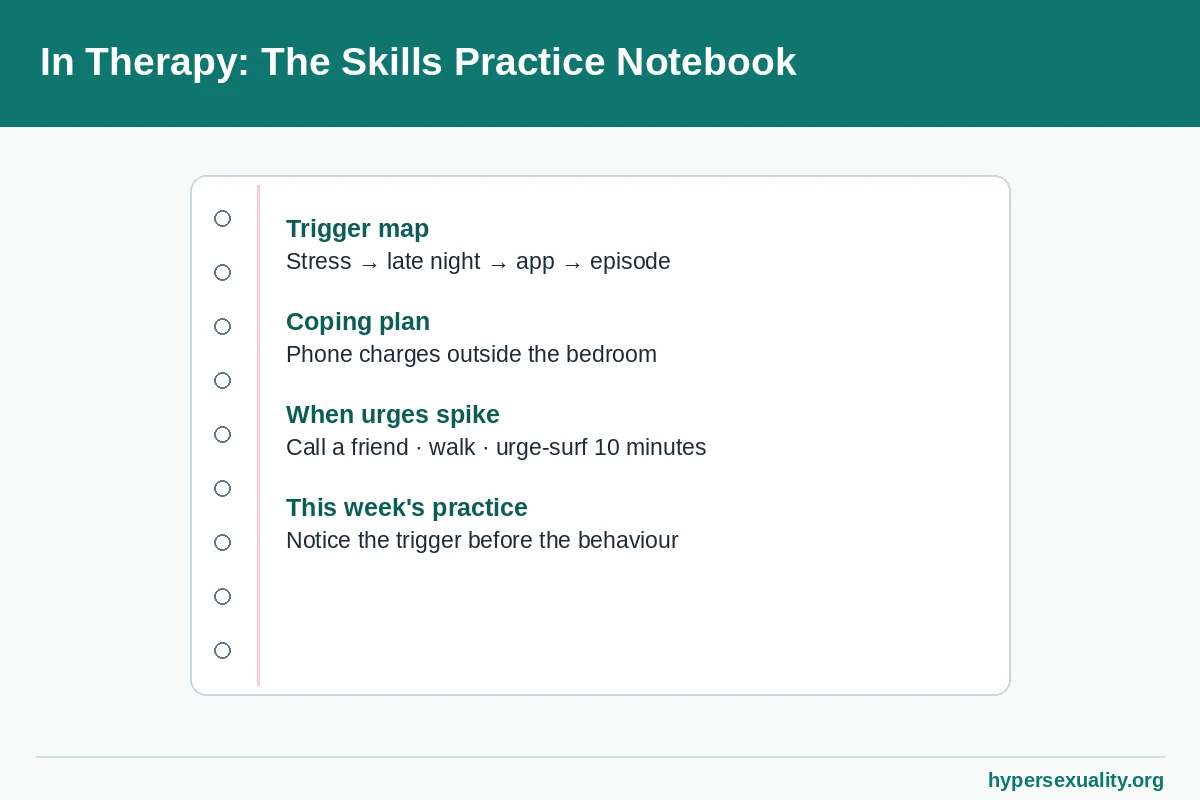
Actual hypersexuality treatment has a best-supported core: structured psychological therapy, most often CBT-based: trigger mapping, urge-management skills, restructuring the thoughts that license episodes, and relapse-prevention planning. Group formats and peer support help many people, particularly against secrecy and shame.
Medication is sometimes part of the picture — a psychiatrist may treat a co-occurring condition, or consider medication aimed at impulsivity or urges — but it is prescribed case by case, never as a generic recipe, and this site does not recommend specific drugs or doses. A different question readers often bring to the same appointment — whether an antidepressant can itself cause hypersexuality — is answered on its own page about antidepressants and hypersexuality.
What the timeline honestly looks like
- First weeks. Assessment, a working map of your triggers, and usually quick early wins from structure alone — many people report the first real sense of agency here.
- Months 2–6. The skills phase: lapses typically become less frequent and shorter; this is also where the harder underlying material (mood, trauma, relationship damage) gets addressed.
- Beyond 6 months. Maintenance: the pattern is quieter, life has been rebuilt around other things, and check-ins focus on high-risk periods rather than constant vigilance.
Research gives this timeline some grounding. In a randomised controlled trial of a structured group CBT programme for men with hypersexual disorder, participants reported significant reductions in hypersexual behaviour after treatment, with improvements maintained at follow-up months later. The evidence base is still small — this field has nothing like the trial volume of depression research — but it consistently points the same way: structured treatment helps most people who engage with it, and outcomes are better when co-occurring conditions are treated too. That consistency is why hypersexuality treatment is offered with confidence despite a small trial base. The fuller background on the pattern itself is on the hypersexuality hub page.
What recovery looks like at month eight
Consider Marcus, a composite example: 41, married, a pattern built around pornography and chat apps that cost him a promotion and nearly his marriage. Month one of treatment was mostly mapping and embarrassment. By month three he had gone six weeks without an episode, then lapsed on a work trip and — the real change — told his therapist and his wife within days instead of restarting the secrecy.
By month eight, urges still visited a few times a week, briefly, and mostly ended with him making tea. His desire for his wife had not been “cured” away; it had become something he could choose again. That ordinariness is the outcome treatment aims at.
Q&A
How long does treatment for hypersexuality usually take?
Most structured programmes run for a few months of regular sessions, with meaningful change often visible in the first 6–12 weeks and consolidation over 6 months or more. There is no fixed course: duration depends on how entrenched the pattern is and whether co-occurring conditions need treatment alongside it.
What does recovery from hypersexuality actually look like day to day?
Quieter than people expect. Urges still appear but are noticed earlier and acted on less; routines, sleep and work stop being organised around the behaviour; secrecy shrinks. Recovery is usually measured in regained choice and repaired life areas, not in the total absence of sexual desire or temptation.
Is medication always part of treating hypersexuality?
No. Many people are treated with psychological therapy alone. Medication enters the picture when a clinician judges it useful — most often to treat a co-occurring condition such as depression or bipolar disorder, sometimes with the aim of reducing impulsivity or urge intensity. That decision belongs to a psychiatrist who knows your full history, not to a webpage.
What happens if I relapse during recovery?
A lapse is treated as data: what was the trigger, which link in the chain failed, what changes before next time? Programmes distinguish a lapse (a single episode) from a relapse (the pattern re-establishing) precisely so that one bad night does not get converted, by shame, into a lost month. The damaging response is secrecy, not the lapse itself.
How do I know if treatment is working?
Track behaviour, not feelings. Useful markers: longer gaps between urges and any action, fewer and shorter episodes, less time and money spent, reduced secrecy, and life areas (sleep, work, relationships) measurably recovering. Your clinician should review these with you; if nothing has moved after a few months of honest work, that is a reason to discuss changing the approach.
Sources: World Health Organization, ICD-11 entry 6C72 “Compulsive sexual behaviour disorder”; Hallberg, J. et al. (2019), “A Randomized Controlled Study of Group-Administered Cognitive Behavioral Therapy for Hypersexual Disorder in Men,” Journal of Sexual Medicine, 16(5), 733–745.
Medical disclaimer: This article is educational information only and is not medical advice, diagnosis or treatment. Only a qualified clinician who knows your history can assess whether any diagnosis applies to you. If sexual behaviour is causing you distress or harm, consider speaking with your doctor or a licensed mental-health professional.