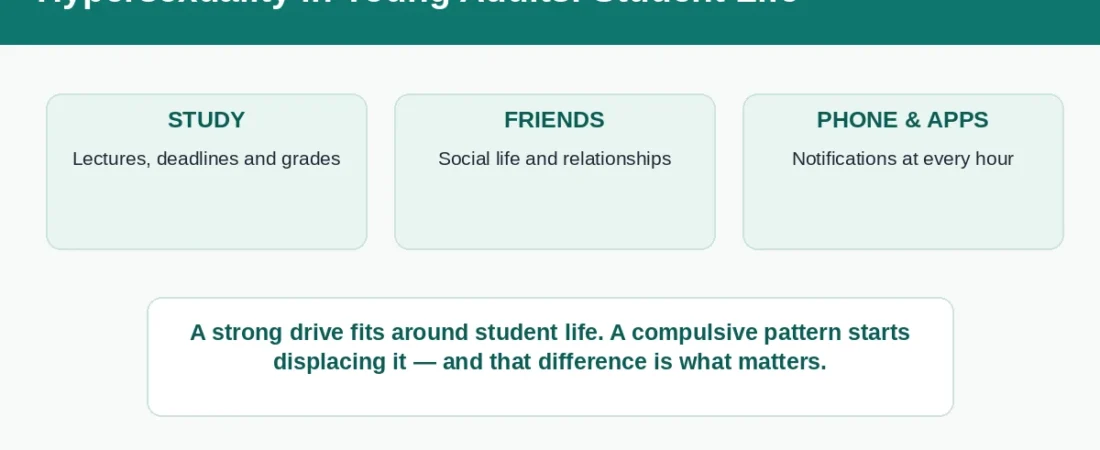
Your twenties are, for most people, the highest-desire decade of life — new freedom, new partners, a phone full of possibilities and a brain that is still finishing its own wiring. That is precisely why hypersexuality in young adults is so easy to misjudge in both directions. Tabloid checklists label ordinary student behaviour as “addiction”, while a genuinely compulsive pattern gets waved away as “just being young”. Neither response helps. This page draws the line where clinicians draw it: not at how much you want sex, but at control, consequences and distress.
Quick answer: Hypersexuality in young adults is a persistent pattern in which sexual urges or behaviour repeatedly escape the person’s own control, continue despite costs to studies, work, money or relationships, and cause real distress. A strong sex drive in your 20s is normal and healthy. The warning sign is not appetite — it is failed attempts to cut back, secrecy, escalation and harm that keeps happening anyway.
Contents
Why your 20s prove nothing either way
Desire typically peaks early in adult life, novelty is everywhere, and routines are unstable — shared flats, irregular sleep, exam stress, first jobs. All of that can make a healthy sex life look intense from the outside. It can also hide a problem in plain sight, because almost every consequence can be blamed on being young: the missed lecture, the empty bank account, the relationship that ended badly.
Research on when this pattern starts is sobering. In the UCLA field trial that tested diagnostic criteria for hypersexual behaviour, just over half of treatment-seeking patients said their sexual behaviour had become problematic before age 18, and roughly another third dated it to their college-age years, 18 to 25.
In other words, hypersexuality in young adults is not a rare edge case — the late teens and twenties are the most common window in which the pattern first takes hold. Catching it then matters, because the habits and the shame are both younger and easier to work with.
How the pattern shows up in student and early-work life
The settings are ordinary; the pattern underneath is what counts.
- Study and work displacement. Revision, coursework or a first job’s probation period quietly loses to late-night sessions. Deadlines are met in panic or not at all, and “I’ll catch up tomorrow” becomes the standing arrangement.
- The all-nighter economy. Sleep is the first currency spent. Behaviour clusters at 1–4 a.m., and the next day’s flatness and irritability get treated with the same behaviour the following night.
- Money that was spoken for. Paid content, apps, cam sites or travel to meet people eats rent money, textbook money or savings — followed by genuine bewilderment about where it went.
- A double life in a shared house. Locked doors, deleted histories, a second account, a practised casualness. Flatmates and partners usually sense the secrecy long before they see the behaviour.
Notice what is missing from that list: any particular amount of sex, pornography or partners. A student with an active, honest, controlled sex life has none of these problems. A student with a modest-looking habit and all four has a pattern worth taking seriously. The full picture of hypersexuality as clinicians define it is about exactly this difference.
Apps, feeds and the delete–reinstall cycle
Your generation is the first to carry an unlimited, private, always-refilling supply of sexual novelty in its pocket. Dating and hookup apps are engineered around the same mechanics as social feeds — variable rewards, fresh faces, one more swipe — and for a brain already prone to losing control, that design is not neutral.
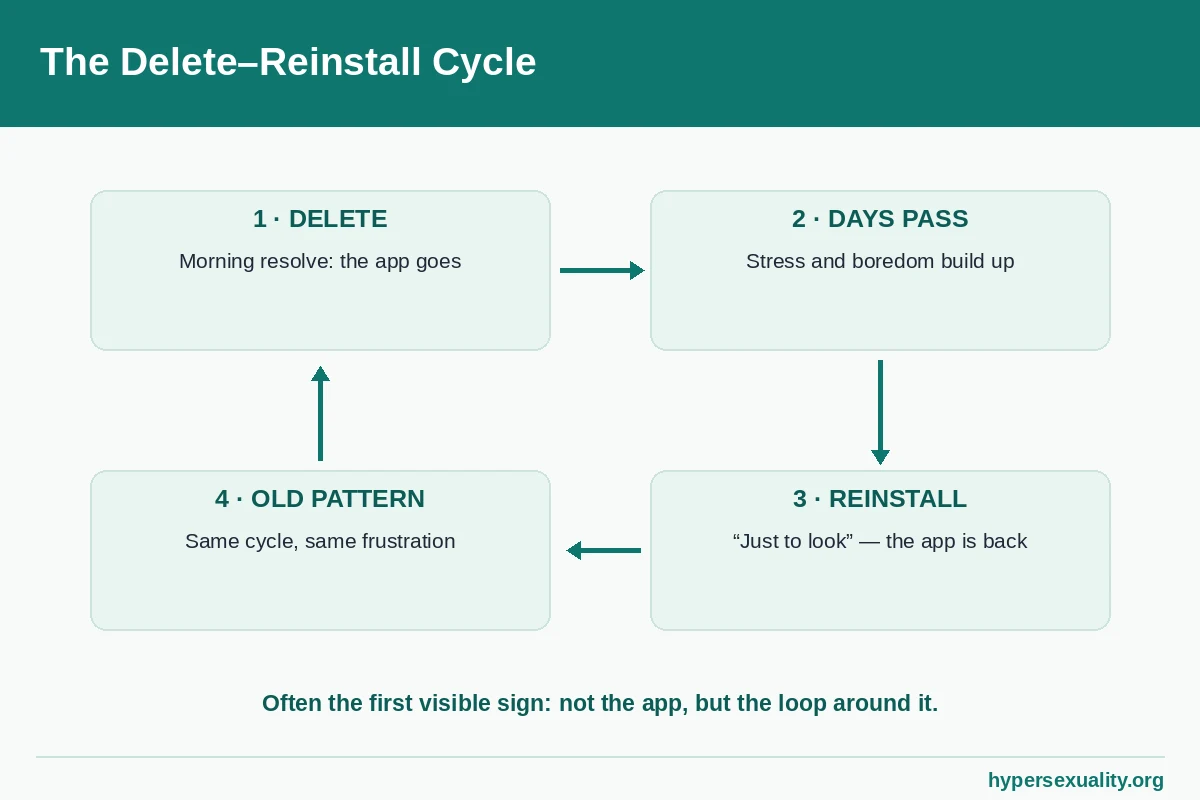
The most recognisable sign is the cycle: delete the apps in a flush of morning resolve, endure a few days of restlessness, reinstall “just to check” by the weekend. If that loop sounds familiar, it is worth reading how clinicians separate a compulsive pattern from problematic pornography use and hypersexuality more broadly — the two overlap heavily at this age, and the distinction shapes what help actually works. For hypersexuality in young adults, the phone is rarely the cause — it is the delivery system.
First relationships: where it surfaces
For many young adults, the pattern only becomes visible inside a first serious relationship. A partner notices the secrecy, the disappearing evenings, the mismatch between promises and behaviour. Two confusions follow almost every time.
The first is desire discrepancy: one partner simply wants sex more often than the other. That is common, workable and not a disorder. The second is different — behaviour that continues after it has been named as harmful, that survives sincere attempts to stop, that gets hidden rather than discussed. That is the pattern this page is about, and it deserves a conversation with a professional rather than another round of apologies and resolutions. That visibility is one reason hypersexuality in young adults is so often discovered by a partner rather than admitted by the person.
What it can look like at 21
Consider Zara, a composite example: a second-year student with good grades in her first year and a part-time café job. By mid-second-year she is missing morning lectures after nights that end at 3 a.m. on apps she has deleted at least a dozen times. She has spent most of her overdraft on paid content she cannot explain to herself. Her boyfriend thinks she has gone off him; in reality she turns down intimacy and then feels driven and miserable an hour later.
Nothing on that list is dramatic. Together — failed control, displacement, secrecy, distress, over months — it is the pattern, arriving in the middle of an ordinary student life.
What hypersexuality in young adults is not
- It is not a high sex drive, however strong. If you can postpone, redirect and stay honest, appetite alone is health, not illness.
- It is not sexual exploration, a colourful dating history, or enjoying pornography — none of these is a symptom by itself.
- It is not guilt imported from a strict upbringing. ICD-11 is explicit: distress based entirely on moral disapproval of your own behaviour does not qualify as this disorder. That conflict is real and deserves support, but it is a different problem.
- It is not a life sentence or an identity. It is a pattern of behaviour, and patterns can change — especially when they are caught early.
Getting help as a student or young worker
You do not need to tell your parents, your flatmates or your employer to get a first professional opinion. Practical routes that fit this stage of life:
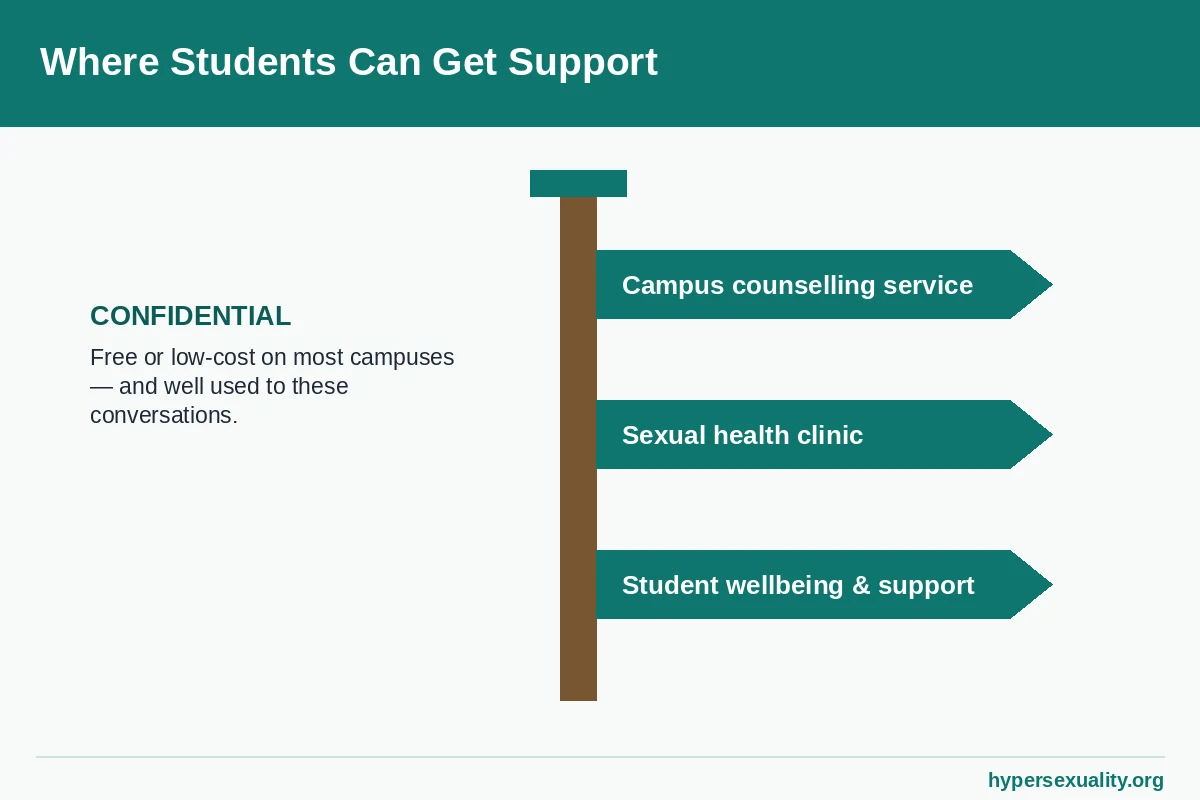
- University or college counselling services are free, confidential and used to exactly this kind of concern, even though students rarely believe that before they walk in.
- Your GP or a sexual health clinic can be a first port of call; both can refer on, and sexual health services are typically non-judgemental and free at the point of use.
- Structured self-reflection first. If you are not ready to talk to anyone, the hypersexuality test screening page walks through the same pattern clinicians ask about — screening, not diagnosis, but a clearer picture than a 2 a.m. search spiral.
- Ask the treatment question directly. What help looks like, and what it can realistically change, is covered in our guide to whether hypersexuality can be treated.
Q&A
Is it normal to think about sex a lot in your 20s?
Yes. Frequent sexual thoughts and a strong drive are typical in this decade and say nothing about disorder on their own. What moves something out of the “normal” column is loss of control, secrecy, escalation and consequences — behaviour that continues after it has started costing you sleep, grades, money or relationships.
Can dating apps make hypersexuality worse for students?
They can feed it. Apps deliver unlimited novelty with almost no friction, at exactly the late-night, stressed, lonely moments when control is weakest. The app is rarely the root cause, but for someone with the underlying pattern it acts as an accelerant — which is why the delete–reinstall cycle is such a common early sign.
Should I tell a new partner about my pattern?
Eventually, honesty tends to beat discovery — partners usually find secrecy more damaging than the behaviour itself. There is no rule about the first date, though. Many people tell a partner once trust exists and they are actively addressing the pattern, ideally with a plan to share rather than just a confession to unload.
Where can a student get help without telling their parents?
Start with your university counselling service or your GP — in most systems both are confidential for adults and will not inform your family. Sexual health clinics are another low-barrier route. If cost is the barrier, campus services and many community clinics are free, and peer support groups cost nothing.
Can hypersexuality affect my studies or first job?
Yes — this is one of the most common early consequences. The route is usually indirect: lost sleep, missed lectures or shifts, concentration eaten by intrusive urges, and time displaced from coursework. If your grades or a probation review are slipping alongside a sexual pattern you cannot control, treat the two as connected until shown otherwise. Student life is where hypersexuality in young adults most often shows its costs first.
Sources: World Health Organization, ICD-11 entry 6C72 “Compulsive sexual behaviour disorder”; Reid, R. C. et al. (2012), “Report of findings in a DSM-5 field trial for Hypersexual disorder,” The Journal of Sexual Medicine, 9(11), 2868–2877.
Medical disclaimer: This article is educational information only and is not medical advice, diagnosis or treatment. Only a qualified clinician who knows your history can assess whether any diagnosis applies to you. If sexual behaviour is causing you distress or harm, consider speaking with your doctor or a licensed mental-health professional.