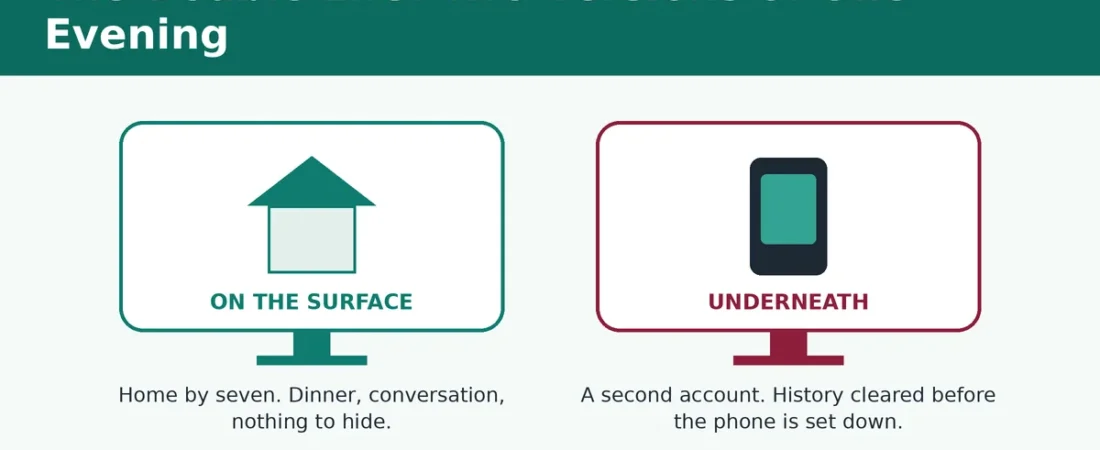
Ask people with a compulsive sexual pattern when they first suspected something was wrong, and most do not point to a particular act. They point to the hiding. The deleted history. The second account. The story told so smoothly it frightened them afterwards. Of all the warning signs, secrecy and lying is usually the first to appear and the last to be admitted — because unlike the behaviour itself, the hiding cannot be explained away as appetite, curiosity or a phase.
This page looks at secrecy and lying about sexual behaviour in detail: what the double life actually consists of, why it develops, and what it tells you that the behaviour alone does not.
Quick answer: Secrecy and lying about sexual behaviour — routinely deleting histories, keeping hidden accounts, lying by omission and maintaining a cover story — is often the earliest warning sign of a compulsive pattern. It matters because it shows the behaviour has become something the person themselves believes would not survive daylight: it conflicts with their own values and stated commitments. Privacy is healthy; a maintained double life is information worth taking seriously.
Contents
Why secrecy and lying usually comes first
Secrecy rarely starts as a plan. It starts as a small, reasonable-feeling edit: clearing a browser history “to avoid an awkward conversation”, minimising a timeframe, answering “just messaging a friend” about someone who is not a friend. Each edit works — the awkward moment passes — and that relief teaches the next one.
What makes secrecy and lying such an early sign is that it begins before the behaviour has caused visible damage. A person can still be keeping up at work, still be present at home, and already be spending real effort on concealment. The secrecy and lying is, in effect, the pattern’s first cost: time, attention and honesty spent on hiding rather than living. Partners often sense this stage before they can name it — a feeling of being managed rather than told.
Our hypersexuality test screening page walks through the wider set of signs clinicians ask about — secrecy among them — as reflection, not diagnosis.
The anatomy of a double life
The double life is rarely one big lie. It is a maintained system, and its parts are recognisable:
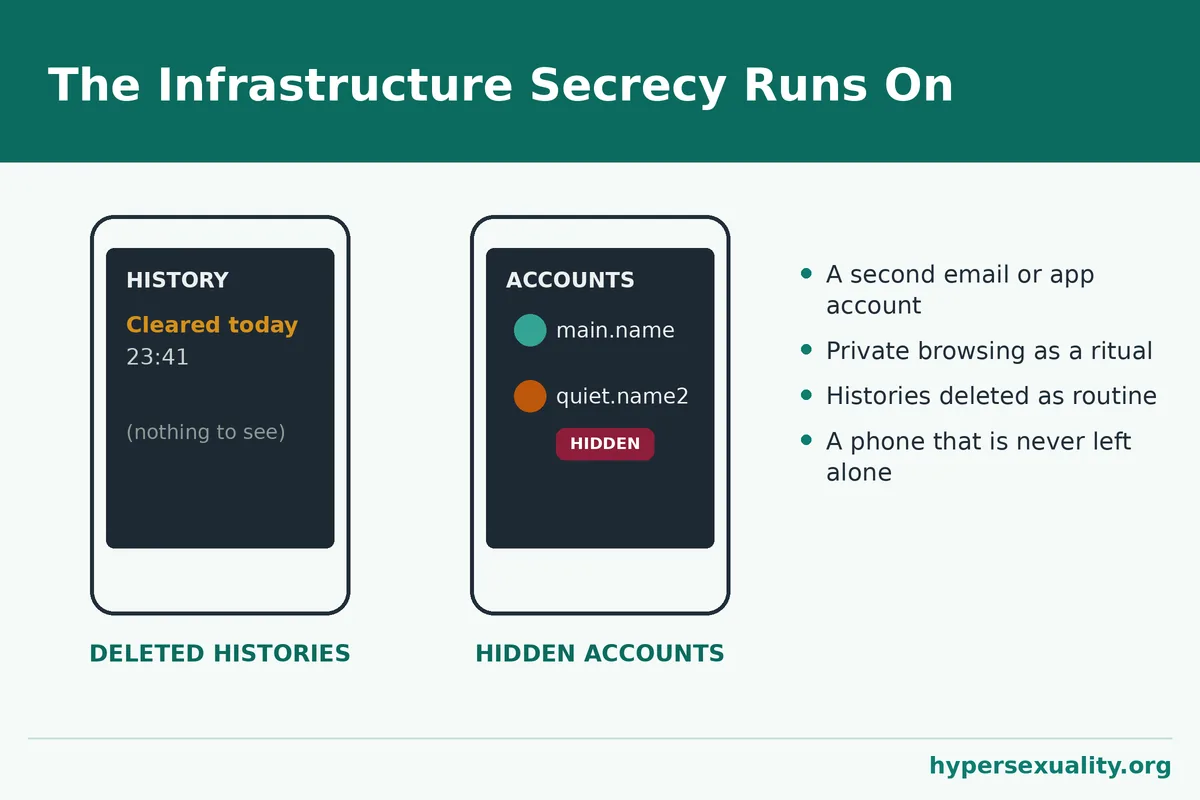
- Deleted histories as routine. Browsing data, messages and call logs cleared not occasionally but as a standing habit — sometimes several times a day, sometimes automatically.
- Separate accounts and devices. A second email address, a hidden app folder, an old phone kept charged, accounts under another name. Infrastructure exists because the behaviour has somewhere it needs to live.
- Lying by omission. Nothing technically false is said; the evening is described accurately except for the two hours that matter. Many people who keep secrets insist they “never lie” because they think only of direct falsehoods — omission is where most secrecy and lying actually happens.
- Rehearsed cover stories. Explanations prepared in advance: the late meeting, the traffic, the friend who needed help. The rehearsal is a sign in itself — spontaneous life does not need scripts.
- Compartmentalised time. Blocks of the day that are vaguely accounted for, defended irritably when asked about, and arranged around access and opportunity.
- A managed version of events for each audience. Partner, friends, family and colleagues each get a slightly different picture, and keeping the versions straight becomes its own burden.
None of these, alone, proves a compulsive pattern — people hide things for many reasons, including fear and shame imported from a strict upbringing. But the system — maintained, effortful, expanding — is the shape clinicians pay attention to.
What secrecy tells a clinician that behaviour doesn’t
Secrecy is not just a symptom sitting next to the behaviour. It is diagnostic information in its own right, and professionals read several things from it.
First, secrecy implies awareness. A person hides what they expect would be judged — which usually means the behaviour conflicts with their own stated values, not only with a partner’s feelings. That inner conflict is part of what distinguishes a compulsive pattern from a carefree one. Second, the effort of concealment measures displacement: the hiding itself eats time and mental space, and it tends to grow even when the behaviour doesn’t.
Third, secrecy blocks every natural corrective. Feedback, consequences and support all depend on someone knowing. A hidden pattern can run for years without meeting a single obstacle.
There is a related thinking pattern underneath much of this: the quiet internal bargains — “this doesn’t count”, “no one is hurt if no one knows”, “I’ll stop after this week” — that grant permission in advance. Our page on permission giving beliefs about sexual behavior unpacks those bargains, because secrecy and lying is usually negotiated with yourself first, and with everyone else second.
Secrecy is not the same as privacy
This distinction matters, and getting it wrong causes real harm — partners demanding total transparency about everything, and people with ordinary private lives fearing they are deceivers:
| Question | Privacy | Secrecy |
|---|---|---|
| What is kept back? | Thoughts, fantasies, solo sexuality, personal history | Behaviour a partner or commitment is directly affected by |
| Why is it kept back? | It belongs to the person alone; sharing is optional | Sharing would change decisions others are making |
| How does it feel to maintain? | Neutral, effortless | Effortful, vigilant, easily defended with irritation |
| What happens if it surfaces? | Mild embarrassment at most | The other person’s picture of reality breaks |
| Does it need infrastructure? | No | Yes — accounts, deletions, cover stories |
A private inner life is part of being an adult. Secrecy begins where someone else’s choices — staying in the relationship, sexual health decisions, shared money and time — are being made on the basis of a picture you know is incomplete.
The cost of running two lives
People maintaining a double life often describe a specific exhaustion that has little to do with the behaviour itself. There is the vigilance: monitoring what each person knows, checking devices, pre-answering questions nobody has asked yet. There is the shrinking: conversations that must be steered, topics avoided, a partner’s innocent questions landing like threats. And there is the isolation — the one person who knows the whole picture is you, which is why secrecy and lying so often travels with loneliness even inside a full household.
For many people this cost, not the behaviour, is what finally brings them to a screening page or a professional’s office. The pattern underneath — attempts to stop that keep failing — is its own recognisable piece, covered in our page on failed attempts to stop sexual behavior.
What it looked like for Miriam
Consider Miriam, a composite example: 38, married, a competent professional whose actual behaviour — late-night pornography and chat apps — took perhaps three hours a week. The hiding took far more. She kept a second messaging account, deleted and reinstalled apps on a cycle, told her husband she was reading during hours she could not afterwards account for, and maintained a small, constantly updated map of what he knew and what he didn’t.
What changed her mind was not discovery. It was catching herself rehearsing — in the shower, word for word — an explanation for a question he had not asked. “The behaviour was three hours,” she said later. “The lying was my whole inner life.” Recognising that the secrecy and lying had become the larger behaviour was what moved her from minimising (“it’s just porn”) to taking the pattern seriously and seeking an assessment.
First honest steps
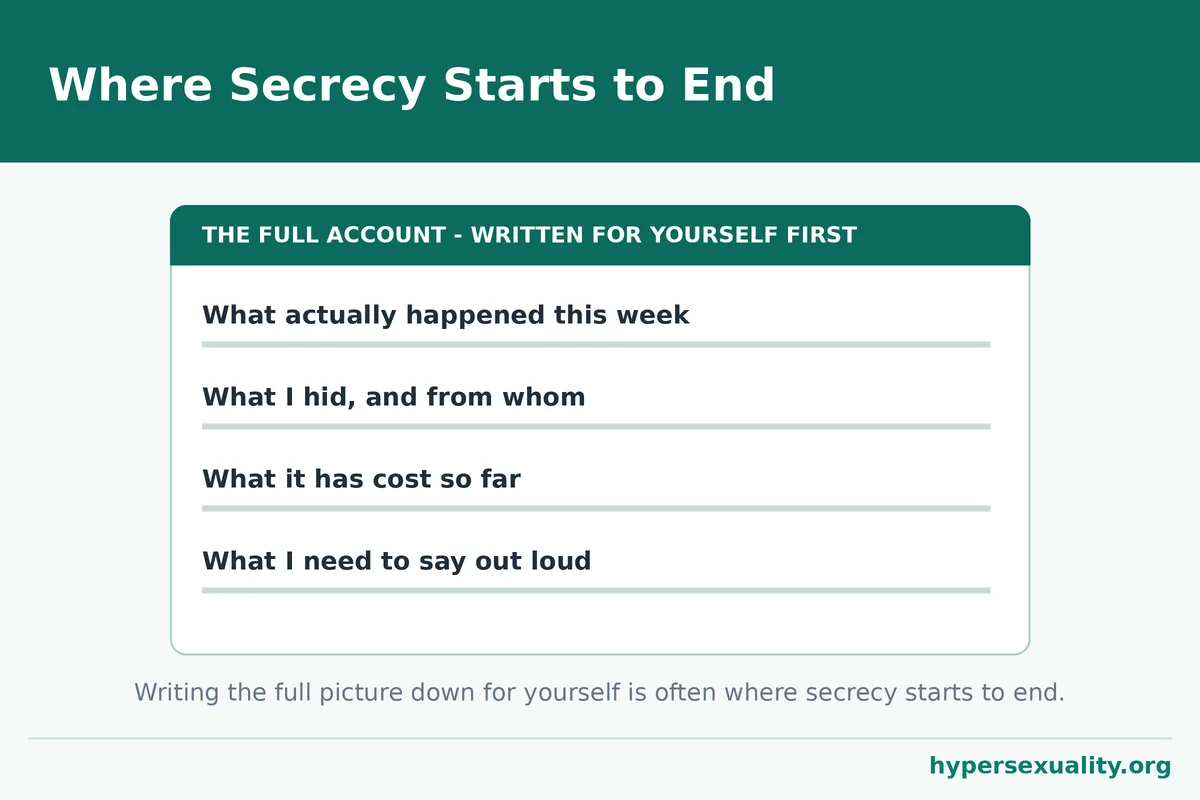
Reducing secrecy does not have to begin with a total confession delivered tonight. It can begin smaller: stop adding new layers (no new accounts, no fresh cover stories), write down — privately, for yourself — what the full picture actually is, and notice which of the escalation markers in our guide to escalation signs are present, because secrecy usually grows alongside them. The step after honesty with yourself is usually one honest conversation with a professional, who has heard all of it before.
Q&A
Is keeping sexual secrets always a sign of a disorder?
No. Privacy about fantasies, solo sexuality and personal history is normal and healthy. Secrecy and lying becomes a warning sign when it is a maintained system — infrastructure, cover stories, lies by omission — protecting behaviour that conflicts with your own commitments and that you have tried and failed to control.
I delete my history but only because my upbringing was strict. Does that count?
It might be shame rather than compulsion, and the two need different responses. The useful questions are about the pattern around the hiding: is there behaviour you cannot control, real-world consequences, and distress that is about the loss of control itself — not only about moral disapproval? ICD-11 is explicit that distress based entirely on moral judgment does not make the diagnosis.
Why do people lie even when telling the truth would go fine?
Because by the time lying is a system, it runs on habit and protection, not calculation. The lie protects the behaviour’s future access as much as its past — and after months of edited versions, telling the truth means admitting the editing too, which can feel like the larger confession.
My partner is secretive about their phone. Is that proof?
No — it is one observation, and phones carry many legitimate privacies. What carries weight is a pattern: guarded devices plus unaccounted time, inconsistencies, irritability when asked ordinary questions, and other signs together. Our guide to signs in a partner covers how to weigh observations without jumping to verdicts.
What is the first step if I recognise the double life in myself?
Stop expanding it. No new accounts or cover stories from today; get the full picture written down for yourself; then use a structured screening to organise what you know and take it to a professional. Honesty with yourself is the first repair — most people find the relief of stopping the maintenance is immediate, even before anything else changes.
Sources: World Health Organization, ICD-11 entry 6C72 “Compulsive sexual behaviour disorder”; Kraus, S. W. et al. (2018), “Compulsive sexual behaviour disorder in the WHO ICD-11,” World Psychiatry, 17(1), 109–110.
Medical disclaimer: This article is educational information only and is not medical advice, diagnosis or treatment. Only a qualified clinician who knows your history can assess whether any diagnosis applies to you. If sexual behaviour is causing you distress or harm, consider speaking with your doctor or a licensed mental-health professional.