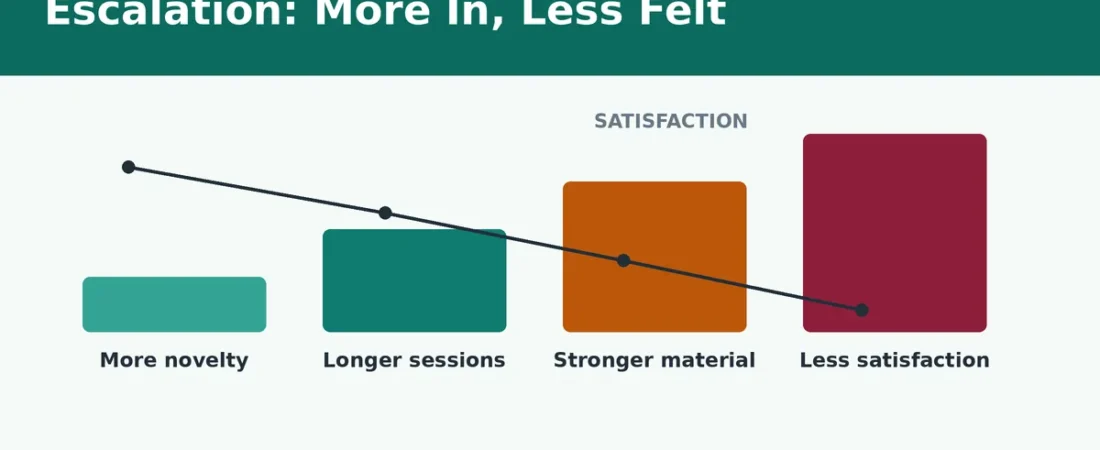
Almost nobody starts where they end up. The material that once held someone’s attention for an evening stops working; the session that ended at midnight ends at two; the line they drew last year — “never anything like that” — is crossed so gradually they cannot date it. This slow drift is called escalation, and of all the changes people notice in their own sexual behaviour, the escalation signs are the ones most often recognised in hindsight and missed in the present.
This page names the progression markers one by one, so they can be recognised while they are still small: novelty hunger, taboo drift, sessions that lengthen, and the flatness afterwards that quietly drives the next round.
Quick answer: Escalation signs are the observable markers that a sexual pattern is needing more to achieve the same effect: familiar content stops satisfying (novelty hunger), material drifts toward what once felt off-limits (taboo drift), sessions get longer and harder to end, and afterwards there is flatness rather than satisfaction. One marker alone proves little. A clear progression over months — more time, more intensity, less satisfaction — is the pattern clinicians take seriously.
Contents
What escalation actually is
Escalation is the sexual-behaviour version of a process well known in addiction science: repeated exposure dulls the response, so the same effect requires a stronger dose. With pornography and sexual behaviour the “dose” is rarely a substance — it is novelty, intensity, risk or time. The brain’s reward system responds most strongly to what is new, which is why the drift is usually toward the unfamiliar rather than toward more of the same.
Two honest qualifications belong here. First, escalation is a pattern description, not a diagnosis: it appears inside compulsive sexual behaviour, but a drifting taste on its own does not make a disorder — control, consequences and distress decide that, which is what our hypersexuality test screening page is organised around. Second, escalation is not inevitable or one-directional; many people notice a drift and correct it. The concern is progression that continues despite the person noticing it and disliking it.
The fuller mechanism — how tolerance builds in sexual behaviour — is covered in our Cluster 1 explainer on escalation and tolerance in sexual behavior. This page stays practical: what the escalation signs look like from the inside.
Escalation signs: the progression markers, one by one
Clinicians listening to a history tend to hear the same sequence. Each marker below is a recognised escalation sign; they usually arrive in roughly this order, though not always. Each of the escalation signs below tends to arrive quietly; recognised together, they are the pattern.
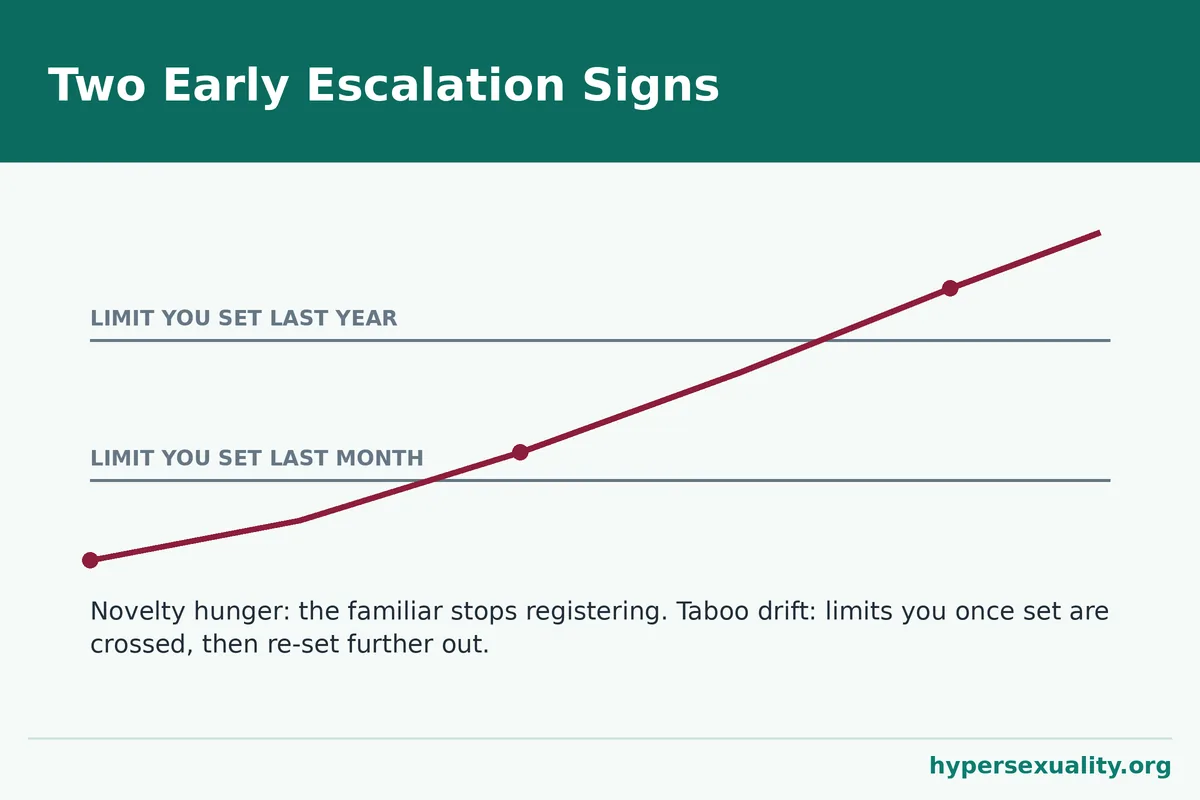
- Novelty hunger. The same content, partners or scenarios stop registering. Browsing becomes the point — the searching, tab-opening and previewing takes longer than any actual viewing, because novelty itself is the reward being chased.
- Taboo drift. Material or behaviour moves toward categories the person would once have declined — harder content, riskier arrangements, scenarios that conflict with their own values. The drift is usually incremental: each step is only slightly beyond the last, which is exactly why it goes unchallenged.
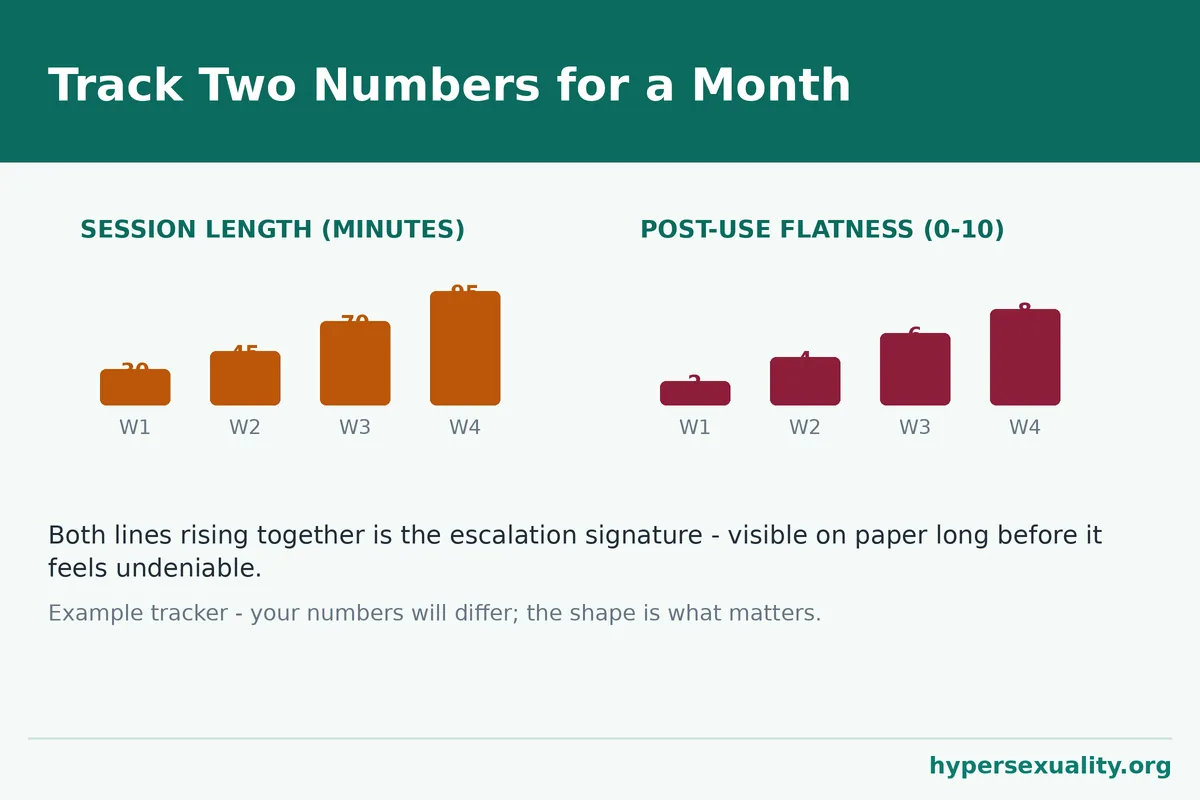
- Session lengthening. Sessions stretch — thirty minutes becomes two hours — and become harder to end. “One more” is the characteristic phrase. Time-based escalation often appears before content-based escalation and is easier to verify honestly from screen-time records.
- Post-use flatness. Afterwards there is not satisfaction but a grey, depleted feeling — and, paradoxically, a pull to go again soon, because the flatness itself gets treated with the same behaviour. Clinicians sometimes call this chasing: the session is no longer producing pleasure, only relieving the flatness the last one left.
- Risk creep. The settings escalate too: at work, in semi-public places, with money that was spoken for, in situations with real discovery or safety consequences that would once have been a firm stop.
- Preoccupation growth. Between sessions, more of the day is colonised — planning, anticipating, mentally replaying. The behaviour’s share of the person’s inner life grows even when its visible frequency doesn’t.
A self-recognition checklist
Read these as a pattern-spotter, not a verdict. Answer for the last six months, and compare with where you were a year ago — escalation signs are about direction, not snapshots. Answering from records (screen time, spending, timestamps) beats answering from impressions.
- Content that used to satisfy me now leaves me restless within minutes.
- I spend more time searching and browsing than watching or doing.
- I have crossed at least one line I previously set for myself about what I would view or do.
- My sessions regularly run longer than I intend, and ending them feels difficult.
- Afterwards I feel flat or irritable more often than satisfied.
- The behaviour has moved into riskier settings or costlier forms than a year ago.
- I think about the next session, plan around it, or replay the last one through much of the day.
- I have noticed all of this — and the progression has continued anyway.
Several of these, sustained and moving in one direction, describe a pattern worth discussing with a professional. The last item matters most: escalation that continues after it has been noticed is where description starts to meet loss of control. Recognising the escalation signs early is what makes them easiest to reverse.
Escalation vs a naturally adventurous sex life
Not every drift is a warning. Tastes genuinely change across a lifetime; couples explore; curiosity is healthy. The difference is not the destination but the mechanics:
| Question | Adventurous exploration | Escalation pattern |
|---|---|---|
| Who is steering? | The person chooses, and can equally choose not to | The drift continues despite decisions to stop it |
| How does it feel afterwards? | Satisfied, connected, amused | Flat, depleted, sometimes distressed |
| What is being chased? | Variety and pleasure | Novelty itself; relief from flatness |
| Effect on the rest of life | None, or positive | Sleep, time, money and honesty start paying |
| Relationship to own values | Comfortable; lines hold | Lines keep being redrawn after the fact |
Notice that the left column can involve material just as unconventional as the right. Clinicians do not assess content; they assess control, trajectory and cost. Our page on secrecy and lying covers the concealment that usually grows alongside escalation, and the two patterns are worth reading together.
What it looked like for Paul
Consider Paul, a composite example: 44, whose pornography use began conventionally enough in his thirties. In the year he finally tracked honestly, the shape was unmistakable. The categories he watched had drifted twice past lines he remembered setting. His sessions, once twenty minutes, averaged over two hours on work nights. The searching had become the ritual — dozens of tabs, little watched to the end.
And the clearest sign came last: he described feeling “nothing much, then grim” after sessions he had spent the whole day anticipating.
Nothing in Paul’s year was dramatic in isolation. Lined up in order, the escalation signs told a single story — more input, less effect, continuing anyway — and seeing the sequence written down was what persuaded him the pattern, not his willpower, was the problem to address.
If you recognise the progression
Escalation is most reversible early, and the honest first moves are modest. Verify before you interpret: pull actual screen-time and spending records rather than trusting impressions, because drift is easy to minimise. Name your lines in the present tense — what you currently decline — and notice whether they hold for a month; lines that keep moving are data. Shorten the runway: escalation feeds on unlimited private access, so friction (devices out of the bedroom, no sessions after a set hour) tests control in a way resolve alone doesn’t.
And if the progression continues through honest attempts, that result is itself the finding — take it to a professional, or start with the partner-focused picture in our next guide if it is someone else’s pattern you are watching: the signs of hypersexuality in a partner are often visible from outside before they are admitted from inside.
Q&A
Is needing more intense content proof of sex addiction?
No. Escalation signs describe a trajectory, not a diagnosis. Tastes change for many benign reasons. What raises clinical concern is the combination: progression plus failed attempts to control it, real-world consequences and distress — sustained over months. A professional assessment weighs the whole picture; no single marker settles it.
Can escalation reverse on its own?
Sometimes. People do notice a drift and correct it, especially when the drivers were situational — a stressful year, unlimited private time, a new app. What distinguishes the concerning pattern is that it continues after being noticed and after sincere attempts to reverse it. If your honest attempts keep failing, treat that as the signal to get support rather than to try the same approach harder.
Why does the same porn stop working?
Because the reward system responds most strongly to novelty. Repeated exposure to the same stimulus produces a duller response — a normal feature of how brains learn, not a personal defect. In a compulsive pattern that dullness gets answered with stronger novelty rather than with a pause, which is what turns a normal mechanism into escalation.
My partner’s tastes have drifted. Should I be worried about the content itself?
The content alone is a weak signal — adults’ tastes vary widely and change. Watch the mechanics instead: Is it costing sleep, money or honesty? Is it displacing intimacy with you? Does it continue after conversations about harm? Those are the questions that distinguish a pattern from a preference.
Does escalation always keep getting worse?
No — it is not a ratchet with no release, and fatalism about it helps no one. Escalation is a learned pattern, and learned patterns can be unlearned, particularly with structured help. The realistic warning is narrower: unaided, in the same conditions that produced it, drift usually continues. Changing the conditions is the work.
Sources: World Health Organization, ICD-11 entry 6C72 “Compulsive sexual behaviour disorder” ; Derbyshire, K. L. & Grant, J. E. (2015), “Compulsive Sexual Behavior: A Review of the Concept and Associated Neurobiological Processes,” Journal of Addiction Medicine, 9(3), 235–241
Medical disclaimer: This article is educational information only and is not medical advice, diagnosis or treatment. Only a qualified clinician who knows your history can assess whether any diagnosis applies to you. If sexual behaviour is causing you distress or harm, consider speaking with your doctor or a licensed mental-health professional.