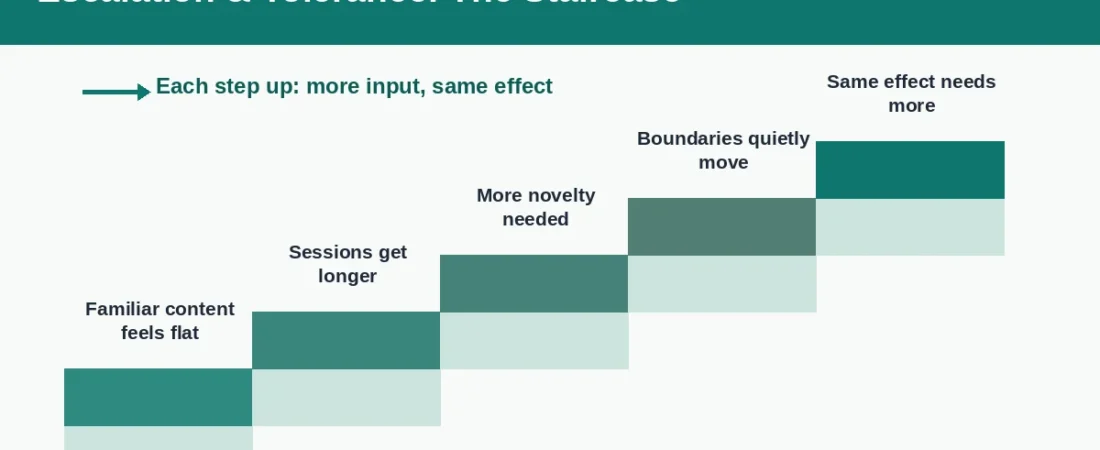
Almost nobody starts at the extreme end of anything. Escalation is a slope, not a cliff. The material that once felt exciting goes flat. Twenty-minute sessions stretch to two hours. Content drifts — slowly, one small step at a time — toward novelty, intensity or themes the person never planned to seek out. Then comes the question that brings many people to pages like this one: how did I get here?
Escalation and tolerance in sexual behavior is the mechanism underneath that slope. The language is borrowed from addiction science and needs care — compulsive sexual behavior is not classified as an addiction — but the learning process it describes is real and well documented. This article explains how it works: desensitisation, novelty-seeking, taboo drift, and the early signs worth recognising in yourself.
Quick answer: Escalation means needing more — more time, more novelty, more intensity — to achieve the same effect from sexual behaviour. Tolerance is the flattening that drives it: with repeated exposure, the brain’s response to the same material dulls, so the person seeks stronger stimulation to feel what they felt before. Together, escalation and tolerance explain why compulsive patterns tend to intensify over time, and why willpower misses the learning process underneath.
Contents
Tolerance: why the same material goes flat
Tolerance begins with an ordinary property of the brain called habituation. Any repeated stimulus — a song, a smell, a video — produces a smaller response over time. In sexual behaviour, the same flattening applies: content that once produced intense arousal barely registers after enough repetition.
Brain-imaging research supports this picture. Voon and colleagues (2014) found that people with compulsive sexual behaviour showed heightened reactivity in reward regions when exposed to sexual cues — a sensitised wanting system — alongside the familiar report that the material itself felt less satisfying. Wanting more while liking less is the engine room of tolerance.
Tolerance in sexual behavior also shows up in time before it shows up in content. Sessions lengthen because the payoff takes longer to reach, and breaks between sessions shorten. These measurable changes usually arrive before any dramatic shift in what a person watches or does.
Novelty-seeking: the brain’s shortcut back to intensity
If tolerance dulls the familiar, novelty restores the spark — instantly. The brain’s reward system responds strongly to new stimuli, an effect long documented in animal research as the Coolidge effect: arousal that has faded for a familiar partner or stimulus revives with a novel one.
Human sexuality has always contained this wiring, but the modern internet industrialised it. Novelty that once required effort, risk or money is now infinite, free, private and one click away. Algorithms supply it before boredom can end a session.
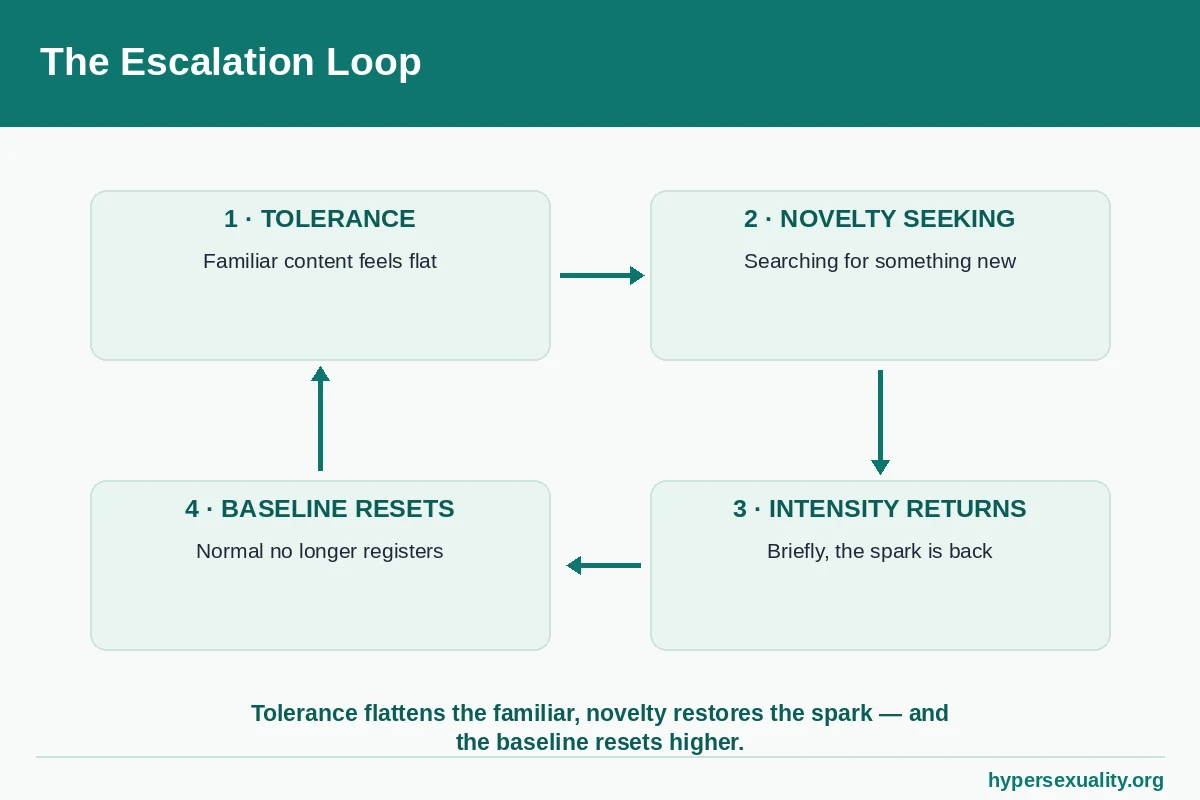
So when familiar content goes flat, the path of least resistance is not to stop — it is to move sideways into something new. Escalation and tolerance feed each other through this shortcut: tolerance creates the flatness, novelty-seeking supplies the fix, and the fix sets a new baseline that will itself go flat.
Taboo drift: when boundaries move quietly
The most unsettling form of escalation is drift in content and context rather than quantity. It rarely happens in leaps. A category that felt like a line is crossed on a tired, stressed night; the line quietly relocates. Over months, the person’s viewing or behaviour can migrate far from their starting point — toward more extreme themes, riskier settings, or material that conflicts with their own values.
Three features make taboo drift hard to notice from inside. Each step is small relative to the last, so no single step feels like a decision. It happens under conditions that weaken judgement — late nights, stress, alcohol, loneliness. And secrecy removes the social feedback that might have flagged it.
Drift does not mean the person’s values have changed, or that they secretly wanted the destination all along; it is a predictable product of tolerance plus unlimited novelty. For the large majority, it also stays within legal, consensual adult material — escalation is a direction, not a destiny toward anything illegal.
The loop that locks escalation and tolerance in
Escalation and tolerance do not run on novelty alone. Cue conditioning strengthens them: places, devices, times of day and emotional states become triggers that fire craving before any conscious choice, because the brain has paired them with reward hundreds of times. Variable, unpredictable rewards — the not-quite-satisfying scroll in search of the right clip — are especially powerful teachers.
This is also where escalation connects to the wider pattern of hypersexuality: a behaviour that is escalating is usually also becoming harder to control, so clinicians ask about change over time, not just current behaviour. The neurochemistry underneath has its own deep dive in our explainer on dopamine tolerance and sexual escalation.
Early signs of escalation worth recognising
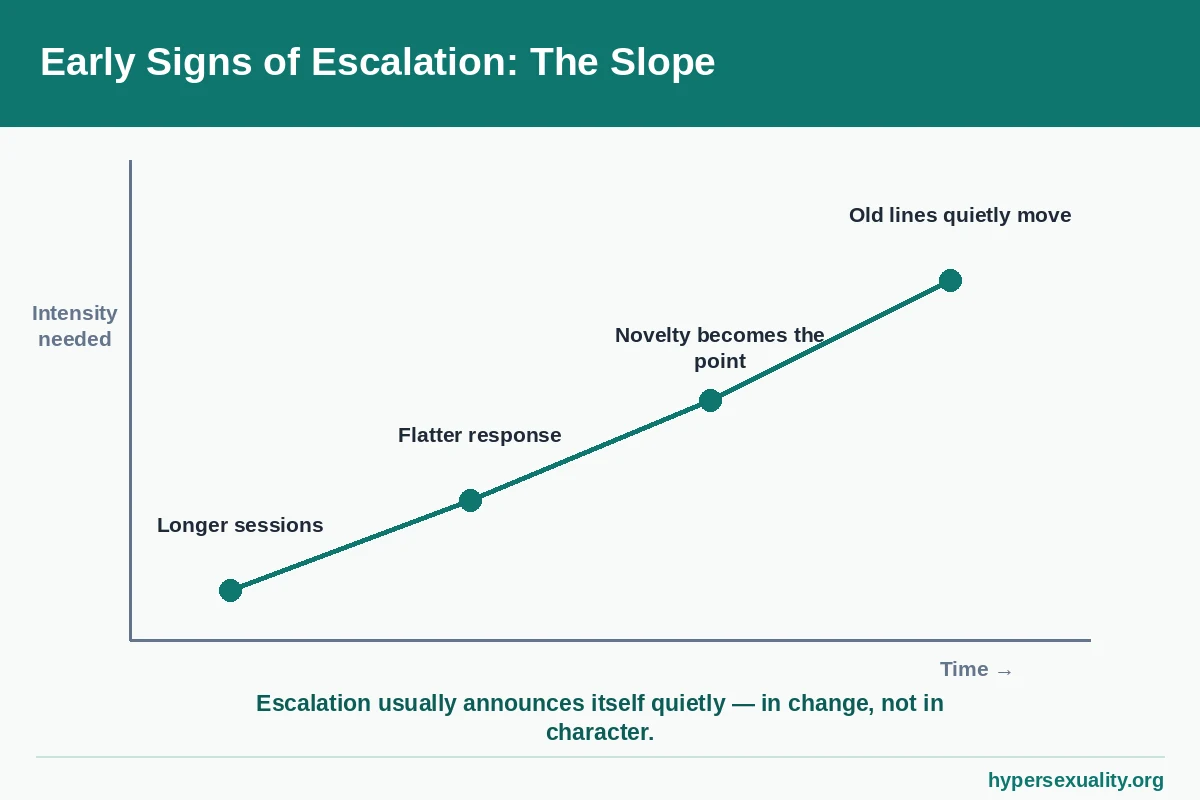
Escalation is easiest to interrupt early, while it is still visible as change rather than identity. The signs people most often report:
- Sessions keep lengthening. What took twenty minutes now takes an hour or more, and stopping mid-session feels disproportionately hard.
- The same content stops working. Familiar material feels flat, and you search longer for something that registers.
- Novelty becomes the point. You are less interested in any particular content than in finding something new; the search consumes the session.
- Old lines quietly move. You return to categories, times or contexts you had decided were off-limits — then renegotiate the rule.
- Partnered sex feels muted by comparison. Real intimacy seems low-intensity next to a screen tuned to your novelty preferences.
- You hide the extent, not just the act. Secrecy grows around how much and how far, because part of you is already tracking the slope.
None of these signs, alone, diagnoses anything. Together, sustained over months, they describe escalation and tolerance at work — and that is information, best used early.
A concrete scenario
Ruben, 29, did not recognise his own pattern in descriptions of “sex addiction,” because nothing in his life looked dramatic. He had a job, a girlfriend, no affairs, no spending problem. What he had was a slope. At 24, mainstream pornography for fifteen minutes. By 27, sessions ran past midnight on work nights. By 29, he spent most of each session searching — skipping, sampling, hunting for a clip that would cut through a flatness he could not explain — and had drifted into content he found faintly repellent, deleted from his history with real disgust.
His values had never changed. His tolerance had. Reading the mechanism, rather than a moral verdict, let Ruben describe the pattern accurately for the first time: not an addict identity — a learning process running in the wrong direction, which could be run backwards.
Can escalation be reversed?
Mostly, yes. Escalation and tolerance are learned patterns, and learned patterns can move in both directions. Habituation fades when exposure falls sharply: sensitivity to ordinary stimulation recovers over weeks to months, which is one reason structured breaks from pornography are a common early treatment step. It is not a moral reset; it is the same learning system recalibrating.
What treatment adds is work on the loop itself: identifying cues, redesigning environments that deliver infinite novelty, and building responses to the emotional states that start sessions. Where escalation is part of a broader loss of control, it belongs inside a full assessment against the hypersexuality vs healthy sexuality yardsticks — control, distress and impairment. Where pornography is the main channel, our guide to problematic pornography use and hypersexuality maps that presentation.
Q&A
Why does the same porn stop working after a while?
Because of habituation: the brain reduces its response to any stimulus seen repeatedly. The material has not changed — your reward system’s reaction to it has. This flattening is tolerance, and it is the trigger for escalation and tolerance to compound, because novelty is the fastest way to make the response fire again.
Does escalation mean I will end up wanting illegal content?
No. Escalation describes a direction — toward more novelty, time or intensity — not a fixed destination. The large majority of people with escalating patterns stay within legal, consensual adult material, and drift reflects tolerance, not hidden desires. If urges ever did point toward illegal material or anyone’s harm, that is a signal to seek professional help immediately — and help for exactly that exists without judgement.
Is tolerance to sexual content permanent?
Generally, no. Sensitivity recovers when exposure is reduced or stopped for a sustained period — typically weeks to months — because habituation is a reversible learning process. What can persist longer are the cue associations (places, devices, emotional states that trigger craving), which is why treatment works on cues and routines, not only on abstinence from content.
How is escalation different from simply having broad sexual tastes?
Breadth is stable and chosen: wide tastes are enjoyed, can be taken or left, and are not migrating under the person. Escalation is a change over time driven by flattening — needing more to feel the same, moving lines you set, and ending up with material that conflicts with your own values. The test is movement and control, not the content itself.
What is the earliest sign of escalation I should watch for?
Time. Sessions lengthening, and stopping feeling harder than it used to, typically arrive before any dramatic change in content. A close second is the character of a session changing from watching to searching — spending more time hunting for something that registers than engaging with anything. Both respond well to early interruption.
Sources: World Health Organization, ICD-11 entry 6C72 “Compulsive sexual behaviour disorder”; Voon, V. et al. (2014), “Neural correlates of sexual cue reactivity in individuals with and without compulsive sexual behaviours,” PLoS ONE, 9(7), e102419.
Medical disclaimer: This article is educational information only and is not medical advice, diagnosis or treatment. Only a qualified clinician who knows your history can assess whether any diagnosis applies to you. If sexual behaviour is causing you distress or harm, consider speaking with your doctor or a licensed mental-health professional.