“I’ve Tried to Stop and Can’t”: What Failed Attempts Really Tell You
The promise is usually made at 3 a.m. It is completely sincere. The app is deleted, the account closed, the words never again said with total conviction — and by Friday, or the next bad day, or the next lonely hotel room, it has happened again. If that cycle is familiar, you have probably already delivered your own verdict on it: weak, dishonest, addicted, broken.
This page exists to tell you that clinicians read the same facts very differently. Failed attempts to stop are not a character report. They are some of the most informative data in this entire field — data about what is driving the behaviour, about where control is actually breaking down, and about what kind of help, if any, the situation calls for.
Quick answer: Repeated failed attempts t
Why failed attempts to stop matter more than frequency
Why the willpower frame fails
If effort were the answer, you would already be finished — most people who reach this page have supplied heroic quantities of effort. Understanding why effort alone fails is the first step to understanding your failed attempts to stop. The willpower frame fails for structural reasons:
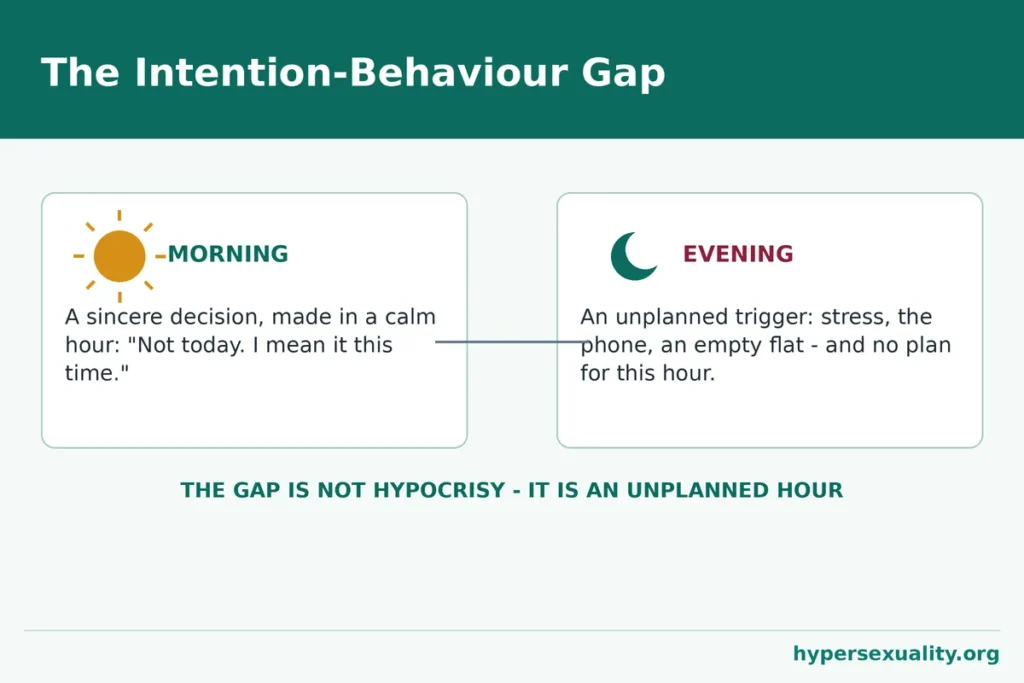
It fights the urge at its strongest point, and changes nothing about the chain. A resolution made in the morning is tested in the evening — tired, stressed or lonely — against a behaviour that has been practised into a reflex, and willpower is a depleting resource while the trigger is not. The behaviour also sits at the end of a sequence — a state (exhaustion, conflict, boredom), a cue (the phone, the empty flat, the hotel room), a ritual, the act — and pu
Which pattern of failures matters clinically
Not every failed attempt means the same thing, and not all failed attempts to stop carry the same weight. A single abandoned resolution in a brutal month is ordinary human frailty. The features below are what shift a history of failures from “life happened” toward “this is the pattern a professional would take seriously”:
What a failed attempt can teach you
What a failed attempt can teach you
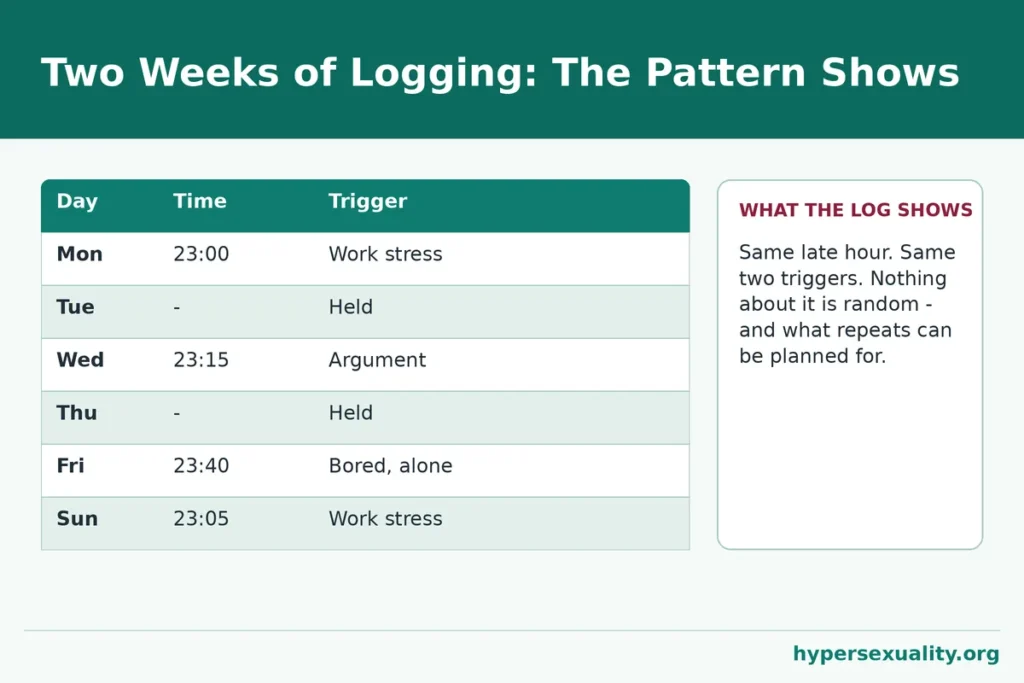
Here is the reframe that changes things practically: every failed attempt is an experiment with a result, if you record it. For two weeks, after any lapse, note four things: the state you were in (tired, wired, rejected, bored), the setting (place, time, device), the first step of the ritual (the innocent-seeming action that started the chain), and the story you told yourself (“just to check”, “I’ve earned it”, “it’s already ruined”).
Most people who do this discover their failures are not random. They cluster — on the same state, the same setting, the same first step. A cluster is a target: it tells you where the chain is weakest, and where a change of design can succeed where a change of resolve did not. Logged this way, failed attempts to stop stop being verdicts and start being instructions.
Written down, failed attempts to stop stop looking random — the same trigger usually repeats.
What it looked like for Ken
Consider Ken, a composite example: 51, divorced, a m
From verdict to next step
If you take one thing from this page, take the translation: I have failed to stop does not mean I am the kind of person who cannot stop. It means the method — unaided resolve against an intact chain — has been tested and found insufficient, which is a finding about method, not about worth.
What to do with it depends on the shape of your pattern. If your failures cluster like Ken’s, design work on the cluster is a reasonable next step. If the table’s right-hand column describes you across the board, take the screening and then take the results to a professional. A different mirror is also worth holding up: the out of control sexual behavior model, which asks not only whether you can stop but how your brakes and accelerator are balanced. And if you arrived from a specific behaviour rather than the general pattern, the compulsive masturbation self-check applies the same lens to the most common single case.
Q&A
How many failed attempts mean it is a real problem?
There is no magic number, and anyone who gives you one is inventing it. Count the pattern of your failed attempts to stop, not just the attempts. What matters is their shape: repeated across months, collapsing quickly, followed by escalation or deepening secrecy, and continuing despite real costs. One or two failed resolutions during a crisis period is ordinary. A dozen sincere failures in ordinary times, with harm accumulating, describes the loss-of-control pattern clinicians take seriously.
If I can stop for a few weeks at a time, am I actually in control?
Partly — and the quality of the stopping matters as much as its length. A few calm weeks where the behaviour simply isn’t missed suggests real control. A few weeks of white-knuckled misery, obsession and irritability, ending in a heavier collapse, suggests control being rented at high interest rather than owned. Look at how the breaks feel and what follows them, not just at the calendar.
Why do I always relapse at the same times and places?
Because the behaviour is learned, and learning is specific. States and settings that have repeatedly preceded it — the hotel room, the post-argument hour, the sleepless night — become triggers that fire the chain almost automatically. That specificity is good news: a predictable pattern can be planned for, interrupted earlier and redesigned, which is why logging the circumstances of lapses is such a powerful step.
Does failing to stop mean I am addicted?
It means you have evidence of a control problem, which is the thing worth acting on regardless of the label. “Sex addiction” is a popular frame but not an official diagnosis; the ICD-11 recognises compulsive sexual behavior disorder, an impulse-control condition defined by exactly this pattern of failed control and persistence despite harm. Whether that diagnosis applies to you can only be settled by a professional assessment — but you do not need the label settled to deserve help with the pattern.
What should I do differently on the next attempt?
Change a link, not just your resolve. From your last few attempts, identify the repeating state, setting and first step — then alter one concretely: the device sleeps elsewhere, the high-risk evening gets a scheduled call, the underlying state (sleep, stress, loneliness) gets its own direct treatment. Tell one person, so a lapse becomes information instead of a secret, and agree in advance what you will do in the hour after a lapse, besides shame. If attempts designed this way still fail, that is the signal to stop running the experiment alone and bring in professional help.
Medical disclaimer: This article is educational information only and is not medical advice, diagnosis or treatment. Only a qualified clinician who knows your history can assess whether any diagnosis applies to you. If sexual behaviour is causing you distress or harm, consider speaking with your doctor or a licensed mental-health professional.
an who kept count — eleven times he had deleted the app, twice he had broken a phone contract early and paid the fee, once he had lasted a hundred days and described it as “the worst hundred days of the year”, white-knuckling through every one of them.
He described himself to a counsellor, at their first session, as “a liar with a sex problem”. The counsellor asked a different question: not why do you keep lying, but when do you keep failing?
Ken’s log took ten days to answer it. Every collapse happened on a work-trip evening, in a hotel, after the particular loneliness of eating alone in a chain restaurant — never at home, never at weekends, never in company. Eleven failures, one shape.
His attempts had not been weak; they had been aimed at his whole life, when the pattern lived in about six evenings a month. The work became specific: the trip evenings were redesigned (a call scheduled, exercise before dinner, the app’s friction restored, a colleague who knew the outline and texted at nine), and the abstinence rule was replaced with a plan that had somewhere to go after a lapse besides collapse. Ken’s history of failure, reread as a map, turned out to be the most useful document in his treatment. That is what failed attempts to stop are for: not verdicts. Maps.
Feature
Less concerning
More concerning
Number and span
One or two attempts, in an unusually hard period
Many attempts, across months or years, in ordinary periods too
Time to relapse
Weeks of control before a lapse
Hours or days; the resolution barely survives contact with the usual trigger
What happens after a lapse
A single episode, then the plan resumes
A collapse into the full pattern — the “already ruined” effect
Escalation after failure
Behaviour returns to its previous level
Each return is heavier: more time, intensity, risk or spending
Secrecy after failure
Someone knows; the attempt was shared
Failures are concealed; the double life deepens with each cycle
Harm during the cycle
Little or none
Behaviour continues through clear costs to work, money, health or a relationship
Read down the right-hand column and you are reading, in plain language, the shape of the clinical pattern: failed control, persistence despite consequences, over an extended period. That is the point at which self-management has had a fair trial, and a structured hypersexuality test screening followed by professional assessment is the proportionate next step — not another resolution made at 3 a.m.
re resolve addresses only the final link, the one with the least leverage, leaving every earlier link intact.
It is usually all-or-nothing, so it manufactures collapse. A rule of “never again, forever” converts one lapse into total failure — and the shame of total failure is itself a trigger. Clinicians call this the abstinence violation effect: the lapse does not cause the binge; the interpretation of the lapse does. People do not fall off the wagon so much as they are pushed by the story they tell about having slipped.
It treats shame as fuel. Shame feels like motivation and behaves like accelerant. The cycle of episode, disgust, vow and episode is powered by exactly the emotion the willpower frame relies on. This is also why secrecy about sexual behavior does so much damage: concealment protects the cycle from every source of interruption.
None of this means change is impossible. It means the unit of change is not effort. It is design: different cues, different tools for the underlying states, support that survives a lapse, and — where the pattern is entrenched — professional treatment aimed at control rather than character.
Clinicians pay close attention to the gap between intention and behaviour, because it separates two situations that look identical from outside. In the first, someone behaves in ways they afterwards regret because the behaviour clashes with their beliefs — a values conflict, producing guilt but not necessarily any loss of control; they could stop, and when it truly matters, they do. In the second, the person has tested their own control, deliberately and repeatedly, and watched it fail. That second situation is what failed attempts to stop actually reveal: not a label, but a demonstration — run by the person on themselves — that intention alone is no longer steering.
Hold on to that distinction, because everything else in this page follows from it — including how much weight your own failed attempts to stop deserve.
This is why the ICD-11 description of compulsive sexual behaviour disorder gives unsuccessful control attempts a central place, and why validated instruments such as the Hypersexual Behavior Inventory build a whole factor around control. Frequency, by contrast, tells a clinician almost nothing — plenty of high-frequency behaviour is fully controlled, and a modest habit that defeats every sincere resolution is the more serious picture. If your history is a list of broken attempts, you are holding the most relevant evidence about your own situation.
Failed attempts to stop are data about triggers and timing, not a verdict on character.
o stop tell you that the problem is not desire and not effort — it is control. A person who wishes they wanted sex less is having a values conflict. A person who sincerely decides to stop, tries, and repeatedly cannot is showing the loss-of-control pattern that the ICD-11 names as central to compulsive sexual behavior disorder: unsuccessful efforts to control the behaviour, continuing despite harm. Your failures are not proof that you have not tried hard enough. They are evidence about what needs to change — and they cannot be fixed by trying the same way, harder.