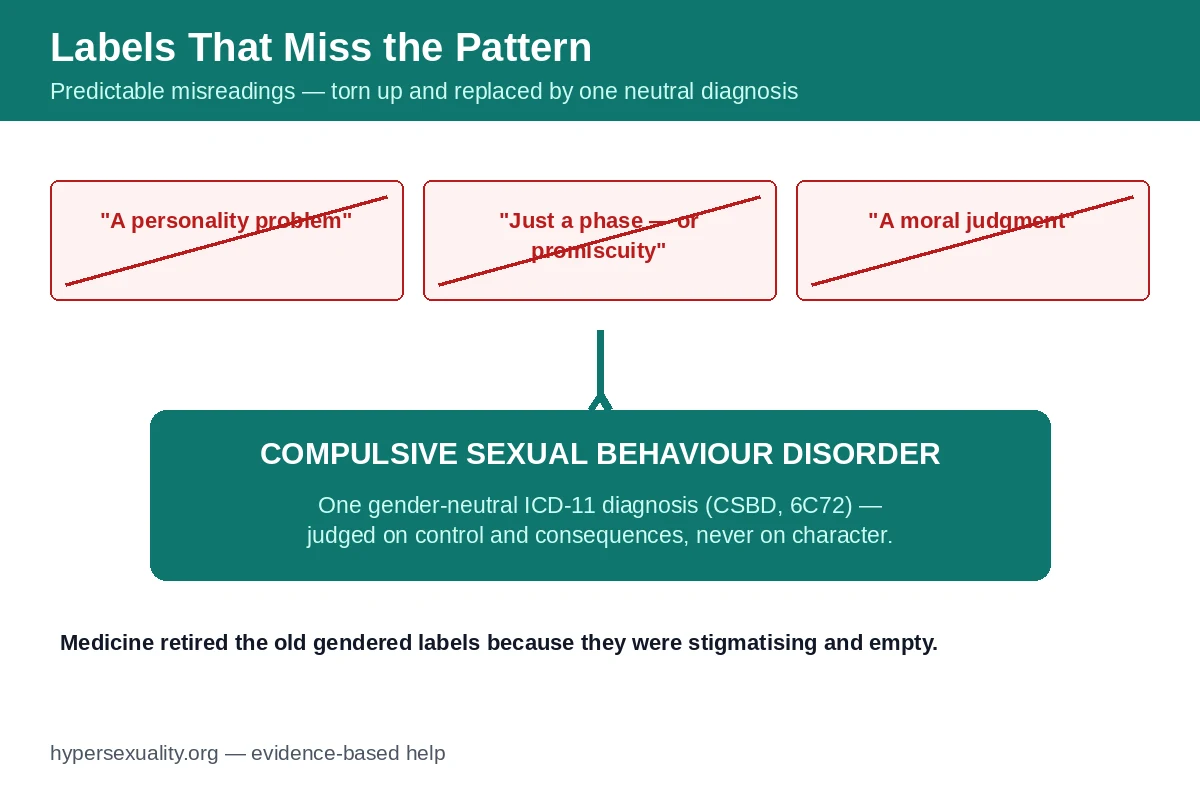
For most of medical history, a woman with intense, out-of-control sexual urges was not offered a diagnosis — she was offered a slur. The old clinical vocabulary for this condition in women (a word you will still find in the titles of pages that rank for this keyword) was abandoned by medicine precisely because it functioned as an insult dressed as science, implying that a woman’s desire itself was the disease. The male equivalent terms were dropped too. Modern clinicians use the same gender-neutral language for everyone: hypersexuality, or compulsive sexual behaviour disorder (CSBD).
That history has a living consequence: because the culture treated female desire as either invisible or shameful, the real pattern in women is still under-recognised — by doctors, by partners, and by women themselves. This article covers how hypersexuality in women actually presents, why it gets misread as something else, and what a respectful assessment looks like.
Quick answer: Hypersexuality in women is the same core pattern as in men — persistent, hard-to-control sexual urges and behaviour that continue despite harm and cause distress or impairment — but it is more often hidden, more often organised around relationships, fantasy, apps and emotional intensity than around pornography volume, and far more often mislabelled, including as a personality problem. A high sex drive in a woman is not a disorder; loss of control plus consequences is the issue, exactly as it is for men.
Contents
A note on words, before anything else
You may arrive at this page having searched an older term. Those words — the ones historically applied only to women — are outdated and stigmatising, and this site does not use them as labels for people. They survive mainly in search boxes and in the titles of lower-quality clinic pages. What those searches are really asking is a legitimate clinical question about hypersexuality in women, and it deserves a legitimate answer in modern language: when does a woman’s sexual desire become a pattern she cannot control, and what helps? We also keep a full list of the outdated words medicine dropped for this condition, and why.
The signs in women — including the overlooked ones
The universal symptom structure (thoughts → behaviour → consequences) is detailed in our symptoms checklist. In hypersexuality in women, several presentations are consistently under-recognised:
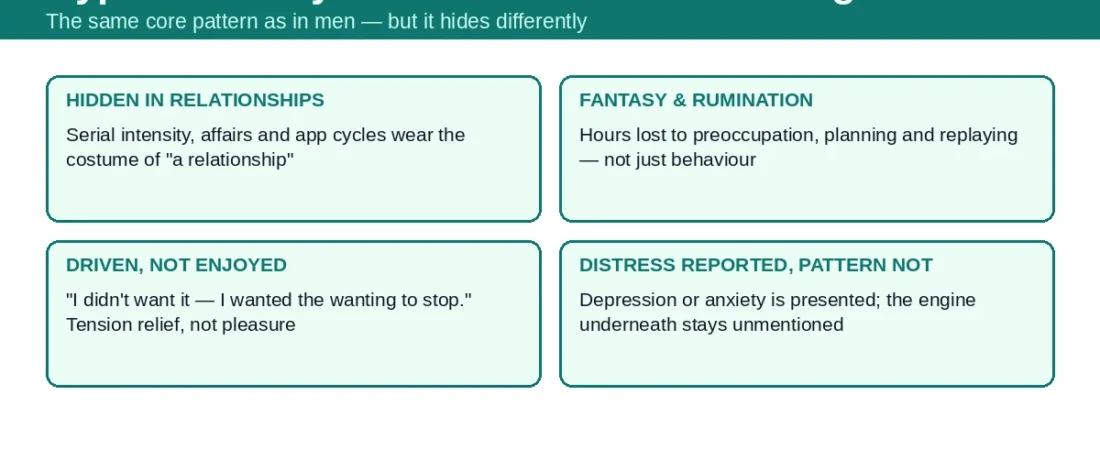
- The pattern hides inside relationships. Where men’s patterns often centre on pornography and anonymous outlets, women’s more often involve intense romantic-sexual preoccupation: serial relationships, affairs, sexting, dating-app cycles, or fixation on a particular person. Because each episode wears the costume of “a relationship”, the compulsive through-line — loss of control, repetition, harm — goes unnoticed for years.
- Fantasy and rumination dominate. Hours lost not to behaviour but to sexual and romantic fantasy, planning and replaying — a mental occupation that interferes with work and presence just as behaviour does.
- Desire that feels driven, not enjoyed. Episodes are frequently described afterwards as tension relief rather than pleasure — “I didn’t even want it; I wanted the wanting to stop.” That driven quality is a clinical marker in any gender.
- Escalation and failed rules. The same signature as in men: swearing off apps, exes or situations, then returning under stress, loneliness, conflict or alcohol — and continuing after consequences such as STI scares, reputational or workplace damage, or a partner’s discovery.
- Sex used to regulate emotion and self-worth. For many women the behaviour spikes specifically around rejection, criticism or feeling invisible — functioning as proof of desirability and a fast anaesthetic for shame. The trigger pattern points treatment in the right direction.
- Distress that gets reported, behaviour that doesn’t. Women often reach services presenting with depression, anxiety or relationship crisis while the sexual pattern — the engine — stays unmentioned, because she expects judgment and, historically, has often received it.
The misdiagnosis trap
This is the section the competitor pages do not write. Women’s compulsive sexual behaviour is misread in a few predictable directions:
| What a clinician or partner sees | What it gets labelled | What may actually be happening |
|---|---|---|
| Intense relationships, sexual impulsivity, emotional storms | “Borderline traits” / personality problem | A compulsive pattern driven by emotion regulation — labels may overlap, but treating character instead of the pattern helps no one |
| Surge of desire and risk-taking in a defined period | “Promiscuity”, a phase, a midlife crisis | A hypomanic or manic episode — episodic, mood-linked, treatable as mood first |
| High desire, happy and controlled | (From family/community) a problem anyway | No disorder at all — moral incongruence or others’ discomfort, explicitly not CSBD |
| Compulsive behaviour plus flatness and exhaustion | Depression only | Depression and a compulsive pattern feeding each other — both need naming |
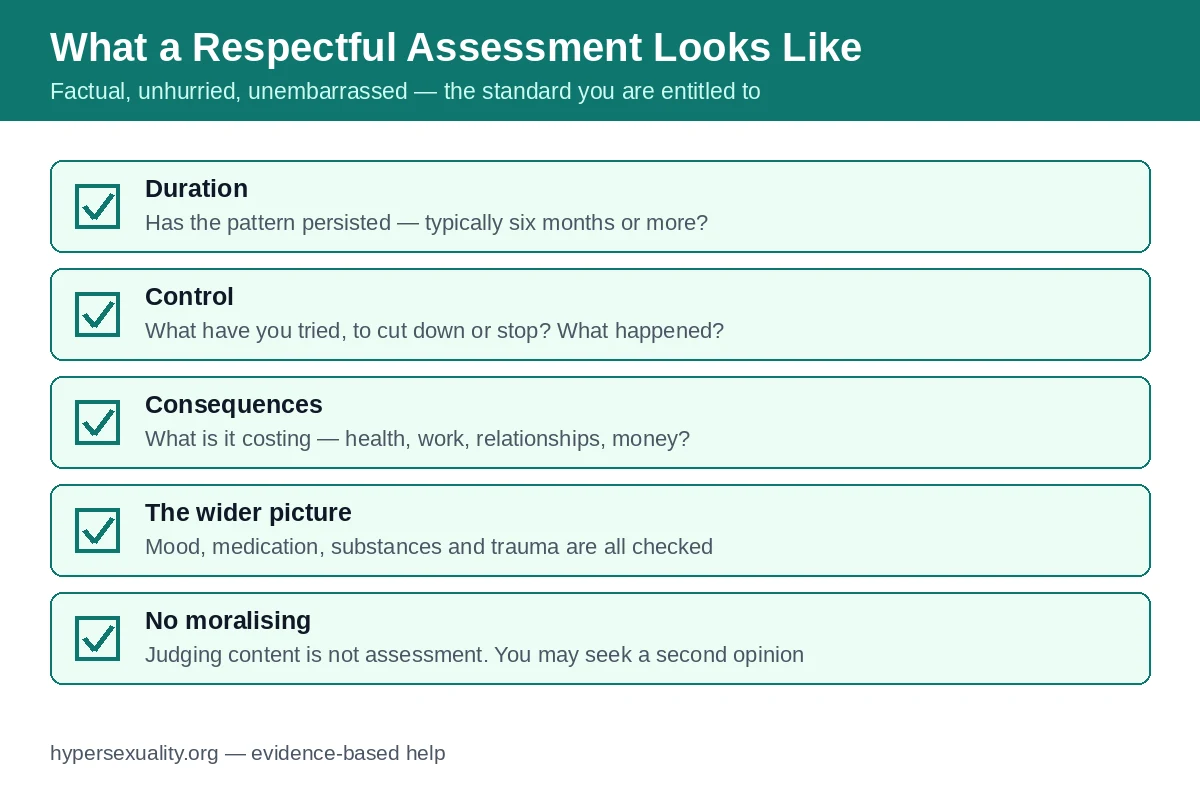
The practical point: an assessment for a woman should ask the same neutral questions asked of a man — duration, control, consequences, mood, medication, substances — and should be willing to find CSBD, a mood episode, medication effects, trauma sequelae, or no disorder, with equal honesty.
Causes and contributors in women
The evidence-ranked cause list in our guide to what causes hypersexuality applies in full: bipolar mood episodes, dopamine-related medication, neurological change, reward learning, trauma and attachment wounds, ADHD and depression, and the digital accelerant. Two notes are specific enough to women to state plainly. First, hormonal fluctuation (cycle, postpartum, menopause) genuinely modulates desire — but normal hormonal variation does not manufacture a compulsive pattern, and “hormone imbalance” is heavily oversold online as an explanation (and as a sales pitch for unproven remedies). Hormonal or thyroid problems are worth ruling out when the wider picture suggests them, not assumed.
Second, trauma histories — including sexual trauma — are reported at high rates among women seeking help for this pattern, and trauma-informed care is therefore not an optional extra; approaches are covered in our Cluster 5 material on trauma-informed therapy.
A concrete scenario. Priya, 35, has been treated twice for anxiety. What she has never told any clinician: since university she has cycled through intense, secret app-based relationships whenever work stress spikes; she has deleted and reinstalled the apps “for the last time” perhaps forty times; she missed a promotion review after an all-night messaging spiral; and she feels not liberated but exhausted and disgusted with herself. Two assessments treated the anxiety as the whole story because she was never asked about sexual behaviour — and she never volunteered it, certain she would be judged with the old word.
Asked directly and neutrally, the pattern took ten minutes to describe — and it, alongside the anxiety, became treatable.
Getting assessed — and being treated with respect
A good assessment of hypersexuality in women sounds like the one Priya eventually got: factual, unembarrassed, interested in control and consequences rather than in judging content. You are entitled to that standard from any clinician, of any gender, and entitled to seek a second opinion if you meet moralising instead. If you are preparing to talk to someone, our guide to how hypersexuality is assessed walks through the appointment step by step, and our screening test can help you organise your own picture first — screening, not diagnosis.
Q&A
Is there a separate diagnosis for hypersexuality in women?
No. CSBD in ICD-11 is a single, gender-neutral diagnosis with the same criteria for everyone. Medicine deliberately retired the old female-only and male-only labels because they were stigmatising and scientifically empty. Anyone using them today as a diagnosis is using abandoned vocabulary.
Why is the condition diagnosed less often in women?
Hypersexuality in women is diagnosed less often because of a mix of under-recognition and under-disclosure: women’s presentations more often centre on relationships and fantasy (easier to misread), clinicians ask women about sexual behaviour less routinely, and shame — powered by a double standard about female desire — keeps women from raising it. Lower diagnosis rates do not mean the pattern is rare in women.
Can hormones cause hypersexuality in women?
Hormones influence desire, and specific endocrine problems can occasionally be part of the picture and are worth ruling out when other signs suggest them. But ordinary cycle, postpartum or menopause changes do not by themselves create a compulsive pattern, and claims that “hormone balancing” cures it are marketing, not evidence.
Is it hypersexuality or just a high sex drive if my partner disapproves?
A partner’s disapproval — or your family’s, or your community’s — is not a diagnostic criterion. ICD-11 states explicitly that distress based purely on moral judgment about the behaviour does not qualify. The tests are control and consequences: Can you stop when you decide to? Is it causing real harm? Those answers, not anyone’s embarrassment, define the issue.
What kind of therapy helps women with this pattern?
The evidence-based core is the same as for men — CBT-based work on triggers, control and emotion regulation — with two emphases that matter often for women: trauma-informed care where trauma is part of the history, and explicit work on shame and the desire–self-worth link. Medication is considered when a driver like bipolar disorder or depression is present, prescribed by a clinician who knows the full picture.
Sources: World Health Organization, ICD-11 entry 6C72 “Compulsive sexual behaviour disorder”; Kaplan, M. S. & Krueger, R. B. (2010), “Diagnosis, assessment, and treatment of hypersexuality,” Journal of Sex Research, 47(2–3), 181–198.
Medical disclaimer: This article is educational information only and is not medical advice, diagnosis or treatment. Only a qualified clinician who knows your history can assess whether any diagnosis applies to you. If sexual behaviour is causing you distress or harm, consider speaking with your doctor or a licensed mental-health professional.