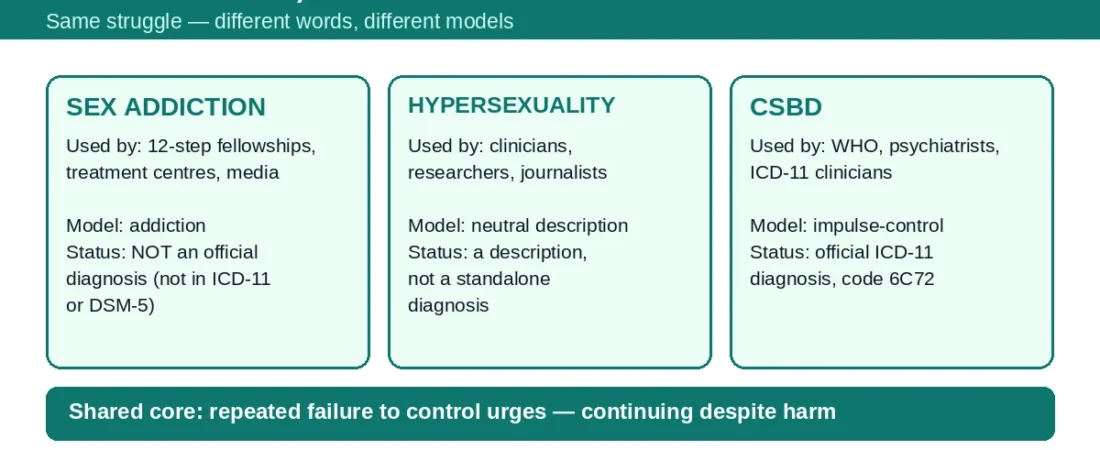
Type your symptoms into a search engine and you will meet three different labels within the first page of results: “sex addiction”, “hypersexuality” and “CSBD”. Treatment centres use them as if they were interchangeable. Clinical manuals do not. A therapist trained in the 12-step tradition may use one word, a psychiatrist another, and your insurance paperwork a third — all while describing what feels, from the inside, like exactly the same struggle.
That confusion is not harmless. The label attached to your problem quietly decides what kind of help you are offered, whether that help is covered, and how much shame comes bundled with it. This article maps the three terms honestly: where each one comes from, who uses it, where they genuinely overlap, and where they part company.
Quick answer: No — the three terms are not strictly the same. Hypersexuality is a broad descriptive word for intense, hard-to-control sexual urges and behaviour. Sex addiction is a popular and 12-step term that frames the pattern as an addiction, but it is not an official diagnosis. CSBD (compulsive sexual behaviour disorder) is the official ICD-11 diagnosis, classified by the WHO as an impulse-control disorder — deliberately not as an addiction. In everyday speech the words overlap; in a clinic, the differences matter.
Contents
The three terms, defined plainly
Hypersexuality: the umbrella description
“Hypersexuality” is the oldest and loosest of the three. It simply describes a pattern: sexual thoughts, urges or behaviour that are unusually intense, frequent, or difficult to control. It makes no claim about why the pattern exists. That is both its strength and its weakness — a person can be hypersexual because of a primary problem with sexual self-regulation, but hypersexuality can also be a symptom of something else: a manic episode, a Parkinson’s medication, a brain injury. Used carefully, it is a description, not a diagnosis.
Sex addiction: the popular and recovery-culture term
“Sex addiction” (and “sexual addiction”) comes from the addiction-recovery world. It was popularised in the 1980s, adapted from alcohol-dependence treatment, and it is the language of Sex Addicts Anonymous, Sexaholics Anonymous and most residential treatment programmes — including the competitor pages that rank for this keyword, which slide between “sex addiction” and “hypersexuality” in the same sentence. The framing has real benefits: it gives people a community, a vocabulary of relapse and recovery, and a structured path.
But it has a scientific problem: neither the WHO nor the American Psychiatric Association recognises “sex addiction” as a formal diagnosis, partly because the brain evidence does not map neatly onto substance addiction, and partly because the label can pathologise people whose real issue is a clash between their behaviour and their moral or religious values.
CSBD: the official diagnosis
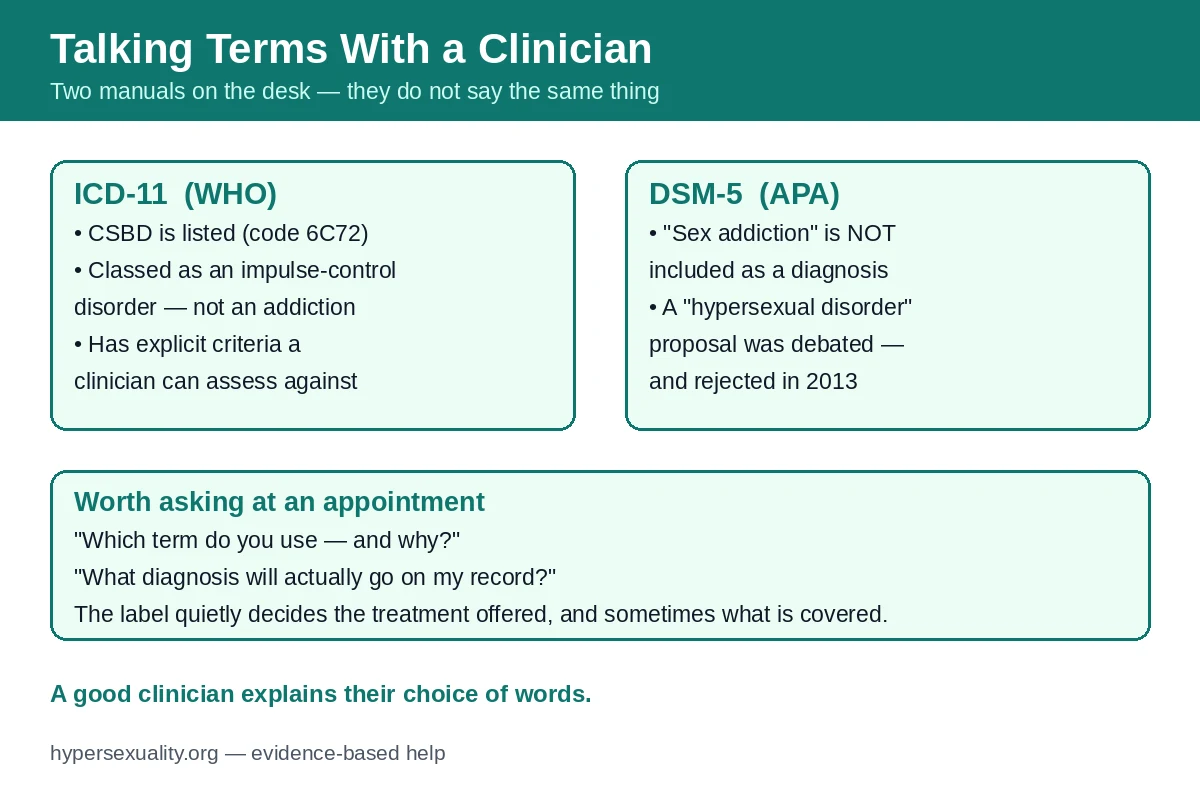
Compulsive sexual behaviour disorder, code 6C72 in ICD-11, is the term with formal diagnostic standing. The World Health Organization included it in 2018 (ICD-11 took effect in 2022) and placed it among the impulse-control disorders, alongside conditions like kleptomania — not among disorders due to addictive behaviours, where gambling and gaming disorder sit. That placement was a deliberate scientific decision: the WHO judged the evidence for an addiction model insufficient, while the failure-to-control-impulses model fit the clinical picture.
CSBD also has explicit criteria, which none of the other terms have in binding form — the ICD-11 criteria for CSBD, explained one by one, show exactly what must be present.
A terminology map: who uses which term, and why
| Term | Used mainly by | Official status | Model behind it | What it emphasises |
|---|---|---|---|---|
| Hypersexuality | Clinicians, researchers, journalists | Descriptive term, not a standalone diagnosis | Neutral / descriptive | Intensity and loss of control, without claiming a cause |
| Sex addiction | 12-step fellowships, many treatment centres, media | Not in ICD-11 or DSM-5 as a diagnosis | Addiction model | Compulsion, escalation, relapse, recovery community |
| Sexual compulsivity | Researchers, some therapists | Research term | Compulsion / anxiety-relief model | Repetitive behaviour used to relieve tension |
| CSBD | WHO, psychiatrists and clinicians using ICD-11 | Official ICD-11 diagnosis (6C72), impulse-control disorder | Impulse-control model | Persistent failure to control urges, causing distress or impairment |
| Hypersexual disorder | APA debate (2008–2013) | Proposed for DSM-5, rejected in 2013 | Mixed | Historical — explains why US paperwork often uses other codes |
| Out-of-control sexual behaviour (OCSB) | Some sex therapists | Clinical framework, not a diagnosis | Non-pathologising model | The gap between a person’s behaviour and their own values/control |
Where the three terms genuinely overlap
Strip away the labels and the core experience described is strikingly similar across all three traditions — and it is the experience, not the vocabulary, that clinicians actually assess:
- Loss of control. Repeated, genuine attempts to cut down or stop that do not hold.
- Centrality. Sexual behaviour becomes the organising activity of the day — planning it, doing it, recovering from it, hiding it.
- Continuation despite harm. The pattern continues after it has already cost money, trust, health, work performance or self-respect.
- Distress or impairment. Not just a partner’s disapproval or a community’s moral judgment — the ICD-11 is explicit that distress based solely on moral disapproval does not qualify.
Notice what is not on that list: a specific number of partners, hours of pornography, or frequency of masturbation. No serious framework, under any label, diagnoses a quantity. Every framework diagnoses a relationship to control and consequences.
Where they part company — and why it matters to you
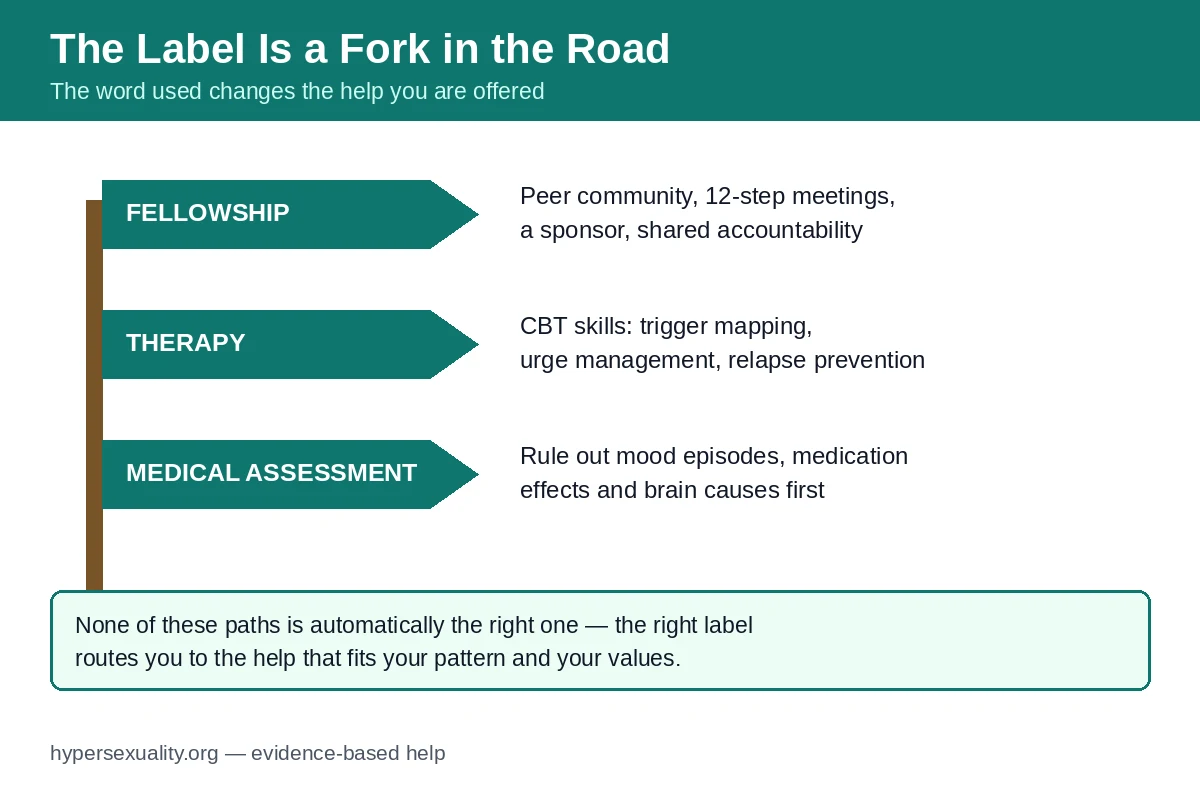
Treatment philosophy. An addiction-model programme may aim for defined “sobriety” from bottom-line behaviours and use sponsor accountability. An impulse-control or CBT approach targets triggers, decision points and emotion regulation, and may define success as control and alignment with your values rather than abstinence categories. Neither is automatically better — but they feel very different from the inside, and you are entitled to know which one you are signing up for.
Insurance and records. Because “sex addiction” is not an official diagnosis, US clinicians often bill under other recognised codes (for example, an impulse-control or “other specified” category), whereas in ICD-11 countries CSBD has its own code. The word on your file can follow you; asking a provider “what diagnosis will you record?” is a fair question.
Shame. “Addict” is an identity word for some people — a relief, even — and a stigma for others. “Person with CSBD” is clunkier but describes a condition, not a character.
Research on moral incongruence shows that people whose behaviour conflicts with their religious values can score high on self-perceived “porn addiction” measures while showing ordinary levels of use — a values problem wearing an addiction label. The right label routes you to the right help: values counselling in one case, impulse-control treatment in the other.
A concrete scenario. Daniel, 38, searches “am I a sex addict?” after his wife finds a second phone. A treatment centre’s page tells him he has sex addiction and quotes him an inpatient programme. A psychiatrist, using ICD-11 language, asks different questions first: Is the pattern persistent over months? Has he repeatedly tried to stop? Is there a mood episode, a new medication, or a substance in the picture?
Same man, same behaviour — two labels, two very different next steps and price tags. The label is not a detail; it is a fork in the road.
So which word should you use?
Use the word that gets you accurately helped. If the word itself is new to you, start with what hypersexuality actually means. If a fellowship community keeps you accountable, its language may serve you well. If you are seeking a medical assessment, “compulsive sexual behaviour” is the term your clinician’s manual recognises. And if you are simply trying to understand yourself, start with the descriptive question underneath all three labels: Have I repeatedly failed to control this, and is it harming my life? That question — explored in our guide to the signs and symptoms of hypersexuality and our hypersexuality self-test — matters more than the noun you attach to the answer.
Q&A
Is CSBD just sex addiction with a medical name?
Not exactly. CSBD is the official ICD-11 diagnosis and is classified as an impulse-control disorder. The WHO deliberately did not classify it as an addiction, because the addiction evidence was judged incomplete. Many clinicians use the terms loosely in conversation, but formally they rest on different models.
Why isn’t sex addiction in the DSM-5?
A formal proposal for “hypersexual disorder” was considered for the DSM-5 and rejected in 2013. The reasons given included insufficient research, the risk of false positives, and the danger of labelling morally conflicted but otherwise controlled behaviour as a disorder.
Can a person have hypersexuality without having CSBD?
Yes. Hypersexuality can be a temporary symptom — for example during a manic episode, or after starting certain dopamine-related medications for Parkinson’s disease — without being the standalone, persistent pattern CSBD describes. That is one reason a professional evaluation looks for underlying causes first.
Which term do therapists actually use in session?
It depends on their training. CSAT-certified and 12-step-oriented therapists commonly say “sex addiction”; psychiatrists and ICD-11-trained clinicians say “CSBD” or “compulsive sexual behaviour”; sex therapists using the OCSB model say “out-of-control sexual behaviour”. Good practitioners will explain their choice.
Does the label change the treatment?
It can. Addiction-model programmes often use sobriety definitions, disclosure processes and fellowship steps. Impulse-control treatment leans on CBT skills — trigger mapping, urge management, relapse prevention. Many real-world plans blend both; what matters is that the approach fits your pattern and your values.
Sources: World Health Organization, ICD-11 entry 6C72 “Compulsive sexual behaviour disorder”; Kraus, S. W. et al. (2018), “Compulsive sexual behaviour disorder in the ICD-11,” World Psychiatry, 17(1), 109–110.
Medical disclaimer: This article is educational information only and is not medical advice, diagnosis or treatment. Only a qualified clinician who knows your history can assess whether any diagnosis applies to you. If sexual behaviour is causing you distress or harm, consider speaking with your doctor or a licensed mental-health professional.