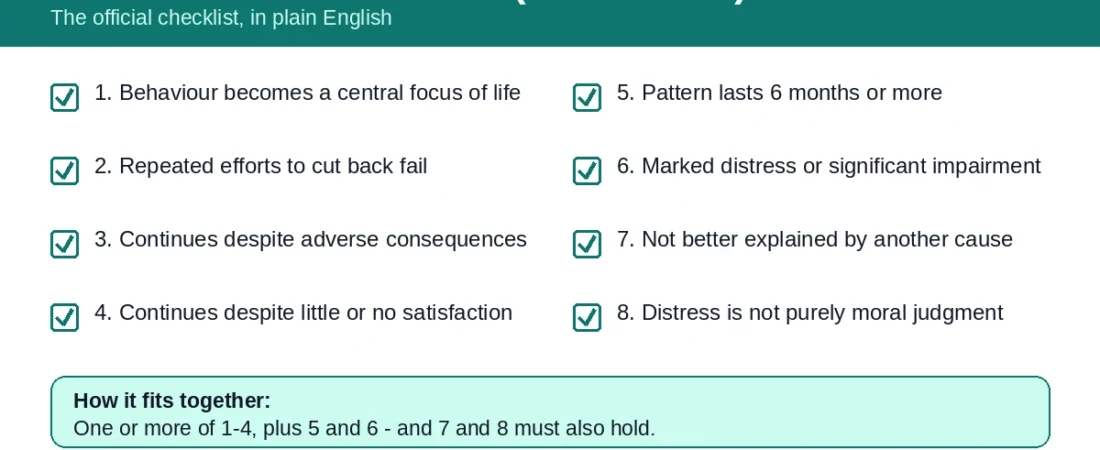
The official criteria for compulsive sexual behavior disorder fit into a short paragraph — yet almost every line of that paragraph is doing a job that casual summaries miss. The csbd icd-11 criteria are not a score sheet for self-diagnosis, and they contain no number of partners, hours or acts that separates “normal” from “disordered.”
Instead, they describe a pattern: loss of control, persistence over time, and real distress or impairment, with two important safeguards built in. This article walks through each requirement in order, translates it into ordinary life, and shows — with examples — what each criterion does and does not prove on its own.
Quick answer: Under ICD-11 (code 6C72), CSBD requires a persistent failure to control intense, repetitive sexual impulses or urges, shown by at least one of: the behaviour becoming a central focus of life, numerous unsuccessful efforts to reduce it, continuing despite adverse consequences, or continuing despite little or no satisfaction. The pattern must persist over an extended period (e.g. six months or more), cause marked distress or significant impairment, not be better explained by another condition, a substance or a medication — and distress based entirely on moral judgment does not count.
Contents
The CSBD ICD-11 criteria at a glance
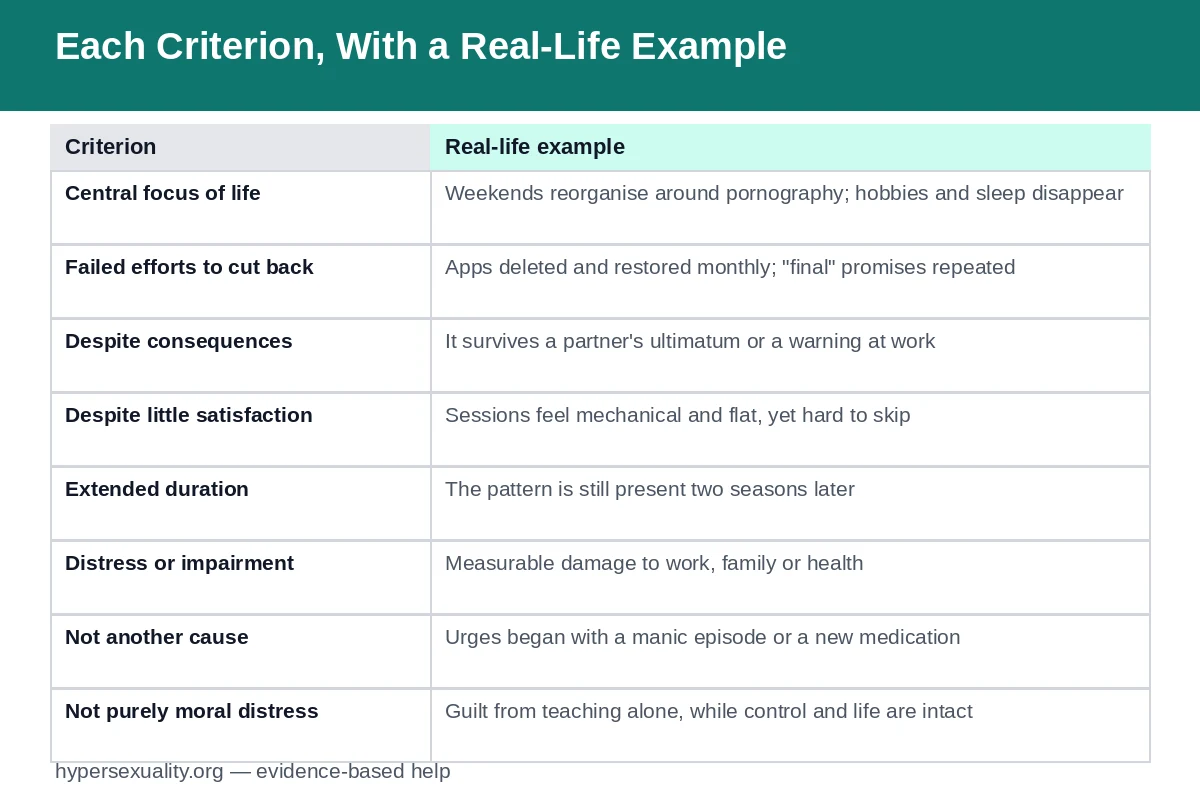
| # | Criterion (plain English) | Real-life example | On its own, enough? |
|---|---|---|---|
| 1 | Sexual behaviour becomes a central focus of life, neglecting health, care, interests or responsibilities | Weekends reorganise around access to pornography; hobbies and sleep quietly disappear | No — needs the control failure + duration + impact |
| 2 | Numerous unsuccessful efforts to significantly reduce the behaviour | Apps deleted and restored monthly; “final” promises made repeatedly in good faith | No — everyone slips sometimes; the repeated, sincere pattern matters |
| 3 | Behaviour continues despite adverse consequences | It survives a partner’s ultimatum, a warning at work, or a health scare | No — context and the other criteria still matter |
| 4 | Behaviour continues despite little or no satisfaction | Sessions feel mechanical and flat, yet hard to skip | No — low satisfaction alone can have many causes |
| 5 | Pattern lasts an extended period (e.g. 6 months or more) | The pattern is still present two seasons later, through changed circumstances | No — a long-lasting chosen pattern is not a disorder |
| 6 | Marked distress or significant impairment in an important life area | Distress about lost control, or measurable damage to work, family or health | Essential — without distress/impairment there is no diagnosis |
| 7 | Not better explained by another disorder, substance or medication | New urges begin with a manic episode or after starting a dopamine-agonist drug | If something else explains it, CSBD is not the label |
| 8 | Distress is not entirely moral judgment or disapproval | Guilt comes only from religious teaching, while control and life are intact | Moral distress alone is explicitly excluded |
Criterion by criterion
The core: failure to control
Everything hangs on the first line — a persistent pattern of failure to control intense, repetitive sexual impulses or urges resulting in repetitive sexual behaviour. Note what the criterion measures: not desire, but the relationship between intention and behaviour. A person with a strong sex drive who can take it or leave it does not meet this, however active they are. A person whose behaviour repeatedly overrules their own settled decisions may — if the rest of the picture fits.
The four ways the pattern can show itself
ICD-11 then lists four manifestations, of which one or more is required. Central focus (criterion 1) is about displacement: the behaviour starts winning competitions for time and attention against health, work and people. Unsuccessful efforts (criterion 2) are the history of attempted self-correction — important because they separate “won’t stop” from “can’t seem to stop.”
Continuing despite adverse consequences (criterion 3) shows the behaviour is no longer responsive to feedback that normally changes behaviour. Continuing despite little or no satisfaction (criterion 4) is the subtlest: the reward has faded but the routine persists, which is why people describe it as automatic rather than enjoyable.
Duration: why “six months” is guidance, not a stopwatch
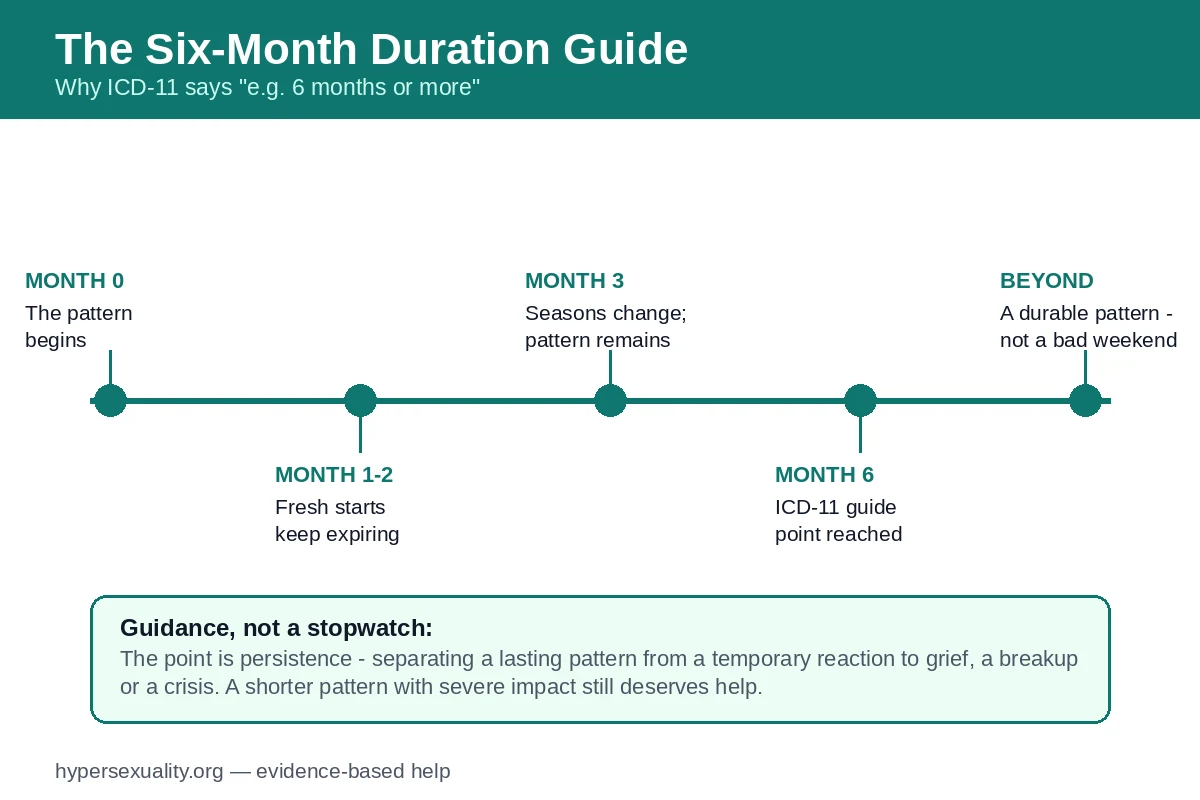
The text says the pattern is manifested over an extended period of time, “e.g., 6 months or more.” The “e.g.” matters. Six months is the reference point clinicians use to separate a durable pattern from a temporary reaction to grief, a breakup or a crisis — not a timer that switches a diagnosis on at day 181. A shorter pattern with severe impact still deserves professional attention; it just may be understood differently.
Distress or impairment: the gatekeeper
The behaviour pattern must result in marked distress or significant impairment in personal, family, social, educational, occupational or other important functioning. This is the criterion that protects ordinary variation in sexuality from being pathologised. Someone whose sex life is frequent, unconventional and entirely untroubled — whose life works — does not meet the criteria, full stop.
The two exclusions that summaries often drop
First, the pattern must not be better accounted for by another mental disorder (the ICD-11 gives a manic episode as the classic example), another medical condition, or the effects of a substance or medication. Hypersexual behaviour that appears only during mania, or after starting certain Parkinson’s medications, is treated by treating that cause. Second, distress entirely related to moral judgments and disapproval is not sufficient — the safeguard discussed at length in our article on moral incongruence and sexual behaviour distress. Both exclusions are why assessment is a conversation, not a tally.
A worked example: reading one case against the criteria
Leo, a composite example, seeks help after eight months of escalating late-night pornography use. Against the CSBD ICD-11 criteria: he has made at least six serious attempts to stop (criterion 2 ✓); the sessions continue after a formal warning about morning lateness (criterion 3 ✓) and he describes them as “numbing, not fun” (criterion 4 ✓); eight months clears the duration guide (criterion 5 ✓); his distress is about lost control and his work is measurably suffering (criterion 6 ✓).
His clinician still checks the exclusions: no mood episodes, no new medication, no substance pattern (criterion 7), and Leo’s distress is about control and consequences, not religious disapproval (criterion 8). Only after all of that does CSBD become a reasonable working diagnosis — and note how much of the work was done by the exclusions and the conversation around them, not by counting behaviours.
What the criteria deliberately leave out
There is no frequency threshold in the CSBD ICD-11 criteria, no list of “qualifying” acts, and no requirement that anyone else be involved or harmed. Solo, digital behaviour can meet the criteria; partnered behaviour can fail to. The criteria also say nothing about sexual orientation or the content of fantasies — it is a diagnosis about control and consequences, not about taste.
Reading the CSBD ICD-11 criteria can clarify a lot, and the natural next steps are the fuller explanation of what compulsive sexual behavior disorder is, the reasoning behind how the WHO classified it, and — if you want structured reflection rather than a label — the screening approach on the hypersexuality test page, remembering that screening is never a diagnosis. Where several explanations are possible, the differential diagnosis of compulsive sexual behavior overview shows how clinicians sort them.
Q&A
What is the ICD-11 code for CSBD?
6C72. In the ICD-11 classification, compulsive sexual behaviour disorder sits under the grouping of impulse control disorders, with that code used for records, billing and research in countries that have adopted ICD-11.
How many of the ICD-11 features do you need to “have” CSBD?
The structure is not “collect all eight.” The CSBD ICD-11 criteria require the core failure-of-control pattern, shown by one or more of the four manifestations, plus duration, plus distress or significant impairment, and the pattern must survive the two exclusions. Meeting a single row of the table in isolation is not a diagnosis.
Why do the criteria say “e.g. 6 months” instead of a firm rule?
Because the point of the duration element is to identify a persistent pattern rather than a short-lived reaction, and real lives do not divide neatly at a date. Clinicians treat six months as the reference guide and judge persistence in context — a severe, clearly impairing pattern is worth discussing with a professional whenever it appears.
Can the criteria apply if the behaviour is entirely online?
Yes. The CSBD ICD-11 criteria are written about impulses, urges and repetitive behaviour, not about specific acts or settings. Pornography use and other online behaviour are among the presentations clinicians most commonly assess under this framework.
If I meet several criteria, does that confirm I have CSBD?
No — self-matching against the CSBD ICD-11 criteria is a prompt for a professional conversation, not a confirmation. The exclusions in particular (another condition, a medication effect, purely moral distress) genuinely require clinical judgment and background knowledge to apply, and they change the conclusion in a substantial share of cases.
Sources: World Health Organization, ICD-11 Clinical Descriptions and Diagnostic Requirements, entry 6C72 “Compulsive sexual behaviour disorder”; Kraus, S. W. et al. (2018), “Compulsive sexual behaviour disorder in the WHO ICD-11,” World Psychiatry, 17(1).
Medical disclaimer: This article is general information about a health topic. It is not medical advice and cannot diagnose you or anyone else. Only a qualified clinician who knows your situation can do that. If sexual behaviour is causing you distress or harm, consider speaking with a doctor, psychologist or qualified therapist.