People usually meet this phrase in one of two ways. A therapist says it in a session. Or they search for “sex addiction,” read the description, and feel it does not quite fit: they are not chasing a high, they do not think of themselves as addicts — yet their sexual behaviour plainly feels out of control. Out of control sexual behavior, almost always shortened to OCSB, is the term a growing number of sex therapists use for exactly that experience.
The phrase does something deliberate. It names the problem by what the person can directly observe — behaviour that has slipped out of their own control — instead of deciding in advance what kind of disorder it must be. This article explains what the term means, where it comes from, who uses it, and how the OCSB model differs from both the “sex addiction” label and the official CSBD diagnosis.
Quick answer: Out of control sexual behavior (OCSB) is a clinical term and treatment model developed by Douglas Braun-Harvey and Michael Vigorito for sexual behaviour that conflicts with a person’s own values, commitments and intentions and feels beyond their control. It is deliberately not a diagnosis and not an addiction label: the model treats the behaviour as a self-regulation and sexual-health problem, and asks what the behaviour is doing for the person — not only how to stop it.
Contents
What “out of control” actually means in this term
The reference point is the person’s own intentions, not society’s rules and not a frequency count. In the OCSB frame, behaviour is “out of control” when there is a persistent gap between what someone intends and what they actually do: they decide to stop or cut back, and the behaviour continues anyway. It conflicts with commitments they have genuinely made — to a partner, to an employer, to their own ethics — and they find themselves organising time, money or secrecy around it.
Notice what the term does not mean. A partner, parent or religious community calling behaviour “out of control” does not make it so; disapproval is not loss of control. Nor does unusual taste or a high sex drive qualify. The defining feature is the same one the wider literature keeps returning to — repeated failed attempts to stop sexual behavior — but OCSB describes it without importing an addiction framework to explain it. In short, out of control sexual behavior is defined by the person’s own yardstick: intentions set, behaviour escaping them anyway.
Where the term comes from
OCSB was developed by Douglas Braun-Harvey, a sex therapist in San Diego, together with Michael A. Vigorito, in their 2016 book Treating Out of Control Sexual Behavior: Rethinking Sex Addiction. Braun-Harvey had spent years watching the addiction model — imported wholesale from substance treatment — misfit many of the men and women in his practice.
Three problems kept appearing. First, classic addiction markers such as clear physiological tolerance and withdrawal were inconsistent. Second, the “addict” identity itself shamed many clients, and shame made them less honest, not more. Third, conflicts between behaviour and moral values were being treated as addiction when the behaviour itself was controlled and infrequent. OCSB was built as the alternative: a sexual-health framework that takes loss of control seriously without pathologising the person.
The out of control sexual behavior model, piece by piece
A self-regulation problem, not a character problem
In this model, out of control sexual behavior is a problem of self-regulation: the systems that should align behaviour with intentions — attention, emotion regulation, impulse control — are being outpaced. The clinical question becomes “what is overwhelming this person’s capacity to regulate it, and in which situations?” rather than “how do we stop this person’s sexuality?”
The dual control model: an accelerator and a brake
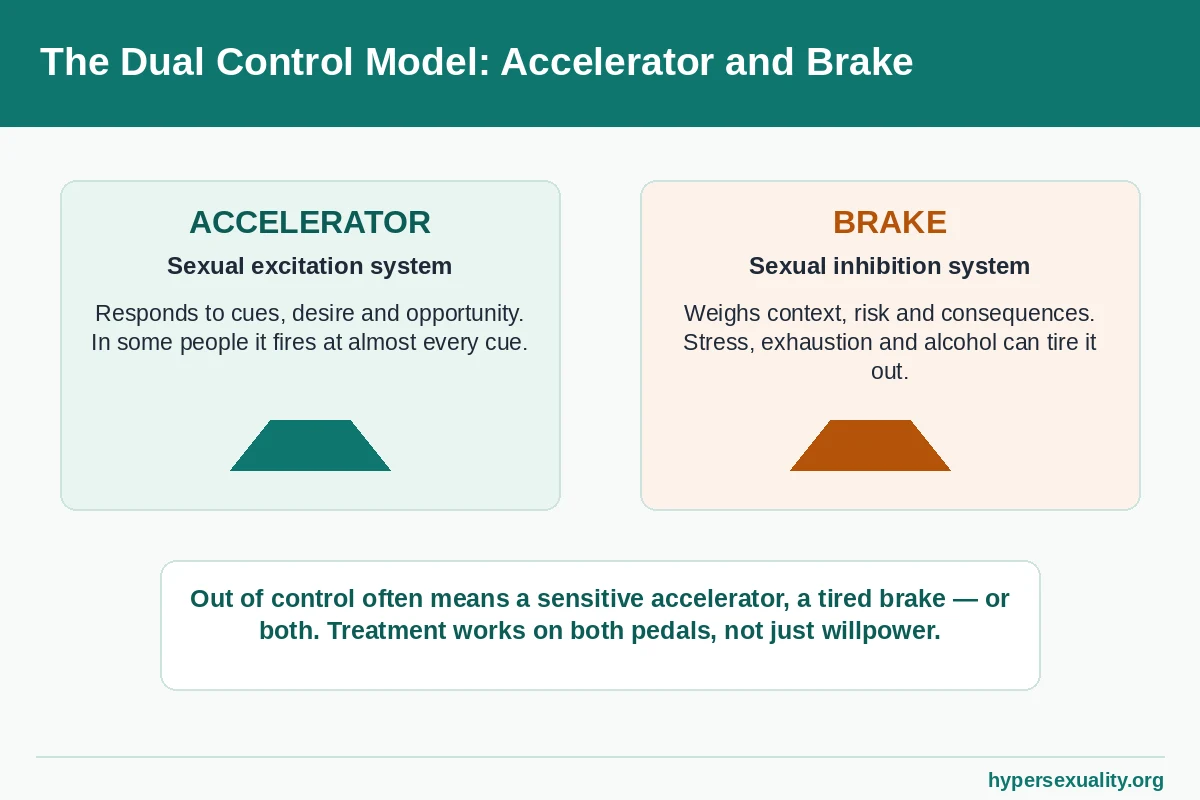
Braun-Harvey grounds the model in the dual control model of sexual response, developed by John Bancroft and colleagues at the Kinsey Institute. In it, sexual response is governed by two independent systems — a sexual excitation system (the accelerator) and a sexual inhibition system (the brake) — and people differ in how sensitive each one is.
Someone may have an ordinary accelerator but a brake that fails under stress, exhaustion, alcohol or emotional pain. Another person may have a highly sensitive accelerator that fires at every cue. Out of control sexual behavior, in this picture, is not a broken sexuality; it is a particular balance of accelerator and brake, meeting particular circumstances. Treatment works on both pedals, not just on willpower.
Sexual health as the measuring stick
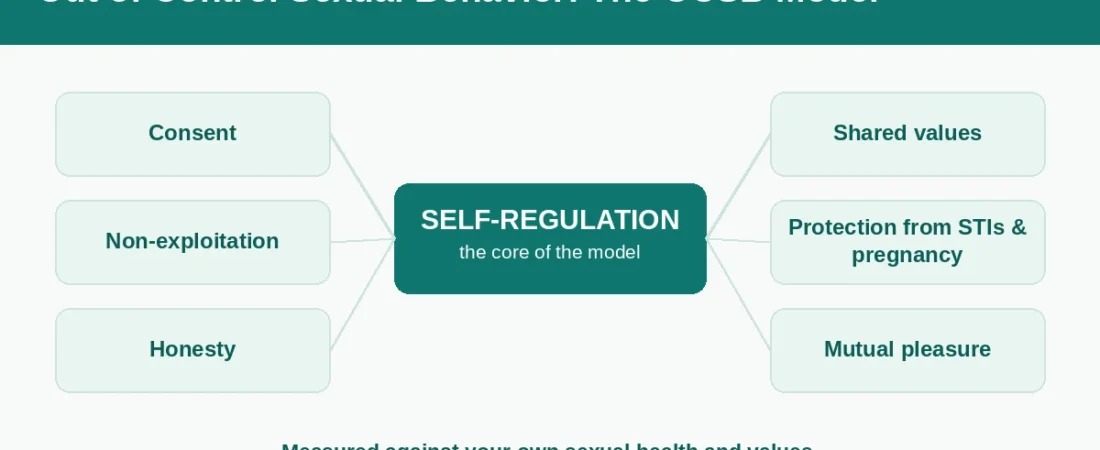
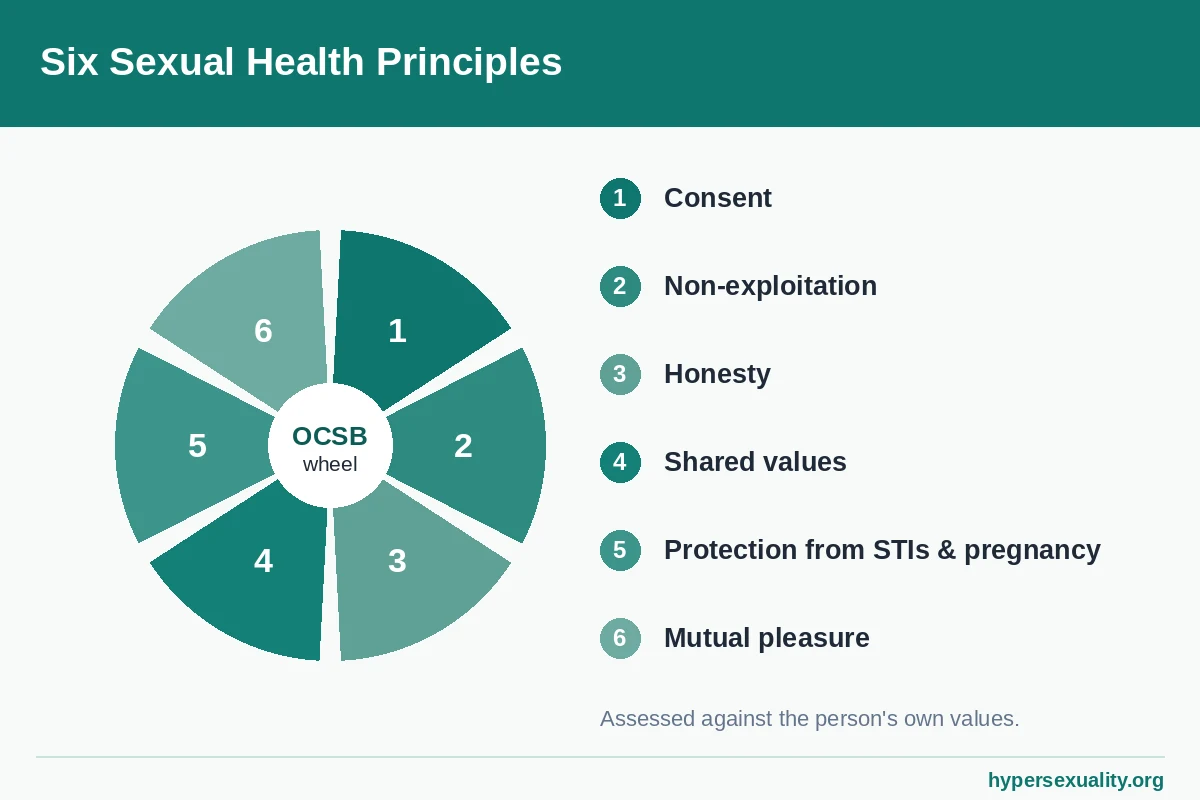
The model’s second foundation is a set of sexual-health principles adapted from the World Health Organization’s framing of sexual health: consent, non-exploitation, honesty, shared values, protection from STIs and unintended pregnancy, and mutual pleasure. Behaviour is assessed against the person’s own sexual health and values — which is why two people with identical behaviour can be assessed differently. The model refuses to treat any consensual behaviour as a symptom in itself.
Who uses the term — and who does not
The term out of control sexual behavior is used mainly by sex therapists, particularly in the AASECT (American Association of Sexuality Educators, Counselors and Therapists) world, and by clients who want help without adopting an addict identity. It appears in clinic descriptions and therapy directories far more than in research journals.
Researchers and psychiatrists, by contrast, generally publish under CSBD or hypersexuality, the terms tied to formal criteria — our hub guide to hypersexuality maps that landscape. The addiction frame remains dominant in 12-step and residential treatment culture. Much reader confusion is simply these three vocabularies describing overlapping territory from different starting points — which is also why questions like how common hypersexuality is get very different-looking answers depending on the definition used.
| Framework | What it is | Core question it asks |
|---|---|---|
| OCSB | A clinical term and treatment model (Braun-Harvey & Vigorito) | “Where has behaviour slipped out of this person’s own control, and why?” |
| Sex addiction | A popular and 12-step treatment framework | “How does this person stop the addictive cycle and stay sober from it?” |
| CSBD | The official ICD-11 diagnosis | “Does this pattern meet the diagnostic criteria, including distress or impairment?” |
A concrete scenario
Noah, 41, sought therapy after his partner discovered messages he had sworn — to himself — he would stop sending. He had read about sex addiction and recoiled from it: “I’m not chasing anything. Half the time I don’t even enjoy it. I just can’t seem to be the person I decided to be.”
His therapist worked in the OCSB frame. Together they mapped his accelerator (a fast, visual trigger response) and his brake (which collapsed specifically on work trips, after drinking, when he felt professionally humiliated). The behaviour was treated as information about regulation, not as an identity. For Noah, that framing was the difference between hiding the problem for another decade and actually describing it honestly in the room.
What changes when a therapist uses this model
Assessment starts from sexual health and the client’s own values, and the client helps define which specific behaviours count as out of control for them. Goals are framed as regaining control and living consistently with one’s values, not lifetime abstinence. Shame is actively reduced, treated as an obstacle to honesty rather than a motivator.
None of this means harm is excused or diagnosis is forbidden. Where a pattern meets ICD-11 criteria, a clinician can still recognise CSBD for records and treatment planning; the models coexist, and the comparison with hypersexuality vs healthy sexuality shows the same yardsticks of control and impact underneath both. What OCSB changes is the starting question — from “what is wrong with you?” to “what has overwhelmed your control, and what would sexual health look like for you?”
Q&A
Is out of control sexual behavior the same as sex addiction?
No. The two phrases often describe the same lived experience — behaviour that keeps escaping a person’s intentions — but they rest on different models. “Sex addiction” applies an addiction framework borrowed from substance treatment. OCSB deliberately avoids that framework and treats the pattern as a self-regulation and sexual-health problem. Which frame a therapist uses shapes the treatment you are offered.
Is OCSB an official diagnosis?
No, and that is by design. OCSB is a clinical term and treatment model, not a diagnosis in any manual. The official diagnosis in this territory is compulsive sexual behavior disorder (CSBD) in the WHO’s ICD-11. A clinician can work within the OCSB model while still recognising CSBD where the criteria are met.
Who created the OCSB model?
The model was developed by sex therapist Douglas Braun-Harvey and Michael A. Vigorito, and published in their 2016 book Treating Out of Control Sexual Behavior: Rethinking Sex Addiction. It grew out of Braun-Harvey’s clinical work with people whose loss of control did not fit the addiction framework well.
What is the dual control model of sexual response?
It is a model, developed by John Bancroft and colleagues, in which sexual response is governed by two independent systems: an excitation system (an accelerator) and an inhibition system (a brake). People differ in the sensitivity of each. In the OCSB framework, behaviour feels out of control when the accelerator is highly reactive, the brake is unreliable under stress or fatigue, or both.
Can I get help for this without calling myself an addict?
Yes. Many sex therapists work explicitly in the OCSB or sexual-health frame, which does not require adopting an addict identity or a 12-step programme. Ask any prospective therapist which model they use; a good clinician will explain their framework plainly. That is the space out of control sexual behavior was created to fill.
Sources: World Health Organization, ICD-11 entry 6C72 “Compulsive sexual behaviour disorder”; Braun-Harvey, D. & Vigorito, M. A. (2016), Treating Out of Control Sexual Behavior: Rethinking Sex Addiction, Springer; Bancroft, J. & Vukadinovic, Z. (2004), “Sexual addiction, sexual compulsivity, sexual impulsivity, or what? Toward a theoretical model,” Journal of Sex Research, 41(3), 225–234.
Medical disclaimer: This article is educational information only and is not medical advice, diagnosis or treatment. Only a qualified clinician who knows your history can assess whether any diagnosis applies to you. If sexual behaviour is causing you distress or harm, consider speaking with your doctor or a licensed mental-health professional.