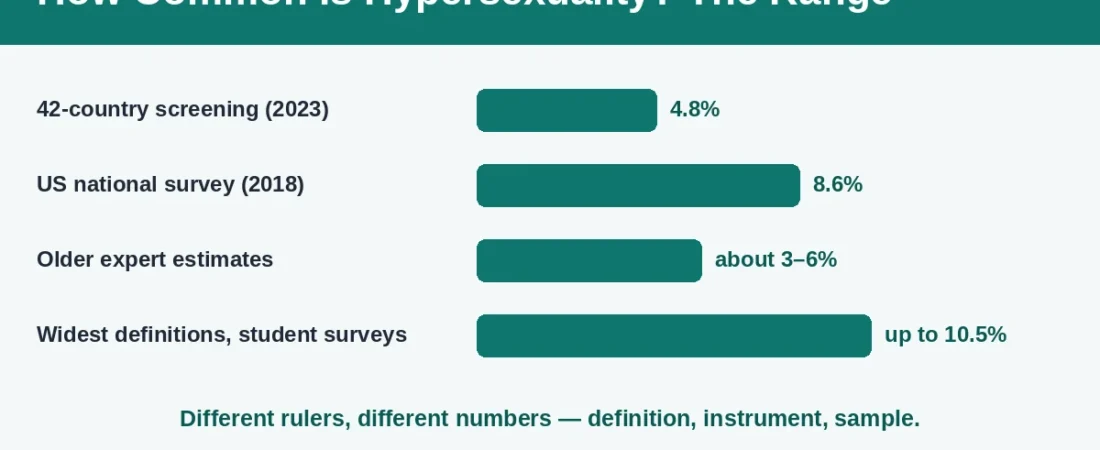
Type this question into a search engine and you will collect numbers that cannot all be true: 2%, 3–6%, 8.6%, 10.5%, “almost 5% in 42 countries”. They are not all lying. They are answering slightly different questions, about different groups of people, using different rulers — and almost no page bothers to tell you which ruler produced which number.
How common is hypersexuality is a genuinely answerable question, but only if the figures come with their methods attached. This article attaches them: the big studies, what each one actually measured, why the range is so wide, and what a fair summary sounds like.
Quick answer: How common is hypersexuality? The most rigorous recent estimate comes from a 42-country survey (Bőthe et al., 2023): about 4.8% of adults screened at high risk of compulsive sexual behaviour disorder — and only 14% of that group had ever sought treatment. Older expert estimates put the figure at roughly 3–6%. Higher numbers, such as 8.6% in a US survey, come from screening questionnaires that measure distress about controlling urges, not confirmed diagnoses — so they run high by design.
Contents
How common is hypersexuality? It depends what you count
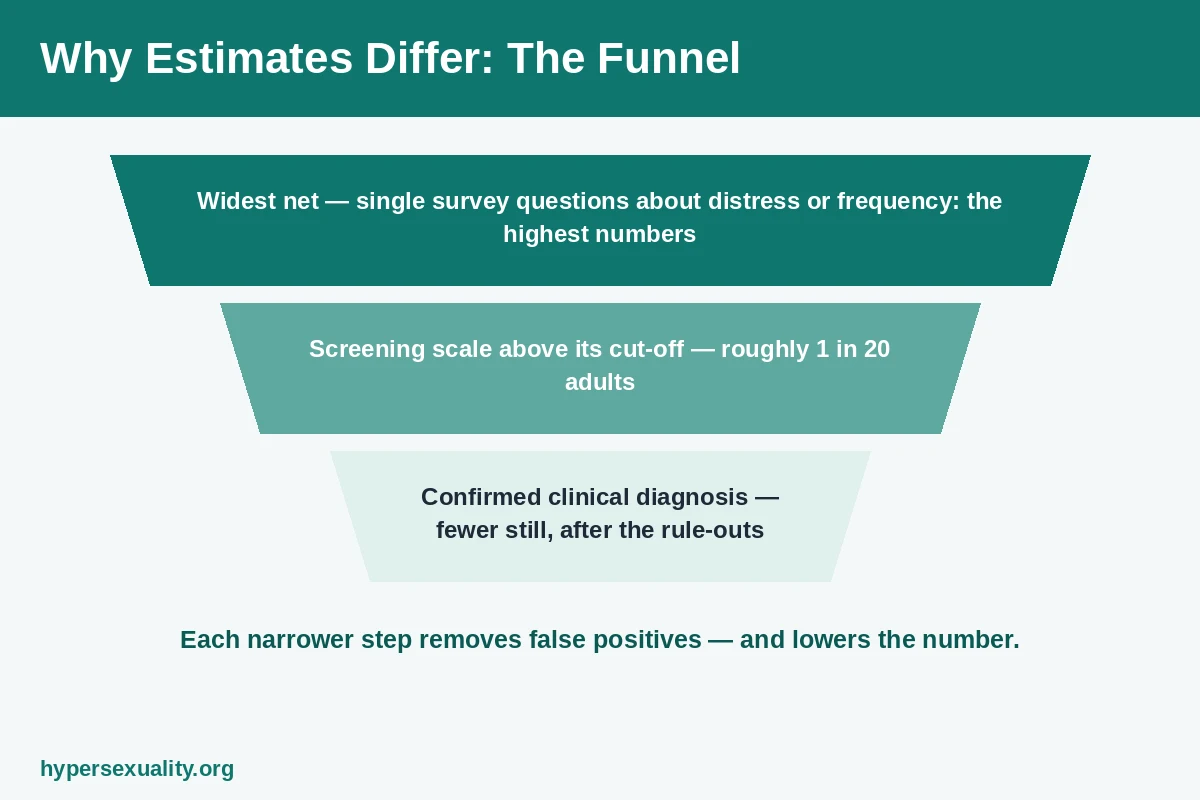
Every prevalence figure is the answer to three hidden choices. The definition: a confirmed ICD-11 diagnosis, a screening score above a cut-off, or simply “distress about controlling my urges”? Each wider net catches more fish. The ruler: full clinical interviews produce the lowest numbers; validated questionnaires produce higher ones; single survey questions produce the highest. The sample: university students, clinic patients, one country’s adults, or 42 countries at once are not interchangeable groups.
Hold those three choices in mind and the confusing range stops being confusing. The numbers below are arranged from the widest net to the narrowest — and the pattern in them is the real answer.
The numbers, study by study
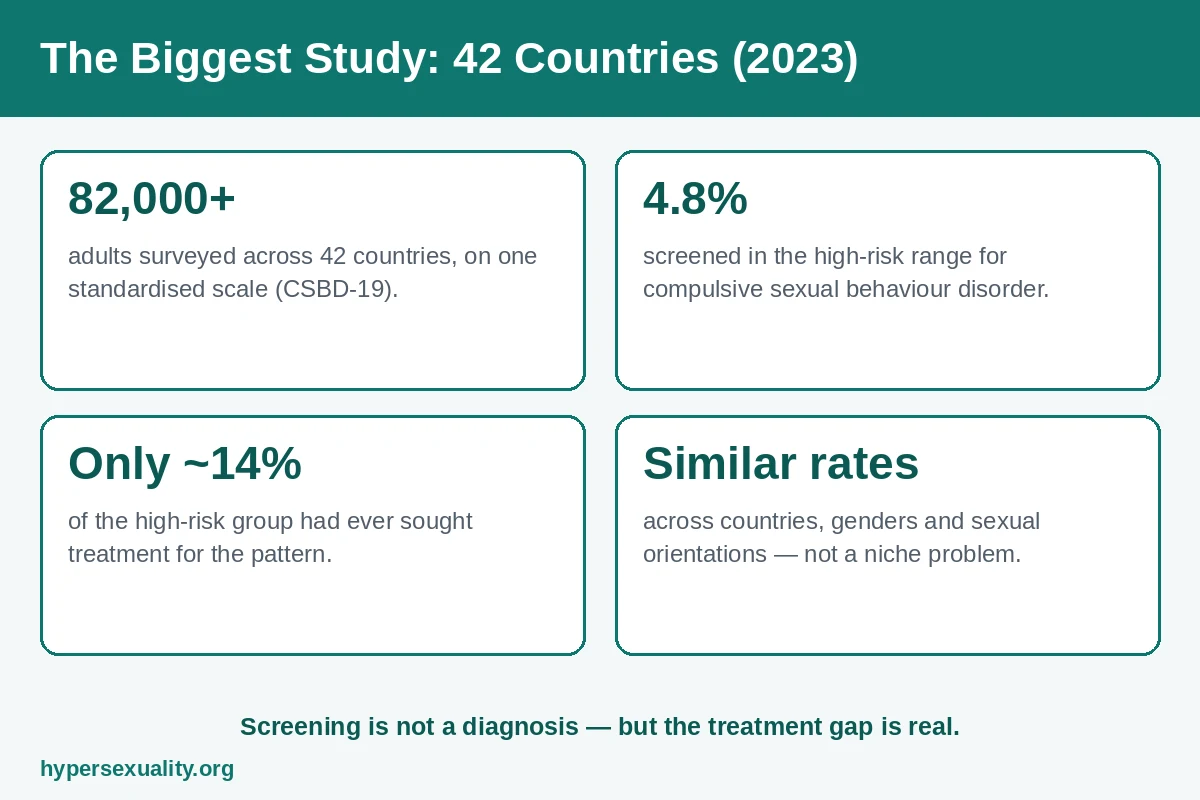
The 42-country study (Bőthe et al., 2023). The largest and most careful effort so far: over 82,000 adults across 42 countries, using a standardised screening scale (the CSBD-19) built directly on the ICD-11 criteria. About 4.8% scored in the high-risk range for compulsive sexual behaviour disorder. Rates were broadly similar across countries, genders and sexual orientations — a useful correction to the assumption that this is a niche or single-culture problem.
Two caveats: it is still a screening instrument, not 82,000 clinical interviews; and “high risk” is not identical to “diagnosed”. Its most quoted second finding deserves equal billing: only about 14% of the high-risk group had ever sought treatment for it.
The US national survey (Dickenson et al., 2018). A nationally representative sample of 2,325 US adults aged 18–50, published in JAMA Network Open. Using a screening scale measuring distress or impairment associated with difficulty controlling sexual feelings, urges and behaviours, 8.6% scored above the clinical cut-point — 10.3% of men and 7.0% of women. That is a real and important finding about how many people struggle. But note the ruler: it measures distress about control, which moral conflict alone can produce — and ICD-11 explicitly excludes distress based purely on moral disapproval. A broader net, a bigger number.
The older expert range (roughly 3–6%). Before the big surveys, reviews and clinical texts commonly estimated 3–6% of adults, drawing on smaller studies and clinical experience, often under looser “sex addiction” definitions. This range still circulates — including on clinic websites — usually without its vintage attached. It is not wildly off, but it was always closer to an informed estimate than a measurement.
The very wide figures (up to ~10.5% and beyond). The top of the range typically comes from studies using the widest definitions in the youngest samples — distress or frequency items in student surveys, for instance — or from pages quietly switching the topic to “problematic pornography use” or lifetime experiences rather than a current disorder. When a number sounds startling, check which of those moves produced it — that check is the fastest way to answer “how common is hypersexuality?” honestly.
So what is the fairest one-line answer?
If a clinician had to summarise the evidence in one sentence, it would sound like this: roughly 1 in 20 adults — around 5% — may meet the pattern at a screening level, with confirmed-diagnosis rates likely somewhat lower, and a large majority of those affected never receiving help. That sentence is less satisfying than a single dramatic percentage. It has the advantage of being true to the studies.
It also explains why personal experience misleads in both directions. In any workplace of a hundred people, the statistics suggest a handful are privately struggling with this pattern — which is why “nobody I know has this” usually means “nobody I know has said it out loud”. The treatment gap is part of the prevalence story: a condition can be common and nearly invisible at the same time, and this one is. That is why “how common is hypersexuality?” keeps being asked: the numbers and the visibility refuse to match. For the chemistry that may underlie the pattern in some people, see the neurotransmitters involved in compulsive sexual behavior; for the definition the studies are trying to count, see hypersexuality.
Reading any future number like a researcher
Victor, a composite example, arrived at an appointment carrying three printouts: one said 3%, one said 6%, one said “1 in 10 men”. His question — “which one is lying?” — is the question this article exists to retire. Walking through the three hidden choices (definition, ruler, sample) took ten minutes, and the printouts stopped contradicting each other: they were three different nets in three different ponds.
He left with a more useful question than the one he brought: not “how many people have this?” but “does my pattern match the definition the careful studies count?” That question has a structured starting point — the hypersexuality test screening page — and a vocabulary check for readers whose searches used older labels: out of control sexual behavior (OCSB) explains one framework clinicians use for exactly this pattern.
Q&A
What percentage of adults have compulsive sexual behavior disorder?
The strongest current estimate is the 42-country Bőthe et al. (2023) study: about 4.8% of adults screened at high risk using an ICD-11-based scale. That is a screening result, not a confirmed-diagnosis rate; the true diagnosed figure is likely a little lower. Older expert estimates of 3–6% are consistent with that neighbourhood.
Why do prevalence estimates for hypersexuality range from 2% to over 10%?
How common is hypersexuality looks like a moving target because the studies are not measuring the same thing. Confirmed diagnoses give the lowest figures; validated screening scales give higher ones; surveys asking about distress over controlling urges give the highest, because they also capture people whose distress is moral rather than compulsive. Sample age and country matter too. Each number is honest about its own net — the confusion comes from comparing them as if the nets were identical.
Is hypersexuality becoming more common, or just more visible?
Nobody knows for certain, because there is no old measurement good enough to compare against — the first rigorous multi-country figure dates from 2023. What has certainly changed is visibility and opportunity: near-unlimited private access to sexual content is historically new, screening tools now exist, and more people search for the topic. Rising search interest shows how common hypersexuality questions are becoming, not proof that incidence is rising.
How many people with this pattern ever get treatment?
In the 42-country study, only about 14% of those who screened at high risk had ever sought treatment. The gap is usually explained by shame, by not knowing the pattern has a name, and by not knowing where to go — which is why accurate public information matters more for this condition than for most.
If I score high on an online screening, does that mean I have the disorder?
No. Screening scales are designed to catch everyone who might have the pattern, which means they also catch people a clinician would assess differently — including people whose distress is mainly moral conflict, which ICD-11 excludes. A high screening score is a reason to seek a proper assessment, never a diagnosis in itself.
Sources: World Health Organization, ICD-11 entry 6C72 “Compulsive sexual behaviour disorder”; Bőthe, B. et al. (2023), “Compulsive sexual behavior disorder in 42 countries: Insights from the International Sex Survey and introduction of standardized assessment tools,” Journal of Behavioral Addictions, 12(2), 393–407; Dickenson, J. A. et al. (2018), “Prevalence of distress associated with difficulty controlling sexual urges, feelings, and behaviors in the United States,” JAMA Network Open, 1(7), e184468.
Medical disclaimer: This article is educational information only and is not medical advice, diagnosis or treatment. Only a qualified clinician who knows your history can assess whether any diagnosis applies to you. If sexual behaviour is causing you distress or harm, consider speaking with your doctor or a licensed mental-health professional.