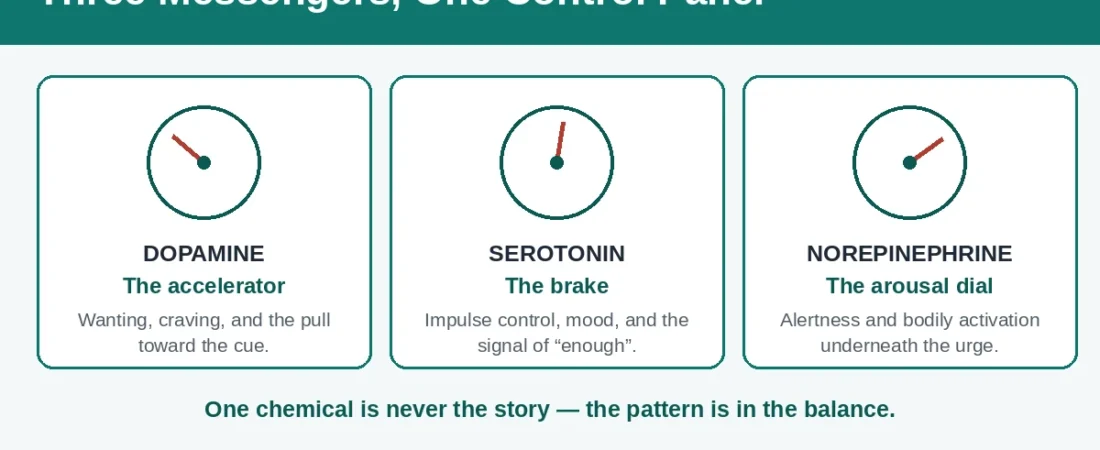
Ask the internet which chemical causes compulsive sexual behaviour and you will get one answer: dopamine. Dopamine matters — but a one-chemical story cannot explain the pattern, because sexual urges are not produced by a single messenger. They emerge from a balance: chemicals that accelerate wanting, chemicals that brake and signal “enough”, and chemicals that set the body’s arousal level underneath both.
The neurotransmitters and compulsive sexual behavior conversation becomes far more useful — and far more honest — when the whole cast is on stage. This article introduces the three that matter most, what each one plausibly does, and why researchers study them when they think about treatment.
Quick answer: Three neurotransmitter systems are most relevant. Dopamine drives wanting and cue-triggered craving. Serotonin acts largely as a brake and satiety signal — it is involved in impulse control, mood and the feeling of “enough”, and raising its signalling tends to dampen sexual drive. Norepinephrine sets arousal and alertness, which is why stress, excitement and being “wired” can intensify urges. No single chemical is “the cause”, and no blood test can measure these systems in the relevant brain circuits. That three-system balance is the heart of neurotransmitters and compulsive sexual behavior.
Contents
Neurotransmitters and compulsive sexual behavior: why one chemical is never the story
Neurotransmitters are messengers between brain cells, but each one works more like a mode than a message. The same chemical can excite one circuit and quiet another, depending on which receptors receive it and where. That is why “high dopamine” or “low serotonin” as complete explanations are always wrong — the meaningful question is how signalling is balanced across circuits: reward, control, mood and arousal.
It is also why the honest version of this topic is a set of roles, not a set of levels. Nobody can currently scan or sample a living person and report that their serotonin braking is at 62%. What researchers have instead are converging clues: what happens when a system is stimulated or blocked in experiments, which conditions cluster together, and what changes when treatments that touch these systems are used. Read the sections below in that spirit.
Serotonin: the brake, the mood regulator, the “enough” signal
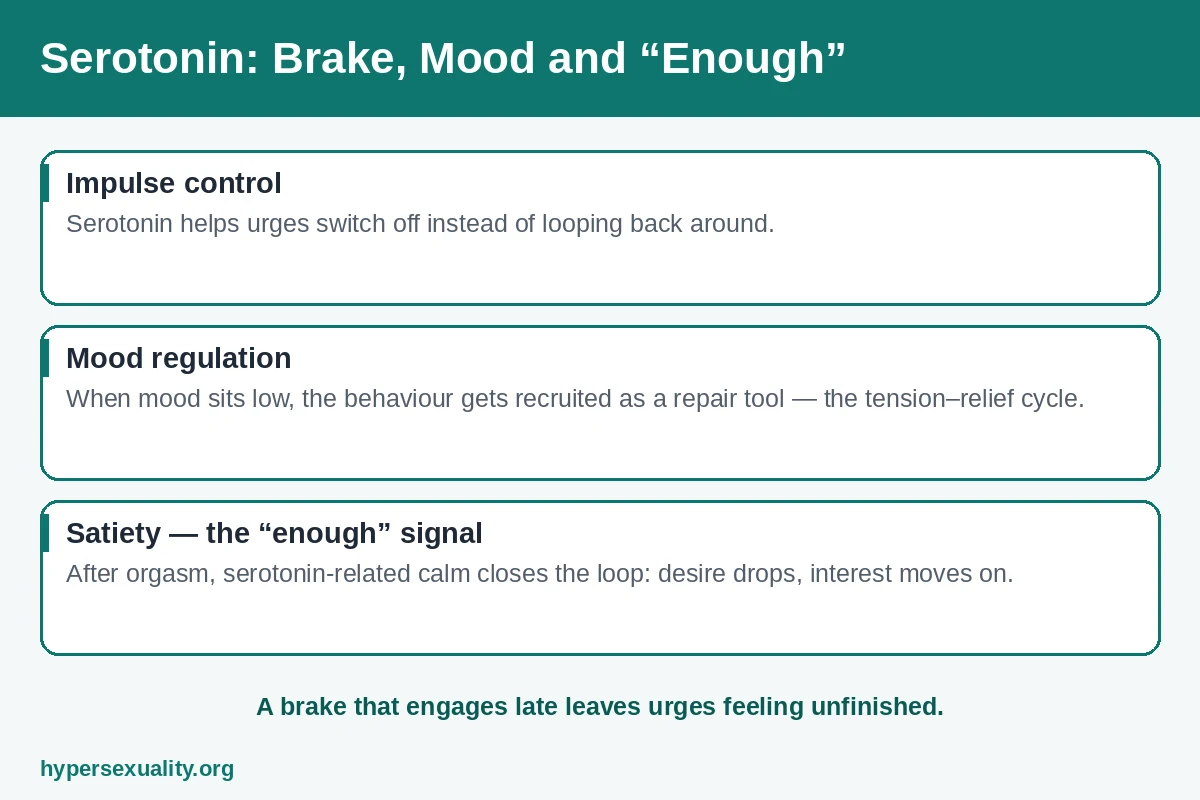
Serotonin is the chemical most often missing from popular accounts, and arguably the most relevant to control. It is deeply involved in mood regulation, in impulse control, and in satiety — the signal that a drive has been satisfied and can switch off. After orgasm, serotonin-related activity is part of the normal refractory calm: desire drops, interest moves elsewhere, the loop closes.
Now run that system weakly and the pattern starts to look familiar. A brake that engages late means urges that take longer to feel “finished”. A mood system that sits low means the behaviour gets recruited as a mood repair tool — which connects serotonin to the depression and anxiety that so often travel with this pattern, and to the tension–relief cycle people describe: urge, act, brief calm, crash, urge.
Clinicians have long noted a practical clue pointing the same direction: medicines that increase serotonin signalling — prescribed for depression, anxiety or obsessive-compulsive problems — very commonly reduce sexual desire and delay orgasm as side effects. That side-effect profile is part of why researchers have studied serotonergic approaches in compulsive sexual behaviour.
The evidence is early and mixed, and it belongs in a consulting room, not a shopping list — this article names no doses and recommends no medication, because whether any of it fits a person depends on their whole clinical picture.
Norepinephrine: the arousal underneath the urge
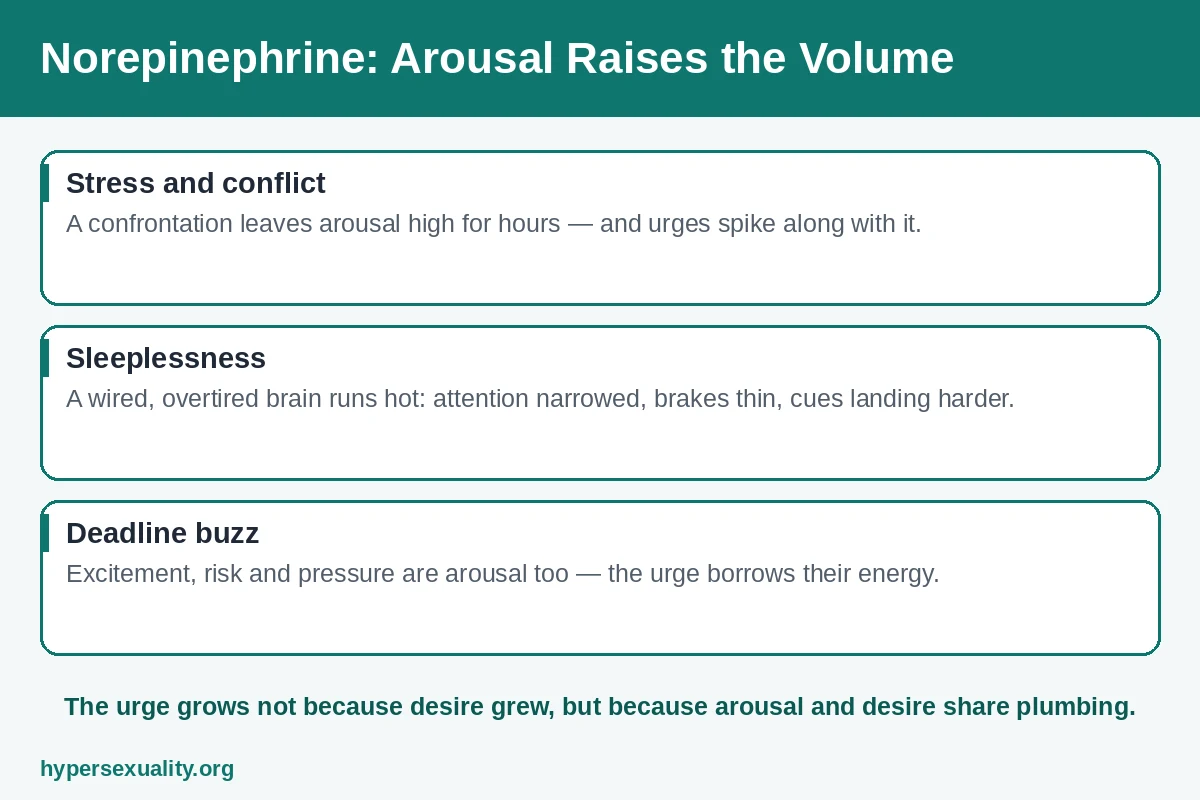
The third system is the one people feel in their body. Norepinephrine (also called noradrenaline) drives arousal and alertness: heart rate up, attention narrowed, senses heightened — the physiology of being keyed up. It surges with excitement, novelty, risk — and with stress.
That last word explains a connection many people with this pattern notice but cannot name. Their urges do not only appear in relaxed, desiring moments; they spike in states of high arousal of any flavour — after a confrontation at work, during a sleepless wired night, in the buzz before a deadline.
If the arousal system is already running hot, a sexual cue lands on prepared ground. The urge feels stronger not because desire grew, but because arousal and desire share plumbing. This is also why states like mania — in which norepinephrine-driven arousal is part of the picture — can bring intense hypersexual behaviour with them, and why calming the state, not just resisting the act, is a real treatment target. In the cast of neurotransmitters and compulsive sexual behavior, norepinephrine is the stage lighting: it decides how intense everything feels.
Putting the three together — and meeting Ruth
Read the pattern through the cast of neurotransmitters and compulsive sexual behavior and it stops being mysterious. A cue fires dopamine wanting. Norepinephrine arousal — from stress, conflict, exhaustion — turns the volume up. Serotonin braking, weakened by low mood and poor sleep, engages late and quietly. The behaviour happens, relief arrives, and the loop files the whole sequence under “what to do when I feel like this”.
Consider Ruth, a composite example. Her urges were worst in a specific state: Sunday evenings, wired and dreading the week, sleep already short. Describing her pattern chemically helped her stop describing it morally. Her plan, built with her therapist, targeted states rather than willpower: Sunday nights restructured, sleep defended, a different decompression ritual installed before the wired feeling peaked. She was not “fixing her serotonin” — she was changing the conditions her whole chemistry operates in, which is what most real treatment does, whichever system a researcher would name.
For the circuit these chemicals act on, see our companion piece on brain reward pathways and sexual compulsion; for how widely the pattern itself is defined, start from hypersexuality. And if reading about states and triggers makes you want to map your own pattern first, the structured self-assessment questions for compulsive sexual behavior are a reasonable, diagnosis-free place to begin.
What this chemistry means for treatment research
Researchers follow the roles. If serotonin signalling brakes urges, do serotonergic treatments reduce compulsive sexual behaviour in controlled trials — and for whom? If arousal states feed urges, do treatments for co-occurring anxiety, ADHD or mood instability reduce the sexual pattern indirectly? These are live research questions with incomplete answers, which is why guidelines describe medication for this pattern as a specialist decision based on the full picture — especially any co-occurring condition — rather than a standard prescription. Following the roles is exactly how researchers now study neurotransmitters and compulsive sexual behavior — system by system, not slogan by slogan.
The next question most readers ask is a fair one — how many people are we even talking about? — and it has its own evidence story, told in how common is hypersexuality.
Q&A
What does serotonin actually do to sexual urges?
Mostly, it restrains and concludes them. Serotonin supports impulse control, steadier mood and the satiety signal that lets desire switch off after satisfaction. When serotonin signalling is boosted by certain antidepressant medicines, reduced libido and delayed orgasm are common side effects — everyday evidence that this system acts as a brake on sexual drive.
Why do stress and feeling “wired” make urges stronger?
Because arousal is shared plumbing. Stress activates norepinephrine, the alertness chemical: heart rate rises, attention narrows, the body is primed for action. Sexual cues landing in that state feel more urgent, and many people learn to use sexual behaviour to discharge tension. The urge is often riding on arousal that was never sexual to begin with.
Do low serotonin levels cause hypersexuality?
Not in any proven, simple sense. The “chemical imbalance” slogan survives because it is memorable, not because it is accurate: nobody can measure your brain’s serotonin signalling in the relevant circuits, and the pattern appears in people with very different mood profiles. Serotonin’s braking role is real; a personal serotonin deficiency as “the cause” is not something any test can establish.
Can a blood or urine test check my neurotransmitter levels for this?
No. Neurotransmitters in blood or urine mostly reflect the body’s peripheral systems, not signalling inside specific brain circuits, and no such test diagnoses or meaningfully assesses this pattern. Assessment is clinical — history, control, consequences, co-occurring conditions — conducted by a professional, not a lab panel ordered online.
If brain chemicals are involved, does treatment always mean medication?
No. Behavioural treatment works on the same systems from the outside in: changing cues retrains dopamine-driven wanting, sleep and stress work calm the arousal system, and treating low mood supports the braking side. Medication enters the conversation mainly when a co-occurring condition (such as depression, anxiety or bipolar disorder) needs treating in its own right, or when a specialist judges the pattern severe enough — a decision for a clinician who knows your history. Either way, treatment works with neurotransmitters and compulsive sexual behavior, not on a single chemical.
Sources: World Health Organization, ICD-11 entry 6C72 “Compulsive sexual behaviour disorder”; Turner, D. et al. (2022), “The World Federation of Societies of Biological Psychiatry (WFSBP) guidelines on the assessment and pharmacological treatment of compulsive sexual behaviour disorder,” Dialogues in Clinical Neuroscience, 24(1), 10–69.
Medical disclaimer: This article is educational information only and is not medical advice, diagnosis or treatment. Only a qualified clinician who knows your history can assess whether any diagnosis applies to you. If sexual behaviour is causing you distress or harm, consider speaking with your doctor or a licensed mental-health professional.