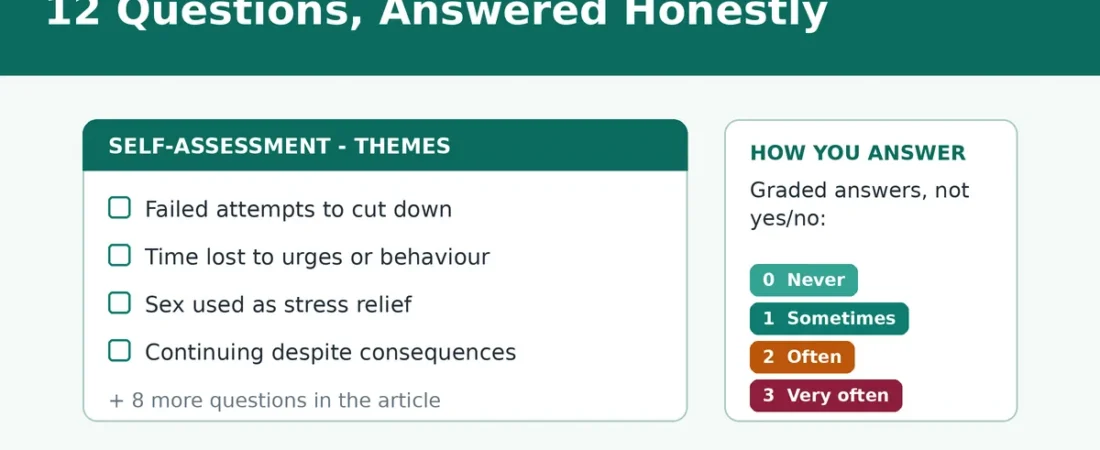
Most online checklists for this topic work by fright. One widely downloaded example tells you that a single “yes” — to any of nine questions — means you are in danger, and four yeses mean your behaviour is life-dominating and out of control. One yes can mean you once hid something embarrassing. It cannot carry that verdict.
This compulsive sexual behavior self-assessment is built the opposite way: graded answers, a six-month window, questions written for this page and mapped to the themes clinicians actually weigh, and scoring bands that tell the truth calmly — including when the honest answer is “this looks like something else”.
Quick answer: This compulsive sexual behavior self-assessment asks 12 original questions about control, centrality, coping use, continuation despite harm, neglect, escalation, secrecy and impact over the past six months. Answer each from never (0) to very often (3), add the scores, and read your band: 0–8 few signs, 9–17 some signals worth reflection, 18–27 a pattern worth a professional conversation, 28–36 a strong pattern to discuss with a clinician soon. It is screening for reflection — never a diagnosis.
Contents
How this compulsive sexual behavior self-assessment works
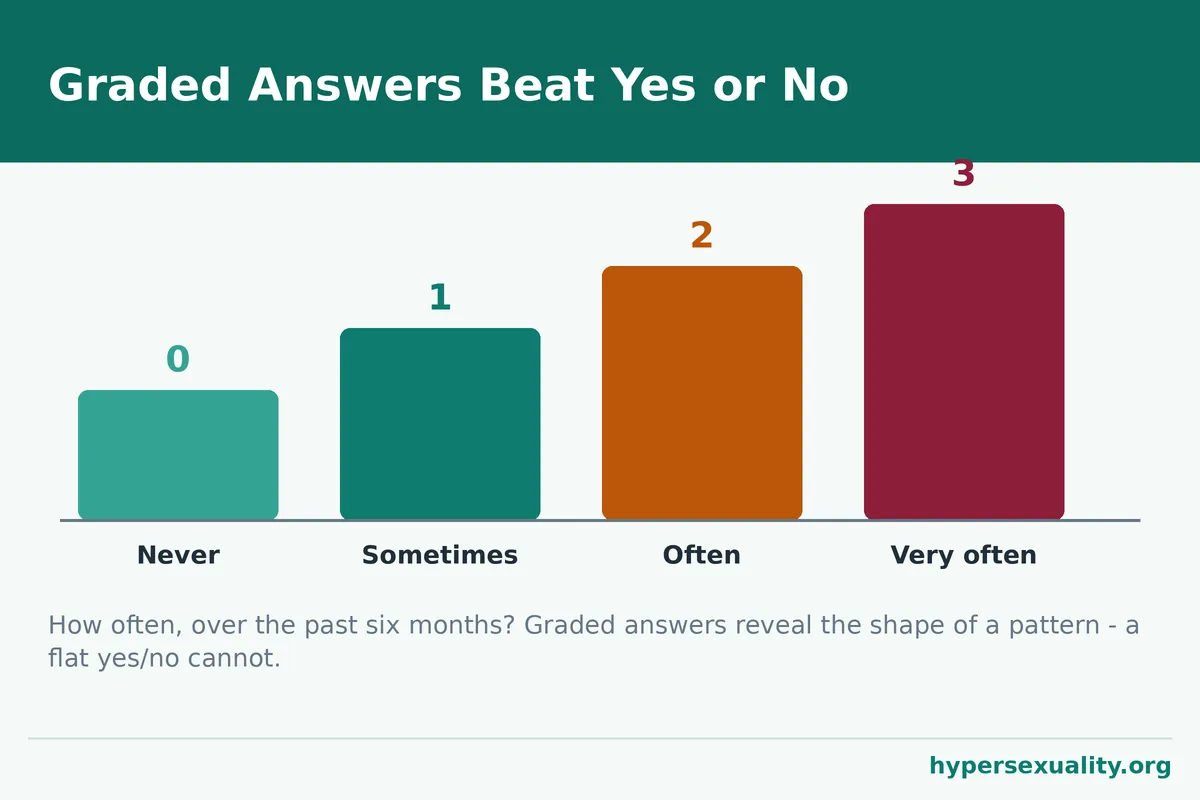
Take the past six months as your window — the same extended period clinicians use, because it filters out a bad fortnight. Answer every question with one of four graded responses: Never = 0, Sometimes = 1, Often = 2, Very often = 3. Graded answers matter: the difference between “once, during a brutal month” and “most weeks, for half a year” is the difference between a human rough patch and a pattern, and yes/no formats erase it. Answer about your behaviour, not about the kind of person you believe you are.
The 12 questions in this compulsive sexual behavior self-assessment were written for this page; each is followed by a short note on why clinicians ask something like it. This page is the practical member of the screening family gathered under our hypersexuality test hub, and its design follows the validated domains explained in our guide to the CSBD-19.
The 12 questions
- In the past six months, how often have sexual urges or fantasies taken up far more of your day than you intended?
Why it is asked: centrality — whether the behaviour has become the organising theme of your mental life. - How often have you tried to cut down or stop a sexual behaviour and found you could not keep it up?
Why it is asked: failed control is the core of the clinical pattern. - How often have you turned to sexual behaviour mainly to escape stress, boredom, loneliness or a low mood?
Why it is asked: coping use — sex doing emotional-regulation duty is a common engine of the pattern. - How often have you carried on with a sexual behaviour after it had already caused a problem — at work, with money, or in a relationship?
Why it is asked: continuation despite harm separates a compulsion from a habit. - How often have you put off sleep, work, study or time with people you care about because of sexual behaviour?
Why it is asked: displacement — what the behaviour is quietly replacing. - How often have you needed more time, more novelty or more intensity to get the same effect?
Why it is asked: escalation, the pattern’s tendency to raise its own dose. - How often have you hidden the extent of your sexual behaviour from people close to you?
Why it is asked: secrecy protects the pattern and corrodes the relationships around it. - How often has sexual behaviour left you feeling flat or dissatisfied rather than satisfied?
Why it is asked: diminished satisfaction is written into the ICD-11 picture and missed by most checklists. - How often have you broken a limit you set for yourself — about money, time, places or apps?
Why it is asked: self-set rules and their collapse are the earliest measurable form of relapse. - How often have you continued a sexual behaviour even though it carried a risk to your health or safety?
Why it is asked: risk-blindness marks the point where the pattern outranks self-protection. - How often has someone who knows you well expressed concern about your sexual behaviour?
Why it is asked: outside observation often registers the pattern before self-report does. - How often have you felt your daily functioning — work, study, ordinary life — genuinely impaired by this pattern?
Why it is asked: impairment is what makes a pattern clinical rather than merely intense. (Distress purely from moral disapproval of your own behaviour is a different matter — see the note below the bands.)
Reading your band
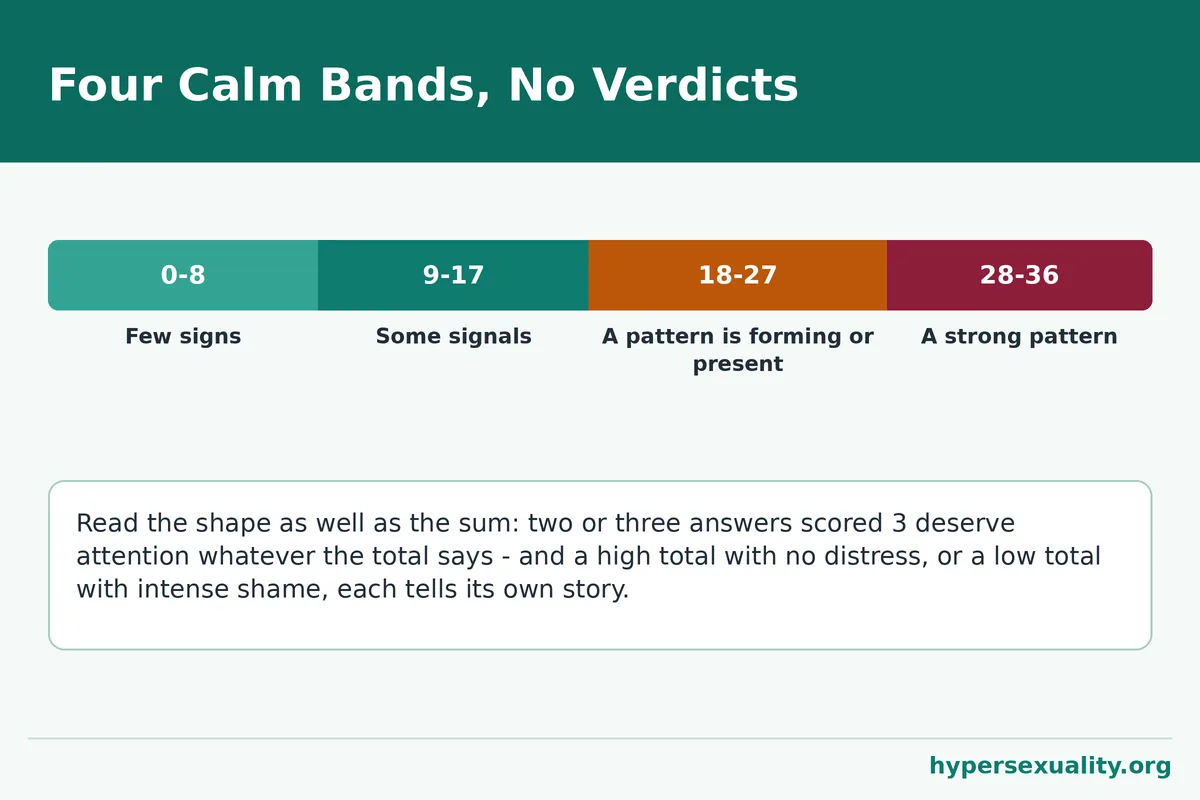
| Total | Band | What it usually means |
|---|---|---|
| 0–8 | Few signs | Occasional friction, no established pattern. Note any single question scored 3 and reflect on that one. |
| 9–17 | Some signals | Real signals in some themes. Worth honest reflection and watching whether the scores climb. |
| 18–27 | A pattern is forming or present | Several clinical themes are active together. A professional conversation is a proportionate next step. |
| 28–36 | A strong pattern | Control, harm and impact are heavily engaged. Book an assessment rather than another attempt to white-knuckle it. |
Read the shape as well as the sum. A total of 15 concentrated in control and secrecy questions is a different message from a 15 spread thinly everywhere, and two or three questions scored at 3 deserve attention whatever the total says. That is what a compulsive sexual behavior self-assessment can honestly tell you — a pattern, a shape, and a proportionate next step — and it is also all it can tell you.
Two results the fear-based quizzes handle badly
A high score with little distress. Sometimes the behaviour is frequent and rule-breaking but sits inside a life the person is genuinely content with, harming no one. A checklist cannot settle whether that is a disorder, a values mismatch with a partner, or neither — which is one reason diagnosis belongs to a clinician, not a form.
A low score with intense shame. If your total is low but you feel crushed by guilt, consider moral incongruence: distress arising because behaviour conflicts with your beliefs, not because it is out of control. ICD-11 explicitly does not count distress based purely on moral judgement as this disorder. The suffering is real and deserves support, but it needs a different kind of help. The early warning signs of hypersexuality — the next article in this cluster — can help you judge whether a pattern is developing underneath the guilt.
What Chris did with a score of 19
Consider Chris, a composite example: 41, expecting either a clean bill or a catastrophe, he scored 19 — the pattern band. What changed his mind about the exercise was the breakdown. His coping and secrecy questions were 3s; his risk and impairment questions were 0s and 1s. Instead of a label, he had a work order: the behaviour was his stress valve, and it ran on concealment.
He took the sheet itself to a first therapy session — as our guide to the questions to ask a psychiatrist about compulsive sexual behavior suggests — and the conversation started from evidence rather than from shame. That is all a good compulsive sexual behavior self-assessment is for: not a verdict, but a well-lit starting point.
Q&A
Is this self-assessment a diagnosis?
No. This compulsive sexual behavior self-assessment is a screening and reflection tool. It organises your experience against the themes clinicians weigh, but diagnosis requires a professional who can assess duration, impact, exclusions such as medication or mania, and the difference between compulsion and moral distress.
Why graded answers instead of yes/no?
Because frequency and persistence are the information. “Sometimes, during one bad month” and “very often, for six months” are clinically different answers that a yes/no format forces into the same box — and fear-based scoring then treats one yes as an emergency. Graded answers keep the result proportionate.
My score is low but I feel terrible about my behaviour. What does that mean?
It may mean the problem is a values conflict rather than loss of control — moral incongruence. ICD-11 excludes distress based purely on moral disapproval from this disorder. That does not dismiss your distress; it redirects it toward the right help, which may be counselling around beliefs and shame rather than addiction treatment.
My score is high but my life seems fine. Should I worry?
Do not panic, and do not bin the result either. Check the shape: which questions carried the score? If control, secrecy and continuation-despite-harm are high, a professional conversation is worthwhile even while life still functions — patterns are cheapest to change before the costs land.
How often should I retake a self-assessment?
If you are monitoring change, every two to three months is reasonable — often enough to see movement, spaced enough for behaviour to actually change. Answer for the new six-month window each time, and compare shapes, not just totals.
Sources: World Health Organization, ICD-11 entry 6C72 “Compulsive sexual behaviour disorder”; Bőthe, B. et al. (2020), “The development of the Compulsive Sexual Behavior Disorder Scale (CSBD-19),” Journal of Behavioral Addictions, 9(2), 247–262; Kraus, S. W. et al. (2018), “Compulsive sexual behaviour disorder in the WHO ICD-11,” World Psychiatry, 17(1), 109–110.
Medical disclaimer: This article is educational information only and is not medical advice, diagnosis or treatment. Only a qualified clinician who knows your history can assess whether any diagnosis applies to you. If sexual behaviour is causing you distress or harm, consider speaking with your doctor or a licensed mental-health professional.