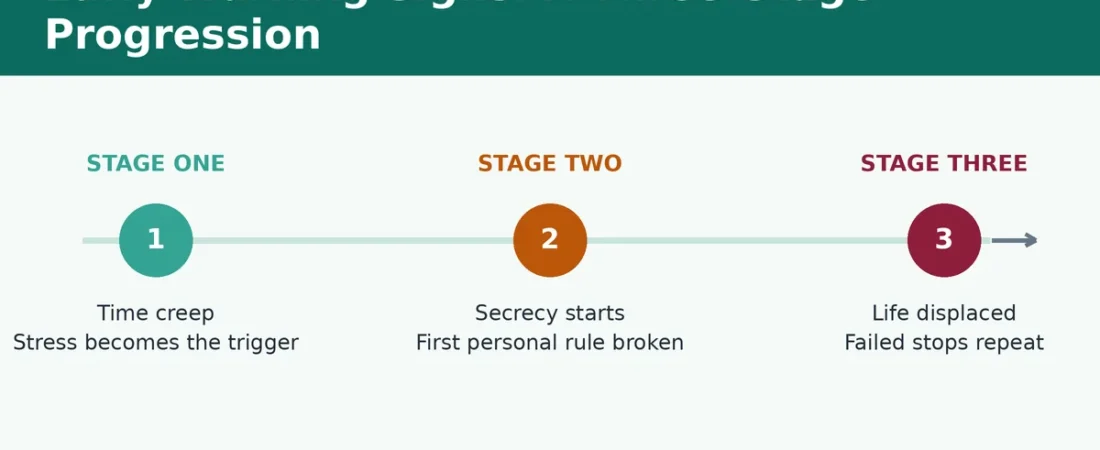
Symptom lists flatten everything. On a typical clinic page, the early warning signs of hypersexuality sit in one undifferentiated pile — preoccupation next to broken relationships, a new habit of deleting browser history listed beside job consequences — as if they all arrive together. They do not.
A compulsive pattern develops in a sequence, and the sequence is the useful part: the first changes are quiet, private and easy to reverse, while the later ones are the costs everyone recognises. This page puts the nine most characteristic changes in the order they typically appear, so you can locate yourself on the timeline honestly — ideally near the beginning of it.
Quick answer: The early warning signs of hypersexuality arrive in stages. First come quiet changes: sessions and thoughts taking more time, sex becoming the default answer to stress, and planning your day around access. Next, the pattern starts protecting itself: secrecy begins, the first personal rule is made and broken, and you need more novelty or intensity. Last, the costs land: life gets displaced, serious attempts to stop fail, and the behaviour continues after a real consequence. Spotting stage one is the whole game.
Contents
Stage one: the quiet changes (signs 1–3)
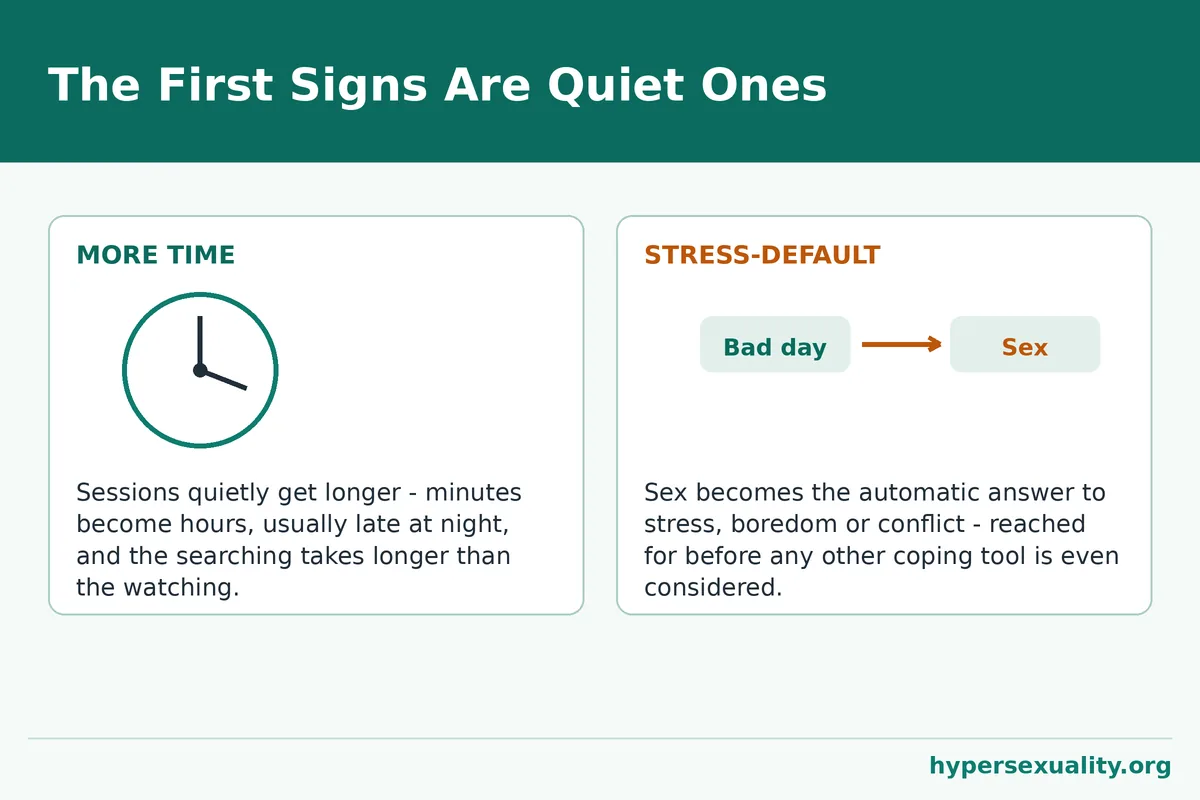
1. Time starts creeping. Nothing dramatic — sessions run longer than intended, checking becomes scrolling, scrolling becomes an hour. The total weekly time rises in small increments you can each explain away. Time creep is the earliest of the early warning signs of hypersexuality precisely because it feels like nothing.
2. Sex becomes the default stress response. A hard meeting, a lonely evening, a spike of anxiety — and the response is automatic, no longer one option among several but the option. When a behaviour becomes your only regulation tool, it has started doing a job it will demand more resources to do.
3. You start planning around access. Choosing the hotel with better Wi-Fi, engineering time alone, arranging the evening so opportunity exists. The behaviour is no longer just happening; it is being provisioned. Planning is the mind reorganising around the pattern — a structural change, not a moment of weakness.
Stage two: the pattern protects itself (signs 4–6)
4. Secrecy appears. Deleted histories, a cleared cache as routine, a second account, a practised vagueness about where an evening went. For many people this is the true turning point: the behaviour now has something to hide, and hiding becomes a behaviour of its own.
5. The first rule is made — and broken. “Not on work nights.” “Only this much money.” “Never that site again.” Rules are evidence you have noticed a problem; the first broken rule, usually within days, is evidence the pattern outranks your intentions. Among the early warning signs of hypersexuality, this is the one people remember most clearly afterwards.
6. You need more. More time, more novelty, more intensity to reach the same effect — the drift clinicians call escalation. What used to register barely does now, and the search itself takes longer than the act.
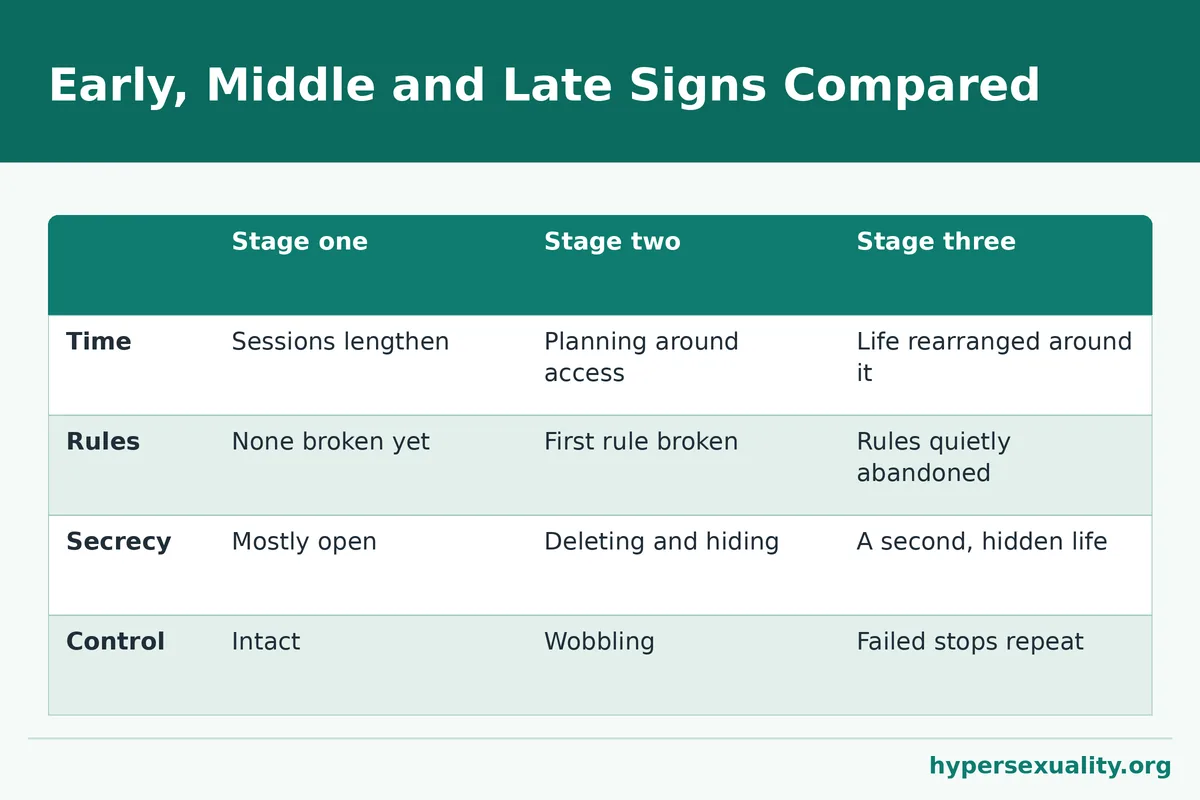
| Stage | Changes | What it usually means |
|---|---|---|
| One — quiet | Time creep; sex as default stress response; planning around access | The behaviour is taking a central role, but nothing has been damaged yet |
| Two — protective | Secrecy begins; first rule made and broken; needing more | The pattern is defending and growing itself; self-correction is failing |
| Three — costly | Displacement; failed serious attempts to stop; continuing after consequences | The clinical picture: the pattern now outranks health, work and relationships |
Stage three: the costs land (signs 7–9)
7. Displacement begins. Sleep is spent first, then punctuality, then presence — at work, with friends, with a partner. Things you value start losing contests they used to win automatically.
8. Serious attempts to stop fail. Not a casual resolution but a genuine, motivated effort — and it does not hold. Repeated failed control is the core criterion clinicians look for; reaching this sign means the pattern is no longer a habit you can simply decide out of.
9. The behaviour continues after a real consequence. A warning at work, a discovered lie, money that was spoken for, a health scare — and after the shame and the promises, the behaviour resumes. Continuation despite harm is the sign that most clearly separates a compulsive pattern from an intense sex life.
What these signs are not
A high sex drive is not on this list, deliberately. Wanting sex often, enjoying pornography, having an adventurous dating life — none of these is a warning sign by itself, because none involves the machinery above: creep, secrecy, broken rules, displacement.
Nor is a single bad month: stress, grief and new relationships all produce temporary surges that settle. The early warning signs of hypersexuality are about direction and persistence — the same changes, recurring, over months. If your only match is moral guilt about behaviour that is modest and controlled, read that differently: values conflict is real suffering, but it is a different problem from compulsion.
Where Elena located herself
Consider Elena, a composite example: 29, she read a list like this one expecting to find herself either “fine” or “a sex addict”, and instead found something more precise. She recognised all three stage-one changes — time creep, stress-default, planning around access — plus the first of stage two: she had started deleting her history as a routine, though she had not broken a rule because she had not yet made one.
Locating herself at the stage boundary changed the conversation she had with herself. She was not diagnosing a disorder; she was early. She worked through the compulsive sexual behavior self-assessment questions in the previous article, set the rule she had been avoiding, and told one friend the truth — breaking the secrecy before it set. Six months on, her stage-one changes had receded rather than advanced. Early is not a lesser version of the problem; it is the cheapest moment to reverse it.
These pages sit under the cluster’s hypersexuality test hub; if your signs cluster near the pattern itself rather than its onset, the next article — on the moment desire turns compulsive — and our cross-cluster guide to the early warning signs of a sex addiction relapse take the story further.
Q&A
What is usually the very first warning sign?
Time. Before any rule is broken or any consequence lands, the behaviour starts quietly consuming more of the day — longer sessions, more mental space, more planning. That is why the early warning signs of hypersexuality begin with time creep: it is the change almost everyone recognises in hindsight and almost no one notices at the time.
I recognise one or two signs. Does that mean I have hypersexuality?
No. Single signs are common and often temporary. What matters is the combination, the direction and the duration: several changes, persisting and progressing over months, especially once secrecy and broken rules appear. Treat a couple of stage-one matches as information, not a verdict.
How long does it take for early signs to become a full pattern?
There is no fixed timetable; it varies from months to years, and many people stabilise at an early stage or reverse it, particularly when they act on what they notice. The progression described here is a tendency, not a conveyor belt — which is exactly why noticing early signs is valuable rather than frightening.
Can these signs appear in someone with a low sex drive?
Yes, and this surprises people. The pattern is defined by control and consequences, not appetite: someone with modest desire can still show time creep around pornography, secrecy, broken rules and displacement. Frequency and desire are the wrong gauges; change and control are the right ones.
What should I do if I recognise stage two or three signs?
Stage two is the moment to stop relying on rules alone: take a structured self-assessment, tell one trusted person, and reduce secrecy — it is the pattern’s protection. Stage three signs — failed serious attempts to stop, continuing after real consequences — are the standard prompt for a professional assessment. Earlier is cheaper, but it is never too late to be accurately assessed.
Sources: World Health Organization, ICD-11 entry 6C72 “Compulsive sexual behaviour disorder”; Derbyshire, K. L. & Grant, J. E. (2015), “Compulsive sexual behavior: A review of the evidence,” Journal of Behavioral Addictions, 4(2), 37–43; Kraus, S. W. et al. (2018), “Compulsive sexual behaviour disorder in the WHO ICD-11,” World Psychiatry, 17(1), 109–110.
Medical disclaimer: This article is educational information only and is not medical advice, diagnosis or treatment. Only a qualified clinician who knows your history can assess whether any diagnosis applies to you. If sexual behaviour is causing you distress or harm, consider speaking with your doctor or a licensed mental-health professional.