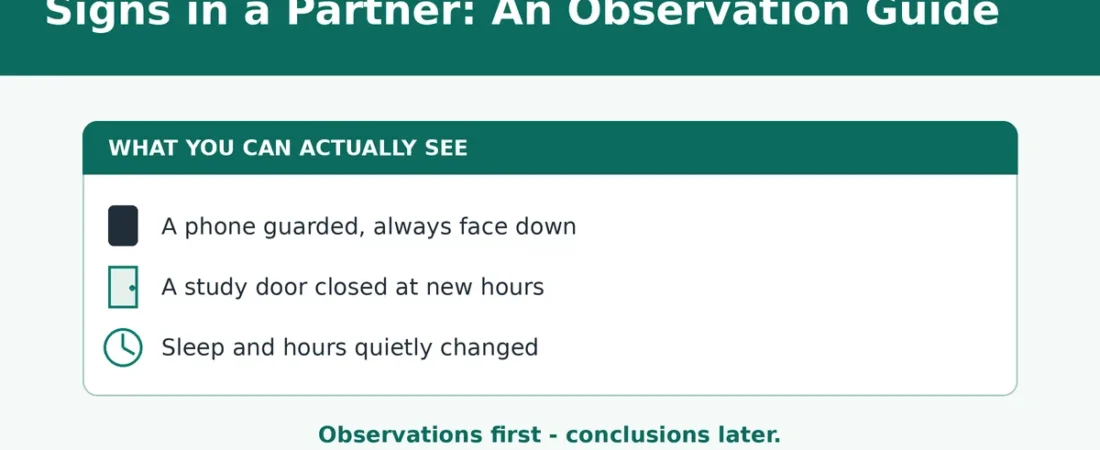
Most partners do not discover a compulsive sexual pattern all at once. They notice weather changes first: a phone that has become guarded, evenings with gaps in them, an irritability that arrives on schedule, an intimacy that has quietly thinned. Long before there is evidence of anything, there is a feeling that the person they live with is somewhere else.
This page is written for that stage — the uncertain one, before any discovery — and it does two things carefully: it sets out the signs of hypersexuality in a partner that spouses usually see first, and it separates those observable signs from suspicion, because confusing the two helps nobody.
Quick answer: The earliest signs of hypersexuality in a partner are usually changes rather than acts: guarding devices, unaccounted time, mood that swings around access, money that doesn’t add up, and a sexual relationship with you that feels displaced by something solitary. No single sign proves a compulsive pattern — affairs, depression, stress and ordinary privacy all mimic parts of the picture. A cluster of changes, sustained over months, is what makes a calm conversation worth having.
Contents
Signs of hypersexuality in a partner: what spouses usually notice first
Spouses who later learn the full story almost always describe the same early list — and notably, it contains very little about sex itself. The signs of hypersexuality in a partner tend to be about availability: of attention, of time, of honesty.
- A phone that changed status. Once left anywhere, now always face-down, always carried, locked with a new code. The device has become defended territory.
- Time with soft edges. Regular blocks — late evenings, “work” in another room, errands that expand — that are vaguely explained and oddly non-negotiable.
- Mood that tracks access. Irritability, restlessness or flatness when the usual private time is interrupted by travel, guests or family life — and a visible settling when it resumes.
- A double bookkeeping of small things. Minor inconsistencies in stories, spending that doesn’t quite match explanations, a version of the day that shifts slightly between tellings.
- Displaced intimacy. Less initiation with you, or sex that feels distracted and separate — alongside evidence of a sexual life happening somewhere you are not.
- Sleep and routine erosion. Late nights as a fixed pattern, tiredness that has become the household’s normal, mornings that start depleted.
Our guide to escalation signs shows the same pattern from the inside — drift and growing need. From outside, it looks like this: changes in availability, visible to a partner before anything is admitted.
Signs, suspicion, and the space between
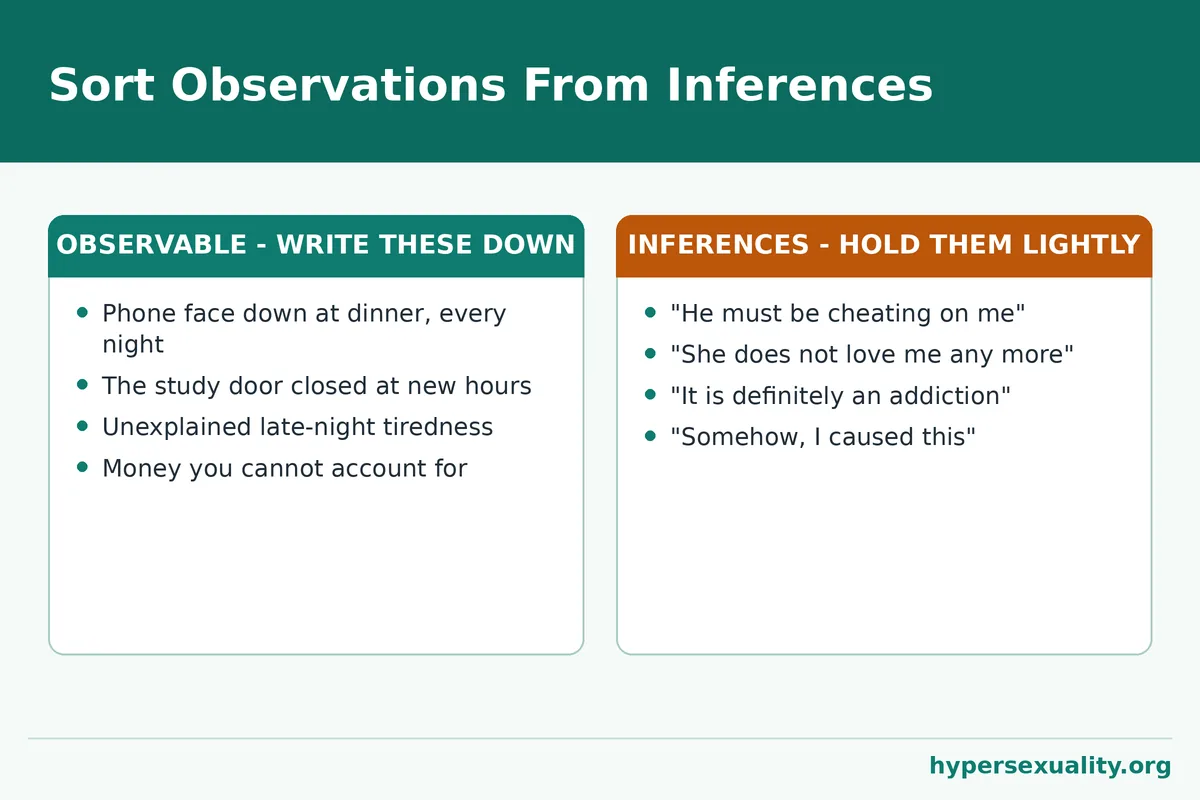
Uncertainty is corrosive, and one of its effects is that suspicion starts to feel like evidence. It isn’t — and acting as if it is can damage a relationship that has a different, fixable problem. Partners weighing signs of hypersexuality in a partner deserve better than a verdict in either direction. A useful discipline is to sort what you have into two columns:
| What you can observe | What you may be inferring |
|---|---|
| The phone is newly locked and always carried | “They must be messaging someone” |
| Two hours most evenings are vaguely accounted for | “I know exactly what they’re doing” |
| Stories about spending don’t match the bank statement | “Everything they say is a lie” |
| Intimacy with you has dropped sharply | “They don’t find me attractive anymore” |
| They become angry when you ask ordinary questions | “Anger proves guilt about this specifically” |
The left column is real, and a sustained pattern in it justifies a serious conversation. The right column may or may not be true — and some of it reflects your own pain more than their behaviour. None of this means doubting your instincts: partners are usually right that something is wrong. The discipline is about naming what is actually known when you raise it: conversations started from the left column go somewhere; conversations started from the right become trials.
What else could explain the same picture
Honesty about the signs of hypersexuality in a partner requires honesty about the alternatives, because several other situations produce an almost identical shadow:
- An affair without compulsion. Secrecy, guarded devices and displaced intimacy can all belong to a single affair — a betrayal, but a different problem, with different questions attached.
- Depression or burnout. Withdrawal, lost libido, irritability and secretive solitary screen time are also the shape of depression retreating into a phone.
- A manic or hypomanic episode. If the change is sudden and comes with reduced need for sleep, racing energy and uncharacteristic risk-taking across life — not just sex — the picture may be mood-driven; our guide to the signs of hypersexuality during a manic episode explains how that presentation differs and why it changes the response entirely.
- Ordinary privacy plus a strained relationship. Some guarding is a reaction to feeling monitored. In a relationship already low on trust, normal privacy can read as concealment.
- A desire mismatch being managed badly. A partner avoiding conversations about mismatched desire may look evasive while hiding nothing but embarrassment.
Holding these open is not naivety. It is what makes your eventual conversation credible — to your partner, and to any professional you later talk to.
How to raise it without an accusation
If the pattern in the left-hand column has held for months, a conversation is reasonable — and how it opens decides whether it becomes one. Some approaches that partners and therapists consistently find workable:
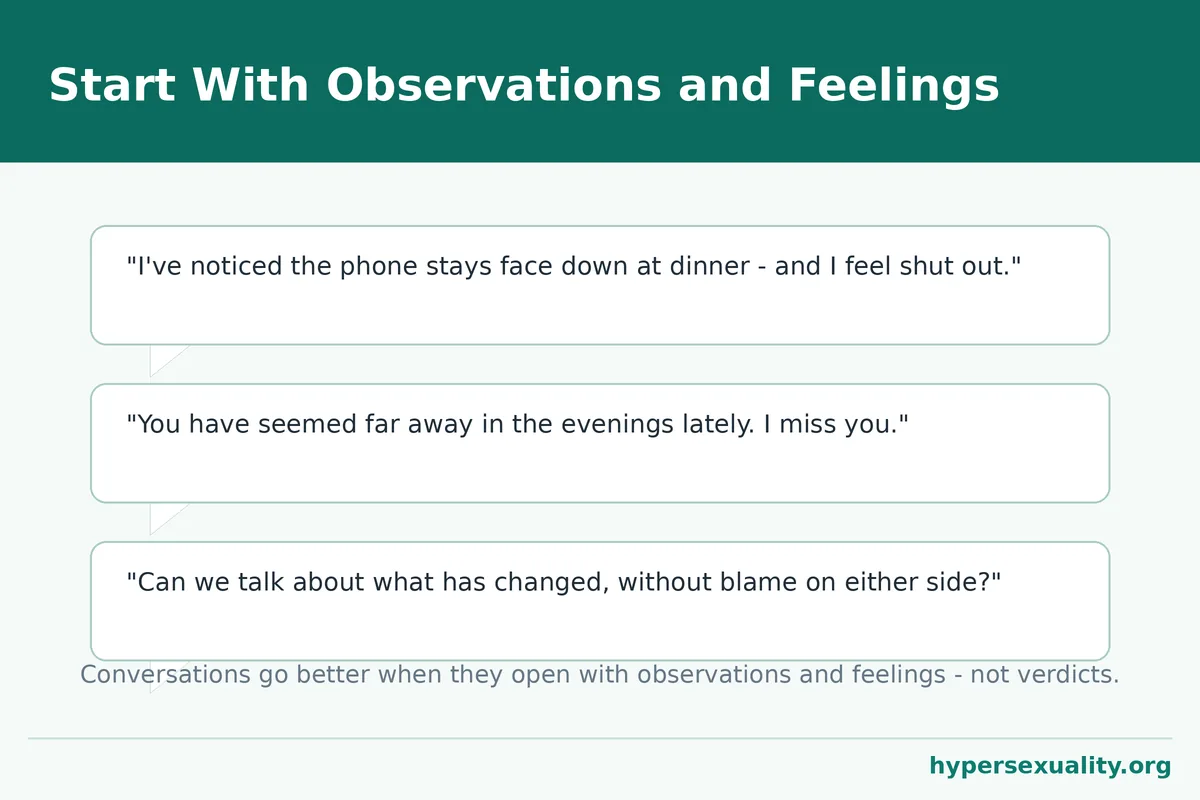
- Describe observations, not conclusions. “I’ve noticed your phone is always locked now, you’re up past two most nights, and we’ve barely been intimate in months. I feel shut out and I’m worried” opens a door. “I know what you’re doing” closes one.
- Name your feeling before their behaviour. Worry and loneliness invite an answer; contempt invites a defence.
- Choose the moment. Not mid-argument, not after a discovery at midnight, not through messages. A calm, private, unhurried setting is part of the message.
- Ask an answerable question. “Is there something going on with you that I don’t know about?” can be answered. A demand for a full confession of unspecified crimes cannot.
- Expect a partial first conversation. Denial or a smaller admission is the common first response even when a real pattern exists — which is information too, and a reason to keep the door open.
- Do not become the investigator. Checking devices, tracking and interrogation may feel necessary, but they corrode you and rarely produce the truth a conversation can’t. If you cannot resist investigating, that is a sign you need support of your own, and it is legitimate to get it.
If a conversation does surface a pattern, the screening framework on our hypersexuality test page can give you both a shared, neutral vocabulary for what happens next — many couples find describing a pattern together easier than trading accusations about acts.
What it looked like for Sana
Consider Sana, a composite example: 35, married six years, who spent the better part of a year convinced she was becoming paranoid. Her husband’s phone had migrated to his pocket permanently. He had developed late “work sessions” behind a closed study door. Their sex life had thinned to almost nothing, which she had filed under her own inadequacy.
What she eventually did differently was the sorting exercise above. Written down, her observations were modest and factual: guarded phone, roughly two unaccounted hours nightly, defensiveness when asked ordinary questions, intimacy near zero.
No proof of anything — and no longer nothing, either. The conversation she opened with those observations was hard and incomplete; he admitted to pornography use he could not control only at the second attempt, a month later. But it began from facts she could stand behind, which is why it began at all. Her observations were modest, factual — and they were the signs of hypersexuality in a partner that a conversation could stand on.
Looking after yourself in the uncertain stage
Suspicion is exhausting, and partners in this stage often neglect the obvious: your sleep, your friendships and your own support matter regardless. If the uncertainty is consuming your days — checking, rehearsing conversations, monitoring moods — that cost is real even if your partner’s pattern turns out to be something else entirely. A counsellor of your own, or a trusted friend who can hear the left-hand column without inflaming the right, is not an escalation. It is maintenance.
And hold the framing that makes all of this bearable: you are not trying to catch someone. You are trying to find out whether the person you share a life with is carrying a pattern neither of you has named yet — our next guide, the internet sex screening test page, shows that pattern from the other side. Knowing the signs of hypersexuality in a partner helps you describe the pattern calmly when the conversation comes.
Q&A
Can I diagnose my partner from these signs?
No — and nobody can diagnose from outside at all. Signs of hypersexuality in a partner are observations that justify a conversation and, if a pattern is admitted or confirmed, a professional assessment. Only a clinician who can take a full history from your partner can say what the pattern actually is.
My partner watches pornography. Is that one of the signs?
Pornography use by itself is not a sign — it is common and, for most people, unproblematic. It becomes relevant only inside the wider pattern: secrecy around it, escalation, displacement of intimacy with you, failed attempts to stop. The behaviour matters less than what surrounds it.
Should I check my partner’s phone to find out for sure?
It is understandable to want certainty, but snooping usually delivers fragments without context, damages trust on both sides, and can become a compulsive pattern of its own for the checking partner. An observation-based conversation, hard as it is, produces more truth than a search history does.
What if my partner denies everything and gets angry?
Anger and denial are common first responses to many kinds of conversations — including innocent ones — so treat the first conversation as a beginning, not a verdict. Stay with what you observed, say what you need, and watch what happens over the following weeks. If nothing changes and the pattern you listed grows, outside support — a counsellor for you, or couples therapy — is a reasonable next step.
Could I be wrong about all of this?
Yes, and this page is written on that assumption. Depression, an affair, burnout and plain privacy in a strained relationship can all cast the same shadow. Being wrong after an honest, observation-based conversation costs little. Being silent while certain costs a great deal. The goal of raising it is information, not a conviction.
Sources: World Health Organization, ICD-11 entry 6C72 “Compulsive sexual behaviour disorder” ; Kraus, S. W. et al. (2018), “Compulsive sexual behaviour disorder in the WHO ICD-11,” World Psychiatry, 17(1), 109–110
Medical disclaimer: This article is educational information only and is not medical advice, diagnosis or treatment. Only a qualified clinician who knows your history can assess whether any diagnosis applies to you. If sexual behaviour is causing you distress or harm, consider speaking with your doctor or a licensed mental-health professional.