When a major therapy directory mentions the CSBD-19 scale at all, it gives it a single line: clinicians use it, it was validated internationally, full stop. Yet this 19-item questionnaire is the instrument modern research on compulsive sexual behaviour actually runs on — the scale behind the largest studies in the field, including work spanning dozens of countries. If you have encountered the name and wondered what it measures, how it is scored, or what a result could possibly mean, this is the explainer the ranking pages never wrote.
Quick answer: The CSBD-19 scale is a 19-item self-report questionnaire published in 2020, built directly on the World Health Organization’s ICD-11 definition of compulsive sexual behavior disorder. It measures five domains — control, salience, relapse, dissatisfaction and negative consequences — on agreement ratings, producing a total from 19 to 76. A total of 50 or more was identified in the validation research as a screening threshold for high risk. It screens; it does not diagnose.
Contents
Built from the ICD-11 definition, not borrowed from addiction
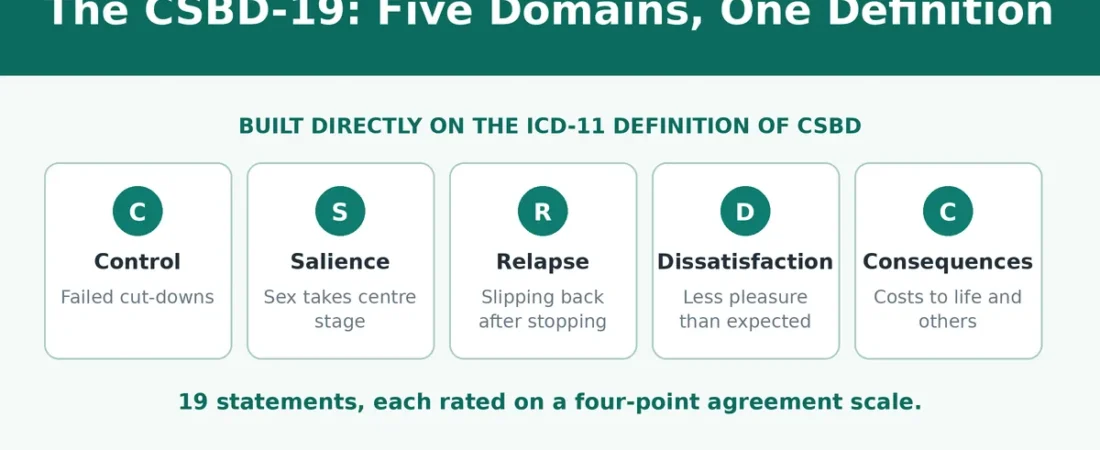
Most older questionnaires in this field were written for the “sex addiction” model of the 1980s and 1990s, and their questions show it. The CSBD-19 scale was built differently. A team led by Beáta Bőthe developed it after the WHO included compulsive sexual behavior disorder in ICD-11, deliberately constructing each item to map onto the ICD-11 diagnostic guidelines — the failed control, the centrality of the behaviour, the continuation despite harm, the diminished satisfaction.
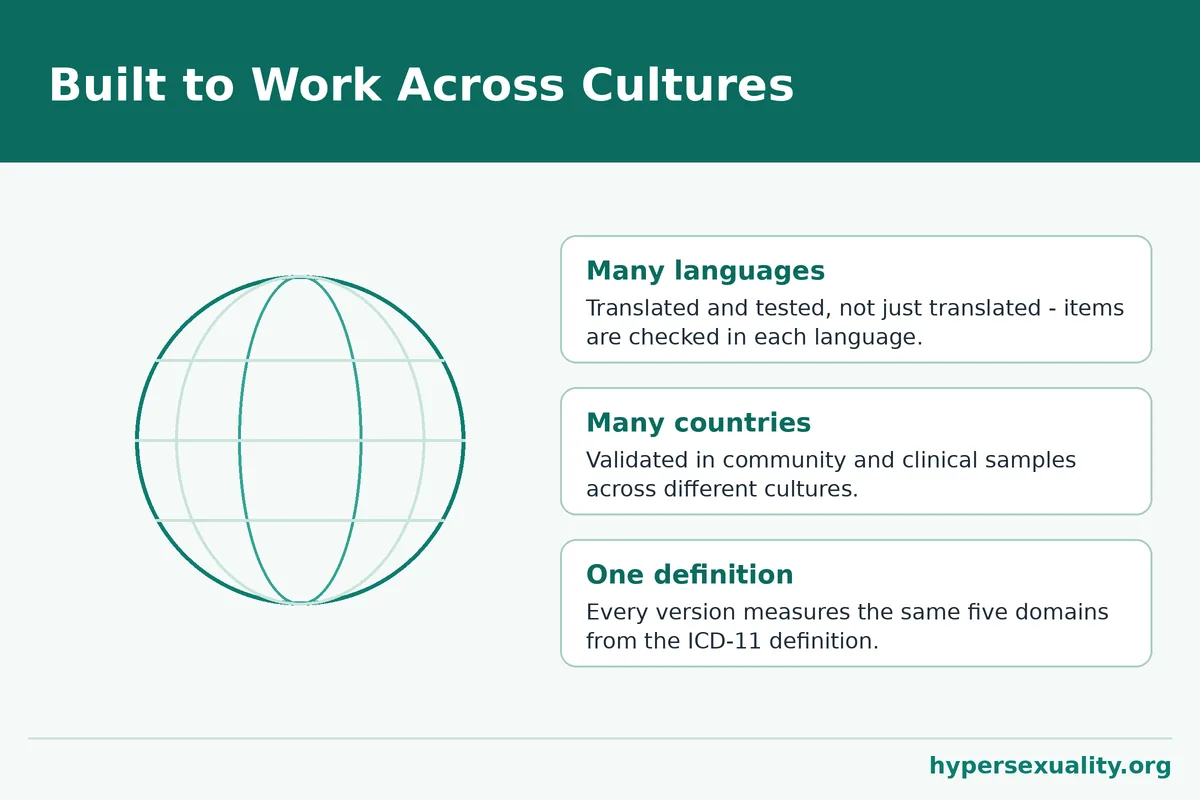
The validation study, published in the Journal of Behavioral Addictions in 2020, tested the scale in four independent samples totalling 9,325 people across the United States, Hungary and Germany, in three languages, and checked statistically that the instrument measures the same thing in each language and in women and men.
That is what “validated” means when directories name-check it — and it is why researchers reach for the CSBD-19 scale when they need numbers they can compare across countries.
The five domains, in plain English
The scale’s real value is not its total but its five domain scores, because each domain describes a different way the pattern can show up.
- Control covers the core experience of failing to rein the behaviour in — urges and behaviour that feel stronger than your intentions. This is the domain closest to the ICD-11 heart of the disorder.
- Salience measures how central sexual behaviour has become in your life: how much of your day, planning and mental space it occupies, and what it has pushed aside.
- Relapse captures the cycle of resolving to change, managing for a while, and sliding back — the repeated return after genuine efforts to reduce the behaviour.
- Dissatisfaction is the domain older tools missed entirely: the degree to which the behaviour has stopped delivering satisfaction, so that it continues almost out of momentum rather than enjoyment. ICD-11 wrote this into the definition, and the CSBD-19 scale measures it directly.
- Negative consequences tallies the harm: neglected responsibilities and relationships, adverse effects in work, study, health and daily functioning.
| Domain | What it asks about | A high score often feels like |
|---|---|---|
| Control | Failing to rein in urges and behaviour | “I decide not to, and then I do.” |
| Salience | How central the behaviour has become | “It organises my day and my head.” |
| Relapse | Returning after efforts to cut down | “I stop, then I slide back.” |
| Dissatisfaction | Pleasure draining out of the behaviour | “I don’t even enjoy it any more.” |
| Negative consequences | Harm to life areas | “It’s costing me work, people, health.” |
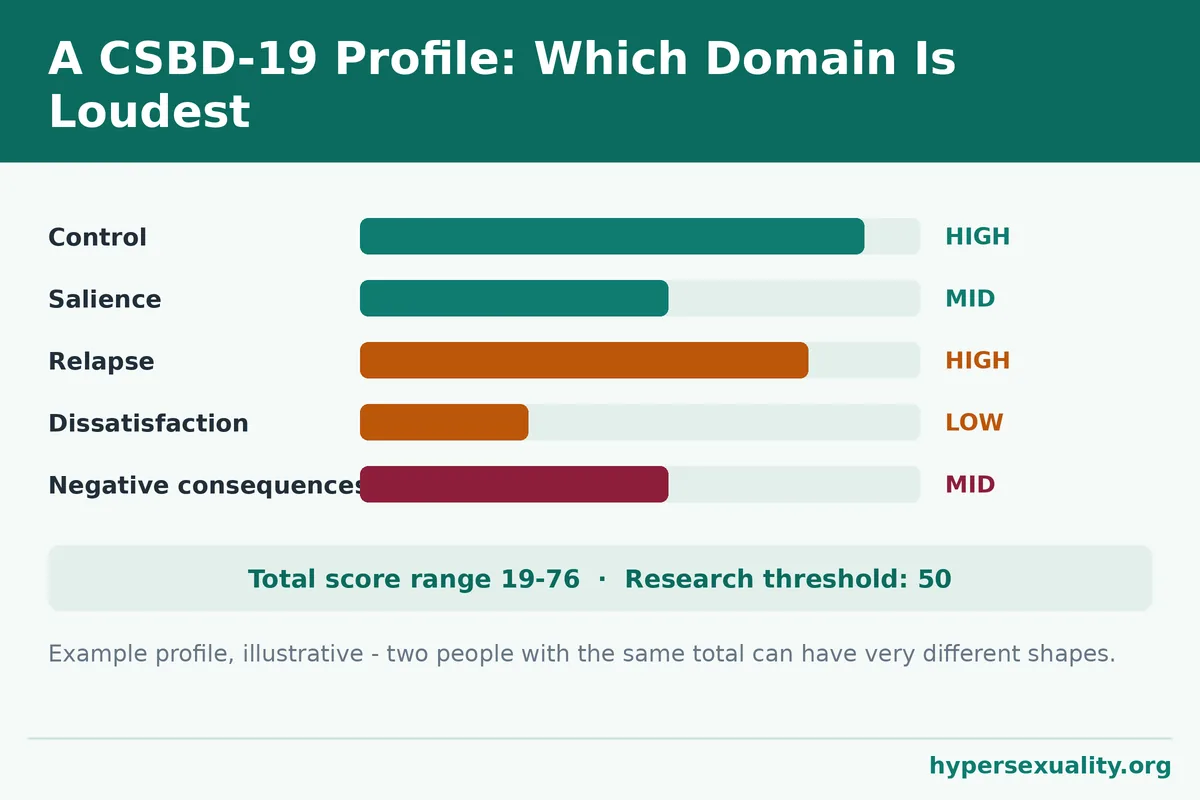
Two people can reach the same total by completely different routes — one dominated by salience, another by relapse and dissatisfaction — and those profiles point toward different conversations in treatment. A single number hides that; the five domains reveal it.
How the scoring works
Each of the 19 statements is answered on a four-point agreement scale, from totally disagree (1) to totally agree (4). Adding the answers gives a total between 19 and 76. In the validation research, a total of 50 points was found to be the optimal threshold separating people at high risk of compulsive sexual behavior disorder from those at low risk.
Two honest warnings about that number. First, it is a screening threshold from group research, designed to flag who merits a closer look — not a diagnostic line that settles an individual case. Second, the domain profile usually tells you more than the total: a 48 built from relapse and dissatisfaction is a very different picture from a 48 built from salience alone. If you ever take the CSBD-19 scale in a clinic or a study, ask for the domain breakdown, not just the headline score.
What Fatima’s profile showed her
Consider Fatima, a composite example: 38, she completed the CSBD-19 scale during the intake for a research-linked clinic programme, expecting a single blunt verdict. Her total came out just under the threshold — close enough to worry her. The domain profile told a more useful story. Her control and salience scores were moderate; her relapse score was high, and her dissatisfaction score was the highest of the five.
In the assessment conversation that followed, that shape reframed everything: the problem was less that urges overwhelmed her daily life, and more that a behaviour she no longer even enjoyed kept re-installing itself after every attempt to stop. That is a specific, workable problem — and she would never have seen it from the total alone.
How it compares with the older tools
The CSBD-19 scale sits alongside two instruments covered elsewhere in this cluster. The HBI, explained in articles 2.6–2.7, organises the pattern into coping, control and consequences, and was built for the older hypersexual disorder framework. The hypersexual disorder screening inventory, covered in the previous article, is a seven-question form tied to a diagnosis the DSM-5 never adopted. The CSBD-19’s advantage is its direct line to the current ICD-11 definition — including the dissatisfaction domain neither older tool measures — plus validation across languages and genders from the start.
On this site it anchors the screening family gathered under the hypersexuality test hub; the questions it inspired for general readers appear in our compulsive sexual behavior self-assessment questions, and the definition it operationalises is set out in our explainer of the CSBD ICD-11 criteria.
Q&A
What CSBD-19 score counts as high?
In the validation study, a total of 50 or more out of 76 best separated high-risk from low-risk respondents, so 50 is the commonly cited screening threshold. Treat it as a flag for a fuller assessment, not a diagnosis — and remember the five domain scores usually carry more useful information than the total.
Can I take the CSBD-19 myself?
The scale was designed as a research and clinical screening instrument, and its items are published in the validation paper’s appendices for professional use. If you complete it privately, read the result the way researchers do — as a risk indication and a domain profile to reflect on, ideally followed by a professional conversation if the scores are high.
Is the CSBD-19 a diagnosis of CSBD?
No. The CSBD-19 scale screens for the pattern defined in ICD-11; diagnosis requires a clinician to confirm the pattern, its duration, its impact, and that it is not better explained by another condition, a substance or a medication — and ICD-11 also excludes distress based purely on moral disapproval, which no questionnaire can judge.
Why does the scale have five domains instead of one score?
Because the pattern is not one thing. Failing to control urges, having the behaviour dominate your mental life, relapsing after honest efforts, losing satisfaction, and accumulating harm are separable experiences that rise and fall independently. Domain scores let clinicians and researchers see which part of the pattern is loudest for a given person.
Does the CSBD-19 work for women and across cultures?
That was a design goal from the start. The validation programme tested the scale in four samples across three countries and languages, with statistical checks (measurement invariance) that it functions equivalently across languages and for women and men — a step most older questionnaires in this field never took. Later research extended its use to a 42-country study of sexual behaviour and risk.
Sources: World Health Organization, ICD-11 entry 6C72 “Compulsive sexual behaviour disorder”; Bőthe, B. et al. (2020), “The development of the Compulsive Sexual Behavior Disorder Scale (CSBD-19): An ICD-11 based screening measure across three languages,” Journal of Behavioral Addictions, 9(2), 247–262; Bőthe, B. et al. (2023), international sexual behaviour study across 42 countries, Journal of Behavioral Addictions.
Medical disclaimer: This article is educational information only and is not medical advice, diagnosis or treatment. Only a qualified clinician who knows your history can assess whether any diagnosis applies to you. If sexual behaviour is causing you distress or harm, consider speaking with your doctor or a licensed mental-health professional.