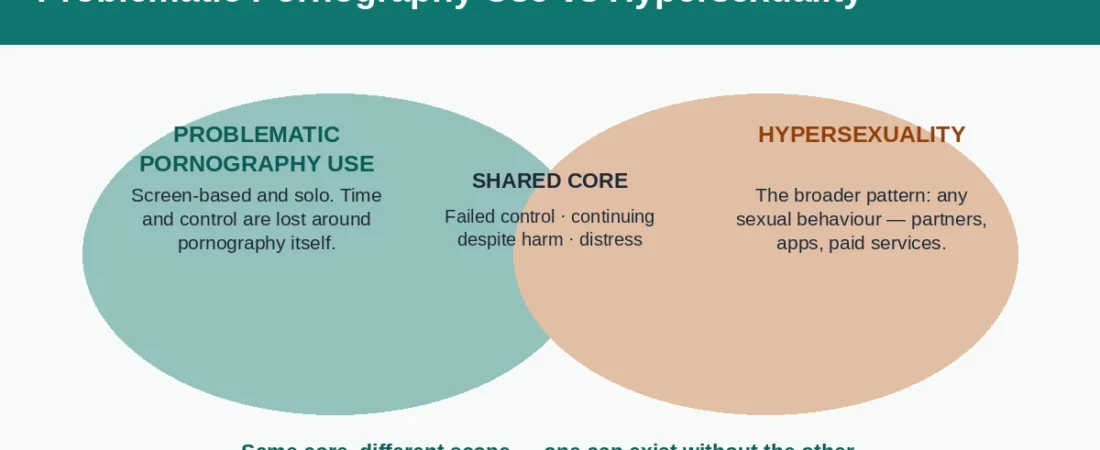
Ask people what their hypersexuality actually looks like, day to day, and most will not describe affairs, paid sex or risky encounters. They will describe a phone. For the largest group of people with this pattern, the behaviour lives almost entirely inside pornography use — private, solo, digital, and for that reason easy to miss in articles written around more dramatic presentations.
Yet the pages that rank for this topic blur the picture. Quiz-style articles fold pornography problems into general hypersexuality, score them with a handful of yes/no questions, and use vocabulary medicine retired decades ago. Problematic pornography use — PPU — deserves its own map: what it is, how it overlaps with hypersexuality, where it genuinely differs, and why some of the people most convinced they have it are struggling with something else entirely.
Quick answer: Problematic pornography use (PPU) is a pattern in which pornography use feels out of control, continues despite consequences, and causes distress or impairment. It is the most common presentation of compulsive sexual behavior disorder — but the two terms are not identical. Hypersexuality can involve many behaviours beyond pornography, and some people who label their porn use an “addiction” are mainly experiencing moral incongruence: guilt about use that is actually infrequent and controlled, which is a different problem needing different help.
Contents
Problematic pornography use: the most common presentation
In clinical and research samples of people seeking help for compulsive sexual behaviour, pornography is the behaviour named most often — frequently the only one. Several features of the medium explain why. It is free or cheap, infinitely novel, available at the exact stressed and sleepless moments when urges fire, and completely private. The escalation and tolerance in sexual behavior that might take years through real-world behaviour can develop in months of algorithmic novelty.
PPU is best understood as a presentation rather than a separate disorder: when the pattern meets the ICD-11 pattern of failed control, persistence and distress or impairment, clinicians assess it under compulsive sexual behavior disorder, with pornography as the channel. Our hub guide to hypersexuality covers the full diagnostic picture.
The signs that point specifically to PPU
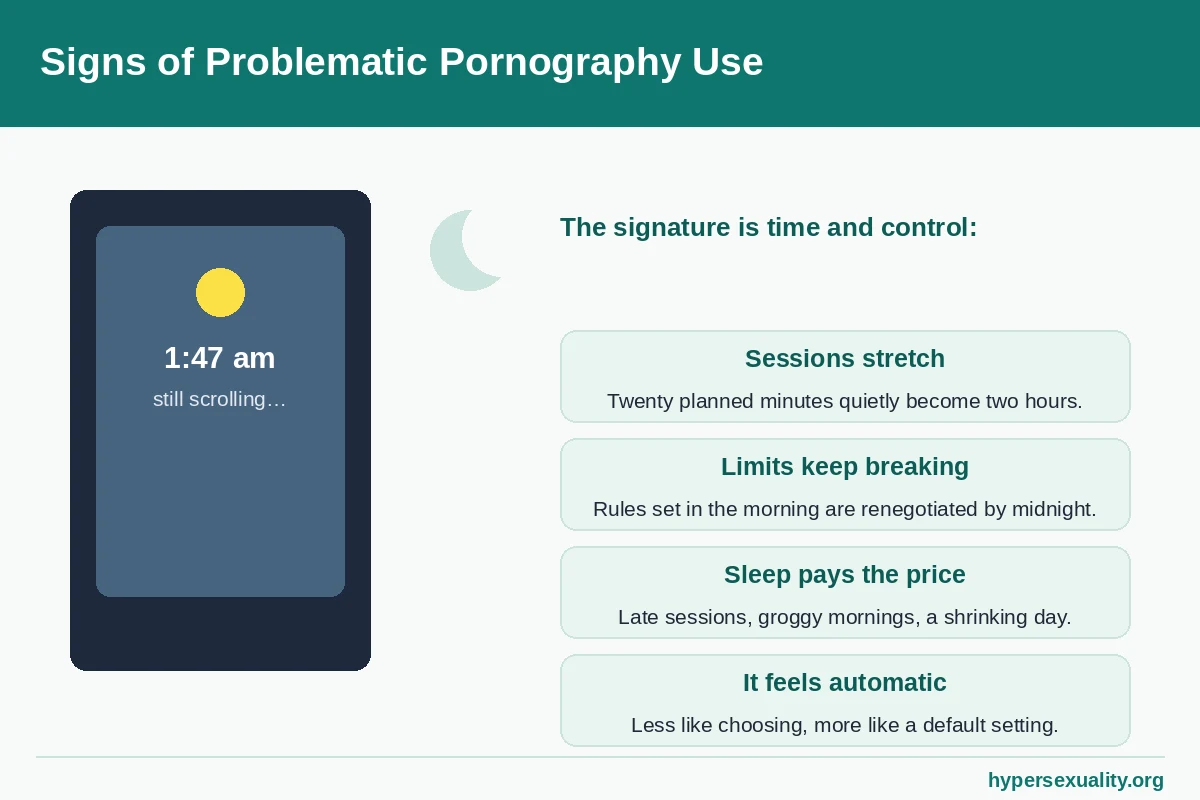
The general symptoms of hypersexuality apply, but PPU has a recognisable signature of its own:
- Time that disappears. Sessions planned for minutes run for hours, often late at night, and the searching takes longer than the watching.
- Failed limits, repeatedly. Deleted apps, blocked sites, “never on work nights” rules — set sincerely, broken routinely, re-set with fresh shame.
- Escalating content. Needing more novelty or intensity to register a response, and drifting toward material that conflicts with your own values.
- Displacement. Sleep, work, study, exercise or a partner’s intimacy quietly rearranged around access and opportunity.
- Secrecy infrastructure. Separate accounts, private browsing as a ritual, histories deleted as a matter of routine.
- Function over pleasure. Use that follows stress, boredom, loneliness or conflict almost automatically — and is described afterwards as relief, not enjoyment.
No single sign settles anything. The pattern — failed control plus real cost, sustained over months — is what clinicians weigh. That pattern is what turns ordinary use into problematic pornography use.
Where PPU and hypersexuality overlap — and where they part
The overlap is the core: both describe failed control, continuation despite consequences, and distress or impairment, and both are assessed the same way. The differences are about scope and shape.
| Question | Problematic pornography use | Hypersexuality (broader pattern) |
|---|---|---|
| What behaviour is involved? | Pornography use (usually with masturbation) | Any sexual behaviour: pornography, partners, apps, paid services, affairs |
| Can it exist on its own? | Yes — it is often the whole pattern | It is the umbrella; pornography may be absent entirely |
| Typical setting | Solo, digital, at home, late at night | Digital, in-person, or both |
| Is it a separate diagnosis? | No — assessed under CSBD when criteria are met | Hypersexuality is the descriptive term; CSBD is the diagnosis |
| What usually drives assessment? | Time loss, escalation, secrecy, impact | The same, across whichever behaviours are present |
Two consequences follow. Someone can have serious PPU without any wider sexual behaviour problem — the pattern is entirely screen-shaped. And someone can be hypersexual with pornography playing no role at all. Treating the terms as synonyms misleads both people.
Moral incongruence: when guilt does the diagnosing
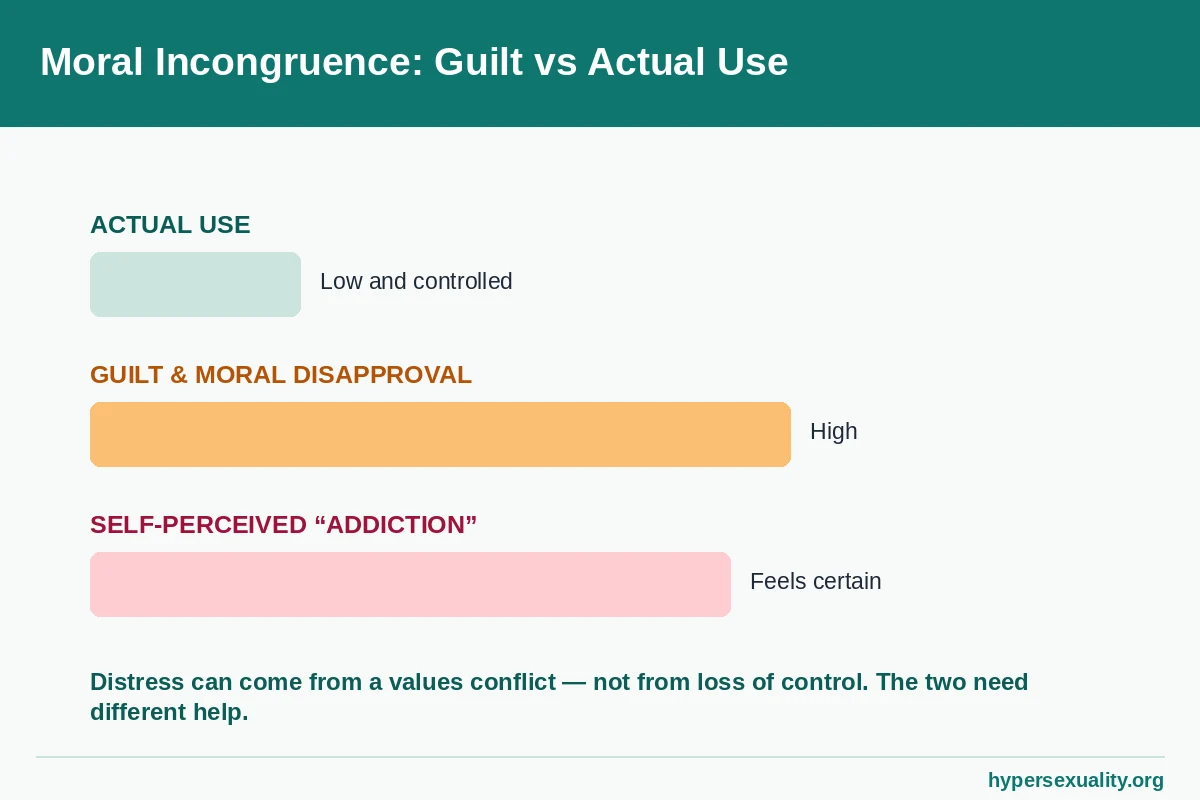
Here is the finding that most ranking pages never mention, and it changes how thousands of people should understand themselves. Research by Joshua Grubbs and colleagues on self-perceived pornography addiction found that how addicted people feel is predicted surprisingly weakly by how much pornography they actually use — and far more strongly by moral disapproval of their own use, especially religious disapproval.
In their model, this is called moral incongruence: distress arising from the gap between behaviour and values, rather than from loss of control.
The practical stakes are high, because the two problems need opposite kinds of help. A person with genuinely out-of-control use needs work on control, cues and consequences. A person whose use is modest and controlled, but who believes each instance is a moral catastrophe, needs the values conflict addressed — and being handed an addiction label instead can deepen shame without touching the real problem. The ICD-11 builds this distinction into the diagnosis itself: distress based entirely on moral judgment does not qualify. Our full explainer on moral incongruence and pornography use works through the evidence in detail.
A concrete scenario
Yusuf, 26, was certain he was addicted. He described panic after every lapse, prayers and promises, apps installed to block sites he then circumvented in his own mind by “failing on purpose.” When a counsellor asked him to track honestly for two weeks, the record surprised him: three uses, totalling under an hour, each stopped when he decided, no missed work, no secrecy beyond embarrassment.
What was out of control was not the pornography — it was the guilt cycle: each use collided with his faith, produced days of self-condemnation, and the distress itself became the trigger for the next lapse. Yusuf did not need addiction treatment. He needed help with the collision between his behaviour and his beliefs — a real problem, honestly named, with its own route to support.
Contrast matters: had his tracking shown nightly hours, broken limits and a shrinking life, the same feelings would have pointed to problematic pornography use instead. The feelings were identical. The pattern was the difference.
A calm self-check (reflection, not a score)
Instead of a quiz with a verdict, use the questions clinicians actually weigh — answered from records, not impressions, over the last six months:
- Have I repeatedly tried to cut down or stop, and failed despite meaning it?
- Has use displaced sleep, work, study, people or partnered intimacy?
- Has the content or time escalated beyond what I originally chose?
- Is there secrecy infrastructure — accounts, rituals, deleted histories — around it?
- Does use follow stress, boredom or conflict almost automatically?
Several sustained “yes” answers describe a pattern worth a professional conversation, and treatment routes exist, including structured therapy such as online CBT for problematic pornography use. Mostly “no” answers alongside intense guilt suggest the moral-incongruence route above. Either way, this is reflection, not diagnosis — no checklist can do that part. Age shapes the picture too, as our guide to hypersexuality in young adults explores.
Q&A
Can you have problematic pornography use without being hypersexual?
In one sense, no — PPU that meets the clinical pattern is the most common form the wider pattern takes. But yes in the way most people mean the question: your problem can be entirely confined to pornography, with no other sexual behaviour involved, no affairs and no risk-taking. It is a single-channel presentation of the same loss of control, and it deserves the same seriousness.
Why do I feel addicted to porn when I barely watch it?
Most likely, moral incongruence. Research by Grubbs and colleagues shows that feeling addicted to pornography is predicted more strongly by moral — especially religious — disapproval of your own use than by how much you actually watch. The guilt is real suffering, but it points to a values conflict rather than a control problem, and the two need different kinds of help.
Is problematic pornography use a separate diagnosis in ICD-11?
No. The ICD-11 contains one diagnosis in this area — compulsive sexual behavior disorder (6C72) — and problematic pornography use is assessed under it when the pattern of failed control, persistence and distress or impairment is present. PPU is the most common presentation clinicians see, not a separate category with its own code.
Does quitting porn completely fix hypersexuality?
Not by itself. If pornography is the whole pattern, stopping removes the behaviour — but the drivers underneath (stress regulation, cue conditioning, escalation habits) usually need their own work, or the pattern migrates to another channel. And if your real problem is moral incongruence, quitting may not even resolve the distress, because the conflict is about values, not access.
Is my porn use too minor to mention to a therapist?
No. Pornography use is the single most common presentation therapists in this field assess, and a competent clinician will discuss it factually and without embarrassment — including the possibility that it is not a disorder at all. Bringing honest records of time, control attempts and impact is more useful than any label you could arrive with.
Sources: World Health Organization, ICD-11 entry 6C72 “Compulsive sexual behaviour disorder”; Grubbs, J. B., Hoagland, K. C., Lee, B. N., Grant, J. T., Sampson, P. & Wu, A. (2020), “Sexual addiction 25 years on: A systematic and methodological review of empirical literature and an agenda for future research,” Clinical Psychology Review, 82, 101925.
Medical disclaimer: This article is educational information only and is not medical advice, diagnosis or treatment. Only a qualified clinician who knows your history can assess whether any diagnosis applies to you. If sexual behaviour is causing you distress or harm, consider speaking with your doctor or a licensed mental-health professional.