When the news broke, the headlines got it wrong: “WHO recognises sex addiction as a mental illness,” they announced. Almost every part of that sentence was inaccurate — and the who classification of compulsive sexual behavior is more interesting than the headlines.
The World Health Organization did add a new diagnosis, compulsive sexual behavior disorder (CSBD), to its ICD-11 manual. But it deliberately did not call it an addiction, and where it chose to file the diagnosis — among the impulse control disorders — was a considered scientific decision with real consequences for treatment, insurance and stigma. This article explains what the WHO actually decided, the reasoning behind the placement, and why the debate is not fully closed.
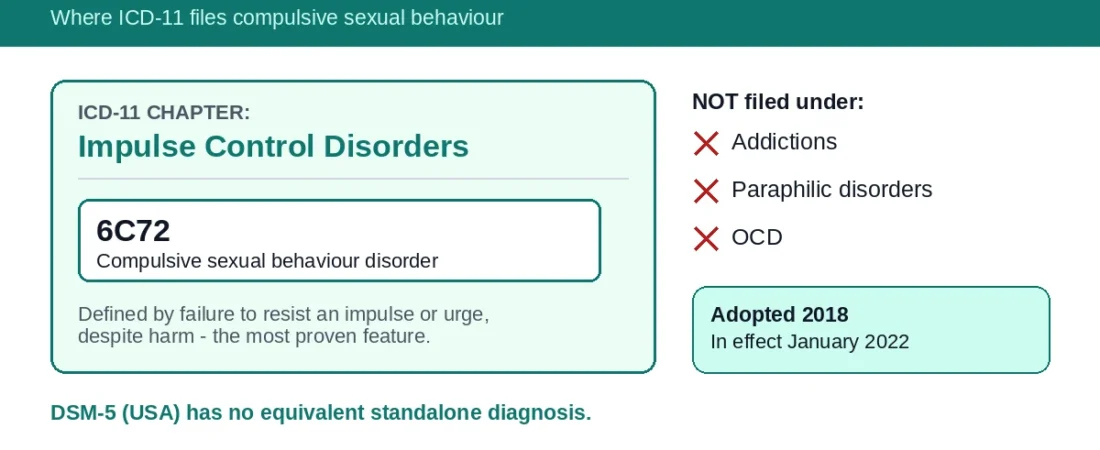
Quick answer: In ICD-11, the WHO classifies compulsive sexual behaviour disorder (code 6C72) as an impulse control disorder — not as an addiction, not as a paraphilic disorder, and not as a form of OCD. The ICD-11 was adopted in 2018 and came into effect in January 2022. The DSM-5, used in the United States, contains no equivalent standalone diagnosis.
Contents
What the WHO classification of compulsive sexual behavior actually says
The ICD-11 is the WHO’s global diagnostic reference — the manual health systems in most countries use to code conditions for records, statistics and payment. Its entry 6C72 defines CSBD as a persistent pattern of failure to control intense, repetitive sexual impulses or urges resulting in repetitive sexual behaviour, sustained over an extended period and causing marked distress or significant impairment, with distress based entirely on moral judgment explicitly excluded.
The home the WHO gave this definition matters as much as the definition itself: CSBD sits in the chapter on impulse control disorders, alongside conditions defined by a failure to resist an impulse or urge despite harm — rather than in the chapter on disorders due to addictive behaviours, where gambling and gaming disorder were placed.
Why impulse control? The reasoning most pages skip
Classification is never filing for its own sake; it is a claim about what kind of problem something is. The researchers who advised the WHO (their reasoning is set out in the journal World Psychiatry) weighed three options and the evidence for each:
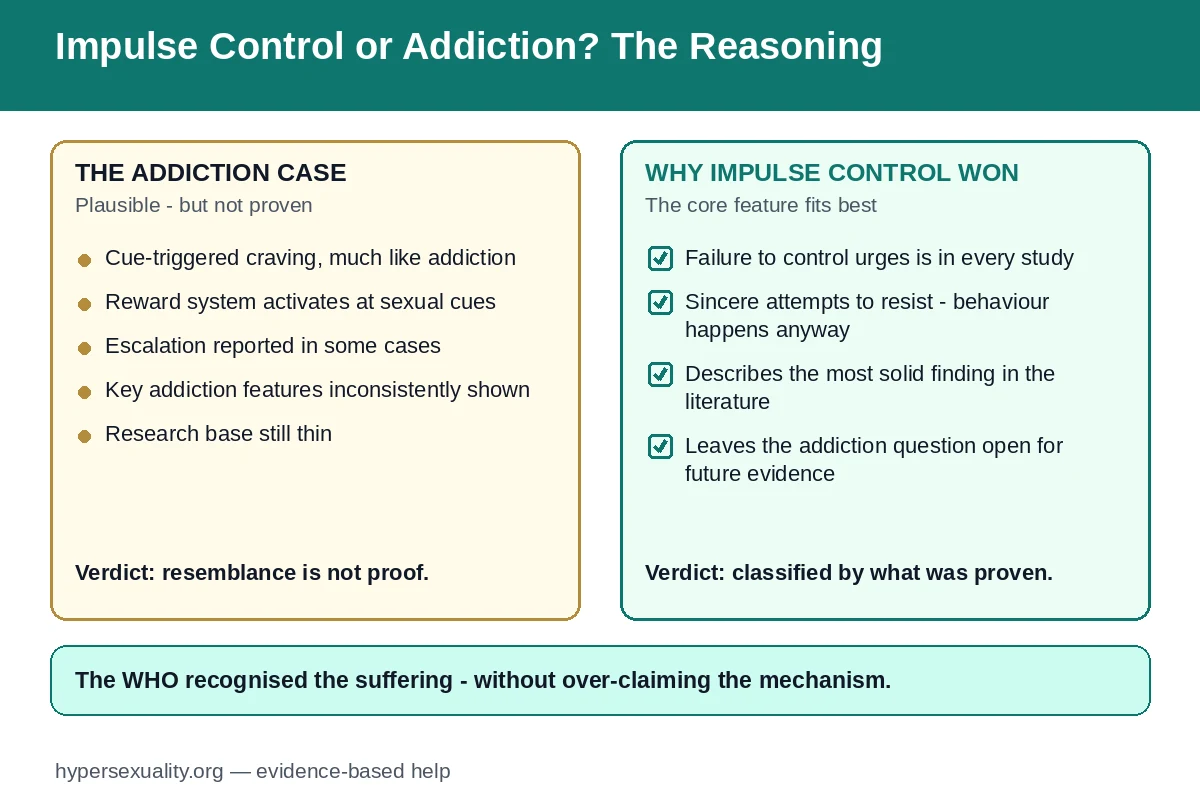
The addiction case — plausible, but not proven
Brain and behavioural studies show genuine parallels with addiction: cue-triggered craving, reward-system activation when people with this pattern view sexual material, and escalation in some cases. If those parallels were the whole story, CSBD would sit beside gambling disorder. But the advisory group’s judgment was that the evidence did not yet establish equivalence: key addiction features were inconsistently demonstrated, and much of the research base was thin. Classifying by resemblance rather than proof would have been a scientific over-claim.
The impulse-control case — the core feature fits best
Within the WHO classification of compulsive sexual behavior, what is consistently present, in every definition and study, is the failure to control an impulse: intense urges, sincere attempts to resist, behaviour that happens anyway. Impulse control disorders are defined by exactly that failure of resistance. Placing CSBD there described the most solid finding in the literature, while leaving the addiction question open for future evidence rather than deciding it by filing cabinet.
The caution case — labels can harm
The WHO was also explicit, in effect, about a social risk: a loosely defined “sex addiction” label can pathologise ordinary sexual variation and be misused — in moral panics, in legal disputes, against sexual minorities. A narrow impulse-control definition, with the moral-judgment exclusion written in, recognised the people who are genuinely suffering while making the label harder to abuse. The same caution explains why CSBD was not placed among the paraphilic disorders (it is about control, not about the object of desire) and why it is distinct from OCD, where intrusive sexual thoughts are typically unwanted and anxiety-driven rather than urge-driven.
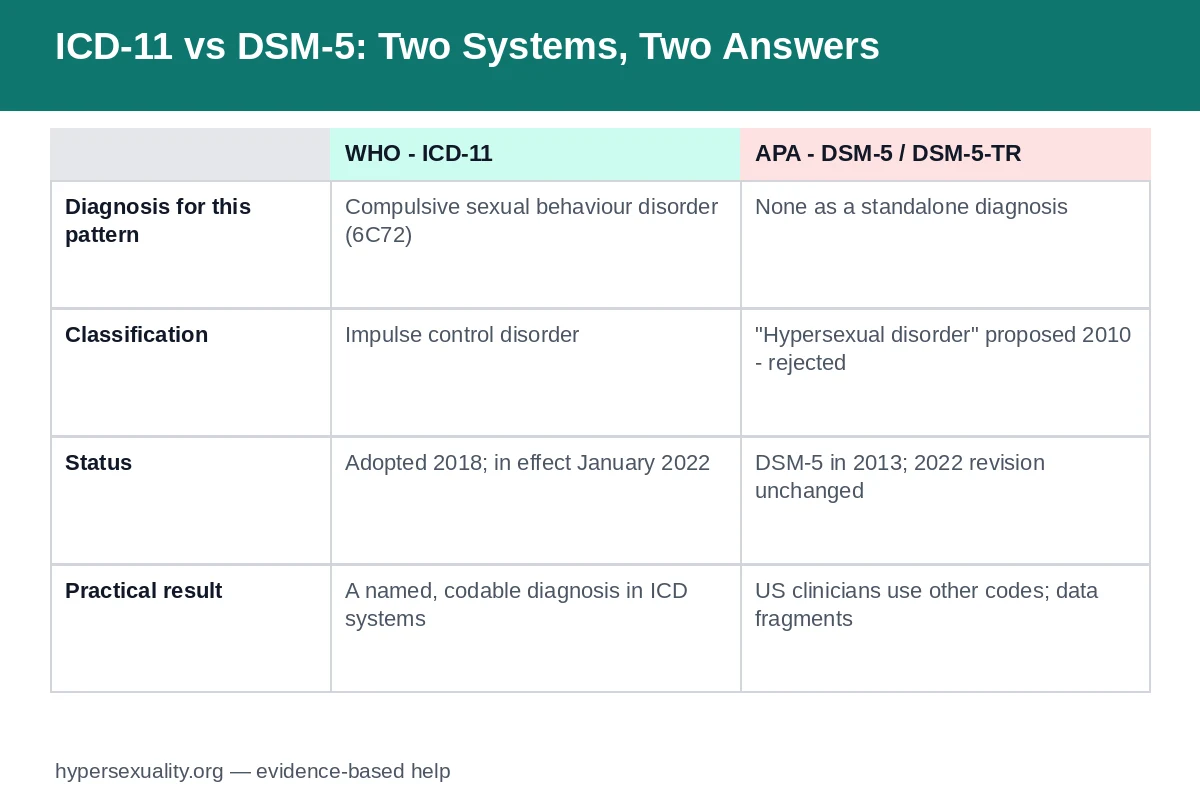
The other side of the Atlantic: ICD-11 vs DSM-5
| WHO — ICD-11 | APA — DSM-5 / DSM-5-TR | |
|---|---|---|
| Diagnosis for this pattern | Compulsive sexual behaviour disorder (6C72) | None as a standalone diagnosis |
| Classification | Impulse control disorder | — (“hypersexual disorder” was proposed in 2010 and rejected) |
| In effect | ICD-11 adopted 2018, effective January 2022 | DSM-5 published 2013; text revision 2022, position unchanged |
| Practical result | A named, codable diagnosis in ICD-using systems | US clinicians work around it with other codes or focus on co-occurring conditions |
What the classification changes in real life
The classification of compulsive sexual behavior is not paperwork — it changes real care. Consider Tomas, a composite example, treated in a European health system that codes with ICD-11. His clinician can record 6C72, which legitimises his referral to a specialist service, shapes a treatment plan oriented around impulse control and the urges’ triggers, and gives researchers a consistent category to study. A patient with the identical pattern in a DSM-5-based system may receive excellent care too — but under a different or adjacent label, which fragments research data and can complicate insurance authorisation.
Classification also steers treatment philosophy: an impulse-control framing foregrounds urge management, trigger work and co-occurring conditions, whereas an addiction framing more often leads toward abstinence-based programme models. Neither is automatically right for every patient, which is precisely why the WHO’s careful placement — recognise the problem, don’t over-claim the mechanism — was the significant move.
There is a quieter benefit too. An official, narrowly drawn diagnosis gives suffering people language that is neither slang nor stigma: not “addict,” not a moral verdict — a health pattern with criteria, exclusions and a code.
A decision, not a full stop
Researchers continue to publish on both sides — addiction-model studies, compulsivity studies, and work suggesting the pattern may be heterogeneous, with different mechanisms in different people. The ICD is revised over time, and a future edition could revisit the classification of compulsive sexual behavior if the evidence hardens. For now, if you want the criteria themselves, read the CSBD ICD-11 criteria explained one by one; for the American side of the story, see why hypersexuality is not in the DSM-5; and for the everyday vocabulary muddle, our guide to sex addiction, hypersexuality and CSBD terminology maps who uses which word and why.
Q&A
Did the WHO declare “sex addiction” a mental illness?
No. That headline misreported the decision twice over. The WHO added compulsive sexual behaviour disorder — a carefully defined pattern — and placed it among impulse control disorders, pointedly not among the addictive disorders where gambling and gaming sit. “Sex addiction” appears nowhere as an ICD-11 diagnosis.
When did the ICD-11 classification of CSBD take effect?
The classification of compulsive sexual behavior in ICD-11 was adopted by WHO member states in 2018–2019 and came into effect internationally on 1 January 2022. Individual countries have transitioned to it at different speeds, so whether a given clinic codes with ICD-11 or an earlier/local system varies by place.
Why isn’t CSBD grouped with gambling and gaming disorder?
Because the WHO judged the evidence insufficient to declare CSBD an addictive disorder. Gambling and gaming were placed in the addictive behaviours chapter on the strength of their evidence base; for CSBD, the addiction parallels were considered suggestive but unproven, while failure of impulse control was demonstrable in every study — so it was classified by what was proven.
Does the WHO classification mean my country diagnoses CSBD?
Not automatically. The ICD-11 is the international reference, but adoption, insurance rules and clinical training differ by country, and the United States primarily uses the DSM-5 system (plus ICD codes for billing in a US-specific form). Availability of a CSBD-informed clinician therefore depends on where you live.
If the WHO says it isn’t an addiction, why do some clinics still say “sex addiction”?
Because the addiction model has a long clinical and self-help tradition, especially in the US, and some providers find its language and programme structures helpful for their patients. It is a difference in treatment philosophy and vocabulary, not proof that one side is ignoring the WHO — though readers deserve to know the official classification when a clinic uses other terms.
Sources: World Health Organization, ICD-11 entry 6C72 “Compulsive sexual behaviour disorder”; Kraus, S. W. et al. (2018), “Compulsive sexual behaviour disorder in the WHO ICD-11,” World Psychiatry, 17(1), 109–110.
Medical disclaimer: This article is general information about a health topic. It is not medical advice and cannot diagnose you or anyone else. Only a qualified clinician who knows your situation can do that. If sexual behaviour is causing you distress or harm, consider speaking with a doctor, psychologist or qualified therapist.