Almost everything written about this condition quietly assumes a male reader — the ranking pages included — yet almost none of it is actually about men: how the pattern typically looks in a male life, why it hides in plain sight, and why the man himself is usually the last to call it a problem. Male sexuality is culturally scripted as a constant, comic appetite. “He’s just a typical bloke” is a sentence that has protected a disorder-level pattern for decades at a time.
So let us be specific. Hypersexuality in men is not a strong sex drive and it is not a moral failing. It is a persistent pattern of sexual urges and behaviour escaping a man’s own control — organised increasingly around pornography, apps and secrecy — while costing him his relationship, his work, his money or his self-respect, and while he keeps failing to stop.
Quick answer: Hypersexuality in men most often centres on compulsive pornography use, masturbation, hookup apps, paid sexual services or affairs, driven less by pleasure than by stress, boredom and the need for novelty. The defining signs are the same as in anyone — failed attempts to stop, escalation, continuing despite harm — but men typically present later than women, because high male desire is normalised, performance pressure converts distress into more seeking, and shame makes the behaviour something to hide rather than treat. It is assessable and treatable at any stage.
Contents
The signs, as they actually appear in men’s lives
The generic symptom list lives in our complete symptoms checklist. Here is how hypersexuality in men most characteristically shows up:
- Pornography as the centre of gravity. Not occasional use, but sessions that stretch, material that escalates, and a private library-like familiarity with content — while real-world sexual interest may paradoxically be falling.
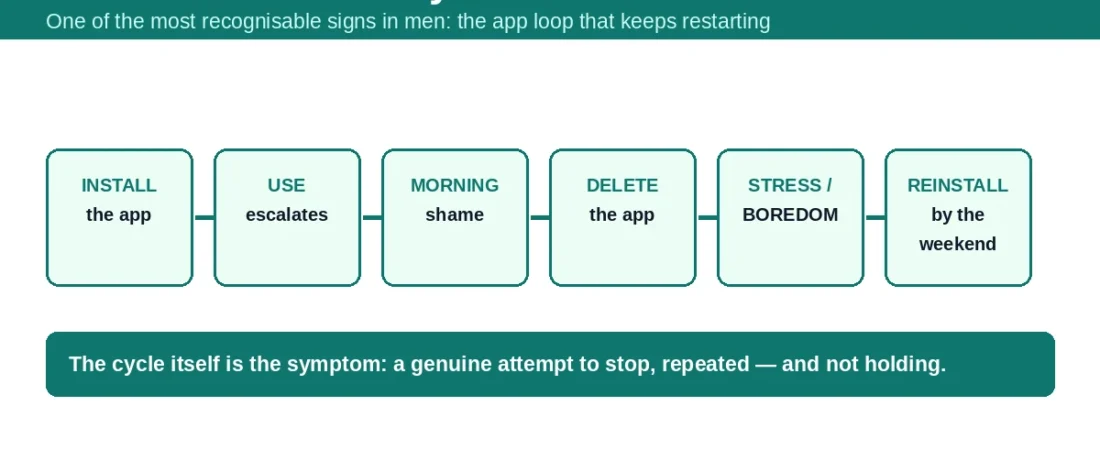
- App-driven cycles. Installing and deleting hookup or dating apps in a loop: delete in the morning shame, reinstall by the weekend. The delete–reinstall cycle is one of the most recognisable male presentations of the “failed control” criterion.
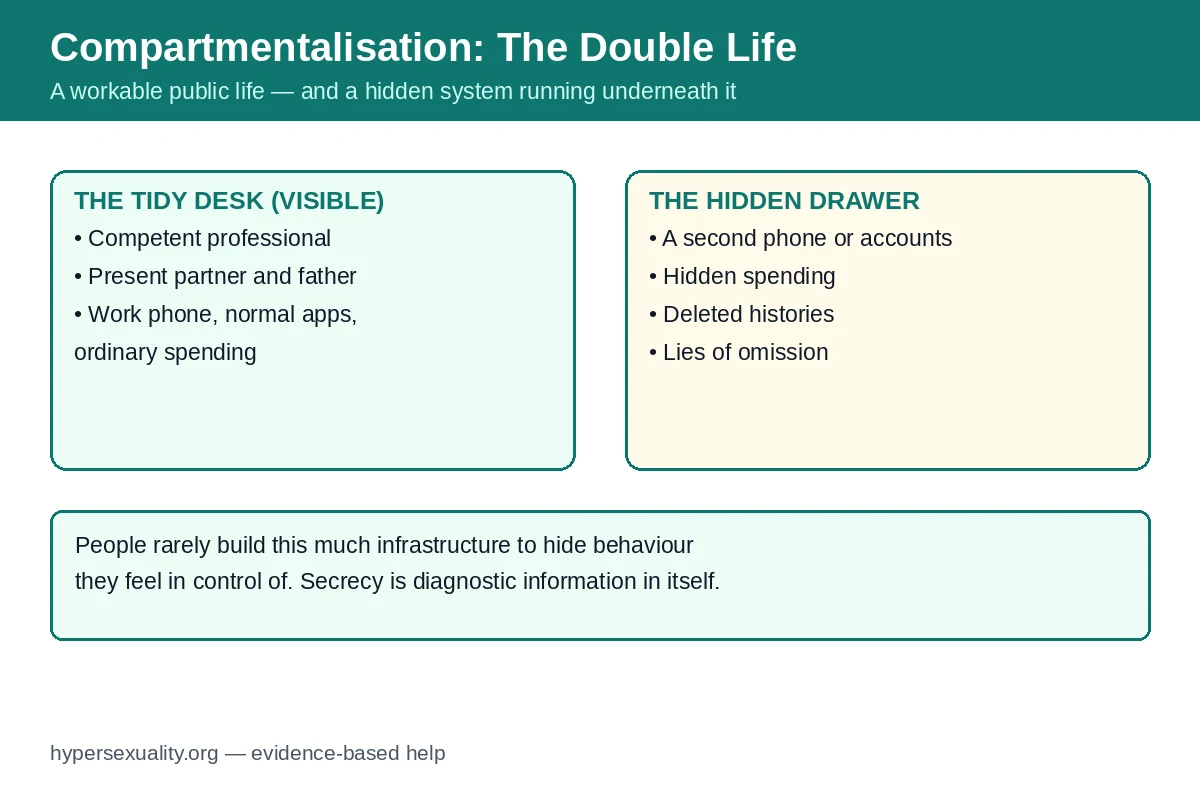
- Compartmentalisation. A workable double life — competent professional, present father, and a hidden sexual system with its own accounts, devices, spending and lies of omission.
- Escalation into risk. More partners, less protection, paid encounters, workplace exposure — not from recklessness of character, but because the previous level stopped producing relief.
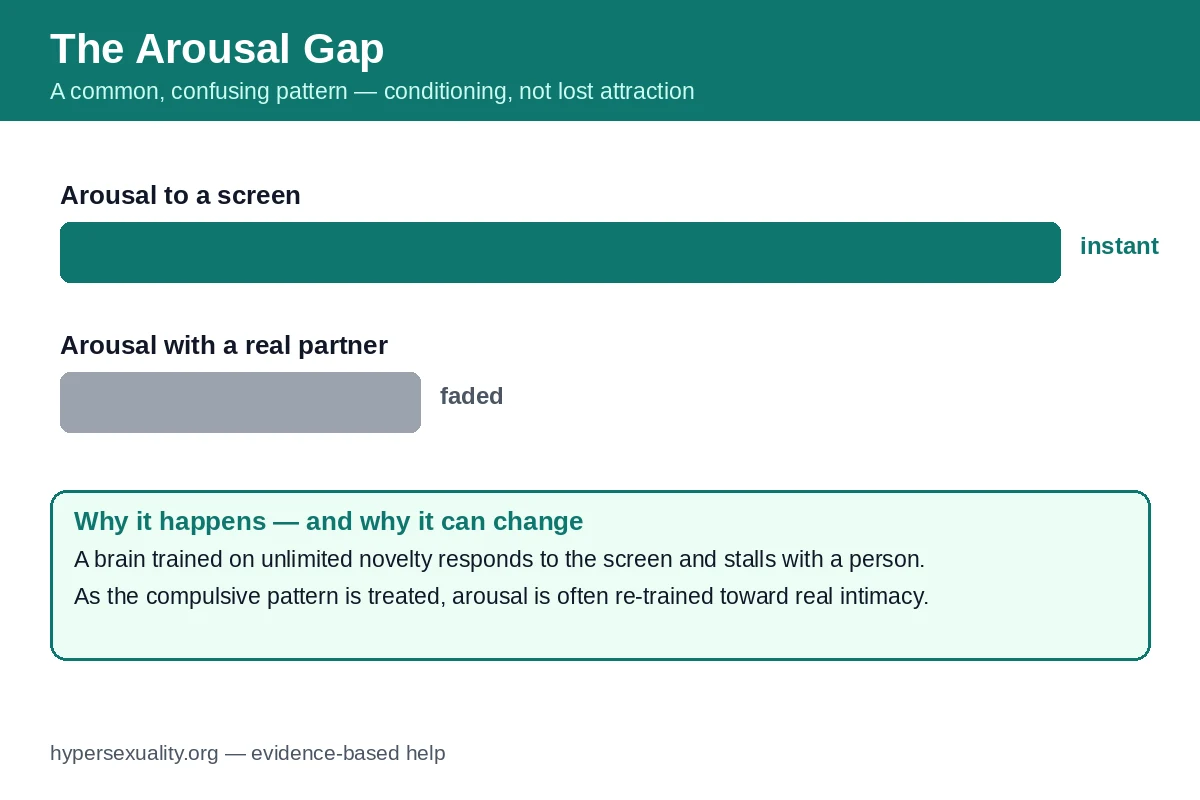
- Erectile and desire problems with partners. A common, deeply confusing feature: difficulty becoming aroused with a real partner while responding instantly to a screen. Men often read this as “low libido” or a physical problem, when the pattern is actually overstimulation and conditioned arousal to novelty.
- Post-episode crash. Irritability, flatness and self-disgust after episodes — followed within days by the cycle restarting, often triggered by the very shame the last episode produced.
Why men, specifically? The contributing causes
The general causes are ranked in our guide to what causes hypersexuality. Layered on top, hypersexuality in men has some specific contributors:
Conditioning by unlimited novelty. Male sexual arousal is strongly visual and novelty-responsive, and mainstream pornography is engineered for exactly that wiring — infinite new stimuli at zero effort. The “Coolidge effect” (renewed arousal with a novel partner or stimulus) is doing ordinary biology; the internet turns it into an industrial process.
Emotional restriction. Many men are raised with a narrow permitted emotional range: anger and sexual desire are allowed out; grief, fear, loneliness and tenderness mostly are not. Sex and pornography then become the all-purpose regulator — the one socially tolerated way to feel something, or to stop feeling. In assessment, asking a man “what do you feel in the hour before an episode?” often produces a blank stare, and that blank is itself the clinical finding.
Stress, status and performance pressure. Job threat, financial strain and relationship dissatisfaction are common triggers — and because the behaviour is secret, it becomes the one domain where a man feeling powerless feels potent and chosen. That emotional equation, not libido, is usually the engine.
The usual medical drivers still apply. Bipolar episodes, ADHD impulsivity, depression, substances and (in older men especially) dopamine-agonist medication for Parkinson’s all present in men and must be ruled in or out before anyone settles on a primary pattern.
Why it stays hidden — often for years
Normalisation. “All men are like this” is the perfect camouflage. Friends laugh, media agrees, and a man can hit every clinical marker while his social world reads it as virility.
Shame with a masculine edge. Admitting you cannot control something men are supposed to command feels like a double failure. So men minimise (“it’s just porn”), negotiate (“I’ll stop when we’re married / after the baby / when work calms down”), and present for help only when discovery forces it — a partner finds out, a job is threatened, a health scare lands.
Misreading the signal. Men frequently arrive at clinics asking for help with erectile dysfunction, “low libido” toward their partner, or anger — and the compulsive pattern surfaces only when a clinician asks directly about pornography habits, apps and failed attempts to stop. If no one asks, no one tells.
A concrete scenario. James, 44, a sales manager, sought help for “stress and a dead bedroom”. His wife assumed an affair; he insisted, truthfully, there was no single other person. There was, instead, a six-year pornography pattern: two hours most nights after she slept, three deleted-and-restored app accounts, £180 a month on paid content, and a string of broken promises to himself.
His arousal with his wife had faded not from lost attraction but from a brain trained on novelty. Naming the pattern accurately — to himself first — was what finally made the marriage conversation, and treatment, possible.
What assessment and help look like for men
A competent assessment of hypersexuality in men is not an interrogation and not a lecture. Expect questions about the pattern’s history, your attempts to control it, triggers (stress, boredom, conflict, alcohol, travel), sexual functioning with partners versus alone, mood, sleep, substances and medication — plus screening instruments where appropriate. Treatment is usually CBT-based skills work (trigger mapping, urge management, rebuilding a life the behaviour is currently substituting for), often alongside couples work if a partner is involved and, where relevant, treatment of the co-occurring driver.
Practical first reading: our self-test and screening guide and the signs a partner usually notices first.
Q&A
Is hypersexuality more common in men than in women?
Hypersexuality in men is diagnosed, and men seek treatment, more often, and community studies of CSBD generally find higher rates in men. But the gap is partly visibility: male behaviour is more likely to be organised around pornography and apps (more measurable), while women’s patterns are more often missed, mislabelled or never presented for help at all.
Can hypersexuality cause erectile dysfunction?
It can contribute to a specific, confusing pattern: reliable arousal to pornography but difficulty with a partner. This is usually conditioning and overstimulation rather than physical damage — and it often improves as the compulsive pattern is treated and arousal is “re-trained” toward real intimacy. New erectile problems still deserve a medical check, because they have many physical causes.
My partner says I’m “just a typical man”. How do I know it’s more than that?
Use the control test, not the frequency test: Have you repeatedly tried to cut down and failed? Is the behaviour secret, escalating, or continuing after real consequences? Does it displace sleep, work or your relationship? If yes, the pattern deserves assessment regardless of what anyone calls typical. That is the honest test for hypersexuality in men: control, not appetite.
Do men with this pattern usually cheat?
Not necessarily. Many men’s patterns are entirely screen-based and involve no other person — which is why “no affair” does not rule the problem out, and why partners can feel betrayed by secrecy and displacement even without physical infidelity. Some patterns do escalate to in-person behaviour; the common thread is loss of control, not the specific outlet.
Where do men actually get help for this?
Start with your GP/doctor or a licensed therapist experienced in compulsive sexual behaviour (credentials such as CSAT are one marker). Peer fellowships exist for men who find the addiction framing useful. If mood episodes, ADHD or medication might be involved, a psychiatric assessment matters more than willpower.
Sources: World Health Organization, ICD-11 entry 6C72 “Compulsive sexual behaviour disorder”; Bőthe, B. et al. (2020), “The development of the Compulsive Sexual Behavior Disorder Scale (CSBD-19): An ICD-11 based screening measure across three languages,” Journal of Behavioral Addictions, 9(2), 247–258.
Medical disclaimer: This article is educational information only and is not medical advice, diagnosis or treatment. Only a qualified clinician who knows your history can assess whether any diagnosis applies to you. If sexual behaviour is causing you distress or harm, consider speaking with your doctor or a licensed mental-health professional.