Ask the internet what causes hypersexuality and you will get everything from “dopamine imbalance” to childhood trauma to — on holistic clinic pages like the one that ranks for this keyword — herbal remedies for “hormonal imbalance”, offered with far more confidence than the science supports. The truth is more interesting and more useful than any single-cause story.
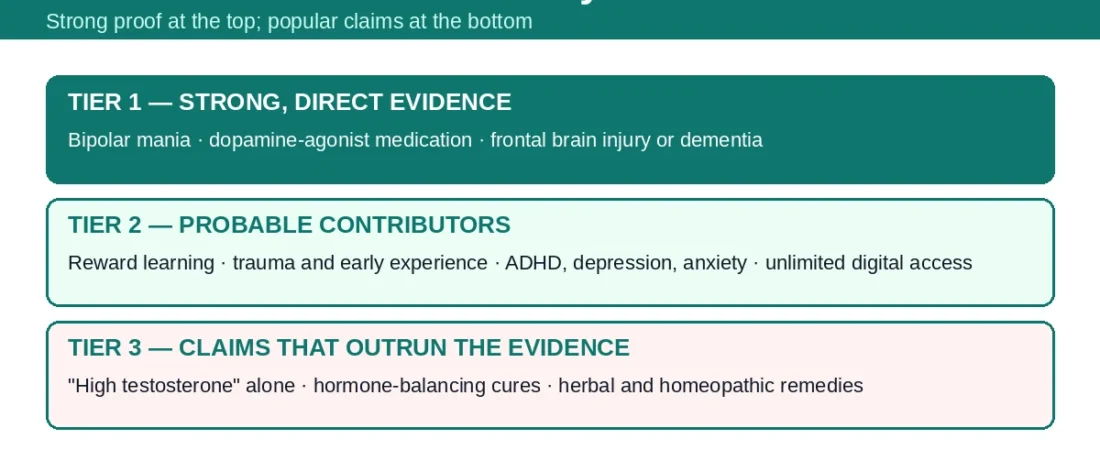
Nobody develops this pattern for one reason. What the research actually shows is a stack: a brain that learns reward fast, a life that teaches sex as an escape, and sometimes a specific medical trigger that switches the pattern on. This article separates the causes into three tiers — what is well evidenced, what is probable, and what is speculation — because knowing which tier your likely driver sits in changes what you do about it.
Quick answer: There is no single cause. The best-evidenced drivers are: (1) bipolar mania/hypomania, (2) dopamine-agonist medication (notably for Parkinson’s disease) and certain brain injuries or dementias affecting the frontal lobes, and (3) a learned pattern in which sexual behaviour becomes the brain’s default way to regulate stress, boredom and pain — often built on early trauma or attachment wounds, amplified by ADHD, depression or anxiety, and locked in by near-limitless digital access. Hormones alone, despite popular claims, explain very little in most adults.
Contents
Tier 1: Causes with strong, direct evidence
The strongest answers to what causes hypersexuality are medical and specific.
Mood episodes: bipolar mania and hypomania
Increased sexual drive and disinhibited sexual behaviour are recognised features of mania — so much so that clinicians treat a sudden, out-of-character surge in sexual behaviour, arriving alongside reduced need for sleep, racing energy and inflated confidence, as a possible early sign of an episode. The pattern is episodic: it rises and falls with mood rather than forming a constant baseline. When hypersexuality is mood-driven, stabilising the mood is the treatment, and the sexual pattern usually settles with it. See bipolar disorder and hypersexuality for the full mood picture.
Medication: the dopamine-agonist effect
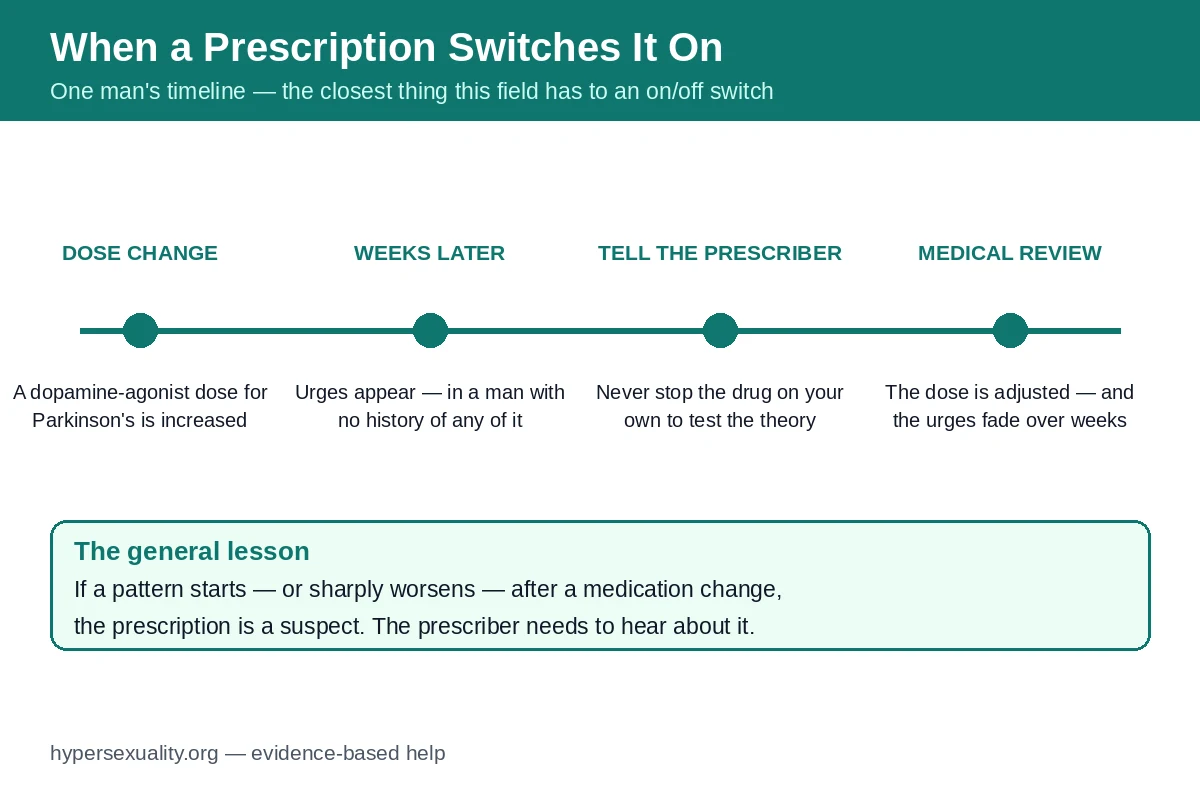
This is the closest thing the field has to a proven on/off switch. Dopamine agonists prescribed for Parkinson’s disease (and, less often, restless legs syndrome) are well documented to trigger impulse-control problems — gambling, compulsive shopping, binge eating and hypersexual behaviour — in a meaningful minority of patients, sometimes within weeks of a dose change, in people with no prior history of any of it. Reduce or change the drug under medical supervision and the behaviour typically recedes. Stimulant misuse can push the same reward circuitry in the same direction.
The lesson generalises: if a pattern starts or sharply worsens after a medication change, the prescription is a suspect, and the prescriber needs to hear about it. Never stop a prescribed drug on your own to test the theory. We cover medication-induced hypersexuality in detail in its own guide.
Brain injury, dementia and neurological disease
The frontal lobes are the brain’s braking system for impulses, and damage there — from head injury, stroke, tumours or frontotemporal dementia — can release sexual behaviour from its usual controls, sometimes as one of the earliest visible changes. Conditions affecting temporal-limbic circuits (the classic example is Klüver–Bucy syndrome) and some epilepsies are also documented. An abrupt, late-life, out-of-character change is a medical red flag first and a psychological question second.
Tier 2: Probable contributors — learning, trauma and co-occurring conditions
Below the proven tier sit the probable answers to what causes hypersexuality in most people who seek help.
The brain’s reward learning (the “why it sticks” layer)
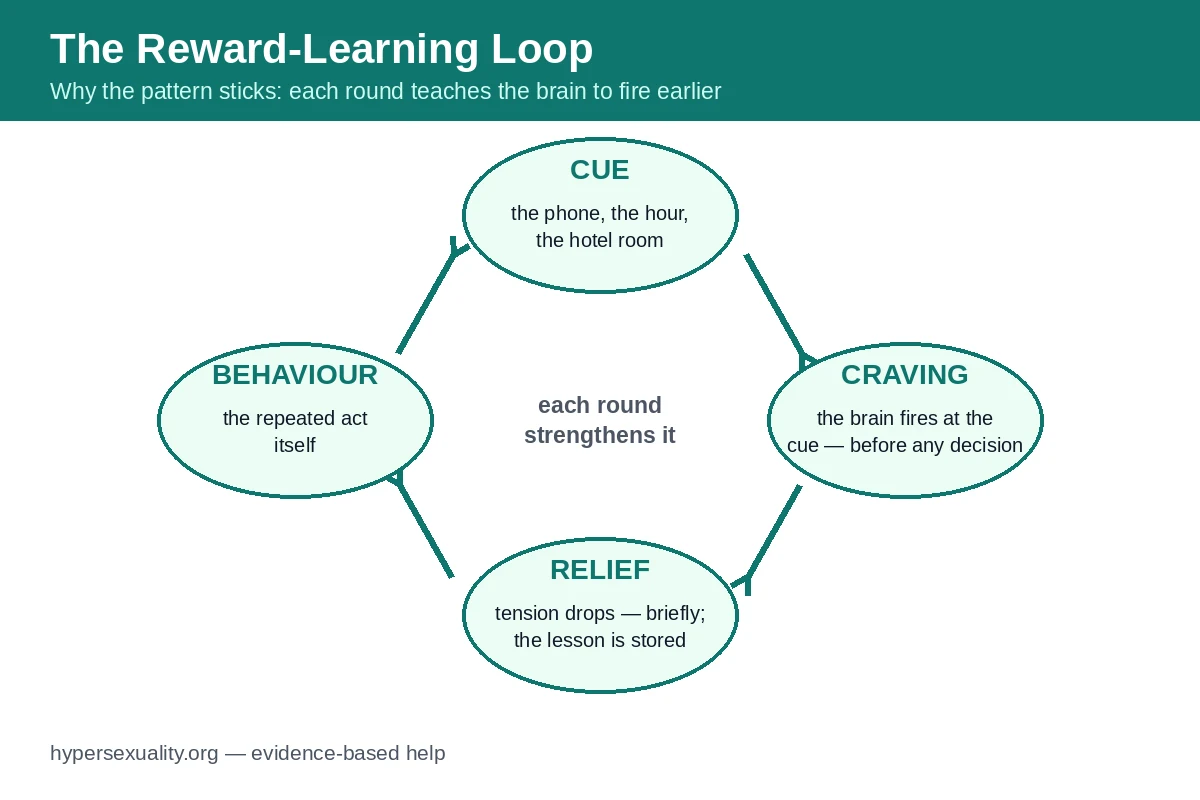
Whatever starts the pattern, reward learning is usually what maintains it. Sexual arousal and orgasm are powerful natural rewards; brain-imaging studies of people with compulsive sexual behaviour show heightened reactivity to sexual cues in reward regions such as the ventral striatum — the same cue-reactivity pattern seen in substance addictions. Repeat a fast, reliable reward often enough and the brain starts firing the craving at the cue — the phone, the hour, the hotel room — before any conscious decision happens.
Serotonin systems, involved in mood and impulse regulation, are also implicated, though the popular “chemical imbalance” story is a simplification of a much less settled picture. More on how dopamine shapes the urge in its own explainer.
Early experience and trauma
Childhood sexual abuse, neglect and chaotic early attachment appear at elevated rates in the histories of people seeking help for compulsive sexual behaviour. The mechanism is not mysterious: a child who learns early that sexual experience is how you get attention, soothe fear or feel powerful may carry sex-as-regulation into adulthood as a default tool. Trauma does not make the pattern inevitable — most survivors do not develop it — and many people with the pattern report no abuse at all. It is a risk factor, not a verdict and not a requirement.
Co-occurring mental-health conditions
ADHD contributes impulsivity, novelty-hunger and emotional dysregulation — a brain that under-responds to ordinary stimulation will go looking for stronger input. Depression contributes the opposite pull: when ordinary life feels flat (anhedonia), intense sexual reward can feel like the only reliable way to feel something. Anxiety contributes the tension–release loop: behaviour spikes under pressure because it reliably, briefly, turns the pressure off. OCD-spectrum traits can entangle the pattern with ritual and intrusive thought. Often the honest answer to “what caused it” is “the condition next door, plus learning”.
Environment: access, secrecy and the digital accelerant
No honest causes article written after 2010 can skip this: infinite, free, private, novel sexual content, available in the exact moments of boredom and stress when urges fire, is a historically new exposure. Access does not create the vulnerability, but it industrialises the habit — escalation that once took years of real-world effort can now happen in months of algorithmic novelty. Opportunity is a cause in the practical sense: remove it and many patterns weaken; that is why environment design works in treatment. When readers ask what causes hypersexuality day to day, this is often the practical answer.
Tier 3: Claims that outrun the evidence
Speculation about what causes hypersexuality fills the rest of the internet. Three claims deserve direct answers:
- “High testosterone causes it.” Testosterone influences desire in both sexes, but most adults with compulsive patterns have hormone levels in the normal range, and high desire without loss of control is not the disorder. Hormonal disorders are occasionally relevant and worth ruling out when other signs point that way — they are not the default explanation.
- “It’s just a sex addiction in the brain, identical to cocaine.” The cue-reactivity overlap is real; identity is not established. The WHO reviewed this debate and classified CSBD as an impulse-control disorder, not an addiction.
- Herbal, homeopathic and “hormone-balancing” cures. Holistic pages may list causes confidently and then sell vitex, maca, acupuncture or homeopathic remedies as treatments for them. For these approaches there is no robust clinical evidence that they treat compulsive sexual behaviour. Mindfulness, exercise and sleep genuinely help regulation — as support, not as substitutes for assessment and evidence-based care when a pattern is causing harm.
A concrete scenario. Tomas, 61, a retired teacher with Parkinson’s, becomes preoccupied with pornography and starts propositioning acquaintances — behaviour his wife of 35 years has never seen. A “causes” list focused on trauma would have sent this couple to the wrong therapy entirely. His neurologist recognised the timeline — symptoms began after a dopamine-agonist dose increase — and adjusted the prescription; the urges faded over the following weeks. Same symptom picture as a lifelong pattern, utterly different cause, utterly different solution.
Putting the tiers together: how clinicians actually think
Clinicians rarely ask “what causes hypersexuality?” as a single-cause question. They ask four sorting questions: When did it start? (lifelong pattern vs sudden change), What moves with it? (mood episodes, substances, medication changes), What does it do for you? (pleasure, escape, self-soothing, novelty), and What else is in the picture? (ADHD, depression, trauma, neurology). Your answers route the treatment — which is why an honest timeline is the most useful thing you can bring to an assessment. For the symptom picture itself, start with our complete checklist of hypersexuality symptoms; for the mood connection, see our explainer on conditions that occur with hypersexuality.
Q&A
Is hypersexuality caused by a chemical imbalance?
That is an oversimplification. Dopamine-driven reward learning and possibly serotonin-related impulse regulation are involved, and imaging shows real brain-response differences to sexual cues. But “imbalance” implies a single measurable defect and a simple chemical fix, neither of which the evidence supports.
Can medication really cause hypersexuality out of nowhere?
Yes — when people ask what causes hypersexuality, this is one of the best-documented answers. Dopamine agonists for Parkinson’s disease are the clearest example, with impulse-control problems emerging after starting the drug or raising the dose. If you suspect this, tell your prescriber promptly; do not stop the medication yourself.
Does childhood trauma always cause compulsive sexual behaviour?
No. Trauma histories are more common in treatment-seeking groups than in the general population, and early experiences can teach sex-as-coping. But most trauma survivors never develop this pattern, and many people with the pattern report no trauma. It is one risk factor among several.
Can pornography cause hypersexuality?
Pornography alone does not create the vulnerability, but unlimited novel access is a powerful accelerant: it trains cue-reactivity, speeds escalation, and is available at exactly the stressed, bored moments when urges fire. For an already-vulnerable person, access is often the difference between a tendency and a disorder-level pattern. So pornography rarely answers what causes hypersexuality on its own — but it often decides how far the pattern goes.
If I find the cause, will the behaviour just stop?
Sometimes — medication-induced and purely mood-episode cases can resolve when the driver is treated. More often, the initial cause and the maintaining habit separate: even after the trigger is addressed, the learned loop needs its own work, usually with CBT-style skills and environment changes. Knowing what causes hypersexuality in your own case is the start of treatment, not the end of the story.
Sources: World Health Organization, ICD-11 entry 6C72 “Compulsive sexual behaviour disorder”; Weintraub, D. et al. (2010), “Impulse control disorders in Parkinson disease: a cross-sectional study of 3090 patients,” Archives of Neurology, 67(5), 589–595.
Medical disclaimer: This article is educational information only and is not medical advice, diagnosis or treatment. Never start, stop or change a prescribed medication because of something you read online — discuss any concern with the clinician who prescribed it. If sexual behaviour is causing distress or harm, consider speaking with your doctor or a licensed mental-health professional.