
Nobody wakes up one morning with a compulsive pattern. There is no single evening, no single website, no single decision where everything changes. What there is, almost always, is a slope — a series of small, understandable steps, each of which made sense at the time, at the bottom of which a person looks up and realises their sexual behaviour is no longer something they do but something that happens to them.
Understanding when healthy sexual expression becomes compulsive means understanding that slope: the mechanism is knowable, the steps are recognisable while you are on them, and the way back up is the reverse of the way down.
Quick answer: Healthy sexual expression becomes compulsive when its function changes. The turn happens in four recognisable steps: sex starts being used to manage feelings rather than for pleasure or connection; the brain learns that it works, so it becomes the default tool; attempts to cut down begin failing; and the behaviour continues despite clear harm, usually wrapped in secrecy. Desire itself does not have to increase at any point — what changes is control, purpose and cost.
Contents
What keeps healthy sexual expression healthy
It helps to be precise about what is being lost. Healthy sexual expression — solo or partnered, frequent or occasional, conventional or adventurous — has a few consistent properties. It is chosen: you could postpone it, and sometimes you do. It is honest: it does not need a cover story. It is proportionate: it fits around sleep, work, money and people rather than displacing them. And it is actually pleasurable: desire leads, satisfaction follows, and the afterwards feels neutral or good. Notice that none of these properties is a number. Frequency is not on the list, because frequency is not what tips. What tips is function — and the next section traces how healthy sexual expression becomes compulsive one step at a time.
How healthy sexual expression becomes compulsive: the mechanism, step by step
Step 1: coping use begins
The first step is almost always innocent, and often it is a response to pain. A brutal week, a bereavement, loneliness, insomnia, a row that cannot be repaired tonight — and sexual release works: it reliably, quickly, switches off the feeling for a while. Nothing about this is pathological; most adults have done it occasionally. The step matters because of what it teaches. Each time sexual behaviour is the fastest route out of a bad feeling, the pairing strengthens. Healthy sexual expression becomes compulsive along this track more than any other: not through appetite, but through usefulness.
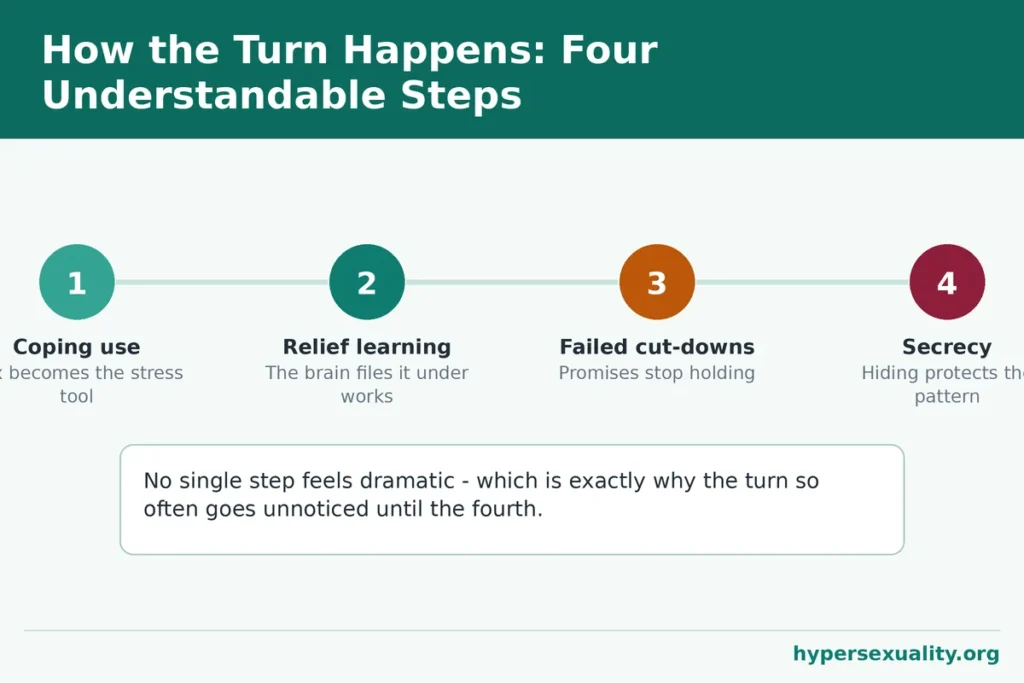
Step 2: relief learning makes it the default
Brains are economical. A behaviour that reliably ends discomfort gets promoted — suggested earlier, reached for faster, questioned less. Sessions lengthen a little; the range of triggers widens from “terrible day” to “boring evening” to “nothing in particular”. Novelty starts to matter more, because the same material delivers less relief — the earliest form of escalation. At this step the person still feels in control, and in a narrow sense they are: each individual episode is still, technically, chosen. What has quietly changed is the default setting underneath the choices.
Step 3: cut-downs start failing
The diagnostic heart of the turn is here. Something — a cost, a fright, a partner’s comment — prompts a sincere attempt to cut back, and the attempt fails. Then another does. This is the moment the pattern announces itself, because it separates “I would like to want this less” from “I intend to stop and I cannot make the intention stick”. Clinicians weigh failed attempts to reduce behaviour heavily for exactly this reason: they are the observable proof that control, the property that kept the expression healthy, is going.
One failed attempt after an extreme week means little; a repeating cycle of resolve and collapse, over months, means a great deal. A repeating cycle is the clearest observable sign that healthy sexual expression becomes compulsive rather than merely heavy.
Step 4: continuing despite harm — and secrecy to protect it
In the final step, the behaviour persists with its costs fully visible: sleep broken, money gone, a relationship damaged, a promise broken — and the person continues anyway, now hiding the behaviour to protect it from interference.
Secrecy is not a side detail here; it is the load-bearing wall. It prevents the feedback (a partner’s knowledge, a friend’s concern, a professional’s assessment) that might interrupt the cycle, and it generates the shame that then requires more of the behaviour to soothe. The loop is now self-maintaining. This is the territory the ICD-11 describes as compulsive sexual behavior disorder — persistent failure to control intense sexual urges, over an extended period, causing marked distress or impairment — and it is reached by degrees, not by a fall.
The same behaviour, two different relationships to it
| Feature | Healthy expression | Compulsive pattern |
|---|---|---|
| Usual trigger | Desire, opportunity, a partner’s invitation | Stress, boredom, loneliness, conflict — desire optional |
| Control | Postponing is easy and unremarkable | Postponing is a battle; rules keep breaking |
| Afterwards | Satisfaction or neutrality | Relief, then flatness or shame |
| Secrecy | Privacy, proportionate and unbothered | Active concealment: deleted histories, cover stories |
| Trend over six months | Stable or life-shaped | Escalating: more time, intensity or risk for the same effect |
What the tipping point looks like in real lives
The scenarios below are composite sketches drawn from common clinical presentations, with details changed. Each one shows a different point on the slope where healthy sexual expression becomes compulsive.
Ingrid, 34, a nurse: had always had what she called a healthy, uncomplicated sex life. When her mother died, night shifts and grief destroyed her sleep, and she fell into a pattern of sexual chat and pornography in the small hours because it was the only thing that switched her mind off. For months it felt like medicine.
The turn, visible only afterwards, came in steps: the sessions stretched past the point of tiredness; she began arranging shifts around being alone afterwards; she snapped at a colleague who borrowed her phone; and when she tried — sincerely, three times — to stop for a month, she lasted nine days, four days, two days. Ingrid’s desire had never increased. Her expression had changed jobs: from pleasure to anaesthetic.
A new father, 31: began escaping the stress and rejection sensitivity of early parenthood into pornography during night feeds. The tipping point was not frequency — it was the first time he lied, easily and instantly, about why he was awake, and felt relief rather than guilt. The lie showed him the behaviour now had protection. That frightened him more than the habit had, and it was the fright that got him to a counsellor while the pattern was still young.
A consultant, 52: whose work meant hotel rooms four nights a week, watched a long-standing, contented use of pornography escalate across two years of loneliness after a divorce: longer sessions, paid content he would once have avoided, two client dinners missed. What he recognised, reading about the mechanism, was step 2 — the widening of triggers from lonely nights to any night at all. Naming the step told him where to push back.

Can it tip back?
Yes — and the mechanism itself is the hopeful news. A pattern built by steps can be dismantled by steps: new coping tools learned where step 1 took hold, defaults retrained, honesty restored where secrecy grew. The destination of that work is not the absence of sexuality but the recovery of healthy sexual expression itself: chosen, honest, proportionate and enjoyed. The earlier the recognition, the lighter the work tends to be, which is why the sexual desire spectrum — this article’s companion map — puts so much weight on direction of travel. Understanding how healthy sexual expression becomes compulsive is what makes the way back visible: each step down has a matching step up.
Two honest cautions: white-knuckling alone rarely reverses the slope, because it fights step 3 while leaving steps 1 and 2 untouched; and if the pattern has reached the disorder end — or arrives with risk, crisis or behaviour you cannot account for — it deserves professional assessment rather than self-management, as our page on when compulsive sexual behavior becomes a mental health emergency explains. A structured hypersexuality test screening is a reasonable first step for locating where on the slope you stand.
Q&A
Does watching pornography regularly mean my sexual expression is unhealthy?
No. Regular pornography use with intact control, no displacement of sleep or responsibilities, no secrecy beyond ordinary privacy and no distress is, for most adults, simply part of their sexual expression. The warning signs are functional: using it as your only stress tool, failing to cut down when you decide to, escalating content, and continuing after it has caused harm. It is a different picture when healthy sexual expression becomes compulsive: control slips first, then the costs appear.
What is the very first sign that healthy expression is becoming compulsive?
The earliest reliable sign is a change of function: reaching for sexual behaviour to manage a feeling — stress, boredom, loneliness, the need to sleep — rather than from desire. When that becomes your default response to discomfort, the first step of the mechanism is in place, long before any dramatic consequence appears.
Can stress alone turn a healthy sex life compulsive?
Stress alone does not create the pattern, but chronic stress is the most common fuel for step 1, because coping use is learned fastest under pressure. What determines the outcome is what happens next — whether other coping tools exist, whether the relief learning generalises, and whether cut-downs hold. Plenty of people pass through a stressed, coping-heavy phase and return to baseline when life eases. Stress is fuel, not fate: whether healthy sexual expression becomes compulsive depends on what happens after step 1.
If I cut down successfully for a month, does that prove I am fine?
It is genuinely reassuring evidence — the ability to reduce, comfortably, is the core property of healthy control. Two qualifications: white-knuckled abstinence that dominates your thoughts for a month is different from easeful control, and a single good month after several failed attempts is worth watching rather than celebrating outright. Look at the trend across several months, not one heroic effort. That ease of control is exactly what is missing when healthy sexual expression becomes compulsive.
Can someone return to healthy sexual expression after a compulsive pattern?
Yes. Treatment does not aim at a sexless life; it aims at restored choice — behaviour you can start, stop and enjoy without the compulsive machinery running it. Many people in recovery describe ending in a healthier relationship with their sexuality than the one they had before the pattern, because the coping and honesty work generalises. Recovery is management of a pattern, not erasure of desire.
Sources: World Health Organization, ICD-11 entry 6C72 “Compulsive sexual behaviour disorder”; Kafka, M. P. (2010), Hypersexual Disorder: A Proposed Diagnosis for DSM-V, Archives of Sexual Behavior, 39(2), 377–400; Kraus, S. W., Voon, V. & Potenza, M. N. (2016), Should compulsive sexual behavior be considered an addiction?, Addiction, 111(12), 2097–2106.
Medical disclaimer: This article is educational information only and is not medical advice, diagnosis or treatment. Only a qualified clinician who knows your history can assess whether any diagnosis applies to you. If sexual behaviour is causing you distress or harm, consider speaking with your doctor or a licensed mental-health professional.