Static symptom lists describe a destination. They tell you what an established compulsive pattern looks like — the preoccupation, the consequences, the shame — but by the time you match that picture, the pattern has usually been running for years. The more useful question is about the journey: what does it look like when sexual behavior is becoming compulsive, while it is still changing?
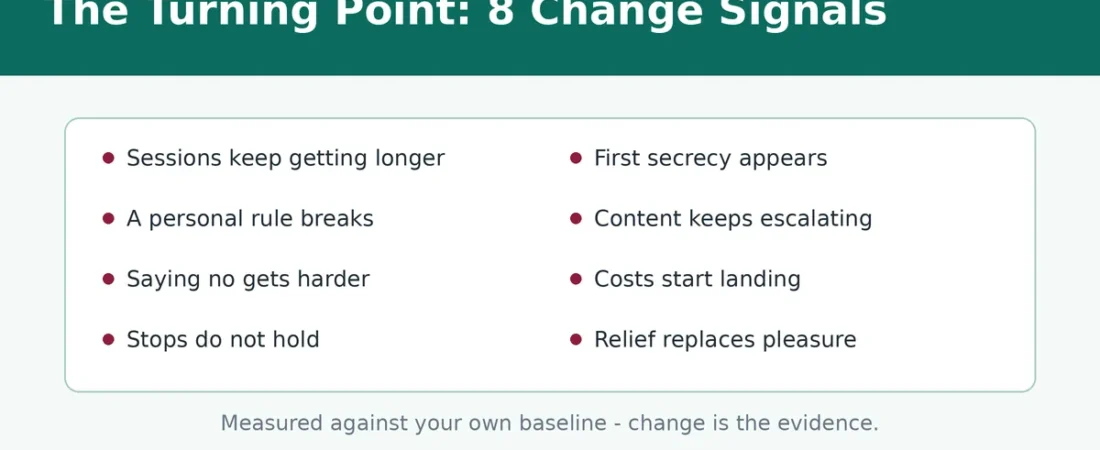
Transitions are easier to spot than states, because you are not comparing yourself with a textbook. You are comparing yourself with yourself, a few months ago. These eight signals are the ones clinicians listen for when someone says “it didn’t used to be like this”.
Quick answer: Sexual behavior is becoming compulsive when the behaviour starts changing in specific directions: secrecy appears where there was none, you make your first personal rule and break it, sessions expand and the clock stops mattering, “just this once” exceptions multiply, regret becomes routine, bad days automatically route to sex, the secret outlet starts beating real intimacy, and pleasure thins into mere relief. Any one is information; several together describe a pattern in motion.
Contents
Why change is the thing to measure
A high sex drive that has been stable for years — strong, frequent, and steered without difficulty — is not a disorder, however it looks from outside. What clinicians weigh is a persistent pattern of failed control and harm, and the first evidence of that pattern is movement: your behaviour departing from your own baseline in the directions below. That is also why these signs are framed as beginnings — secrecy starting, rules being made — rather than as quantities.
Taken together, they are the observable evidence that sexual behavior is becoming compulsive rather than simply strong. You do not need to know how much sex is “too much”. You need to know whether the relationship between you and the behaviour has changed. The endpoint this movement can reach is defined in our explainer of what is compulsive sexual behavior disorder; the pages around this one — the hypersexuality test hub and the previous article on early warning signs — help you place the change in context.
The 8 transition signs
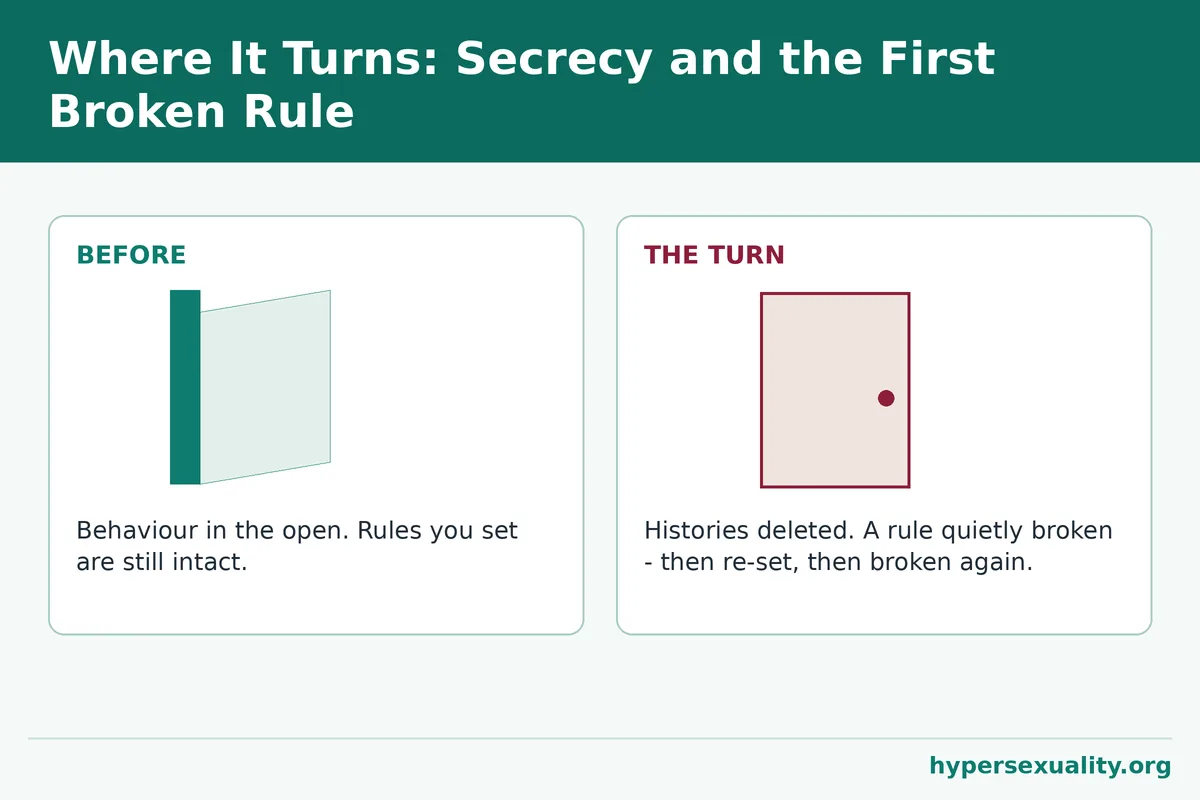
1. Secrecy appears where there was none. The first deleted history, the first vague answer about an evening, the first account a partner does not know exists. Secrecy is rarely the first change in the behaviour itself, but it is the first change in your relationship to it — you have started treating it as something that could not survive daylight.
2. You make your first rule — and break it. “Weekends only.” “Nothing on the work laptop.” “A monthly spending cap.” Rules appear when a part of you has already judged the behaviour a problem. The breaking, usually quickly and usually with an elaborate justification, is the single clearest early proof that intention is losing to pattern.
3. Sessions expand and the clock stops mattering. What took twenty minutes takes two hours; the planned stopping point slides; you surface surprised by the time. Expansion is escalation’s quieter twin — not yet needing stronger material, just more of the day.
4. “Just this once” becomes a policy. Exceptions stop being events and become a system: travel days do not count, bad weeks do not count, after midnight does not count. When the exceptions need their own bookkeeping, the rule they except has already fallen.
5. Regret becomes routine. Occasional regret is universal. The transition sign is regret on a schedule — the same flat, self-critical morning-after, repeated without changing anything. Routine regret means the behaviour now regularly outruns your own values.
6. Bad days automatically route to sex. Stress, loneliness, conflict, boredom: where you once had several responses, one response now fires by default and the others feel effortful. The behaviour has been hired as your emotion-regulation system, and systems defend their jobs.
7. The secret outlet starts beating real intimacy. You choose the screen or the secret over an available, willing partner — not from lack of desire for them, but because the compulsive channel is faster, more controllable, more certain. When the pattern starts outcompeting the relationship it hides from, it has become self-sustaining.
8. Pleasure thins out; relief is what is left. The experience stops being enjoyable in any simple way and becomes a pressure discharged — a tension released, followed by flatness. Clinicians call this diminished satisfaction, and the ICD-11 definition counts it, because behaviour that no longer even rewards you is behaviour running on compulsion rather than desire.
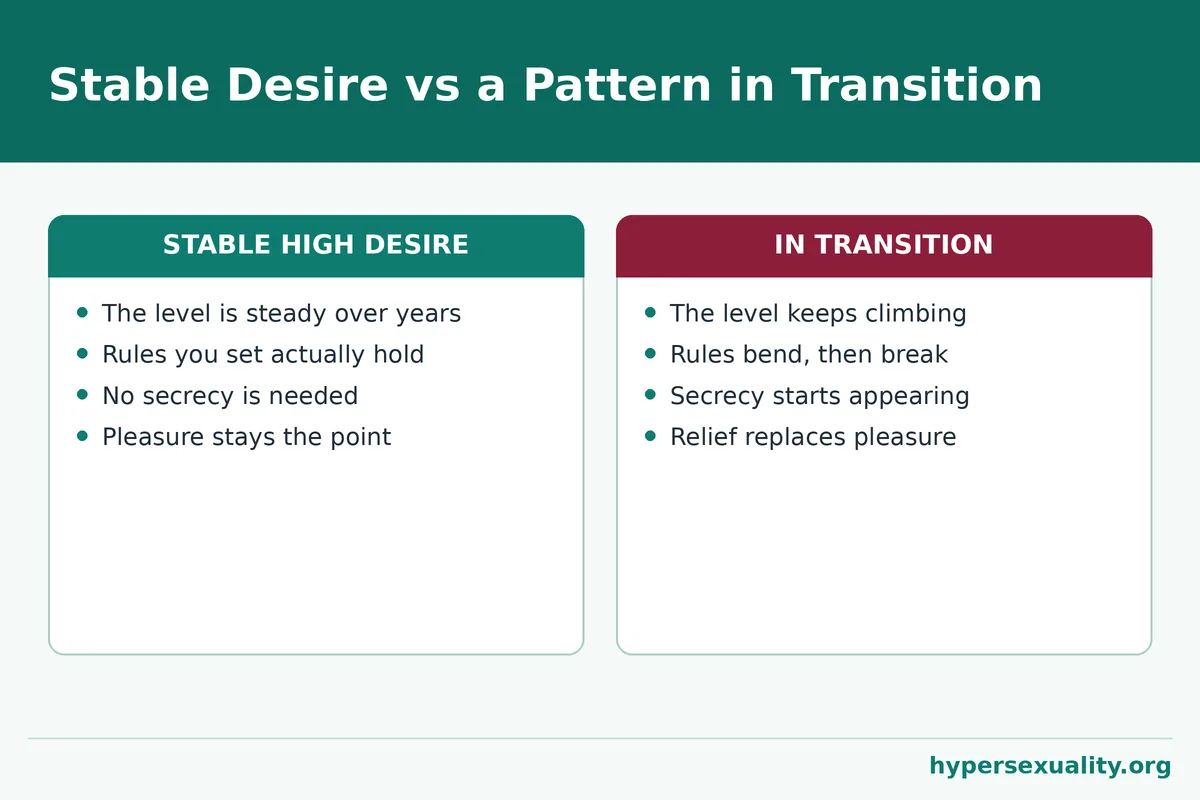
| Stable high desire | A pattern in transition | |
|---|---|---|
| Direction | Same, year after year | Changing — more time, more secrecy, more intensity |
| Rules | Rarely needed; kept when made | Made, renegotiated, broken |
| Secrecy | Low; behaviour survives daylight | Growing; behaviour needs protecting |
| Afterward | Satisfaction, no residue | Routine regret, flatness |
| vs. intimacy | Complements it | Starts outcompeting it |
Read down the right-hand column of that table. If most of its rows sound familiar, you are not looking at a stable sex life — you are watching the process by which sexual behavior is becoming compulsive, in real time.
How Sam caught his own transition
Consider Sam, a composite example: 36, he did not think of himself as having a problem — no consequences he could point to, a drive he had always had. What unsettled him was a notes-app log he had kept for a month for unrelated reasons, in which he could watch four of the eight signs arrive in sequence: the first deleted history in week one, a “no weekdays” rule in week two, the rule broken twice by week four, and sessions that had stretched from half an hour to entire evenings.
Nothing had “happened” yet — no discovery, no cost — but the direction was unmistakable and it was new. He treated the log the way he would treat a worrying trend in any other part of his life: not as a catastrophe, but as data that deserved a response while the response could still be small.
What to do when you see the shift
Start with evidence rather than labels: a few weeks of honest noting will show whether the changes are a blip or a trajectory. Then measure the costs directly — the next article in this cluster, the impact audit, turns “this feels like it’s growing” into scored domains you can track.
If the signs are stage-three territory — failed serious attempts to stop, behaviour continuing after real harm — skip the self-monitoring and book a professional assessment. And hold the distinction this whole cluster is built on: noticing that sexual behavior is becoming compulsive is not a diagnosis. It is an early, accurate observation — the kind that makes later help shorter and simpler.
Q&A
How quickly can sexual behavior become compulsive?
There is no standard clock. For some people the transition runs over a few intense months — often with an accelerant such as unlimited private access, a stressful life change or a new app; for others it creeps over years. Speed matters less than direction: change in the directions listed here, sustained, is the signal.
Can the transition reverse on its own?
Sometimes, especially early and when the trigger was situational — a brutal work period ends, a relationship stabilises, access changes. But “on its own” usually still means something changed. If the signs persist or multiply across a few months despite your situation improving, treat that as the pattern asserting itself rather than a phase passing. The question to keep asking is the transition question: whether sexual behavior is becoming compulsive, month on month, or settling back.
Is one transition sign enough to worry about?
One sign is enough to pay attention; it is not enough to conclude anything. The broken rule worries clinicians most because it tests control directly. Secrecy plus expansion plus routine regret, arriving together, is the combination that most reliably says the pattern is moving.
How is this different from the early warning signs?
They are neighbouring lenses. Early warning signs are ordered by stage — what tends to appear first, next and late across the whole development of a pattern. This article isolates the transition itself: the specific changes that show sexual behavior is becoming compulsive rather than merely strong, whenever in that timeline they occur.
My partner’s behaviour is changing like this. What can I do?
Name changes, not character: “you’ve started deleting things; you broke the rule you set” is discussable in a way “you’re an addict” is not. Share what you have observed, ask what they have noticed, and suggest assessment as information-gathering rather than verdict. You cannot run someone else’s pattern-recognition for them, but concrete observations are the hardest kind to unhear.
Sources: World Health Organization, ICD-11 entry 6C72 “Compulsive sexual behaviour disorder”; Kraus, S. W., Voon, V. & Potenza, M. N. (2016), “Should compulsive sexual behavior be considered an addiction?” Addiction, 111(12), 2097–2106; Derbyshire, K. L. & Grant, J. E. (2015), “Compulsive sexual behavior: A review of the evidence,” Journal of Behavioral Addictions, 4(2), 37–43.
Medical disclaimer: This article is educational information only and is not medical advice, diagnosis or treatment. Only a qualified clinician who knows your history can assess whether any diagnosis applies to you. If sexual behaviour is causing you distress or harm, consider speaking with your doctor or a licensed mental-health professional.