There are a lot of quizzes about sexual behaviour online, and most of them fail in the same two ways: they ask questions that have nothing to do with the clinical pattern (including, in one popular case, whether you find sex repulsive — which points in the opposite direction), and then they score you with a single crude line: half yes, “high chance”.
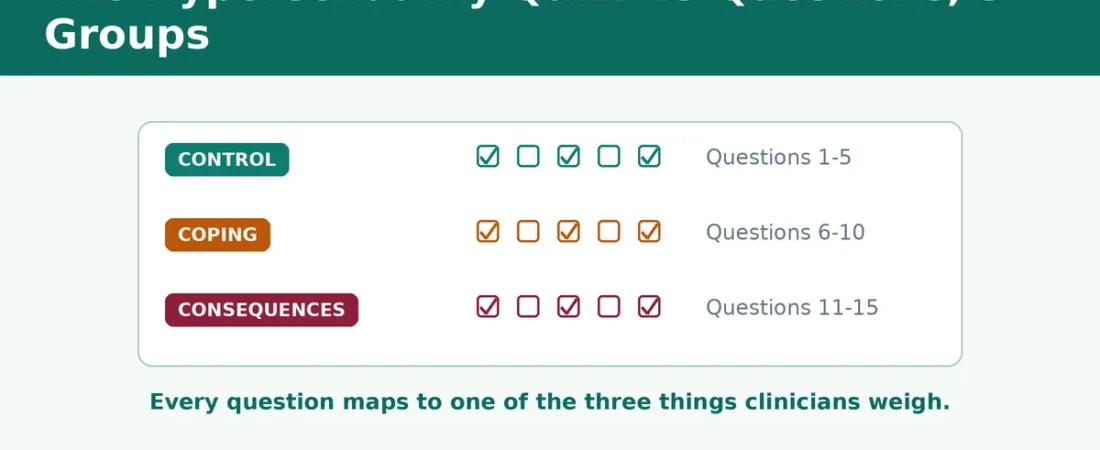
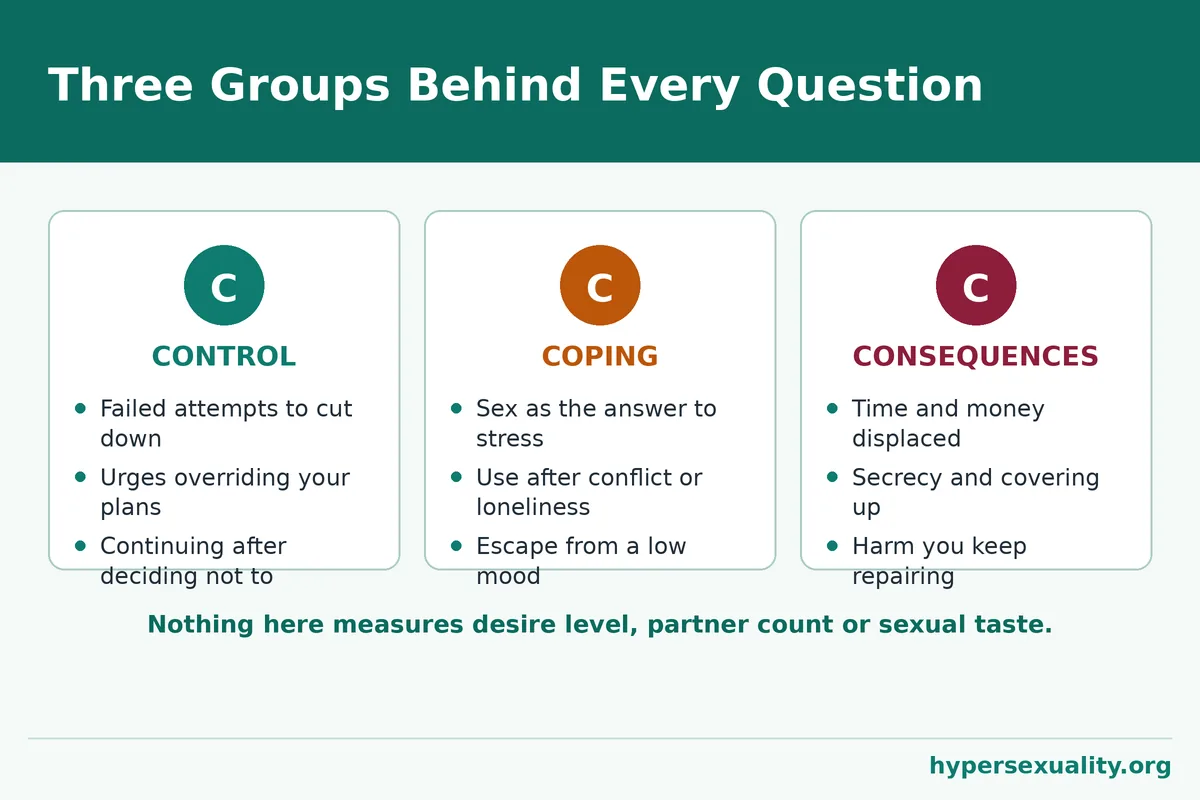
This hypersexuality quiz is built differently. Every question below is there because it maps to one of the three things clinicians actually weigh: control (can you steer it?), coping (what job is it doing for you?), and consequences (what is it costing?). And every question comes with a one-line explanation, because a quiz you do not understand cannot tell you anything true.
Answer yes or no, thinking about the last six months. There are no trick questions and no questions about how much you desire sex — desire alone is not what this is measuring.
Quick answer: A hypersexuality quiz is a short screening in question form. This one asks 15 yes/no questions about control, coping use and consequences — the three elements of the compulsive pattern — and interprets your score in bands, with the shape of your answers mattering as much as the total. It is a reflection tool, not a diagnosis: only a professional assessment can sort a compulsive pattern from a high sex drive or a values conflict.
Contents
How to take this quiz honestly
Three ground rules before you start. Answer for a typical recent month, not your best week or your worst night. Answer about behaviour you actually did, not behaviour you merely fantasised about — fantasy is not a symptom. And if a question describes something you did once, months ago, under unusual circumstances, answer no: this hypersexuality quiz is hunting for a pattern, and a pattern means repetition. The explanations under each question tell you what a “yes” actually points to, so read them as you go.
The 15 questions
Work through all 15 questions in this hypersexuality quiz in order — control first, then coping, then consequences.
Control — can you steer it?
- Have you promised yourself you would cut down or stop a sexual behaviour, and then done it anyway?
This is the single most diagnostic-flavoured question here: a genuine intention, genuinely defeated, more than once. - Do you find it hard to stop once you have started, even when you planned to stop earlier?
Sessions, browsing or encounters that routinely overrun your own stopping point signal fading brakes. - Have you deleted apps, blocked sites or set rules that you later undid or worked around?
Building barriers and then dismantling them is failed control with extra steps — clinicians ask about it directly. - Do urges interrupt your concentration at work, in conversation or while driving?
Intrusive, hard-to-redirect urges are different from ordinary desire, which can wait. - Have you tried to fill the time with something else and found the urge simply waited you out?
If distraction never works, the drive is running the schedule rather than joining it.
Coping — what job is it doing?
- Do you turn to sexual behaviour when you are stressed, anxious or low?
This is the coping signature: the behaviour is being used as an emotion regulator. - Do you use it when you are bored or lonely, even when you do not especially want sex?
Wanting relief is not the same as wanting sex; confusing the two hides the real need. - Afterwards, do you feel briefly better and then flat, irritable or ashamed?
The relief-crash cycle is what keeps coping use repeating — the fix never lasts. - Is sexual behaviour your main way of unwinding — ahead of rest, exercise, friends or hobbies?
A narrowing coping toolkit is an early structural sign, before any dramatic consequence appears.
Consequences and impact — what is it costing?
- Has sexual behaviour cost you sleep, money or time you could not afford?
Concrete costs, honestly tallied, separate a pattern from a preference. - Has it caused a problem at work or in your studies — lateness, missed deadlines, discipline, risk?
Impairment in a major life role is one of the thresholds clinicians take most seriously. - Has a partner or someone close to you been hurt, or have you kept secrets from them about it?
Secrecy and relational harm are consequences even when nothing has been “found out” yet. - Have you continued after a consequence — a scare, a cost, a confrontation — that you expected would stop you?
Continuing despite known harm is a core ICD-11 element, not a detail. - Do you need more — more time, more novelty, more intensity — than you used to, for the same effect?
Escalation is the pattern’s growth signature; stable appetite, however strong, is not. - Do you feel distressed about your sexual behaviour most weeks, not just immediately afterwards?
Persistent distress differs from ordinary post-hoc guilt; both matter, but they point to different help.
Scoring: read the band, then read the shape
Count your yes answers in this hypersexuality quiz:
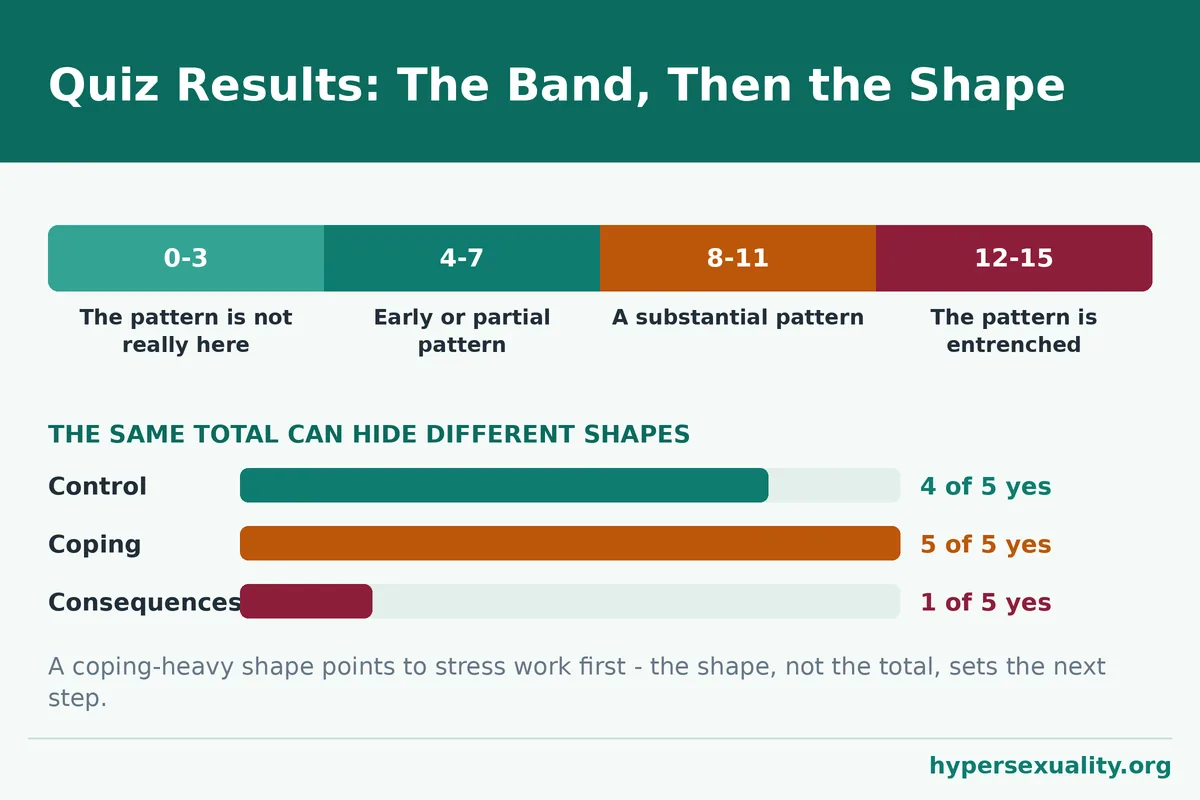
- 0–3 — The pattern is not really here. What you are experiencing is most likely a healthy (possibly strong) sex drive, or a values question rather than a control question.
- 4–7 — Early or partial pattern. Worth honest attention, especially if your yeses cluster in one group. Coping-heavy answers suggest working on what the behaviour is doing for you; control-heavy answers suggest the brakes need support before consequences arrive.
- 8–11 — A substantial pattern. Several elements of the compulsive picture are present at once. This is the band where a professional assessment genuinely earns its keep.
- 12–15 — The pattern is entrenched. Control, coping and consequences are all in play. Please treat this as a prompt to seek an assessment soon, not as a verdict to sit with alone.
Then the part most quizzes skip: shape beats total. Eight yeses concentrated in Coping describe a different situation — and a different first intervention — from eight yeses spread across Control and Consequences. The first is an emotion-regulation problem with a sexual outlet; the second is a pattern already damaging a life.
What a score felt like from the inside
Consider Tom, a composite example: 41, who scored 9 and immediately decided he was “basically an addict”. Scoring again with the explanations open, he saw the shape: five of his nine yeses sat in Coping. Every episode he could remember followed the same script — a bruising day at work, an empty evening, behaviour he did not even enjoy, then the flat crash. His control answers were mostly no; when he set a limit on a good week, he kept it.
His hypersexuality quiz had not diagnosed him with anything. It had shown him that his problem had a door — the hour after work — and that the door could be worked on directly. Three months of restructuring that hour, plus one honest conversation with a counsellor about work stress, moved his score to 4. Your shape will be your own; that is exactly why it is printed here.
What this quiz leaves out — deliberately
No question here asks how often you have sex, how many partners you have had, or what you are into. None of that defines a disorder, and quizzes that ask it are measuring their own discomfort, not your health. This hypersexuality quiz also cannot detect the look-alikes: a manic episode, a medication effect, or OCD’s unwanted intrusive thoughts can all produce yes answers.
If your pattern began suddenly, or alongside a mood change or a new prescription, skip quizzes entirely and start with a doctor. And if your honest answers are low but your distress is high, you may be in the moral-conflict group — a real and painful problem, covered in our explainer of the hypersexuality pattern, but not the same one this quiz screens for.
For a more granular version with graded answers, the 12-question hypersexuality test scores each item from “never” to “often”. And if your quiz result has left you unsure which of three different things you are even asking about, start with “Am I hypersexual?” — it untangles the question itself. Whichever route you take, this hypersexuality quiz has done its job if it leaves you with a clearer question, not a label.
Q&A
How is this quiz different from other hypersexuality quizzes online?
Every question maps to control, coping or consequences — the elements clinicians weigh — and each carries an explanation of what it is asking. Nothing here measures desire level, partner count or sexual taste, and the scoring interprets the pattern of your answers in bands instead of declaring a percentage verdict.
I scored in a high band. Does that mean I am a sex addict?
No. A high band means several elements of the compulsive pattern are present and worth a professional assessment. Diagnosis requires more: duration, context, and ruling out other causes such as a mood episode, medication or OCD. A quiz — this one included — cannot do that sorting.
I scored low but I still feel awful about my sexual behaviour. Why?
That combination usually points to a values conflict (moral incongruence): behaviour that is controlled and infrequent but clashes with your beliefs. ICD-11 explicitly does not count distress based purely on moral judgement as this disorder. The distress is real and deserves support — it is just a different problem with a different route through it.
Can I use this quiz to check on my partner?
You can read the questions to understand what clinicians look for, but answering on someone else’s behalf produces a caricature, not information. If you are worried about a partner, the useful step is a conversation — or, if secrecy and harm are already present, support for yourself first.
How often should I retake the quiz?
Every two to three months is a sensible rhythm if you are actively working on the pattern. Retaking weekly mostly measures mood. What you are watching for is movement in the Control and Consequences groups — those are the scores that show change is real.
Sources: World Health Organization, ICD-11 entry 6C72 “Compulsive sexual behaviour disorder”; Grubbs, J. B. et al. (2020), “Sexual addiction 25 years on,” Clinical Psychology Review, 82, 101925; Bőthe, B. et al. (2020), “The development of the Compulsive Sexual Behavior Disorder Scale (CSBD-19),” Journal of Behavioral Addictions, 9(2), 247–258.
Medical disclaimer: This article is educational information only and is not medical advice, diagnosis or treatment. Only a qualified clinician who knows your history can assess whether any diagnosis applies to you. If sexual behaviour is causing you distress or harm, consider speaking with your doctor or a licensed mental-health professional.