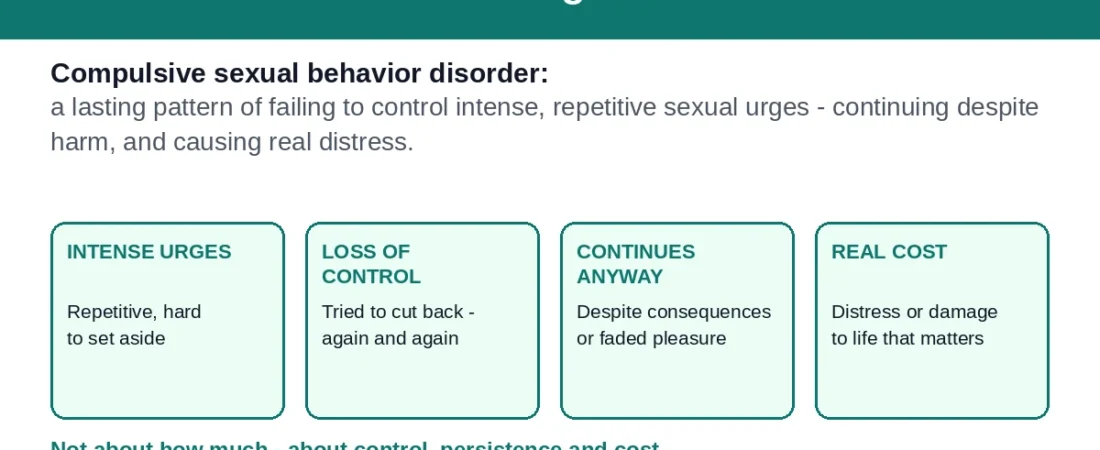
It is the diagnosis with the intimidating name — and a surprisingly human meaning. If you have landed here asking what is compulsive sexual behavior disorder, the short version is this: it describes a lasting pattern in which a person repeatedly cannot control intense sexual impulses or urges, the behaviour keeps happening anyway, and it causes real distress or damage in their life.
The name is clinical. The experience it describes — promising yourself “never again,” meaning it, and then watching it happen again — is painfully ordinary. This guide translates the official definition into everyday language, shows what the pattern looks like from the inside, and clears up the things CSBD is not.
Quick answer: Compulsive sexual behavior disorder (CSBD) is a diagnosis in the WHO’s ICD-11 for a persistent failure to control intense, repetitive sexual impulses or urges, lasting over an extended period (typically six months or more), which causes marked distress or significant impairment — and which is not explained solely by moral disapproval of the behaviour.
Contents
What is compulsive sexual behavior disorder, in one paragraph?
Strip away the terminology and CSBD has four moving parts. First, the urges are intense and repetitive — they keep returning and are hard to set aside. Second, there is a genuine failure of control: the person has usually tried, often many times, to cut back. Third, the behaviour continues despite consequences, or despite bringing little satisfaction any more. Fourth, the pattern has weight — it produces real distress or interferes with family life, work, study, health or other things the person values.
Remove any one of those parts and you may still have something worth discussing with a professional, but you are probably describing something else: a high sex drive, a values conflict, a symptom of another condition, or a difficult habit — each of which needs a different kind of help.
The official definition, translated
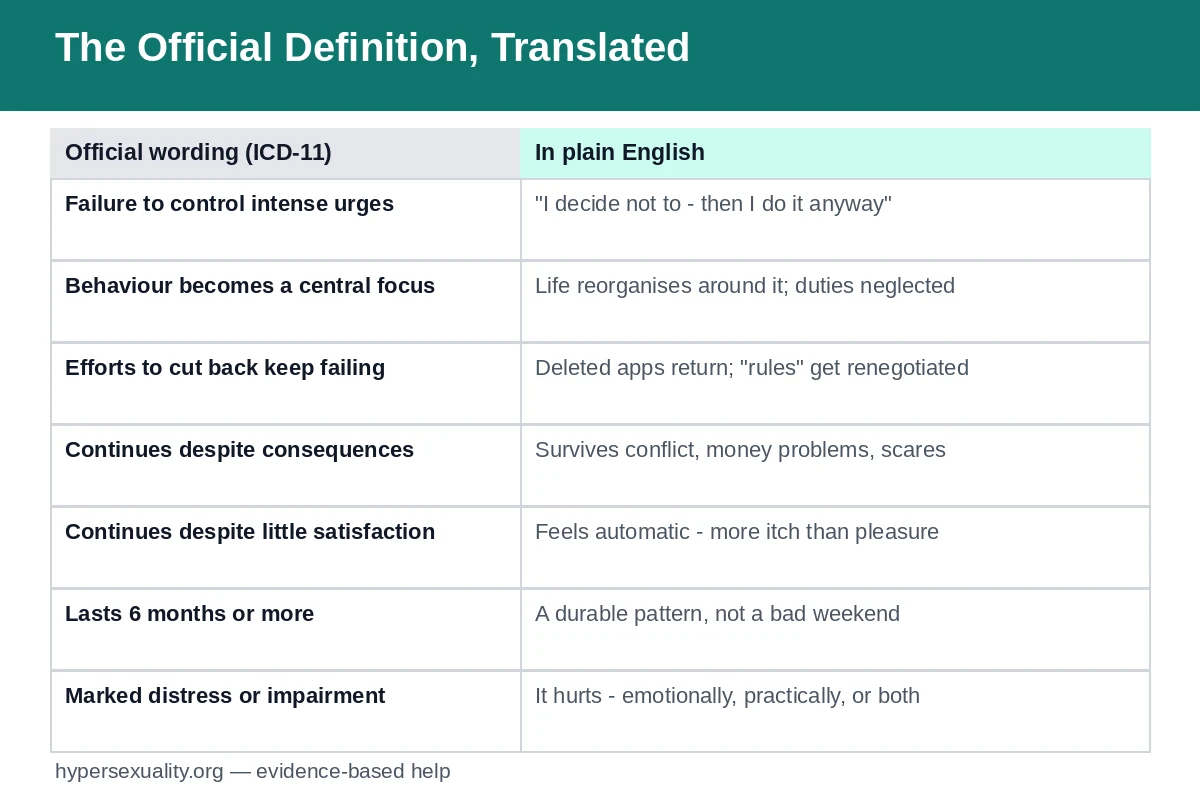
The ICD-11 wording is precise but dry. Here is what each element means in daily life:
| Official element (ICD-11) | What it looks like in plain English |
|---|---|
| Persistent failure to control intense, repetitive sexual impulses or urges | “I decide not to, and then I do it anyway — again and again.” |
| Behaviour becomes a central focus of life | Plans, free time and attention increasingly organise themselves around the behaviour; other interests and responsibilities get neglected. |
| Numerous unsuccessful efforts to reduce it | Deleted apps return, “rules” get renegotiated, fresh starts keep expiring. |
| Continues despite adverse consequences | The behaviour survives relationship conflict, money problems, health scares or trouble at work. |
| Continues despite little or no satisfaction | It feels less like pleasure and more like scratching an itch that immediately returns. |
| Extended period (e.g. 6 months or more) | This is a durable pattern, not a bad weekend or a short phase. |
| Marked distress or significant impairment | It hurts — emotionally, practically, or both — in at least one important area of life. |
| Not better explained by something else | A manic episode, a medication effect or another condition may need to be ruled out first. |
One clause deserves special emphasis because it protects so many people from a wrong label: distress that is entirely related to moral judgments and disapproval about sexual behaviour is not sufficient for this diagnosis. Feeling guilty because your behaviour conflicts with your upbringing or faith is a real and painful experience — researchers call it moral incongruence — but on its own it does not make the behaviour a disorder.
Does this sound familiar?
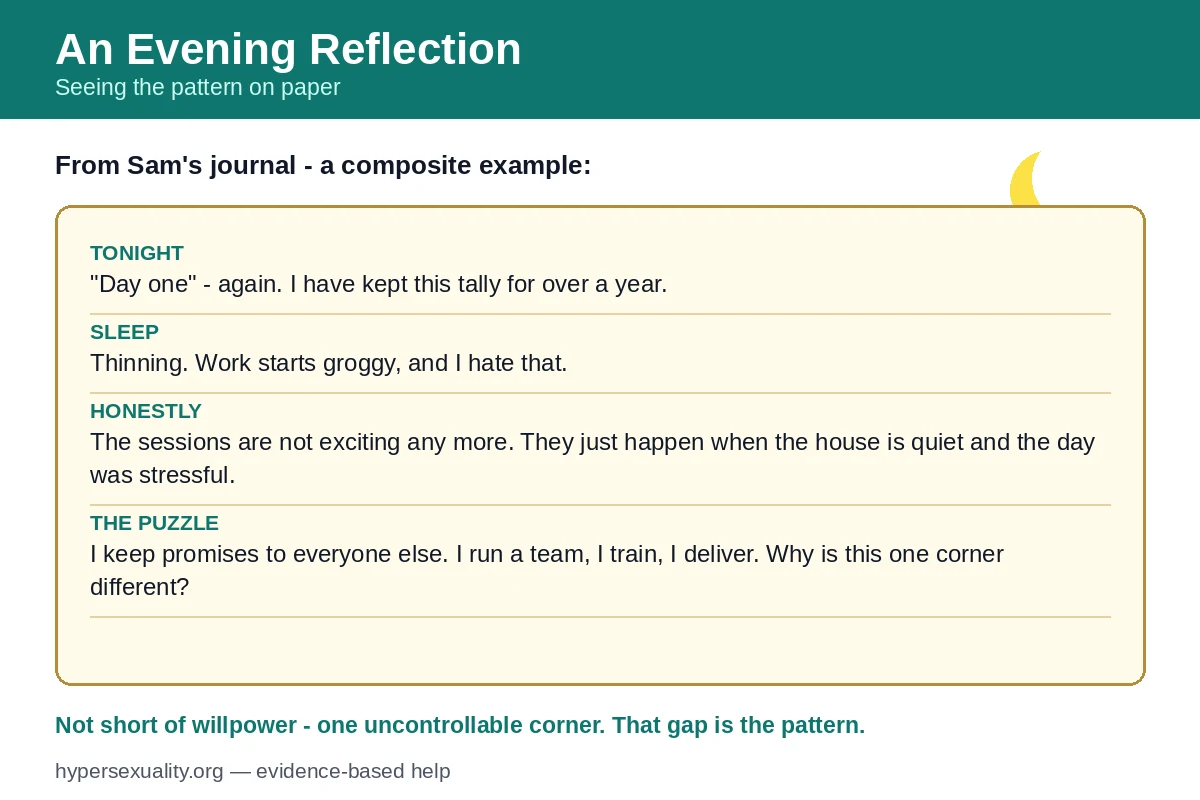
Clinicians do not listen for a confession; they listen for a pattern. It might sound like Sam, a composite example. Sam’s behaviour is almost entirely private — pornography late at night. There are no partners, no spending, nothing anyone else would notice. But Sam has kept a private tally of “day ones” for over a year. Sleep has thinned. Work starts groggily. The sessions are not exciting any more; they are what happens automatically when the house is quiet and the day has been stressful.
Sam is not short of willpower in the rest of life — Sam runs a team, trains for races, keeps promises to everyone except, repeatedly, to Sam. That gap between global competence and one uncontrollable corner is characteristic, and it is why “just try harder” is such poor advice for this pattern.
Notice what is absent from Sam’s story: any particular amount. CSBD is not defined by hours, frequency or appetite size. It is defined by control, persistence and cost.
Three labels you will meet — and why they differ
| Term | Who uses it | Status |
|---|---|---|
| Compulsive sexual behavior disorder (CSBD) | WHO / ICD-11; clinicians worldwide | Official diagnosis, classified as an impulse control disorder |
| Hypersexuality | Clinicians, researchers, general public | A descriptive term for the same broad territory; not itself an ICD-11 diagnosis title |
| Sex addiction | Popular media, some treatment programmes and 12-step groups | Not an official diagnosis in ICD-11 or DSM-5; WHO deliberately did not classify CSBD as an addiction |
The addiction question is genuinely debated among researchers, because the brain’s reward system is involved. But the official position matters practically: classification shapes what treatment is offered, how it is coded, and how research is funded — which is why the WHO’s reasoning has its own article in this series.
How a professional actually decides
No quiz or checklist — including any on this site — can diagnose compulsive sexual behavior disorder. A professional assessment usually involves a conversation about the pattern’s history, attempts to control it, its consequences, and your wider mental and physical health. Screening questionnaires may support that conversation, but the clinician’s job includes ruling out look-alikes: a manic or hypomanic episode, OCD with sexual obsessions, effects of medication or substances, and moral incongruence. If reading this has left you thinking “this might be me,” the practical route is to read how hypersexuality is assessed in a real evaluation, try the reflective “am I hypersexual?” page, and treat both as preparation for a conversation — not as a verdict.
Q&A
Is CSBD just the medical name for sex addiction?
Not exactly. The two labels overlap in everyday conversation, but they come from different models. “Sex addiction” applies an addiction framework that neither ICD-11 nor DSM-5 has adopted for this pattern; Compulsive sexual behavior disorder is the WHO’s impulse-control framing, chosen deliberately. Some treatment providers use the terms interchangeably, which is a source of real confusion for patients.
Can CSBD involve only pornography, with no other people involved?
Yes. The behaviours involved can be entirely solo or digital — pornography use and masturbation are among the most commonly reported presentations in research. A pattern does not need partners, spending or risk to others to be clinically significant; control, persistence and personal cost are what count.
Do you need every feature on the list for it to count?
No. The ICD-11 describes the failure-of-control pattern as shown by one or more of the listed features (central focus, unsuccessful cut-down attempts, continuing despite consequences, continuing despite little satisfaction), together with duration and distress or impairment. A clinician weighs the whole picture rather than ticking every box.
Is CSBD recognised in the United States?
Indirectly. The DSM-5, used by US psychiatrists, does not include CSBD as a standalone diagnosis — a proposal to add “hypersexual disorder” was considered and rejected. US clinicians therefore often work with the pattern under other codes or treat co-occurring conditions, while ICD-11 (used in much of the rest of the world) names it directly.
If the behaviour only happens when I’m stressed, can it still be CSBD?
It can be part of the picture. Using sexual behaviour to escape or regulate difficult feelings is common in this pattern. Stress-linkage does not rule CSBD in or out by itself — what matters is the overall pattern of control, persistence and impact, which is why an assessment looks at triggers as well as behaviour.
Sources: World Health Organization, ICD-11 entry 6C72 “Compulsive sexual behaviour disorder”; Bőthe, B. et al. (2023), “Compulsive sexual behavior disorder in 42 countries,” Journal of Behavioral Addictions, 12(2), 393–407.
Medical disclaimer: This article is general information about a health topic. It is not medical advice and cannot diagnose you or anyone else. Only a qualified clinician who knows your situation can do that. If sexual behaviour is causing you distress or harm, consider speaking with a doctor, psychologist or qualified therapist.