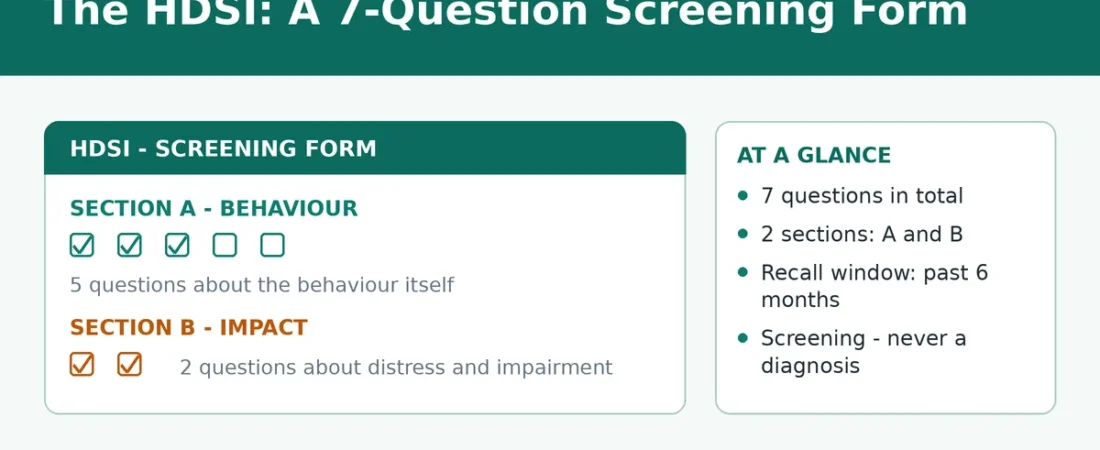
Search for the hypersexual disorder screening inventory and the top result is not an article at all. It is a bare PDF of the form itself, sitting in a university repository: seven questions, a row of numbers from 0 to 4, and no explanation whatsoever. People download it at worried moments, answer it in a vacuum, and are left holding a set of numbers with no idea what the form was designed to do — or whether it can tell them anything at all. This page is the missing manual: what the inventory is, why it is built the way it is, and how to read it honestly.
Quick answer: The hypersexual disorder screening inventory (HDSI) is a 7-question screening form developed for the proposed “hypersexual disorder” diagnosis during the DSM-5 revision. Its five Section A questions cover behaviour over the past six months; its two Section B questions cover distress and life impairment. It is a screening tool, not a diagnosis — and because the DSM-5 ultimately rejected hypersexual disorder, the HDSI survives mainly as a research instrument and a useful map of what clinicians ask.
Contents
Where this form came from
The hypersexual disorder screening inventory belongs to a specific moment in psychiatric history. In 2010, psychiatrist Martin Kafka proposed formal diagnostic criteria for “hypersexual disorder” for the DSM-5, the American Psychiatric Association’s diagnostic manual. A proposed diagnosis needs a practical way to check its criteria in real patients, so a short screening inventory was built to match the proposal: seven questions, each rated by how often it had been true over the previous six months, from 0 (never) to 4 (almost always).
The inventory was then tested in the DSM-5 field trial reported by Reid and colleagues in 2012, where clinicians used the criteria with real treatment-seeking patients and found they could apply them reliably. The diagnosis itself, however, was not adopted — the DSM-5 left hypersexual disorder out, over concerns that included false positives and the risk of pathologising normal desire.
The World Health Organization later took a different route, and the pattern now has a recognised home in ICD-11 as compulsive sexual behavior disorder. The screening form outlived the proposal it was built for, which is exactly why it needs explaining rather than just downloading.
Section A and Section B: behaviour first, impact second
The most important thing about the hypersexual disorder screening inventory is its split into two sections, because that split is the whole logic of the diagnosis it served.
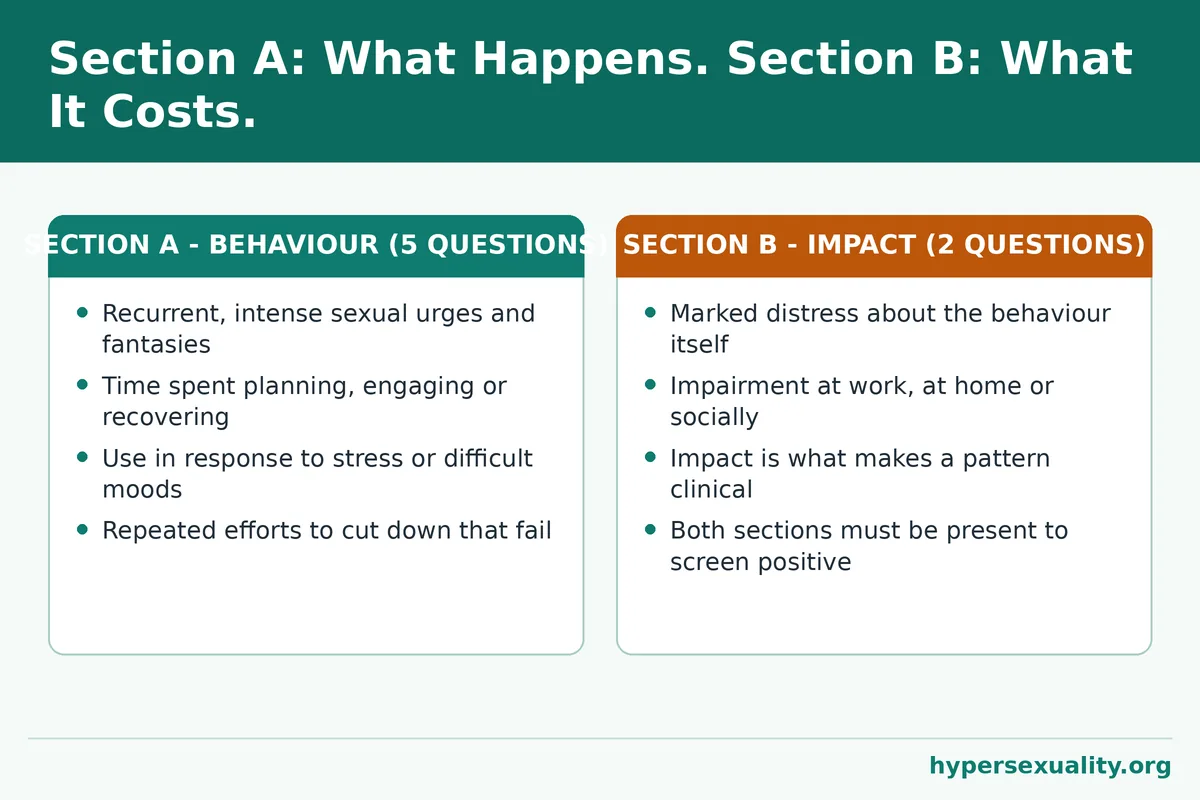
Section A contains five questions about behaviour and experience. In themes, they ask about: sexual fantasies, urges and behaviour taking up a great deal of time; using sexual behaviour to cope with difficult feelings such as worry, sadness or boredom; turning to sexual behaviour in response to stressful life events and responsibilities; repeated, unsuccessful attempts to cut down or control the behaviour; and continuing sexual behaviour despite the risk of physical or emotional harm to yourself or others. Each is rated by frequency over the past six months — the questions measure a pattern, not an episode.
Section B contains two questions, and they are the gatekeepers. They ask whether the pattern has caused significant personal distress — feeling very upset or bad about yourself, shame, or keeping the behaviour secret — and whether it has caused significant problems in personal, social, work or other important areas of life.
| Section A | Section B | |
|---|---|---|
| Number of questions | 5 | 2 |
| What it measures | The behaviour pattern itself | Distress and impairment |
| Themes | Time consumed, coping use, stress response, failed control, continuing despite risk | Feeling distressed or keeping secrets; problems in life areas |
| Role in screening | Shows the pattern is present | Shows the pattern matters clinically |
The distinction matters because a person can endorse Section A items — a vivid fantasy life, sex used for stress relief — and have a full, functional, untroubled life. The proposed criteria deliberately required Section B as well: without distress or impairment, there was no disorder to find. Any reading of the form that ignores Section B is reading only half the instrument.
Why every question asks about six months
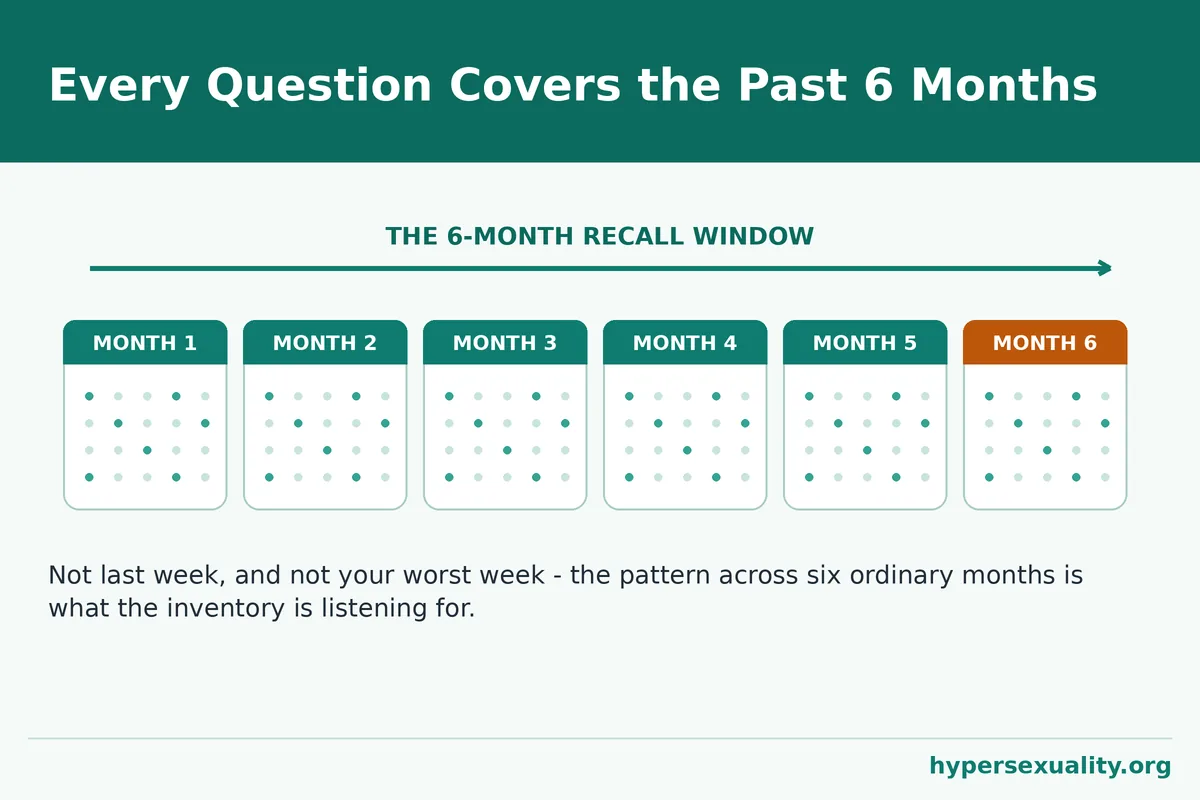
Each question on the hypersexual disorder screening inventory begins from the same window: the past six months. That is not filler. A six-month frame filters out the temporary surges that follow a break-up, a bereavement, a new relationship or a stressful quarter at work, and asks instead about persistence — the quality that separates a compulsive pattern from a rough patch. It also matches the wider clinical logic: ICD-11 describes compulsive sexual behavior disorder as a pattern sustained over an extended period, commonly six months or more. When you answer the form, answer for the half-year, not for your worst week — otherwise you are measuring weather and calling it climate.
How clinicians actually read the answers
Nobody competent adds up the seven numbers and announces a verdict. The reading is a pattern check. Clinicians look for Section A questions endorsed at the frequent end of the scale — the behaviour is not occasional but characteristic — together with at least one Section B question endorsed, showing the distress or impairment that makes the pattern clinical rather than merely intense. They also apply the exclusions written into the original proposal: the pattern should not be better explained by a substance, a medication, a medical condition or a manic episode, and the inventory was designed for adults.
That is why the same form can be reassuring for one person and a prompt to seek assessment for another. Read as a whole — behaviour, impact, duration, exclusions — the hypersexual disorder screening inventory tells you whether a professional conversation is worth having. It cannot tell you what that conversation will conclude.
What happened when Jonas found the form
Consider Jonas, a composite example: 34, he found the PDF at 1 a.m. after a bad week and answered everything as a 3 or 4, rating his worst days rather than his past six months. His total frightened him.
A month later, steadier, he went through it again question by question and noticed two things. His Section A answers were genuinely high on two themes — time consumed, and using sex to cope with stress — but lower on the others. And his Section B answers were honest 1s and 2s: he was worried and secretive, but his work, friendships and health were intact.
The form had not given him a diagnosis; it had given him a map. He took the two real themes — time and stress-coping — to a therapist as a starting point, which is precisely the job a screening inventory is meant to do.
The limits to keep in mind
Three cautions. First, the inventory screens for a diagnosis that does not officially exist — its modern value is as a structured self-reflection and a piece of research history, not as a ruling on compulsive sexual behavior disorder, which is defined on ICD-11 lines. Second, it was developed and tested largely with treatment-seeking men, so its behaviour in the general population is less certain.
Third, a self-scored form cannot apply the exclusions — only a clinician who knows your history can judge whether mania, medication or another condition explains the picture.
For the broader definition the inventory gestures toward, see what is compulsive sexual behavior disorder, and for how this form compares with the subscale approach of the HBI, see our guide to the HBI subscales: coping, control, consequences. The scale built directly on the ICD-11 definition is covered next, in our explainer of the CSBD-19. This page sits inside our wider hypersexuality test hub, where all the screening tools are gathered.
Q&A
Is the HDSI a diagnosis?
No. The hypersexual disorder screening inventory is a screening form: it flags whether a pattern of answers resembles the proposed hypersexual disorder criteria closely enough to justify a full assessment. Diagnosis is a clinical judgement that also weighs duration, exclusions and your wider history — none of which a seven-question form can do.
What score on the HDSI means I have a problem?
There is no single official cut-off total for self-use, and treating it as one misreads the instrument. Clinicians look at the pattern: Section A behaviours endorsed at the frequent end of the scale, plus Section B distress or impairment. A high total driven by Section A alone, with no distress and no life impact, was deliberately not enough under the proposed criteria.
Why does the HDSI ask about the past six months specifically?
Because persistence is the point. Six months of pattern separates a compulsive problem from a temporary surge caused by stress, grief or a new relationship. The same extended timeframe appears in the ICD-11 description of compulsive sexual behavior disorder, which is why the window survived even though the DSM-5 diagnosis did not.
If the DSM-5 rejected hypersexual disorder, why does this inventory still exist?
Because it was published, tested in a field trial, and remains useful to researchers studying the history and measurement of this pattern — and because its two-section structure still teaches the most important lesson in this field: behaviour alone is not disorder; behaviour plus distress or impairment is what clinicians look for.
Should I use the HDSI or a newer scale?
For self-reflection, the HDSI’s structure is instructive, but the instrument built directly on the current ICD-11 definition is the CSBD-19, which adds domains the HDSI never covered, such as dissatisfaction. Either way, treat any result as screening — a reason to reflect or to book an assessment, never as a verdict.
Sources: World Health Organization, ICD-11 entry 6C72 “Compulsive sexual behaviour disorder”; Kafka, M. P. (2010), “Hypersexual Disorder: A Proposed Diagnosis for DSM-V,” Archives of Sexual Behavior, 39(2), 377–400; Reid, R. C. et al. (2012), “Report of the DSM-5 Hypersexual Disorder Field Trial,” Journal of Sexual Medicine, 9(11), 2868–2877.
Medical disclaimer: This article is educational information only and is not medical advice, diagnosis or treatment. Only a qualified clinician who knows your history can assess whether any diagnosis applies to you. If sexual behaviour is causing you distress or harm, consider speaking with your doctor or a licensed mental-health professional.