
If you have read any research headline about hypersexuality in the last decade — dating apps, depression, treatment outcomes — there is a good chance the numbers came from one questionnaire: the Hypersexual Behavior Inventory, universally shortened to the HBI. Yet almost everything published about it is written for other researchers.
This page is the translation: what the Hypersexual Behavior Inventory is, where it came from, what its 19 questions are really organised around, how its scoring works, and where its limits lie — in plain English, for the people the scores are actually about.
One thing this page will not do is reproduce the inventory’s questions. The HBI is a clinical instrument; we explain its architecture — what each part measures and why — rather than photocopying its items, because an inventory taken from a copied list, without its context, stops being the instrument it claims to be.
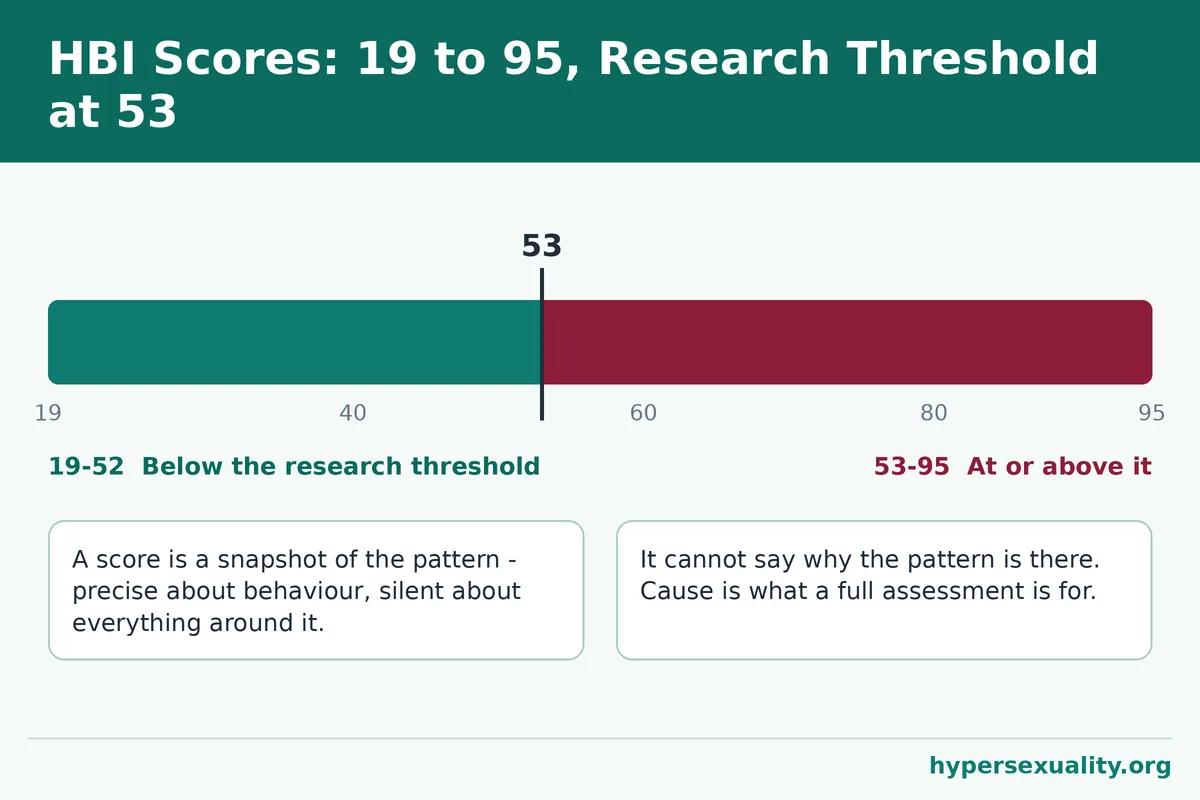
Quick answer: The Hypersexual Behavior Inventory (HBI) is a 19-item self-report questionnaire developed by Reid, Garos and Carpenter (2011) to measure hypersexual behaviour against the diagnostic criteria proposed for the DSM-5. It produces a total score (19–95) and three subscale scores — Coping, Control and Consequences. A total of 53 or more is the research threshold for a clinically significant pattern. It is a measurement tool for clinicians and researchers, not a self-diagnosis.
Contents
Where the HBI came from
In 2010, psychiatrist Martin Kafka proposed formal criteria for a “hypersexual disorder” for the DSM-5, psychiatry’s diagnostic manual. Whether or not the diagnosis was adopted, researchers needed a standardised way to measure the pattern the criteria described. Rory Reid and colleagues at UCLA built the Hypersexual Behavior Inventory for exactly that job, publishing its development in 2011 after testing it in an outpatient sample of men seeking help for hypersexual behaviour.
The DSM-5 ultimately declined to include hypersexual disorder — a story told in full elsewhere on this site — but the HBI had already become the field’s measuring stick, and it remains the most psychometrically studied instrument in this area: its internal consistency is very high (alpha ≈ .95), and it was used in the DSM-5 field trial itself. That history explains the HBI’s shape: it measures Kafka’s proposed criteria — which is why it maps so naturally onto the pattern ICD-11 later formalised as compulsive sexual behaviour disorder, with one gap we will come to.
The three things it measures
The Hypersexual Behavior Inventory’s 19 items sort into three factors. In plain language:
Coping (7 items). How much sexual behaviour is being used as an emotion-regulation tool — the response you reach for when stressed, dysphoric, bored or overwhelmed. This factor captures the function of the behaviour: not what you do, but what job it does.
Control (8 items). The brakes. How often urges override intentions, how much difficulty you have limiting or stopping behaviour you have decided to limit, how fully the pattern obeys you rather than the other way round. This is the factor closest to the core of every diagnostic framework.
Consequences (4 items). The wake. Interference with work, study and responsibilities, and the personal fallout that accumulates around the behaviour. Fewest items, but weighted with meaning: consequences are what turn a private struggle into a clinical concern.
Read together, the three factors are a small theory of the disorder: behaviour used to cope, escaping control, producing consequences. Two people can reach the same total by completely different routes — one coping-driven, one control-driven — and a good clinician reads the shape, not just the sum. That reading is such a skill in itself that the HBI subscales have their own page on this site.
How the scoring works
Hypersexual Behavior Inventory scoring is simple arithmetic with careful interpretation. Each item is answered on a five-point frequency scale, from “never” to “very often”. Add the answers and you get a total between 19 and 95; each subscale has its own range (Coping 7–35, Control 8–40, Consequences 4–20). The number researchers use most is 53: in the original validation work, a total score of 53 or above identified the clinically significant range — the level at which the pattern resembled that of patients in treatment.
Two cautions belong with that number permanently. First, it is a research threshold derived from specific samples, not a pass/fail line handed down by a diagnostic manual. Second, the HBI’s famous reliability (alpha ≈ .95) means its questions hang together consistently — it does not mean a score above 53 is 95% certain to be a disorder. Reliability is about the ruler, not about what the ruler proves. Clinicians who use the HBI treat it as one structured input beside an interview — which is exactly how its authors present it, and how the wider hypersexuality test screening landscape works at its best.
What the research does with it: a worked example
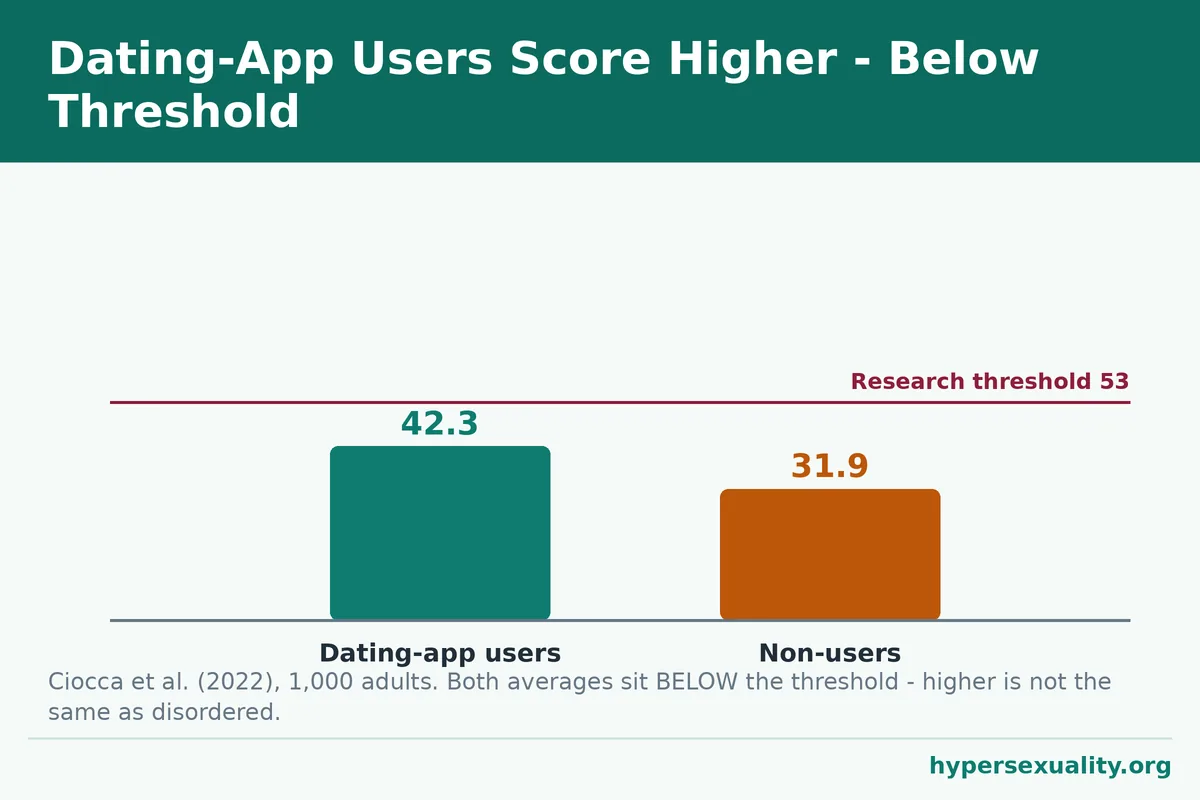
To see the HBI earning its keep, take a 2022 Italian study (Ciocca and colleagues, in the journal Sexes) of 1,000 adults, comparing dating-app users with non-users. Dating-app users scored higher on every part of the inventory — total 42.3 versus 31.9 on average, with coping, control and consequences all elevated, alongside more depression symptoms. Headlines wrote themselves.
But look at the numbers with the threshold in mind: even the higher-scoring group averaged well below 53. The study shows a real, measurable tendency — app users, on average, report more hypersexual behaviour and lower mood — and simultaneously shows that the average app user is nowhere near the clinical range. That double lesson is the HBI at its most useful: it measures a dimension honestly, in a way that resists both panic and dismissal. It is also why a screening lineage that began with the SAST needed a successor built from criteria rather than from a treatment model.
What it felt like to be measured
Consider Dev, a composite example: 36, in therapy for the first time after his partner found messages he could not explain. At the second session his therapist handed him the HBI. Dev’s total came to 58 — above the research threshold, which he heard as a verdict and met with a week of dread.
The session that followed rearranged it. His Consequences score was nearly maximal: the wake was real and he was not minimising it. His Control score was mid-range. And his Coping score was the peak — nearly every item about using sexual behaviour to manage stress and low mood endorsed at the top of the scale.
The formulation that emerged was not “58, therefore addict”. It was: a man whose emotion-regulation system had one tool, whose life was now presenting the bill. Treatment aimed at the coping engine first. The inventory had not diagnosed Dev; it had shown his therapist where to dig, and shown Dev a picture of his pattern he could finally argue with productively. For readers whose patterns entwine with past trauma, that digging has its own considerations, covered in our page on PTSD and hypersexual behavior.
The HBI’s limits, plainly
The Hypersexual Behavior Inventory was developed and first validated in men in outpatient treatment; its performance in women and in general community samples is less established, and later studies keep working on that gap. It is self-report, so it inherits both minimisation and catastrophising. It was built on proposed criteria that were never adopted — Kafka’s DSM-5 draft rather than the ICD-11 text — so it does not test ICD-11’s duration framing or its moral-judgement exclusion; a person in pure values conflict can score high on it without the pattern ICD-11 means.
And like every questionnaire, it cannot detect the look-alikes — mania, medication effects, OCD — that a clinician is trained to sort. None of this diminishes the HBI. It defines its job: the best-studied ruler the field has, to be read by someone who knows what rulers cannot do.
Q&A
Can I take the HBI online and score myself?
Copies circulate, but self-scoring strips out the part that makes the HBI valuable: interpretation against your history, by someone who can also spot the look-alikes. If you want a self-screening built for solo use, the ICD-11-mapped screening on this site is designed for exactly that. If a clinician gives you the HBI, ask them to walk through your subscale shape, not just your total.
Is 53 a diagnosis cut-off?
No. It is a research threshold from the original validation samples — the point above which scores resembled those of patients in treatment. Diagnosis of CSBD is a clinical judgement under ICD-11, involving duration, context and exclusions that no total score encodes.
Why do researchers prefer the HBI over older tests like the SAST?
Three reasons: it was built from proposed diagnostic criteria rather than a treatment philosophy; its psychometrics are thoroughly published (very high internal consistency, field-trial use); and its three subscales let studies ask which part of the pattern a treatment or a risk factor moves — something a single addiction score cannot show.
What does a high Coping score but low Control score mean?
Roughly: the behaviour is being used heavily as an emotion regulator, but the brakes still largely work. Clinicians often read that as an earlier or more functionally-driven picture, where building alternative regulation — and treating underlying mood or anxiety — may matter more than abstinence frameworks. It is a formulation clue, not a severity grade.
Does the HBI work for women?
It is used with women in research and practice, but its original development sample was men in treatment, and validation work in female and community samples is thinner. A careful clinician interprets a woman’s HBI alongside interview material rather than by the male-derived threshold alone.
Sources: World Health Organization, ICD-11 entry 6C72 “Compulsive sexual behaviour disorder”; Reid, R. C., Garos, S. & Carpenter, B. N. (2011), “Reliability, validity, and psychometric development of the Hypersexual Behavior Inventory in an outpatient sample of men,” Sexual Addiction & Compulsivity, 18(1), 30–51; Ciocca, G. et al. (2022), “Hypersexual Behavior and Depression Symptoms among Dating App Users,” Sexes, 3, 298–307.
Medical disclaimer: This article is educational information only and is not medical advice, diagnosis or treatment. Only a qualified clinician who knows your history can assess whether any diagnosis applies to you. If sexual behaviour is causing you distress or harm, consider speaking with your doctor or a licensed mental-health professional.