
Search for the SAST and you will mostly find the test itself, dumped onto clinic and counselling pages with a score table and a booking link. What you will rarely find is anyone explaining the instrument: where it came from, what its questions are actually organised around, why two quite different tests share the name, or what its own author warned about it.
That explanation matters, because the sexual addiction screening test is the ancestor of almost every sex addiction questionnaire online — and its strengths and its flaws were both inherited by everything that followed. This page gives the SAST the treatment its influence deserves: respectful about what it pioneered, honest about where 1989 shows.
A note on method before we start: the SAST is a clinical instrument, and we describe its structure, themes and scoring rather than reproducing its questions. That is both a copyright courtesy and good practice — a screening you take from a copied list, stripped of context, is already being misused.
Quick answer: The sexual addiction screening test (SAST) is a 25-item yes/no questionnaire created by Patrick Carnes in 1989 to screen for sexually addictive behaviour. It groups its questions around preoccupation, loss of control, relationship disturbance and affect disturbance. The original treated 13+ “yes” answers as a strong signal; the revised SAST-R (2010) expanded the test to 45 items with a 25-item core and a lower threshold. It is a screening conversation-starter with known limits — dated items, weak reliability in women — not a diagnosis.
Contents
Where the SAST came from
The sexual addiction screening test appeared in 1989, in Carnes’ book Contrary to Love. Context explains its design. Carnes was building the first treatment model for out-of-control sexual behaviour, borrowing the architecture of addiction treatment: the behaviour was framed as a disease process with preoccupation, ritual, compulsive acting out and despair as its cycle. The SAST was built to identify people who fit that model — which means it was developed on, and normed against, people (overwhelmingly men) already in treatment for it, compared with people who were not.
That origin is not a scandal; most screenings start this way. But it fixes the instrument’s character: the SAST is very good at recognising the pattern it was built from, and much less tested on everyone else — women, people from strongly religious backgrounds, people whose distress is about values rather than control.
What the test actually asks about
The sexual addiction screening test’s 25 questions are not random; the revised version makes their organisation explicit as four subscales, and the same four themes run through the original:
- Preoccupation. How much mental territory sexual thoughts, urges and planning occupy — the behaviour’s centre-of-gravity in a person’s inner life.
- Loss of control. Failed attempts to stop or limit behaviour, promises to oneself broken, the sense of being driven rather than choosing.
- Relationship disturbance. Damage and friction in close relationships connected to the behaviour — complaints, secrecy from a partner, emotional hurt.
- Affect disturbance. The emotional weather around the behaviour: using it to escape problems, feeling depressed or degraded afterwards, distress as a standing feature.

Read that list again and you can see both the instrument’s insight and its exposure. Control and preoccupation remain core to every modern framework, including ICD-11. But affect disturbance is where the moral-incongruence problem enters: a person can endorse shame, secrecy and feeling “degraded” items purely because their behaviour violates their upbringing — with control fully intact — and the SAST has no internal way to tell the difference.
Carnes knew about part of this risk. His published caveats warn that people whose behaviour carries heavy cultural sanctions may score on secrecy and shame without being addicted, and that the test “does not address the need of women”, whose results in the original research showed poor reliability. Those caveats were printed alongside the test in 1989. Most pages that copy the questions quietly drop them.
How the sexual addiction screening test is scored
Here is the part the copied pages almost never explain: there are two scorings, and they are not interchangeable.
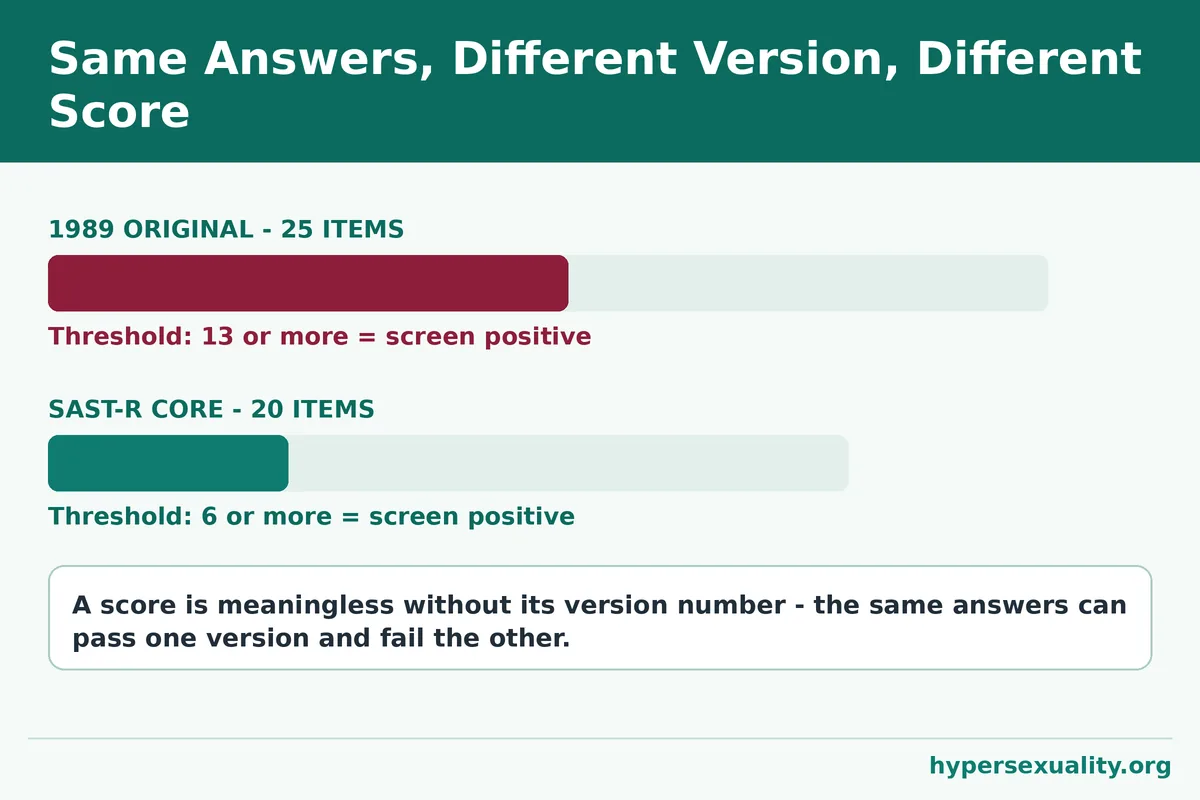
The original SAST (1989) is the 25-item version most websites reproduce. Its interpretation came from the score distribution in Carnes’ samples: scores of 13 or more were found almost exclusively (96.5% in his table) among people in the addicted group, so 13+ is quoted as the classic threshold. Scores in the 5–12 range were ambiguous territory even in the original data.
The SAST-R (2010), Carnes’ revision with Green and Carnes, expanded the instrument to 45 items: a 25-item core plus supplementary subscales addressing internet behaviour and specific versions for men, women and gay men. On the revised core, a score of 6 or more flags likely addiction — a completely different threshold from 13, because the item pool and the validation samples changed.
The consequence is simple and routinely ignored: a SAST score quoted without its version is meaningless. “I scored 9” is a red flag on the SAST-R core and a shrug on the 1989 original. Any page that gives you a number without naming its version has not understood the instrument it is hosting.
The criticisms, honestly
Dated items. The test was written when sexual behaviour left paper trails: one original item asks about subscribing to sexually explicit magazines. Behaviour has migrated to phones and apps; the instrument’s surface has not, which is one reason the SAST-R added an internet subscale.
Gender. The original was built on men, and its reliability in women was poor — by the author’s own account. The SAST-R’s separate women’s subscale was an attempt to repair this, but the classic 25-item version still circulating online is the male-normed one.
Shame confounding. As described above, the secrecy and distress items cannot distinguish compulsion from a values conflict — the false-positive problem that ICD-11’s moral-judgement exclusion now handles at the diagnostic level but that a 1989 screening cannot.
Model lock-in. The sexual addiction screening test presupposes the addiction model. ICD-11 classifies the same pattern as an impulse-control disorder, and modern instruments such as the Hypersexual Behavior Inventory and the CSBD-19 were built from diagnostic criteria rather than from a treatment philosophy. A high SAST score tells you the addiction-model pattern is present; it cannot adjudicate between the models.
None of this makes the SAST worthless. It makes it a period instrument: historically important, still clinically used, and absolutely requiring interpretation — which is precisely what its author printed underneath it and what the internet mostly deleted.
What happened when one score met a clinician
Consider Carla, a composite example: 45, referred to a psychosexual clinic after a GP appointment about low mood. Intake included the SAST; she scored 14 of 25 — over the classic threshold — and arrived at her first session believing the matter was settled.
The clinician did something the score could not: she went through the answers. Carla’s endorsements clustered in affect disturbance and relationship disturbance — shame, secrecy, feeling degraded, a spouse’s worry. On loss of control, she answered no almost throughout: her behaviour was infrequent, planned, and stopped whenever she decided. The “relationship disturbance” was real — but it was the disturbance of a strict shared faith, not of compulsive harm.
The clinician’s formulation was moral incongruence with depression, and the treatment followed that. Same score as a textbook “addict” profile; entirely different human situation. The SAST had done its job — it had started the conversation. It just could not finish it.
The SAST next to the modern instruments
If you take one screening this year, you have options the 1989 test never anticipated. The general hypersexuality test on this site is built directly from the ICD-11 criteria with banded scoring and the moral-conflict caveat built in rather than footnoted. If you arrived via a generic sex addiction test, its interpretation guide applies to SAST results too: read the pattern, name the version, respect the limits.
The SAST deserves its place in the field’s history. Your health deserves the interpretation its author asked for.
Q&A
What is a good (normal) score on the SAST?
On the 1989 original, scores of 0–4 were typical of the non-addicted comparison group, and 5–12 was ambiguous even in Carnes’ own data. On the SAST-R core, the flag is 6 or more. Neither number is a clean bill of health or a diagnosis — they mark where a conversation becomes worthwhile.
Is the sexual addiction screening test still used by clinicians?
Yes, particularly in addiction-model practices and in the United States, often alongside interviews and other measures. It is less common in services organised around ICD-11, where criteria-based screenings and the CSBD-19 are preferred. Its age shows most in its items, less in its underlying four-domain structure.
Why do different websites give different SAST questions and cut-offs?
Because two instruments share the name: the 25-item 1989 original and the 45-item SAST-R of 2010, with different cores and thresholds (13+ versus 6+). Sites copy whichever version they found, rarely say which, and sometimes mix them. Always ask which version produced your score.
Can women rely on the SAST?
Cautiously at best. Carnes himself reported poor reliability for the original among women, and the SAST-R added a specific women’s subscale to address it. If you are a woman handed the classic 25 items, treat the score as a rough conversation-starter and weight a clinical interview far more heavily.
The SAST says I am likely addicted, but my behaviour is controlled and rare. What now?
That profile — high shame and secrecy items, intact control — is the classic moral-incongruence false positive, which Carnes’ own caveats anticipated. It does not mean nothing is wrong; it means the problem is probably the collision between your behaviour and your values. That needs its own kind of help, and it starts with an honest conversation, not an addiction label.
Sources: World Health Organization, ICD-11 entry 6C72 “Compulsive sexual behaviour disorder”; Carnes, P. (1989), Contrary to Love: Helping the Sexual Addict (origin of the SAST); Carnes, P. J., Green, B. A. & Carnes, S. (2010), the SAST-R revision and its subscale structure, described in the IITAP/CSAT literature.
Medical disclaimer: This article is educational information only and is not medical advice, diagnosis or treatment. Only a qualified clinician who knows your history can assess whether any diagnosis applies to you. If sexual behaviour is causing you distress or harm, consider speaking with your doctor or a licensed mental-health professional.