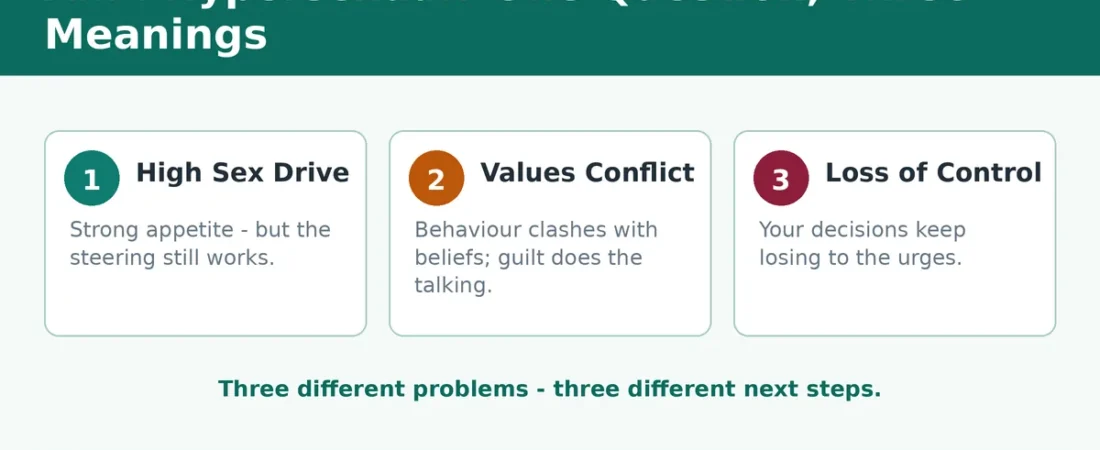
If you typed “am I hypersexual” into a search bar tonight, you probably do not yet know which question you are asking — and that is not a criticism, because the same four words carry at least three completely different worries. One person means: my sex drive is much stronger than my partner’s, and I feel like a freak for it. Another means: my behaviour clashes with everything I was raised to believe, and I feel filthy. A third means: I have tried to stop and I cannot, and it is starting to cost me things I care about.
Those are three different problems. They feel different, they behave differently, and — this is the part no quiz page tells you — they need three different responses. Taking a generic sex addiction test before sorting out which question is yours is how people end up either panicking over a healthy sex drive or explaining away a genuinely compulsive pattern.
This page sorts the question first. Then, if you still want a screening, you will know which one fits.
Quick answer: If you are asking “am I hypersexual?”, one of three things is usually going on: you have a high sex drive (not a disorder), your behaviour conflicts with your values (distressing, but explicitly not this disorder under ICD-11), or you have a pattern of lost control with real consequences (the thing clinicians call hypersexuality or CSBD). The honest way to answer the question is to work out which of the three you mean — the signs, and the right next step, are different for each.
Contents
Meaning one: “My sex drive is just very high”
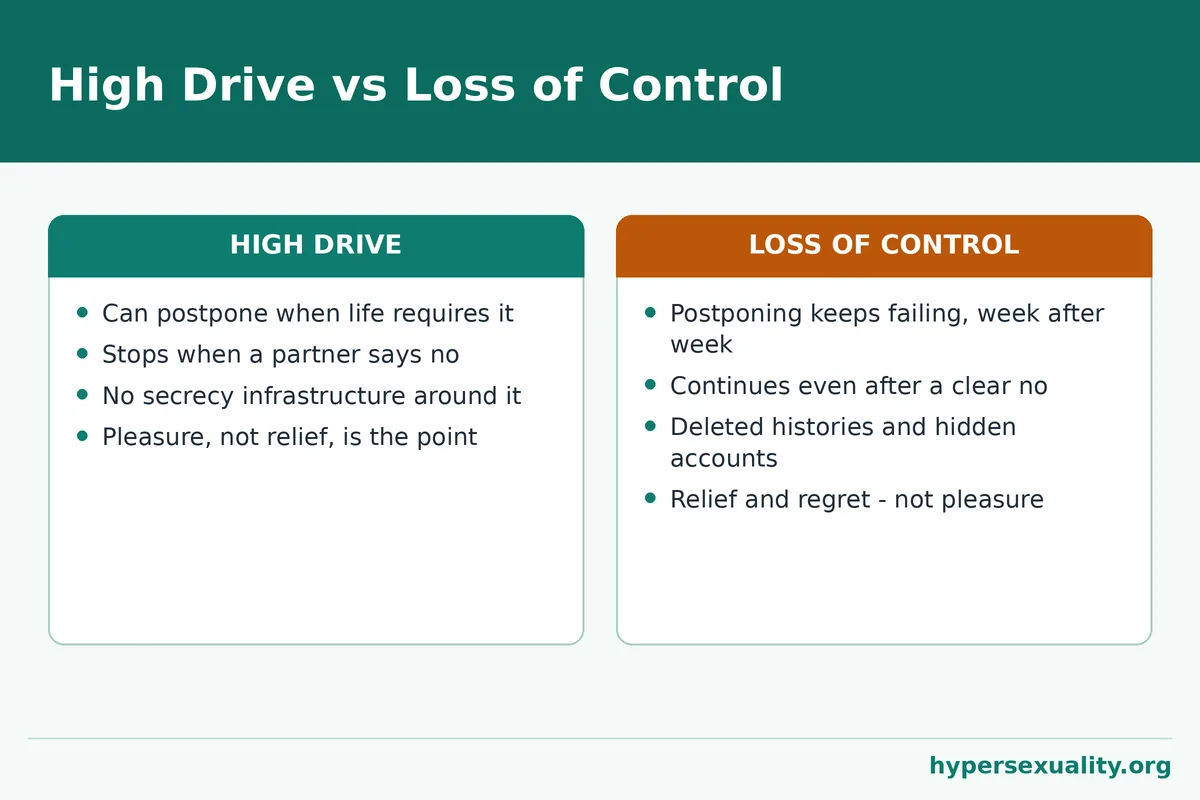
This is the most common meaning, and the least pathological. Desire varies enormously between people and across a lifetime, and “much more than my partner” or “more than my friends seem to” is a comparison, not a symptom. Here is the telltale shape of a high drive that is not a disorder: you can postpone it when life requires; it does not generate secrecy, debt, risk or dread; you enjoy it rather than feeling driven by it; and if a partner says no, you are disappointed — not derailed.
A strong appetite that you steer comfortably is health, however unusual it looks from outside. The clinical line is not drawn at how much. It has never been drawn at how much. If this is your meaning, the honest answer to “am I hypersexual?” is no — you are a person with a strong drive.
Meaning two: “My behaviour clashes with my values”
The second meaning of “am I hypersexual?” hides in the shame. A person raised with strict religious or cultural teaching about sex may experience intense distress about behaviour that is, by any clinical measure, infrequent and controlled — occasional pornography use, say, always stopped when they choose. Researcher Joshua Grubbs calls this moral incongruence: the suffering comes from the gap between behaviour and belief, not from loss of control. ICD-11 anticipated exactly this case and wrote it out of the diagnosis: distress that is entirely due to moral judgement about sexual behaviour does not qualify as compulsive sexual behaviour disorder.
That exclusion matters, because the help is different. A values conflict calls for honest work on beliefs, conscience and community — sometimes with a therapist who respects the faith in question. Labelling it an addiction does not relieve it; it usually deepens the spiral of lapse, shame, and “proof” of sickness.
Meaning three: “I cannot seem to control it”
The third meaning is the clinical one, and it has a recognisable anatomy. Control fails repeatedly: sincere attempts to cut down or stop do not hold. Time and life reorganise: work, sleep, relationships and money are displaced, not just competed with. It continues despite cost: after a consequence that should have been a turning point — a discovery, a debt, a health scare — the behaviour resumes. And it runs for months, not a bad week.
Where those four are present, the question “am I hypersexual?” deserves a professional answer, because that pattern is what ICD-11 describes as compulsive sexual behaviour disorder, and it is also the pattern a screening can usefully map. Notice what is absent from the list: any particular amount of sex, pornography or partners.
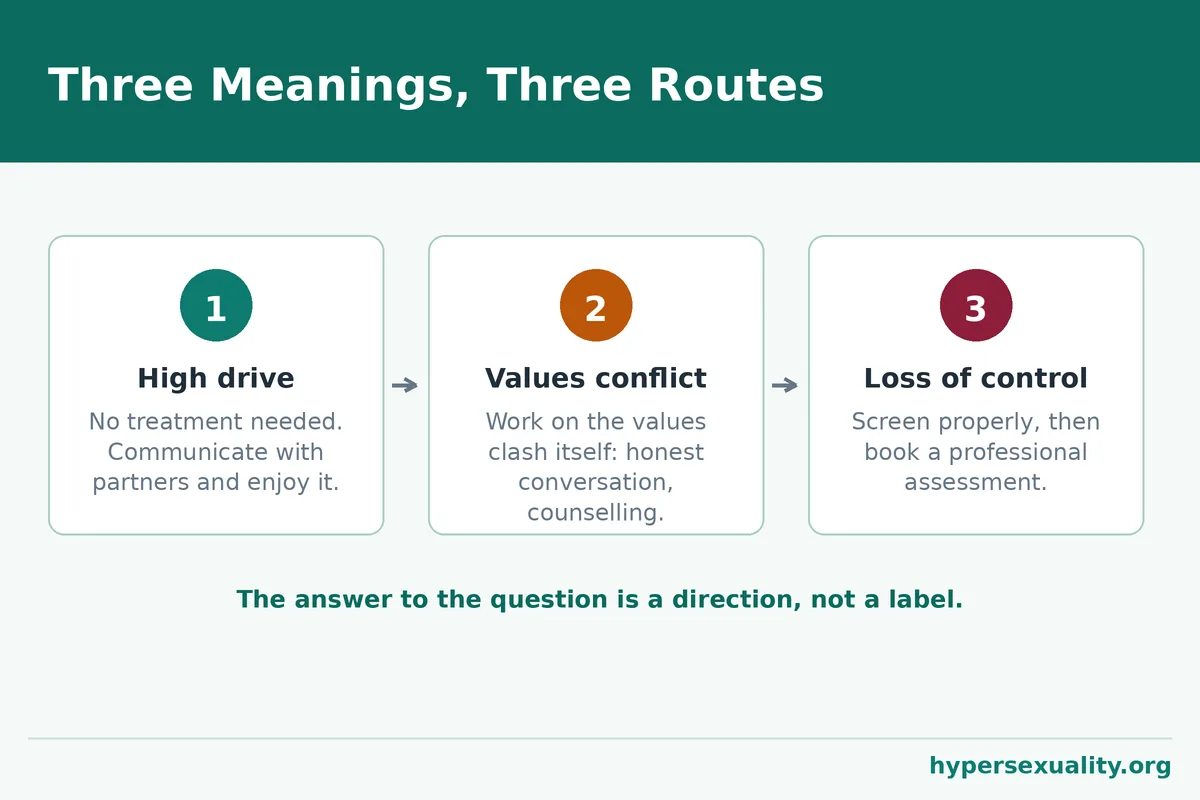
| What you might mean | Telltale signs | The honest next step |
|---|---|---|
| “My drive is high” | Strong desire, easily postponed, no secrecy or harm, enjoyed not endured | Reassurance; possibly a conversation with your partner about mismatched desire |
| “It clashes with my values” | Modest, controlled behaviour + intense guilt; distress spikes after, calm control during | Work on the values conflict itself; support that respects your beliefs |
| “I can’t control it” | Failed attempts to stop, life displaced, continuing despite real consequences, for months | Take a screening, then book a professional assessment |
What the three-way sort looked like for one searcher
Consider Aisha, a composite example: 29, who searched “am I hypersexual” after a night of crying over her browser history. Reading the three meanings, she expected to land on number three. Instead, the details would not fit it. Her use was occasional — a few times a month. She could and did stop for weeks when travelling. There were no secrets with real stakes, no costs, no failed resolutions about control.
What there was, in flood, was shame: every episode collided with the teaching she had grown up with, and she had been calling that collision an addiction for two years. Aisha’s problem was real — two years of self-condemnation is real suffering — but it was meaning two, and it needed a different door: a counsellor experienced in faith-and-sexuality work, not an addiction programme. Sorting the question did not minimise her distress. It finally aimed it.
A five-minute self-sort
Before any test, sort out which “am I hypersexual” you are actually asking. Answer these three, in writing if you can:
- The postponement test. When life demands it — a deadline, a guest in the house, a sleeping child — can you reliably postpone sexual behaviour without distress or bargaining? Reliable postponement is the signature of a drive you steer.
- The cost test. In the last six months, what has this actually cost: time, money, sleep, honesty, health, opportunities? List facts, not feelings. An empty list alongside loud distress points to meaning two; a growing list points to meaning three.
- The afterwards test. Immediately after the behaviour, what dominates — satisfaction, neutrality, or a shame spiral that itself becomes the trigger for next time? The third answer describes the loop clinicians listen for.
Where do your answers cluster? High drive, values conflict, or control pattern — most people find the cluster is obvious once the three are separated, which is precisely what the rush-to-test pages never let you see. If your answers point to the control pattern, the structured hypersexuality test will map it in detail; the quicker hypersexuality quiz works too. And if something in your pattern might have roots in past trauma, the page on PTSD and hypersexual behavior is worth reading before you settle on any label.
When to skip the self-sort and see someone
Some versions of this question should not be worked through alone. If the change in your sexual behaviour arrived suddenly, especially alongside unusually high mood, very little need for sleep, or a sense of being superhuman, that combination suggests a mood episode and needs a doctor promptly. If it began after a new medication — particularly medicines for Parkinson’s or restless legs — tell the prescriber before you tell yourself a story about addiction.
If the behaviour involves legal risk or anyone else’s safety, that is beyond self-help territory entirely. And if the distress itself is becoming dangerous — hopelessness, self-harm thoughts — treat that as the emergency it is. In every other case, the sort above, followed by a screening such as a sex addiction test read with the same three-way lens, will give you a clearer answer than any single score.
Q&A
I scored high on an online quiz — does that settle “am I hypersexual?”
No. Most online quizzes count distress and frequency, and both can be high without any loss of control. Run your result through the three meanings on this page: if your high score is built from guilt items rather than failed-control and consequence items, the quiz has measured your values conflict, not a disorder.
Can you be hypersexual without having much sex?
The pattern is about control and preoccupation, not frequency. Someone can spend hours daily in fantasy, planning and pornography use with few partnered encounters and meet the full picture — while someone with frequent, honest, controlled partnered sex meets none of it.
My partner says I am hypersexual. Are they probably right?
Partners see consequences clearly — secrecy, displacement, broken promises — but they can also misread a desire mismatch as pathology. Both things happen often enough that the honest move is the self-sort on this page, and, if the control pattern shows up, an assessment you both hear the result of.
Is hypersexuality the same as having a high sex drive in your teens or twenties?
No. Desire peaks early in adult life, and high drive at a young age is statistical normality, not a warning sign. The warning signs are the same at 21 as at 51: failed control, displacement of study or work, secrecy, and continuing despite cost.
What if I fit meaning two — the values conflict — but I still want it to stop?
Then the work is real, but it is values work, not addiction treatment: examining what you believe, what your community taught you, and what you actually want your sexual life to be. Many people find a therapist who will respect — not argue with — their faith framework. ICD-11’s exclusion exists precisely to route you there instead.
Sources: World Health Organization, ICD-11 entry 6C72 “Compulsive sexual behaviour disorder”; Grubbs, J. B. et al. (2020), “Sexual addiction 25 years on: A systematic and methodological review of empirical literature,” Clinical Psychology Review, 82, 101925.
Medical disclaimer: This article is educational information only and is not medical advice, diagnosis or treatment. Only a qualified clinician who knows your history can assess whether any diagnosis applies to you. If sexual behaviour is causing you distress or harm, consider speaking with your doctor or a licensed mental-health professional.